Custom Walk in Rome, Italy by melissamlord_b3bd5 created on 2025-06-10
Guide Location: Italy » Rome
Guide Type: Custom Walk
# of Sights: 16
Tour Duration: 4 Hour(s)
Travel Distance: 7.6 Km or 4.7 Miles
Share Key: U4TEB
Guide Type: Custom Walk
# of Sights: 16
Tour Duration: 4 Hour(s)
Travel Distance: 7.6 Km or 4.7 Miles
Share Key: U4TEB
How It Works
Please retrieve this walk in the GPSmyCity app. Once done, the app will guide you from one tour stop to the next as if you had a personal tour guide. If you created the walk on this website or come to the page via a link, please follow the instructions below to retrieve the walk in the app.
Retrieve This Walk in App
Step 1. Download the app "GPSmyCity: Walks in 1K+ Cities" on Apple App Store or Google Play Store.



Step 2. In the GPSmyCity app, download(or launch) the guide "Rome Map and Walking Tours".
Step 3. Tap the menu button located at upper right corner of the "Walks" screen and select "Retrieve custom walk". Enter the share key: U4TEB
1) Piazza di Trevi & Fontana di Trevi (Trevi Square & Trevi Fountain) (must see)
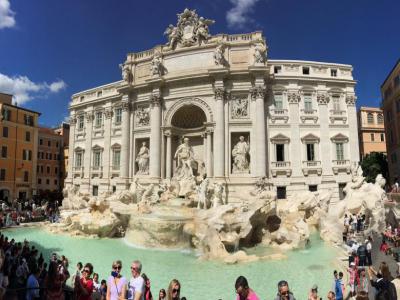
The Trevi Fountain is one of Rome’s most iconic landmarks, drawing visitors to the eponymous Trevi Square all day long. Surprisingly, the fountain was not initially built in the heart of the city; instead, the city grew around it. Its name derives from the Latin word "trivium," which means “three streets,” as it sits at the junction of three streets: De Crocicchi, Poli, and Delle Muratte.
The fountain’s history dates back to 1629 when Pope Urban VIII commissioned Gian Lorenzo Bernini to redesign it, though his plans were never realized. Later, Pope Clement XII organized a competition in 1730, leading to Nicola Salvi's selection for the project, who incorporated the fountain into the rear of the Poli Palace. Salvi passed away before its completion. Giuseppe Pannini and other artists finalized the work in 1762.
Measuring over 26 meters in height and 49 meters in width, it is the largest Baroque fountain in Rome.
The Trevi Fountain features a Corinthian façade and bas-reliefs depicting the origins of the Acqua Vergine aqueduct, constructed in 19 BC. According to legend, a virgin guided Roman engineers to the aqueduct’s source, an event depicted in the fountain’s bas-reliefs. The aqueduct, which survived the Gothic invasions and was restored during the Middle Ages, still supplies water to the fountain today.
At the heart of the fountain is Oceanus, depicted riding a shell-shaped chariot drawn by two horses and guided by Tritons. The horses symbolize the sea’s contrasting moods-calm and turbulent. Flanking Oceanus are the statues of Abundance and Salubrity, representing prosperity and health. The symmetrical Rococo design combines dynamic artistry with Baroque grandeur, reflecting 18th-century European trends.
The Trevi Fountain is also known for the tradition of tossing coins, which promises a return to Rome. Popularized by the 1954 Hollywood film "Three Coins in the Fountain," visitors toss coins over their left shoulder with their right hand, generating daily about €3,000. This money, collected by municipal authorities, is donated to charity.
Celebrated in films like Roman Holiday and La Dolce Vita, the Trevi Fountain’s global fame is further evidenced by replicas worldwide. Access to the fountain is now limited to 400 visitors at a time, ensuring a more enjoyable visit to this timeless masterpiece. Surrounding the fountain are charming shops, restaurants, and gelaterias, making it a delightful spot to soak in Rome’s vibrant atmosphere.
Tip:
The fountain holds particular allure at night, especially after 10 pm when it is beautifully illuminated and the crowds dissipate, allowing you to enjoy the site almost exclusively.
The fountain’s history dates back to 1629 when Pope Urban VIII commissioned Gian Lorenzo Bernini to redesign it, though his plans were never realized. Later, Pope Clement XII organized a competition in 1730, leading to Nicola Salvi's selection for the project, who incorporated the fountain into the rear of the Poli Palace. Salvi passed away before its completion. Giuseppe Pannini and other artists finalized the work in 1762.
Measuring over 26 meters in height and 49 meters in width, it is the largest Baroque fountain in Rome.
The Trevi Fountain features a Corinthian façade and bas-reliefs depicting the origins of the Acqua Vergine aqueduct, constructed in 19 BC. According to legend, a virgin guided Roman engineers to the aqueduct’s source, an event depicted in the fountain’s bas-reliefs. The aqueduct, which survived the Gothic invasions and was restored during the Middle Ages, still supplies water to the fountain today.
At the heart of the fountain is Oceanus, depicted riding a shell-shaped chariot drawn by two horses and guided by Tritons. The horses symbolize the sea’s contrasting moods-calm and turbulent. Flanking Oceanus are the statues of Abundance and Salubrity, representing prosperity and health. The symmetrical Rococo design combines dynamic artistry with Baroque grandeur, reflecting 18th-century European trends.
The Trevi Fountain is also known for the tradition of tossing coins, which promises a return to Rome. Popularized by the 1954 Hollywood film "Three Coins in the Fountain," visitors toss coins over their left shoulder with their right hand, generating daily about €3,000. This money, collected by municipal authorities, is donated to charity.
Celebrated in films like Roman Holiday and La Dolce Vita, the Trevi Fountain’s global fame is further evidenced by replicas worldwide. Access to the fountain is now limited to 400 visitors at a time, ensuring a more enjoyable visit to this timeless masterpiece. Surrounding the fountain are charming shops, restaurants, and gelaterias, making it a delightful spot to soak in Rome’s vibrant atmosphere.
Tip:
The fountain holds particular allure at night, especially after 10 pm when it is beautifully illuminated and the crowds dissipate, allowing you to enjoy the site almost exclusively.
2) Foro di Augusto (Forum of Augustus)
Augustus was the first Roman emperor, the one who transformed the Roman Republic into the Roman Empire. After the assassination of his great-uncle, Julius Caesar, Augustus navigated a series of civil wars, eventually defeating Mark Antony and Cleopatra to secure power. His reign, from 27 BC until his death in 14 AD, marked a period of relative peace and stability known as the Roman Peace. During that time, he oversaw significant reforms in government, infrastructure, and the military.
Augustus is also recognized for his ambitious building projects, including the construction of the Pantheon and the Altar of Peace, as well as for fostering a flourishing Roman culture and arts. His leadership solidified the imperial system, making the Roman Empire a dominant force for centuries.
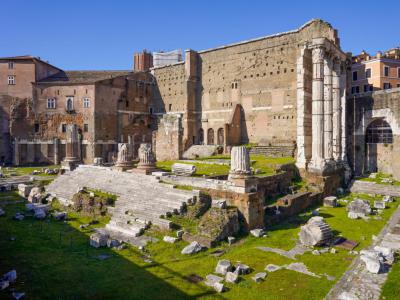
The Forum of Augustus was built in 42 BC after his victory at the Battle of Philippi to fulfill a promise to honor Mars Ultor, the Roman God of War. The central feature of the forum was the Temple of Mars Ultor, which was adorned with numerous statues. At its center stood a statue of Augustus in military attire, accompanied by statues of Mars and Venus.
In total, there were 108 portrait statues in the temple, each with inscriptions detailing their respective person's achievements. Along the left side were the statues of famous Republican leaders honoring Rome's military and political history, while the right side was reserved for figures from the Caesar family, tracing Augustus's lineage back to the founder of Rome, Romulus.
Today, the Forum of Augustus is partially preserved. While much of it lies in ruins, several key elements, such as some of its large marble foundations, columns, and parts of the inner sanctuary of the Temple of Mars Ultor, can still be seen. Although most statues and reliefs no longer exist in their original form, there are depictions and descriptions of the forum's artwork that can be found in historical sources.
Although much of the forum is now underground or obscured by later constructions, the remaining spaces allow visitors to get an idea of its general layout as a place for public business and display of Augustus's power and military achievements.
Augustus is also recognized for his ambitious building projects, including the construction of the Pantheon and the Altar of Peace, as well as for fostering a flourishing Roman culture and arts. His leadership solidified the imperial system, making the Roman Empire a dominant force for centuries.
The Forum of Augustus was built in 42 BC after his victory at the Battle of Philippi to fulfill a promise to honor Mars Ultor, the Roman God of War. The central feature of the forum was the Temple of Mars Ultor, which was adorned with numerous statues. At its center stood a statue of Augustus in military attire, accompanied by statues of Mars and Venus.
In total, there were 108 portrait statues in the temple, each with inscriptions detailing their respective person's achievements. Along the left side were the statues of famous Republican leaders honoring Rome's military and political history, while the right side was reserved for figures from the Caesar family, tracing Augustus's lineage back to the founder of Rome, Romulus.
Today, the Forum of Augustus is partially preserved. While much of it lies in ruins, several key elements, such as some of its large marble foundations, columns, and parts of the inner sanctuary of the Temple of Mars Ultor, can still be seen. Although most statues and reliefs no longer exist in their original form, there are depictions and descriptions of the forum's artwork that can be found in historical sources.
Although much of the forum is now underground or obscured by later constructions, the remaining spaces allow visitors to get an idea of its general layout as a place for public business and display of Augustus's power and military achievements.
3) Foro di Nerva (Forum of Nerva)
Roman Emperor Nerva, who reigned from 96 to 98 AD, is best known for initiating the Nerva-Antonine dynasty, a period of relative peace and prosperity in the Roman Empire. He came to power after the assassination of Emperor Domitian and was recognized for his efforts to restore stability to the empire following Domitian's autocratic rule.
Nerva is also famous for adopting Trajan, who later became his successor, thus securing the empire's future leadership and setting a precedent for the adoption of capable heirs rather than relying on biological descent. Nerva was the first of the so-called "Five Good Emperors", followed by Trajan, Hadrian, Antoninus Pius, and Marcus Aurelius, who ruled successively from 96 to 180 AD. His brief reign is often seen as a time of reform, focusing on social welfare, land distribution to the poor, and easing the harshness of previous administrations.
The construction of what's known as the Forum of Nerva was initiated by his predecessor, Emperor Domitian, before the year 85 AD. But it was officially completed and inaugurated 12 years later by Nerva, hence its name. This forum was the fourth and smallest of the imperial forums. It replaced the former Argiletum street, which had served as a market area, mainly for booksellers and cobblers. The new forum continued to function as both a thoroughfare and a grand entrance to the larger Roman Forum.
After the decline and fall of the Western Roman Empire, the area fell into disuse and became marshland. In the 9th century, several houses were constructed on the site, using materials salvaged from the ruins. The onsite Temple of Minerva remained relatively intact until Pope Paul V ordered its demolition in 1606.
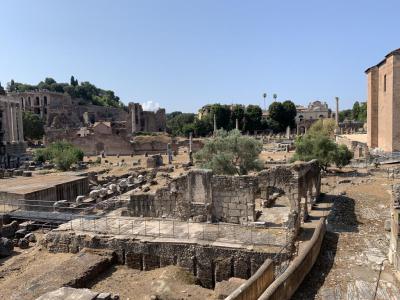
Today, only a portion of the columns known as Le Colonnacce survive along the side of the Minerva Temple. These Corinthian columns are situated just less than two meters away from the temple's wall. While the Forum of Nerva does not have the same scale or visibility as the Roman Forum or the Forum of Caesar, it is still a fascinating site for those exploring ancient Roman history.
Nerva is also famous for adopting Trajan, who later became his successor, thus securing the empire's future leadership and setting a precedent for the adoption of capable heirs rather than relying on biological descent. Nerva was the first of the so-called "Five Good Emperors", followed by Trajan, Hadrian, Antoninus Pius, and Marcus Aurelius, who ruled successively from 96 to 180 AD. His brief reign is often seen as a time of reform, focusing on social welfare, land distribution to the poor, and easing the harshness of previous administrations.
The construction of what's known as the Forum of Nerva was initiated by his predecessor, Emperor Domitian, before the year 85 AD. But it was officially completed and inaugurated 12 years later by Nerva, hence its name. This forum was the fourth and smallest of the imperial forums. It replaced the former Argiletum street, which had served as a market area, mainly for booksellers and cobblers. The new forum continued to function as both a thoroughfare and a grand entrance to the larger Roman Forum.
After the decline and fall of the Western Roman Empire, the area fell into disuse and became marshland. In the 9th century, several houses were constructed on the site, using materials salvaged from the ruins. The onsite Temple of Minerva remained relatively intact until Pope Paul V ordered its demolition in 1606.
Today, only a portion of the columns known as Le Colonnacce survive along the side of the Minerva Temple. These Corinthian columns are situated just less than two meters away from the temple's wall. While the Forum of Nerva does not have the same scale or visibility as the Roman Forum or the Forum of Caesar, it is still a fascinating site for those exploring ancient Roman history.
4) Basilica di San Pietro in Vincoli (Basilica of St. Peter in Chains)
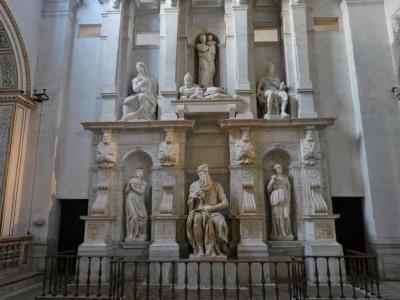
This basilica gained significant recognition thanks to Michelangelo's "Moses", a masterpiece sculpted in the early 16th century for Pope Julius II's unfinished tomb. Originally intended to be a grand structure featuring numerous statues and towering nearly 40 feet tall in Saint Peter's Basilica, only three statues were completed-Moses and the flanking figures of Leah and Rachel-before Julius passed away. The subsequent pope, a member of the rival Medici family, had different plans for Michelangelo, leading to the abandonment of the unfinished tomb. Despite this, the intense power of the remarkable Moses sculpture remains unparalleled in its setting. Legend has it that Michelangelo's profile, as well as that of the pope, can be discerned in the intricate details, such as the lock of Moses's beard beneath his lip.
In the church itself, Saint Peter takes a secondary role to the commanding presence of Moses. Under the main altar, an urn made of bronze and crystal houses the reputed chains that once bound Saint Peter during his imprisonment in Jerusalem and Rome. Other notable treasures include a 7th-century mosaic depicting Saint Sebastian, situated in front of the second altar to the left of the main altar, and the tomb of the Pollaiuolo brothers, two Florentine artists from the 15th century, located near the entrance.
Why You Should Visit:
Understated exterior, incredible interior; a Michelangelo must-see.
In the church itself, Saint Peter takes a secondary role to the commanding presence of Moses. Under the main altar, an urn made of bronze and crystal houses the reputed chains that once bound Saint Peter during his imprisonment in Jerusalem and Rome. Other notable treasures include a 7th-century mosaic depicting Saint Sebastian, situated in front of the second altar to the left of the main altar, and the tomb of the Pollaiuolo brothers, two Florentine artists from the 15th century, located near the entrance.
Why You Should Visit:
Understated exterior, incredible interior; a Michelangelo must-see.
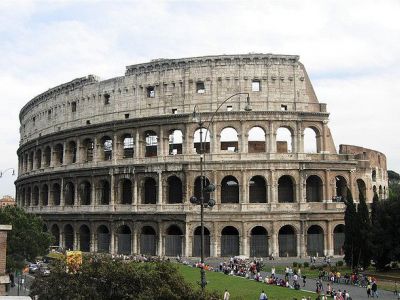
5) Colosseo (Colosseum) (must see)
The Colosseum, Rome’s iconic elliptical amphitheater, is the largest ancient amphitheater ever built, covering 24,000 square meters. Constructed between 69 and 80 AD by the Flavian dynasty, it was initially called the Flavian Amphitheater. Its modern name stems from the Colossus of Nero statue that once stood nearby, with the term "Colosseum" emerging during the medieval period.
Built on the land reclaimed from Emperor Nero’s landscaped Domus Aurea complex after the Great Fire of 64 AD, the Colosseum represented a gift to the Roman people under Emperor Vespasian. It was constructed using travertine, tuff, and concrete and was funded by spoils from the Jewish War. The latter, fought in 70 AD, led to the Siege of Jerusalem and brought back numerous prisoners who largely contributed to the massive workforce needed for the construction. The amphitheater comprised four tiers that could hold between 50,000 and 80,000 spectators at a time. Its free-standing structure features three architectural orders – Doric, Ionic, and Corinthian.
The lowest tier was for the emperor and the royal family, the two middle ones were for the noble Romans and members of government, while the highest tier was for the ordinary citizens. The elaborate system included 80 entrances, passageways for crowd control, and numbered pottery tickets for seating. Admission was free and the main sponsor was the emperor himself.
The Colosseum hosted gladiatorial contests, animal hunts, and mythological reenactments. Events often featured exotic animals imported from Africa and the Middle East. Emperor Trajan's games, for example, involved over 11,000 animals and 10,000 gladiators over 123 days! The below-ground passages were used to bring men and animals into the arena, which was separated from the audience by a ditch. Occasionally, it was reportedly even flooded for naval battles. Executions were common during intervals, with the condemned facing wild beasts or acting out tragic myths.
During the medieval period, the Colosseum served as a fortress and even a stone quarry. Passers-by habitually chipped off pieces of it for souvenirs which, together with some natural causes like earthquakes, led to its partial destruction.
Despite popular belief that the early Christians were martyred here in numbers, evidence suggests that most executions occurred elsewhere. By the 17th century, the Colosseum became recognized as a sacred site. Today, it hosts the Pope’s Good Friday “Way of the Cross” procession.
Only the north side of the building, as well as the underground passages, have survived intact. The arena floor is totally gone. Inside the Colosseum, there's a historical exhibition with both permanent and changing displays.
Tips:
Visit early in the morning or late in the evening to avoid long queues and heat. The ground and first floors are open to visitors without a special ticket, while the subterranean part and the third floor are accessed on pre-booked tours only. Opt for a guided tour to skip lines and access the Forum area. Alternatively, buy tickets in advance or at the Roman Forum. Enhance your experience with an audio guide for detailed historical insights.
Built on the land reclaimed from Emperor Nero’s landscaped Domus Aurea complex after the Great Fire of 64 AD, the Colosseum represented a gift to the Roman people under Emperor Vespasian. It was constructed using travertine, tuff, and concrete and was funded by spoils from the Jewish War. The latter, fought in 70 AD, led to the Siege of Jerusalem and brought back numerous prisoners who largely contributed to the massive workforce needed for the construction. The amphitheater comprised four tiers that could hold between 50,000 and 80,000 spectators at a time. Its free-standing structure features three architectural orders – Doric, Ionic, and Corinthian.
The lowest tier was for the emperor and the royal family, the two middle ones were for the noble Romans and members of government, while the highest tier was for the ordinary citizens. The elaborate system included 80 entrances, passageways for crowd control, and numbered pottery tickets for seating. Admission was free and the main sponsor was the emperor himself.
The Colosseum hosted gladiatorial contests, animal hunts, and mythological reenactments. Events often featured exotic animals imported from Africa and the Middle East. Emperor Trajan's games, for example, involved over 11,000 animals and 10,000 gladiators over 123 days! The below-ground passages were used to bring men and animals into the arena, which was separated from the audience by a ditch. Occasionally, it was reportedly even flooded for naval battles. Executions were common during intervals, with the condemned facing wild beasts or acting out tragic myths.
During the medieval period, the Colosseum served as a fortress and even a stone quarry. Passers-by habitually chipped off pieces of it for souvenirs which, together with some natural causes like earthquakes, led to its partial destruction.
Despite popular belief that the early Christians were martyred here in numbers, evidence suggests that most executions occurred elsewhere. By the 17th century, the Colosseum became recognized as a sacred site. Today, it hosts the Pope’s Good Friday “Way of the Cross” procession.
Only the north side of the building, as well as the underground passages, have survived intact. The arena floor is totally gone. Inside the Colosseum, there's a historical exhibition with both permanent and changing displays.
Tips:
Visit early in the morning or late in the evening to avoid long queues and heat. The ground and first floors are open to visitors without a special ticket, while the subterranean part and the third floor are accessed on pre-booked tours only. Opt for a guided tour to skip lines and access the Forum area. Alternatively, buy tickets in advance or at the Roman Forum. Enhance your experience with an audio guide for detailed historical insights.
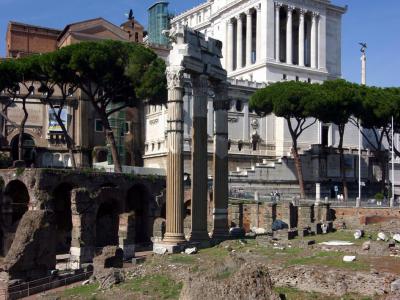
6) Foro di Cesare (Forum of Caesar)
Julius Caesar is arguably the best known and most dominant personality in Roman history. He became the dictator of Rome at the end of the Roman Republic period. Known for his military genius, he expanded Rome's territory through successful campaigns, particularly in Gaul, which is modern-day France, Belgium, the Netherlands, and parts of Germany. His assassination in 44 BC by a group of senators led to the demise of the Roman Republic and the rise of the Roman Empire.
Julius Caesar built the Forum of Caesar to showcase his power and accomplishments. The forum served both as a symbol of his political and military successes, particularly his conquest of Gaul, and as a practical solution to overcrowding in the Roman Forum. It also allowed Caesar to enhance his image, connecting his name to a grand architectural project and solidifying his legacy in the city.
A central element of the forum was the Temple of Venus Genetrix, which Caesar vowed to build before the Battle of Pharsalus in 48 BC. By doing so, he sought the favor of Venus, the legendary ancestor of his gens Julia, in a battle against rival Pompey, who also worshiped the goddess. The temple was completed after Caesar's assassination.
The Forum of Caesar functioned as more than just an expansion of the Roman Forum. It became a hub for public and senatorial affairs, reinforcing Caesar's close association with the Senate. He even had the Senate meet in front of the temple, a move that was unpopular among senators. The Julian Senate House was also reconstructed under Caesar, bringing the senate house closer to his forum and further symbolizing his political dominance.
The forum housed significant statues, including an equestrian statue of Caesar, a statue of his favorite horse, and later a gilded statue of Cleopatra, thus setting a precedent for honoring notable women. Inside the Temple of Venus Genetrix, a collection of art and artifacts and a prized collection of engraved gems were displayed.
Today, the Forum of Caesar is largely in ruins, but several notable remains can still be seen. The most visible of them are the Temple of Venus Genetrix's ruins. While much of the forum is beneath the level of modern streets lined with contemporary buildings, part of the old paved area, showcasing the layout of the ancient public space, is still in sight. Coupled with some imagination, it can allow you to fully envision the original space.
Julius Caesar built the Forum of Caesar to showcase his power and accomplishments. The forum served both as a symbol of his political and military successes, particularly his conquest of Gaul, and as a practical solution to overcrowding in the Roman Forum. It also allowed Caesar to enhance his image, connecting his name to a grand architectural project and solidifying his legacy in the city.
A central element of the forum was the Temple of Venus Genetrix, which Caesar vowed to build before the Battle of Pharsalus in 48 BC. By doing so, he sought the favor of Venus, the legendary ancestor of his gens Julia, in a battle against rival Pompey, who also worshiped the goddess. The temple was completed after Caesar's assassination.
The Forum of Caesar functioned as more than just an expansion of the Roman Forum. It became a hub for public and senatorial affairs, reinforcing Caesar's close association with the Senate. He even had the Senate meet in front of the temple, a move that was unpopular among senators. The Julian Senate House was also reconstructed under Caesar, bringing the senate house closer to his forum and further symbolizing his political dominance.
The forum housed significant statues, including an equestrian statue of Caesar, a statue of his favorite horse, and later a gilded statue of Cleopatra, thus setting a precedent for honoring notable women. Inside the Temple of Venus Genetrix, a collection of art and artifacts and a prized collection of engraved gems were displayed.
Today, the Forum of Caesar is largely in ruins, but several notable remains can still be seen. The most visible of them are the Temple of Venus Genetrix's ruins. While much of the forum is beneath the level of modern streets lined with contemporary buildings, part of the old paved area, showcasing the layout of the ancient public space, is still in sight. Coupled with some imagination, it can allow you to fully envision the original space.
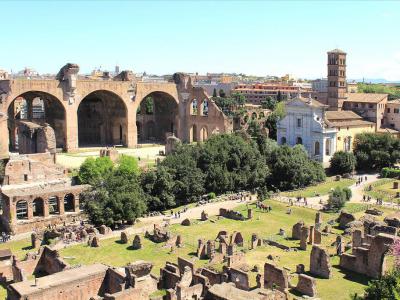
7) Foro Romano (Roman Forum) (must see)
The Roman Forum, once the pulsating heart of ancient Rome's public life, evolved from a simple marketplace around 500 BC into the epicenter of Roman political, social, and religious activity. Known as the Forum Magnum, it became a hub for triumphal processions, public speeches, elections, criminal trials, gladiatorial matches, and commerce. Statues and monuments celebrating Roman leaders solidified its status as one of history’s most significant meeting places.
Initially featuring early structures like the Regia (a royal residence) and the Temple of Vesta, the Forum developed into a formal assembly area called the Comitium, where the Senate and government convened. Over centuries, temples, tribunals, and public buildings, such as the Senate House and the Temple of Saturn, transformed the Forum into a multifunctional hub. The Basilica Aemilia, built in 179 BC, expanded judicial activities, while Julius Caesar’s enhancements, including the Basilica Julia and Curia Julia, underscored its role as a center for politics, commerce, and religion.
Despite its prominence, the Forum’s importance began to decline with the emergence of grander structures, such as Trajan's Forum and the Basilica Ulpia, to the north. Unlike the more planned Imperial Forums, the Roman Forum grew organically, reflecting a mix of architectural styles across periods. Constantine the Great’s construction of the Maxentius Basilica in 312 AD marked its final significant addition, temporarily restoring its political centrality. However, the fall of the Western Roman Empire in the 5th century AD led to the Forum's destruction and decline.
Today, the Roman Forum is a sprawling ruin but remains a priceless historical treasure. Though reduced to crumbling remains, it continues to captivate visitors, drawing nearly five million annually. Highlights of the site include the Sacred Street, the Arch of Titus, and remnants of iconic buildings like the Temple of Castor and Pollux.
Initially featuring early structures like the Regia (a royal residence) and the Temple of Vesta, the Forum developed into a formal assembly area called the Comitium, where the Senate and government convened. Over centuries, temples, tribunals, and public buildings, such as the Senate House and the Temple of Saturn, transformed the Forum into a multifunctional hub. The Basilica Aemilia, built in 179 BC, expanded judicial activities, while Julius Caesar’s enhancements, including the Basilica Julia and Curia Julia, underscored its role as a center for politics, commerce, and religion.
Despite its prominence, the Forum’s importance began to decline with the emergence of grander structures, such as Trajan's Forum and the Basilica Ulpia, to the north. Unlike the more planned Imperial Forums, the Roman Forum grew organically, reflecting a mix of architectural styles across periods. Constantine the Great’s construction of the Maxentius Basilica in 312 AD marked its final significant addition, temporarily restoring its political centrality. However, the fall of the Western Roman Empire in the 5th century AD led to the Forum's destruction and decline.
Today, the Roman Forum is a sprawling ruin but remains a priceless historical treasure. Though reduced to crumbling remains, it continues to captivate visitors, drawing nearly five million annually. Highlights of the site include the Sacred Street, the Arch of Titus, and remnants of iconic buildings like the Temple of Castor and Pollux.
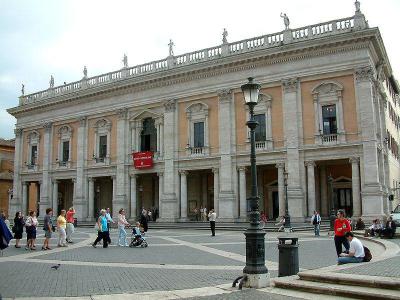
8) Musei Capitolini (Capitoline Museums) (must see)
The Capitoline Museums in Rome are among the city's most prestigious art and archaeology institutions, second in prominence only to the Vatican Museums. Established in 1471 by Pope Sixtus IV, who donated significant bronze sculptures to the city, it is recognized as the world's oldest public museum. Designed by Michelangelo in 1536, the museum spans two main buildings: the Conservators' Palace and the New Palace, housing artifacts from ancient, medieval, and Renaissance periods.
Significant expansions occurred in 1734 under Pope Clement XII, who added Cardinal Albani’s antiquities to prevent their export. Rodolfo Lanciani’s 19th-century reorganization emphasized the archaeological context. The collection now covers nearly 13,000 square meters and includes modern additions such as the Central Montemartini branch and the Exedra of Marcus Aurelius.
Local highlights include the Equestrian Statue of Marcus Aurelius, moved indoors in 1990 (its place in the square is now taken by a replica), and the iconic Capitoline Wolf, a bronze sculpture potentially dating to the 5th century BC or the medieval period. The Colossus of Constantine, the Hercules of the Forum Boarium, and the Boy with Thorn are among other bronze masterpieces found here. Also noteworthy are The Dying Gaul and Arnolfo di Cambio’s Portrait of Charles I of Anjou made in the 13th century, Europe’s earliest lifelike portrait of a living figure.
Historical artifacts include the Protomoteca, busts relocated from the Pantheon, and the Conaccordo Gallery, which connects the palaces and leads to the Tabularium and the Temple of Veiovis. The Conservators' Palace features the Hall of the Horatii and Curiatii with 16th-century frescoes, and the Pinacoteca Capitolina which displays Renaissance works by Caravaggio, Titian, and Tintoretto. Its corridor showcases an Epigraphic Collection, while a staircase leading to the Tabularium gallery affords breathtaking views of the Roman Forum.
With a full-day ticket, visitors can leisurely explore both palaces, culminating in a panoramic view of ancient Rome.
The Capitoline Museums also hold historical significance as the venue where the 1957 Treaties of Rome, a cornerstone of the European Union, were signed.
Tip:
The Terrazza Caffarelli café atop the Capitoline Museums offers stunning panoramic views of Rome's rooftops and ancient ruins, especially at sunset. Enjoy excellent coffee, cakes, or an aperitivo with snacks. Accessible via Piazzale Caffarelli, the café welcomes all, even those without museum admission, for a memorable culinary and scenic experience.
Significant expansions occurred in 1734 under Pope Clement XII, who added Cardinal Albani’s antiquities to prevent their export. Rodolfo Lanciani’s 19th-century reorganization emphasized the archaeological context. The collection now covers nearly 13,000 square meters and includes modern additions such as the Central Montemartini branch and the Exedra of Marcus Aurelius.
Local highlights include the Equestrian Statue of Marcus Aurelius, moved indoors in 1990 (its place in the square is now taken by a replica), and the iconic Capitoline Wolf, a bronze sculpture potentially dating to the 5th century BC or the medieval period. The Colossus of Constantine, the Hercules of the Forum Boarium, and the Boy with Thorn are among other bronze masterpieces found here. Also noteworthy are The Dying Gaul and Arnolfo di Cambio’s Portrait of Charles I of Anjou made in the 13th century, Europe’s earliest lifelike portrait of a living figure.
Historical artifacts include the Protomoteca, busts relocated from the Pantheon, and the Conaccordo Gallery, which connects the palaces and leads to the Tabularium and the Temple of Veiovis. The Conservators' Palace features the Hall of the Horatii and Curiatii with 16th-century frescoes, and the Pinacoteca Capitolina which displays Renaissance works by Caravaggio, Titian, and Tintoretto. Its corridor showcases an Epigraphic Collection, while a staircase leading to the Tabularium gallery affords breathtaking views of the Roman Forum.
With a full-day ticket, visitors can leisurely explore both palaces, culminating in a panoramic view of ancient Rome.
The Capitoline Museums also hold historical significance as the venue where the 1957 Treaties of Rome, a cornerstone of the European Union, were signed.
Tip:
The Terrazza Caffarelli café atop the Capitoline Museums offers stunning panoramic views of Rome's rooftops and ancient ruins, especially at sunset. Enjoy excellent coffee, cakes, or an aperitivo with snacks. Accessible via Piazzale Caffarelli, the café welcomes all, even those without museum admission, for a memorable culinary and scenic experience.
9) Campo de' Fiori Market
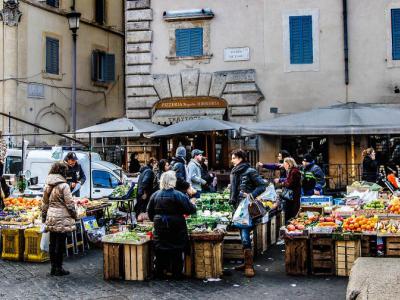
In the morning and noon hours, head to one of the most beautiful and colorful open-air markets in Rome – the main attraction of the Campo de' Fiori area. This market is primarily for fresh fruit and vegetables, but you will also find other goodies such as olive oil, balsamic vinegar, honey, vegetable pâté (pesto, artichoke, etc.), liquors, spices, cheeses, flowers, souvenirs, and flea-market-type things. Some vendors sell small products you can take home, and also give free samples, so this can be a pleasant way to try local specialties. With so much fresh fruit, some will happily make most of it into a juice for you – try the pomegranate for some intense goodness!
There also are many great restaurants and cafés laying around, with a view on the market, so you can try some handmade pizza or some carbonara if you're peckish. In the late afternoon and evening, the square turns into terraces for the restaurants and cafés, gradually becoming a nightlife hotspot with lots of street artists and performers who entertain the crowds.
Tip:
Please follow European tradition and don't touch the produce unless vendors tell you to "pick". They're happy to give advice and share recipes but, as anywhere in Rome, don't really bargain much (unless you're buying more than one of somethings at a time).
There also are many great restaurants and cafés laying around, with a view on the market, so you can try some handmade pizza or some carbonara if you're peckish. In the late afternoon and evening, the square turns into terraces for the restaurants and cafés, gradually becoming a nightlife hotspot with lots of street artists and performers who entertain the crowds.
Tip:
Please follow European tradition and don't touch the produce unless vendors tell you to "pick". They're happy to give advice and share recipes but, as anywhere in Rome, don't really bargain much (unless you're buying more than one of somethings at a time).
10) Fontana dei Quattro Fiumi (Fountain of the Four Rivers) (must see)
The focal point of Navona Square, the Fountain of the Four Rivers has been in place since the 17th century. While Rome has a longstanding affinity for fountains, dating back to antiquity, the Baroque era brought a new dimension to these water features, showcasing the generosity of the papacy.
In the case of the Fountain of the Four Rivers, Pope Innocent X, whose family seat – the Pamphili Palace – overlooks the square, entrusted the task to one of the most groundbreaking artists of the time, Gian Lorenzo Bernini. Created in 1651, the fountain was Rome's pinnacle achievement in fountain design, a symbolic masterpiece brimming with the dynamic and dramatic elements sought after by Baroque artists. Its central Egyptian obelisk is crowned with the Pamphili emblem, a dove with an olive twig.
Pope Innocent X chose Bernini after being secretly shown his model. The fountain was innovative, combining sculpture and architecture in a way unmatched by previous Roman fountains.
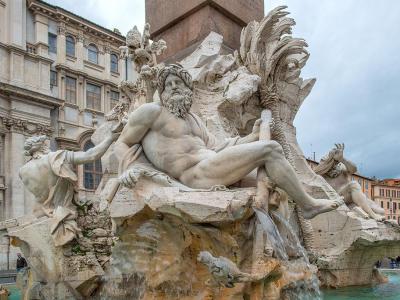
Here, the travertine base supports sculptures of four river gods, representing the major rivers of the continents over which papal authority had extended at that time. These include the Nile (for Africa), the Danube (for Europe), the Ganges (for Asia), and the Plate (for the Americas). Each figure conveys symbolic details: the Ganges is depicted holding a long oar, symbolizing the river's navigability; the Nile's veiled head signifies its unknown source; the Danube, the largest river near Rome touches the Pope's coat of arms; and the Plate sits atop a pile of coins, reflecting America’s wealth.
The fountain's unveiling on June 12, 1651, was marked by grand celebrations orchestrated by the Pamphili family. Allegorical figures of Fame and Curiosity paraded the streets, urging Romans to witness the reveal. The crowd marveled at the lifelike sculptures and water features, described as naturalistic and astonishing.
However, the project faced significant public opposition. Critics condemned its expense during the famine of 1646 to 1648, expressing their discontent through pasquinades demanding "Bread, not fountains." Street vendors and Roman Jews lamented their displacement from the square's market, which was closed to enhance its splendor.
Despite the controversy, the Fountain of the Four Rivers remains a cornerstone of Rome’s cultural and architectural legacy, blending mythology, artistry, and geographical narratives.
Tip:
To capture the essence of this fountain in photographs, it is recommended to shoot from various angles and positions, so as to get as much detail as possible. With ample space surrounding the fountain, take your time to find the perfect shot-or perhaps even multiple perfect shots.
In the case of the Fountain of the Four Rivers, Pope Innocent X, whose family seat – the Pamphili Palace – overlooks the square, entrusted the task to one of the most groundbreaking artists of the time, Gian Lorenzo Bernini. Created in 1651, the fountain was Rome's pinnacle achievement in fountain design, a symbolic masterpiece brimming with the dynamic and dramatic elements sought after by Baroque artists. Its central Egyptian obelisk is crowned with the Pamphili emblem, a dove with an olive twig.
Pope Innocent X chose Bernini after being secretly shown his model. The fountain was innovative, combining sculpture and architecture in a way unmatched by previous Roman fountains.
Here, the travertine base supports sculptures of four river gods, representing the major rivers of the continents over which papal authority had extended at that time. These include the Nile (for Africa), the Danube (for Europe), the Ganges (for Asia), and the Plate (for the Americas). Each figure conveys symbolic details: the Ganges is depicted holding a long oar, symbolizing the river's navigability; the Nile's veiled head signifies its unknown source; the Danube, the largest river near Rome touches the Pope's coat of arms; and the Plate sits atop a pile of coins, reflecting America’s wealth.
The fountain's unveiling on June 12, 1651, was marked by grand celebrations orchestrated by the Pamphili family. Allegorical figures of Fame and Curiosity paraded the streets, urging Romans to witness the reveal. The crowd marveled at the lifelike sculptures and water features, described as naturalistic and astonishing.
However, the project faced significant public opposition. Critics condemned its expense during the famine of 1646 to 1648, expressing their discontent through pasquinades demanding "Bread, not fountains." Street vendors and Roman Jews lamented their displacement from the square's market, which was closed to enhance its splendor.
Despite the controversy, the Fountain of the Four Rivers remains a cornerstone of Rome’s cultural and architectural legacy, blending mythology, artistry, and geographical narratives.
Tip:
To capture the essence of this fountain in photographs, it is recommended to shoot from various angles and positions, so as to get as much detail as possible. With ample space surrounding the fountain, take your time to find the perfect shot-or perhaps even multiple perfect shots.
11) Piazza Navona (Navona Square) (must see)
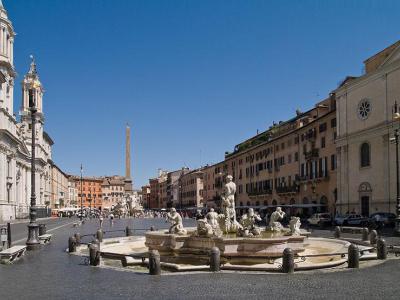
Navona Square, one of Rome’s most iconic places, is built on the site of the ancient (1st-century AD) Stadium of Domitian. The stadium’s elongated oval shape defines the square’s layout, which was originally designed for Roman games (or agones). Over time, the name evolved from Circus Agonalis (which means “competition arena”) to Navona. After the fall of the Roman Empire, the stadium fell into ruin and was quarried for materials, leaving few remnants today.
In the late 15th century, Navona Square was designated a public space when the city market moved there from Capitoline Hill. It became a celebrated example of Baroque architecture and art during the mid-17th century under Pope Innocent X, whose family property, the Pamphili Palace, overlooks the square. The latter also features several masterpieces, including Gian Lorenzo Bernini’s Fountain of the Four Rivers at its center, crowned by the Obelisk of Domitian. The renowned Church of Saint Agnes in Agone with its impressive dome further highlights the area's artistic significance. Also noteworthy are the Braschi Palace, presently home to the Museum of Rome, and the Cupis Palace, which now offers pre-booked accommodations.
Navona Square is also home to two additional fountains. The Fountain of the Moor, at the southern end, was originally sculpted by Giacomo della Porta in 1575, with Bernini adding a statue of a Moor wrestling a dolphin in 1673. At the northern end, the Fountain of Neptune, also by della Porta (created in 1574), gained its central Neptune statue in 1878.
The square has a rich cultural history, hosting theatrical performances and festivals, including a popular annual Christmas market, from December to January.
Navona Square made an appearance in several movies, including “Angels & Demons” (of 2008, starring Tom Hanks), “Yesterday, Today and Tomorrow” (with Sophie Loren, made in 1964), and “The Talented Mr. Ripley” (directed in 1999 by Anthony Minghella, featuring Matt Damon). The atmosphere in Navona Square exudes a cool and relaxed vibe which, complete with its cinematic and architectural appeal, makes it an ideal spot for photography.
Tip:
In the evenings, when the central fountain is illuminated, the square becomes particularly scenic.
If looking for more intimate and more value-for-money meals and refreshments, consider venturing onto one of the side streets adjacent to the square, filled with multiple eateries and cafes.
In the late 15th century, Navona Square was designated a public space when the city market moved there from Capitoline Hill. It became a celebrated example of Baroque architecture and art during the mid-17th century under Pope Innocent X, whose family property, the Pamphili Palace, overlooks the square. The latter also features several masterpieces, including Gian Lorenzo Bernini’s Fountain of the Four Rivers at its center, crowned by the Obelisk of Domitian. The renowned Church of Saint Agnes in Agone with its impressive dome further highlights the area's artistic significance. Also noteworthy are the Braschi Palace, presently home to the Museum of Rome, and the Cupis Palace, which now offers pre-booked accommodations.
Navona Square is also home to two additional fountains. The Fountain of the Moor, at the southern end, was originally sculpted by Giacomo della Porta in 1575, with Bernini adding a statue of a Moor wrestling a dolphin in 1673. At the northern end, the Fountain of Neptune, also by della Porta (created in 1574), gained its central Neptune statue in 1878.
The square has a rich cultural history, hosting theatrical performances and festivals, including a popular annual Christmas market, from December to January.
Navona Square made an appearance in several movies, including “Angels & Demons” (of 2008, starring Tom Hanks), “Yesterday, Today and Tomorrow” (with Sophie Loren, made in 1964), and “The Talented Mr. Ripley” (directed in 1999 by Anthony Minghella, featuring Matt Damon). The atmosphere in Navona Square exudes a cool and relaxed vibe which, complete with its cinematic and architectural appeal, makes it an ideal spot for photography.
Tip:
In the evenings, when the central fountain is illuminated, the square becomes particularly scenic.
If looking for more intimate and more value-for-money meals and refreshments, consider venturing onto one of the side streets adjacent to the square, filled with multiple eateries and cafes.
12) Basilica di Santa Maria sopra Minerva (Basilica of Saint Mary above Minerva) (must see)
Tucked away just behind the Pantheon in Minerva Square, Santa Maria above Minerva is a Dominican church and a hidden gem of both religious and architectural importance. This is the only surviving example of original Gothic religious architecture in Rome, as most medieval churches were modified with Baroque designs.
Despite its somewhat unassuming facade, the Santa Maria above Minerva – formerly the Dominican order's headquarters – also boasts an intriguing history and some truly magnificent artistic treasures. Chief among them are Michelangelo’s Christ the Redeemer sculpture and the Carafa Chapel's frescoes.
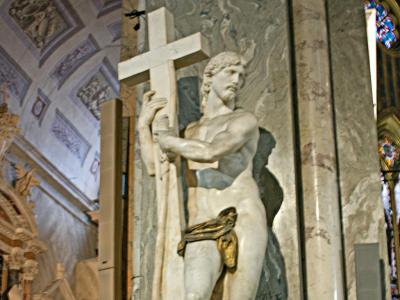
The former is found to the left of the main altar. The sculpture's first version, begun in 1515, was abandoned due to a flaw in the marble. The one we see today, completed in 1521, received acclaim for its artistry, particularly its lifelike knees. Originally, Michelangelo depicted Christ unclothed to symbolize his triumph over sin, however, a bronze loincloth was added in 1546.
The Carafa Chapel, commissioned by Cardinal Oliviero Carafa in honor of Saint Thomas Aquinas, was inaugurated in 1493. Lavishly adorned with frescoes by Florentine painter Filippino Lippi, it shows the scenes of Saint Thomas's life, including him debating with heretics, as well as some allegorical ones like him presenting Cardinal Carafa to the Virgin Mary. These frescoes are widely recognized as the best Renaissance painting in Rome outside the Sistine Chapel.
Looking up, you can't fail to notice the stunning deep blue painted ceiling and the round stained glass windows, rightfully regarded as the finest in the city.
The basilica also holds the remains of the Saint Catherine of Siena and early Renaissance painter Fra Angelico.
In 1628, the Convent of Minerva became the seat of the Congregation of the Holy Office, where the Roman Inquisition held trials, including that of Galileo Galilei. In 1633, Galileo was tried for heresy for supporting the theory that the Earth revolves around the Sun. Facing interrogation under threat of torture, he was found "vehemently suspect of heresy" and forced to recant. Galileo was sentenced to house arrest for life, and his works were banned. His trial marked a defining moment in the conflict between science and religion. Legend claims that, after his abjuration, Galileo allegedly muttered the rebellious phrase: "and yet it moves..."
Despite its somewhat unassuming facade, the Santa Maria above Minerva – formerly the Dominican order's headquarters – also boasts an intriguing history and some truly magnificent artistic treasures. Chief among them are Michelangelo’s Christ the Redeemer sculpture and the Carafa Chapel's frescoes.
The former is found to the left of the main altar. The sculpture's first version, begun in 1515, was abandoned due to a flaw in the marble. The one we see today, completed in 1521, received acclaim for its artistry, particularly its lifelike knees. Originally, Michelangelo depicted Christ unclothed to symbolize his triumph over sin, however, a bronze loincloth was added in 1546.
The Carafa Chapel, commissioned by Cardinal Oliviero Carafa in honor of Saint Thomas Aquinas, was inaugurated in 1493. Lavishly adorned with frescoes by Florentine painter Filippino Lippi, it shows the scenes of Saint Thomas's life, including him debating with heretics, as well as some allegorical ones like him presenting Cardinal Carafa to the Virgin Mary. These frescoes are widely recognized as the best Renaissance painting in Rome outside the Sistine Chapel.
Looking up, you can't fail to notice the stunning deep blue painted ceiling and the round stained glass windows, rightfully regarded as the finest in the city.
The basilica also holds the remains of the Saint Catherine of Siena and early Renaissance painter Fra Angelico.
In 1628, the Convent of Minerva became the seat of the Congregation of the Holy Office, where the Roman Inquisition held trials, including that of Galileo Galilei. In 1633, Galileo was tried for heresy for supporting the theory that the Earth revolves around the Sun. Facing interrogation under threat of torture, he was found "vehemently suspect of heresy" and forced to recant. Galileo was sentenced to house arrest for life, and his works were banned. His trial marked a defining moment in the conflict between science and religion. Legend claims that, after his abjuration, Galileo allegedly muttered the rebellious phrase: "and yet it moves..."
13) Pantheon (must see)
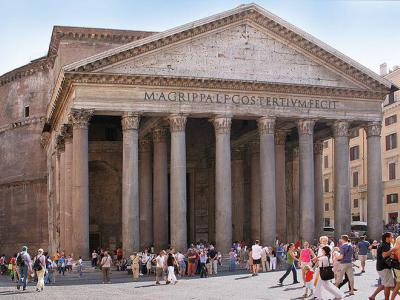
The Pantheon is one of Rome’s most iconic landmarks, renowned for its architectural brilliance. Originally a Roman temple, its name comes from the Ancient Greek "pan theos," which means dedication to all gods. Built on the site of a temple commissioned by consul Marcus Agrippa during Augustus’ reign, the current structure was completed under Emperor Hadrian around 126 AD. It was transformed into a Catholic Church of Saint Mary and the Martyrs in 609 AD, ensuring its preservation through centuries.
The Pantheon’s unique design combines a classical portico supported by Corinthian granite columns with a domed cylindrical structure (called a rotunda). The unsupported concrete dome, still the largest of its kind in the world, features a central oculus that provides natural light, ventilation, and symbolic celestial connections. The rotunda's harmonious dimensions-43 meters in both height and diameter-epitomize Roman engineering excellence, while its original massive bronze doors, each weighing over 20 tons, and intricate drainage system (allowing to effectively divert rainwater) highlight the ingenuity of its creators.
Throughout its history, the Pantheon has been a vibrant part of Roman life. It served as a burial site during the Renaissance, housing notable figures like painter Raphael and Italian kings Victor Emmanuel II and Umberto I. Its materials, such as bronze, have been repurposed for other projects like Bernini’s baldachin above the high altar of Saint Peter's Basilica. However, its core structure remains remarkably intact. Today, the church still host religious ceremonies, including masses, weddings, and Pentecost celebrations.
The Pantheon’s influence extends far beyond Rome. Its dome inspired architectural marvels like the Florence Cathedral and Rotunda of the U.S. Capital in Washington D.C., while its combination of classical and modern elements shaped countless government and academic buildings worldwide.
With over six million annual visitors, the Pantheon remains a symbol of Roman ingenuity and artistic achievement. Tourists can enjoy free entry to this historic site or soak in its splendor from Rotonda Square, savoring gelato while marveling at its timeless beauty.
Tip:
Incredible at night (from the outside), it is especially so if you enjoy musicians with talent and engagement... but beware of pickpockets.
The Pantheon’s unique design combines a classical portico supported by Corinthian granite columns with a domed cylindrical structure (called a rotunda). The unsupported concrete dome, still the largest of its kind in the world, features a central oculus that provides natural light, ventilation, and symbolic celestial connections. The rotunda's harmonious dimensions-43 meters in both height and diameter-epitomize Roman engineering excellence, while its original massive bronze doors, each weighing over 20 tons, and intricate drainage system (allowing to effectively divert rainwater) highlight the ingenuity of its creators.
Throughout its history, the Pantheon has been a vibrant part of Roman life. It served as a burial site during the Renaissance, housing notable figures like painter Raphael and Italian kings Victor Emmanuel II and Umberto I. Its materials, such as bronze, have been repurposed for other projects like Bernini’s baldachin above the high altar of Saint Peter's Basilica. However, its core structure remains remarkably intact. Today, the church still host religious ceremonies, including masses, weddings, and Pentecost celebrations.
The Pantheon’s influence extends far beyond Rome. Its dome inspired architectural marvels like the Florence Cathedral and Rotunda of the U.S. Capital in Washington D.C., while its combination of classical and modern elements shaped countless government and academic buildings worldwide.
With over six million annual visitors, the Pantheon remains a symbol of Roman ingenuity and artistic achievement. Tourists can enjoy free entry to this historic site or soak in its splendor from Rotonda Square, savoring gelato while marveling at its timeless beauty.
Tip:
Incredible at night (from the outside), it is especially so if you enjoy musicians with talent and engagement... but beware of pickpockets.
14) Chiesa di Sant' Ignazio di Loyola (Church of St. Ignatius of Loyola)
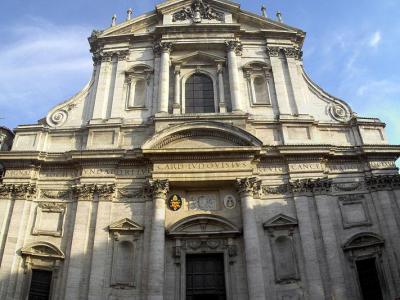
The Church of Saint Ignatius of Loyola at the Mars Field in Rome is a Baroque Latin Catholic titular church, dedicated to the founder of the Society of Jesus. Constructed between 1626 and 1650, it initially served as the chapel for the Roman College, later the Pontifical Gregorian University. This grand 17th-century preaching temple exemplifies the Counter-Reformation's architectural and religious fervor.
The church's history is rooted in the Roman College, established in 1551. Built on the land initially intended for a Poor Clares monastery, the available limited space prompted Jesuit architect Giovanni Tristano to complete a modest Church of the Annunciation in 1567. However, the church soon became inadequate for the college's growing student body.
After Ignatius of Loyola's canonization in 1622, Pope Gregory XV proposed building a larger church. His nephew, Cardinal Ludovico Ludovisi, commissioned Jesuit mathematician Orazio Grassi to design the new structure. Construction began in 1626 and culminated in 1650. The new church replaced the smaller one, occupying a quarter of the Roman College's block. Its Rococo square was added later.
The church's Latin cross plan, Corinthian pilasters, marble adornments, and gilded interiors mirror the Jesuit mother church, the Gesù. The grandiose frescoes painted on the nave ceiling by a Jesuit lay brother Andrea Pozzo, using the artistic technique called “deceive the eye,” create the illusion of a vast, open space, and are a major highlight.
Due to a lack of funds for a real dome, Pozzo painted an illusionary one, making the nave’s barrel vault appear as an idealized celestial vision where Saint Ignatius is received into heaven by Christ and the Virgin Mary. The artist's mastery of perspective, light, and shading gives the illusion of a towering cupola, visible from a specific marble disk in the nave floor. Another vantage point further east aligns with a second “deceive the eye” painting that depicts a tall, ribbed dome at the crossing- replacing the dome that was never built. The original painting, completed in 1685, was lost to fire, but in 1823, Francesco Manno faithfully recreated it based on Pozzo’s sketches and studies, preserving its striking visual deception.
The church's history is rooted in the Roman College, established in 1551. Built on the land initially intended for a Poor Clares monastery, the available limited space prompted Jesuit architect Giovanni Tristano to complete a modest Church of the Annunciation in 1567. However, the church soon became inadequate for the college's growing student body.
After Ignatius of Loyola's canonization in 1622, Pope Gregory XV proposed building a larger church. His nephew, Cardinal Ludovico Ludovisi, commissioned Jesuit mathematician Orazio Grassi to design the new structure. Construction began in 1626 and culminated in 1650. The new church replaced the smaller one, occupying a quarter of the Roman College's block. Its Rococo square was added later.
The church's Latin cross plan, Corinthian pilasters, marble adornments, and gilded interiors mirror the Jesuit mother church, the Gesù. The grandiose frescoes painted on the nave ceiling by a Jesuit lay brother Andrea Pozzo, using the artistic technique called “deceive the eye,” create the illusion of a vast, open space, and are a major highlight.
Due to a lack of funds for a real dome, Pozzo painted an illusionary one, making the nave’s barrel vault appear as an idealized celestial vision where Saint Ignatius is received into heaven by Christ and the Virgin Mary. The artist's mastery of perspective, light, and shading gives the illusion of a towering cupola, visible from a specific marble disk in the nave floor. Another vantage point further east aligns with a second “deceive the eye” painting that depicts a tall, ribbed dome at the crossing- replacing the dome that was never built. The original painting, completed in 1685, was lost to fire, but in 1823, Francesco Manno faithfully recreated it based on Pozzo’s sketches and studies, preserving its striking visual deception.
15) Piazza Colonna & Colonna di Marco Aurelio (Column Square & Column of Marcus Aurelius)
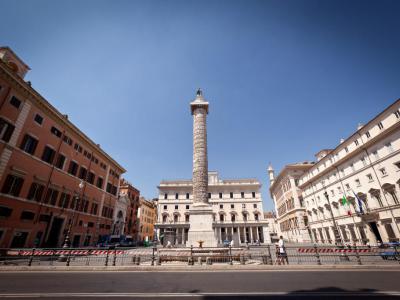
Column Square in Rome derives its name from the monumental Column of Marcus Aurelius. Erected in 193 AD, it commemorates the emperor's wars against Germanic tribes along the Danube River. Modeled after Trajan’s Column, this 40-meter Doric column features intricate spiral reliefs depicting scenes from these military campaigns.
At a closer look, binoculars or a long-lens camera can reveal intricate images, including a depiction of the so-called "Miracle Rain" attributed to divine intervention. At a desperate moment during one of Marcus Aurelius' battles, the surrounded Romans, suffering from heat and thirst, were saved by a rainstorm. According to legend, the rain was invoked by an Egyptian magician, and while the Romans drank and regained strength, the storm unleashed fire and thunderbolts upon their enemies. This event reinforced the Romans' belief in their divine right to overcome barbarianism and marked a pivotal moment in the campaign.
The column houses an internal staircase leading to a platform at the top. Originally part of the Field of Mars, possibly situated near the Temple of Marcus Aurelius (now gone), it also served as a funerary monument. In the 16th century, Pope Sixtus V restored the column, placing a statue of Saint Paul on top of it. The latter was done perhaps to Christianize the site or emulate Trajan’s Column, where the same pope had a statue of Saint Peter installed.
The surrounding square evolved over centuries, bordered by prominent structures from different eras. One such is the Chigi Palace. Built in 1562, it now serves as the residence of Italy’s Prime Minister. Another one, Wedekind Palace, constructed in 1838, incorporates Etruscan columns sourced from the ancient city of Veii, which the Romans conquered in the 4th century BC. Other significant buildings include Ferrajoli Palace, once a Papal post office, and Galleria Alberto Sordi, formerly known as the Colonna Gallery, a 19th-century addition.
The square also features a fountain constructed in 1577 to provide clean drinking water to the residents of Rome, restored in 1830. Crafted from pink marble sourced from the Greek island of Chios, it features an oval basin adorned with 16 intricately carved white-marble lion heads. At each end of the basin, two groups of dolphins entwine their tails around seashells, spouting water from their mouths, adding further to the site’s aesthetic appeal.
At a closer look, binoculars or a long-lens camera can reveal intricate images, including a depiction of the so-called "Miracle Rain" attributed to divine intervention. At a desperate moment during one of Marcus Aurelius' battles, the surrounded Romans, suffering from heat and thirst, were saved by a rainstorm. According to legend, the rain was invoked by an Egyptian magician, and while the Romans drank and regained strength, the storm unleashed fire and thunderbolts upon their enemies. This event reinforced the Romans' belief in their divine right to overcome barbarianism and marked a pivotal moment in the campaign.
The column houses an internal staircase leading to a platform at the top. Originally part of the Field of Mars, possibly situated near the Temple of Marcus Aurelius (now gone), it also served as a funerary monument. In the 16th century, Pope Sixtus V restored the column, placing a statue of Saint Paul on top of it. The latter was done perhaps to Christianize the site or emulate Trajan’s Column, where the same pope had a statue of Saint Peter installed.
The surrounding square evolved over centuries, bordered by prominent structures from different eras. One such is the Chigi Palace. Built in 1562, it now serves as the residence of Italy’s Prime Minister. Another one, Wedekind Palace, constructed in 1838, incorporates Etruscan columns sourced from the ancient city of Veii, which the Romans conquered in the 4th century BC. Other significant buildings include Ferrajoli Palace, once a Papal post office, and Galleria Alberto Sordi, formerly known as the Colonna Gallery, a 19th-century addition.
The square also features a fountain constructed in 1577 to provide clean drinking water to the residents of Rome, restored in 1830. Crafted from pink marble sourced from the Greek island of Chios, it features an oval basin adorned with 16 intricately carved white-marble lion heads. At each end of the basin, two groups of dolphins entwine their tails around seashells, spouting water from their mouths, adding further to the site’s aesthetic appeal.
16) Piazza di Spagna & Fontana della Barcaccia (Spanish Square & Fountain of the Longboat)
The Spanish Square is one of Rome's most popular destinations, known for its blend of historical and cultural significance. Dominated by the iconic Spanish Steps next to it, the square also serves as a hub for high fashion, with designer boutiques lining the surrounding streets.
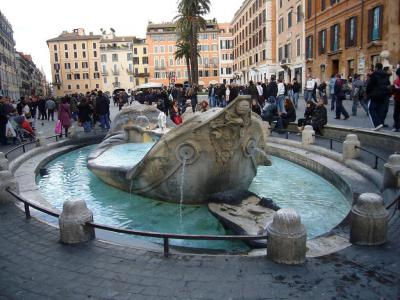
At the base of the Spanish Steps lies the "Fountain of the Longboat," an Early Baroque masterpiece created between 1627 and 1629. Commissioned by Pope Urban VIII as part of a project to install fountains in Rome’s major squares, it was designed by Pietro Bernini, possibly with assistance from his son, Gian Lorenzo. The fountain’s design, a half-sunken boat overflowing with water, was inspired by a local legend. During a devastating flood of the River Tiber in 1598, a small boat was reportedly carried to the square and left there as the waters receded. The fountain’s water flows gently due to the low pressure of the Acqua Vergine aqueduct, adding a soothing charm.
The fountain also features symbolic details, such as the Barberini family's papal coat of arms, honoring Pope Urban VIII’s ancestry. Its intricate design includes water flowing from seven points, with streams emerging from central balusters, human-faced suns inside the boat, and external spouts. This harmonious blend of engineering and artistry reflects the Baroque era's grandeur.
The Spanish Square is steeped in literary history as well. Adjacent to the fountain is the former residence of English poet John Keats, who died there in 1821. Now a museum, the house preserves memorabilia of the Romantic generation. Keats found solace in the sound of the fountain’s water, which inspired the epitaph on his tombstone: "Here lies one whose name was writ in water."
On the right side of the square stands the Ferrari di Valbona Palace, once home to Cardinal Lorenzo Cybo de Mari. The building, remodeled in 1936 under Fascist-era designs, showcases modern terraces that complement the surrounding Baroque architecture.
Spanish Square invites visitors to relax, bask in the sun, and enjoy its timeless beauty. The gentle gurgle of the Longboat Fountain and its rich history make it a serene yet captivating centerpiece of Rome.
At the base of the Spanish Steps lies the "Fountain of the Longboat," an Early Baroque masterpiece created between 1627 and 1629. Commissioned by Pope Urban VIII as part of a project to install fountains in Rome’s major squares, it was designed by Pietro Bernini, possibly with assistance from his son, Gian Lorenzo. The fountain’s design, a half-sunken boat overflowing with water, was inspired by a local legend. During a devastating flood of the River Tiber in 1598, a small boat was reportedly carried to the square and left there as the waters receded. The fountain’s water flows gently due to the low pressure of the Acqua Vergine aqueduct, adding a soothing charm.
The fountain also features symbolic details, such as the Barberini family's papal coat of arms, honoring Pope Urban VIII’s ancestry. Its intricate design includes water flowing from seven points, with streams emerging from central balusters, human-faced suns inside the boat, and external spouts. This harmonious blend of engineering and artistry reflects the Baroque era's grandeur.
The Spanish Square is steeped in literary history as well. Adjacent to the fountain is the former residence of English poet John Keats, who died there in 1821. Now a museum, the house preserves memorabilia of the Romantic generation. Keats found solace in the sound of the fountain’s water, which inspired the epitaph on his tombstone: "Here lies one whose name was writ in water."
On the right side of the square stands the Ferrari di Valbona Palace, once home to Cardinal Lorenzo Cybo de Mari. The building, remodeled in 1936 under Fascist-era designs, showcases modern terraces that complement the surrounding Baroque architecture.
Spanish Square invites visitors to relax, bask in the sun, and enjoy its timeless beauty. The gentle gurgle of the Longboat Fountain and its rich history make it a serene yet captivating centerpiece of Rome.
