Custom Walk in Graz, Austria by cass1313_2de7b created on 2025-06-17
Guide Location: Austria » Graz
Guide Type: Custom Walk
# of Sights: 9
Tour Duration: 1 Hour(s)
Travel Distance: 2.1 Km or 1.3 Miles
Share Key: 6FHTC
Guide Type: Custom Walk
# of Sights: 9
Tour Duration: 1 Hour(s)
Travel Distance: 2.1 Km or 1.3 Miles
Share Key: 6FHTC
How It Works
Please retrieve this walk in the GPSmyCity app. Once done, the app will guide you from one tour stop to the next as if you had a personal tour guide. If you created the walk on this website or come to the page via a link, please follow the instructions below to retrieve the walk in the app.
Retrieve This Walk in App
Step 1. Download the app "GPSmyCity: Walks in 1K+ Cities" on Apple App Store or Google Play Store.



Step 2. In the GPSmyCity app, download(or launch) the guide "Graz Map and Walking Tours".
Step 3. Tap the menu button located at upper right corner of the "Walks" screen and select "Retrieve custom walk". Enter the share key: 6FHTC
1) City Museum
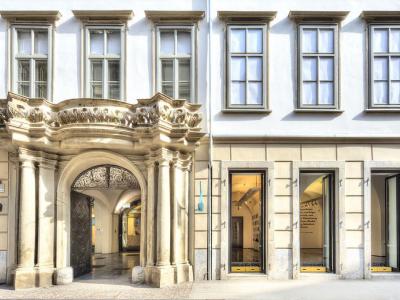
The City Museum in Graz, situated in the Khuenberg Palace on Sackstrasse, offers an extensive look into Graz's cultural and historical background. It was established in 1928, commemorating the city's 800th anniversary. Originally located in the Attems Palace, the museum faced challenges in adequately showcasing its collection until it found a permanent home in Khuenberg Palace in 1972.
Known as the Graz Museum, it explores both the past and present of the city, presenting a variety of exhibitions ranging from historical retrospectives to contemporary urban issues. Noteworthy is the Museum Pharmacy (Museumsapotheke), a well-preserved pharmacy offering insight into the historical medical practices of the region.
Over time, the museum has hosted numerous special exhibitions and photo displays featuring works by notable individuals, fostering a connection between historical artifacts and contemporary artistic expressions. Dr. Gerhard M. Dienes' leadership from 1995 to 1997 brought about significant modernization efforts, enhancing the museum's appeal and allowing for a more nuanced exploration of Graz's history and cultural identity.
Today, the City Museum Graz stands as a reflection of the city's rich history and its ongoing cultural development, encouraging both residents and visitors to engage with Graz's multifaceted story.
Known as the Graz Museum, it explores both the past and present of the city, presenting a variety of exhibitions ranging from historical retrospectives to contemporary urban issues. Noteworthy is the Museum Pharmacy (Museumsapotheke), a well-preserved pharmacy offering insight into the historical medical practices of the region.
Over time, the museum has hosted numerous special exhibitions and photo displays featuring works by notable individuals, fostering a connection between historical artifacts and contemporary artistic expressions. Dr. Gerhard M. Dienes' leadership from 1995 to 1997 brought about significant modernization efforts, enhancing the museum's appeal and allowing for a more nuanced exploration of Graz's history and cultural identity.
Today, the City Museum Graz stands as a reflection of the city's rich history and its ongoing cultural development, encouraging both residents and visitors to engage with Graz's multifaceted story.
2) Sporgasse (Spor Street) (must see)
Spor Street is older than Graz. It began its career as a street for commerce in Roman times. It was originally a trade route called the Strata Hungarica. It extended from the Murtal to the Roman provincial capital. The name Spor refers to the word "spur." Spur makers and armorers lived here in the 14th century.
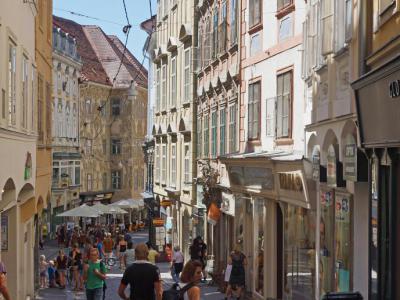
The street today is mainly a pedestrianized shopping street lined with historical buildings. On the edge of the Main Square is the 15th and 16th century stuccoed, baroque Luegg-haus. Opposite is the Art Nouveau House with a 16th century core and a flowery Art Nouveau facade (built in 1900).
Nearby the Art Nouveau House is the Baroque and Rococo facade of the "Inn To the Roman Emperor." It was built in the 15th century and rebuilt in 1755. The Staircase church is the oldest parish church in Graz, first noted in a document in 1343. The House of the Teutonic Knights, built in the 15th century, has an inner courtyard with pillar arcades.
The Palace Saurai is at the upper end of the street. It is from 1566. There is a statue of a sword-wielding Turk in front. The "Golden Pate Inn" with a round bay window and arched stone gates dates from the 17th century. Queen Elizabeth II had dinner there in 1967.
Today, ancient Spor Street lives up to its history as a street for commerce. It is a busy no-cars shopping zone with stores offering exotically flavored ice creams, sneakers, shoes, watches and jewelry, baked goods and Italian fashions. And the list goes on.
The street today is mainly a pedestrianized shopping street lined with historical buildings. On the edge of the Main Square is the 15th and 16th century stuccoed, baroque Luegg-haus. Opposite is the Art Nouveau House with a 16th century core and a flowery Art Nouveau facade (built in 1900).
Nearby the Art Nouveau House is the Baroque and Rococo facade of the "Inn To the Roman Emperor." It was built in the 15th century and rebuilt in 1755. The Staircase church is the oldest parish church in Graz, first noted in a document in 1343. The House of the Teutonic Knights, built in the 15th century, has an inner courtyard with pillar arcades.
The Palace Saurai is at the upper end of the street. It is from 1566. There is a statue of a sword-wielding Turk in front. The "Golden Pate Inn" with a round bay window and arched stone gates dates from the 17th century. Queen Elizabeth II had dinner there in 1967.
Today, ancient Spor Street lives up to its history as a street for commerce. It is a busy no-cars shopping zone with stores offering exotically flavored ice creams, sneakers, shoes, watches and jewelry, baked goods and Italian fashions. And the list goes on.
3) Grazer Burg (Graz Castle)
Situated east of Graz's old town, close to Graz Cathedral, Graz Castle was constructed starting in 1438 under the patronage of Duke Frederick V, who later ascended to become Holy Roman Emperor Frederick III. Its strategic significance was limited, so it was linked to the fortress on Schloßberg through a covered passage. Graz became the capital of Inner Austria in 1564, leading to the castle's expansion and refurbishment as the residence of the region's Archdukes. However, with Archduke Ferdinand II's relocation to Vienna upon his coronation as emperor in 1619, the castle lost its primary role and fell into disrepair.
Over the centuries, there were various minor renovations, but by 1822, sections were deemed rundown, resulting in partial demolition between 1853 and 1854. In the early 20th century, some renovations and expansions occurred, and since 1922, the castle has housed the Styrian governor's offices.
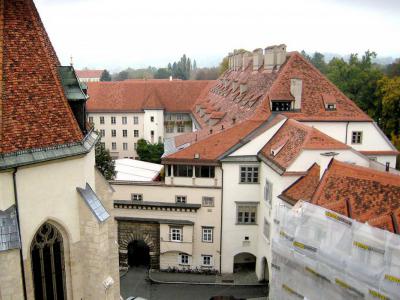
During World War II, the castle sustained significant damage and underwent reconstruction from 1947 onwards. Between 1950 and 1952, new structures were added, forming what is now called the New Castle. Presently, alongside the provincial governor's offices, the castle hosts several departments of the Styrian provincial government. While access to the castle is limited, visitors can explore its courtyards and the iconic double spiral staircase, appreciating its historical significance from the exterior.
Over the centuries, there were various minor renovations, but by 1822, sections were deemed rundown, resulting in partial demolition between 1853 and 1854. In the early 20th century, some renovations and expansions occurred, and since 1922, the castle has housed the Styrian governor's offices.
During World War II, the castle sustained significant damage and underwent reconstruction from 1947 onwards. Between 1950 and 1952, new structures were added, forming what is now called the New Castle. Presently, alongside the provincial governor's offices, the castle hosts several departments of the Styrian provincial government. While access to the castle is limited, visitors can explore its courtyards and the iconic double spiral staircase, appreciating its historical significance from the exterior.
4) Altstadt
The historical core of Graz, known as the Old Town (Altstadt), is a remarkable showcase of the city's diverse history and architectural development. Recognized as a UNESCO World Heritage Site in 1999, and later expanded in 2010 to include "City of Graz - Historic Center and Eggenberg Castle," this designation underscores the city's commitment to preserving its rich heritage. Graz carefully integrates new architecture into its historic ensemble, which dates back to the Gothic period and beyond.
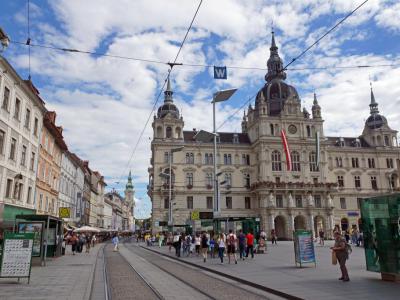
The Old Town, is renowned for its well-preserved city center, featuring charming Baroque buildings with red roofs, lively fountains, and the imposing presence of a castle atop a hill. This area, which extends into the Inner City district, encapsulates Graz's cultural and historical essence.
Graz's origins can be traced back to the Chalcolithic Age, but it wasn't until the Middle Ages that the city experienced continuous settlement. In the 12th century, the Babenberg dukes transformed Graz into a thriving commercial center. Subsequently, under Habsburg rule, especially during King Rudolph I's reign in 1281, Graz further prospered, becoming the seat of power for the Inner Austrian line of the Habsburgs during the 14th century, with the Schloßberg castle serving as their residence and governing center. The influence of the Renaissance in the 16th century left a lasting impression on Graz, particularly through the contributions of Italian architects and artists.
Today, Graz's Old Town not only preserves its historical heritage but also thrives as a dynamic cultural hub. Visitors can explore numerous museums, government buildings, the cathedral, the Clock Tower, and the enchanting Glockenspiel, all of which contribute to the appreciation of Graz's rich history and architectural legacy.
The Old Town, is renowned for its well-preserved city center, featuring charming Baroque buildings with red roofs, lively fountains, and the imposing presence of a castle atop a hill. This area, which extends into the Inner City district, encapsulates Graz's cultural and historical essence.
Graz's origins can be traced back to the Chalcolithic Age, but it wasn't until the Middle Ages that the city experienced continuous settlement. In the 12th century, the Babenberg dukes transformed Graz into a thriving commercial center. Subsequently, under Habsburg rule, especially during King Rudolph I's reign in 1281, Graz further prospered, becoming the seat of power for the Inner Austrian line of the Habsburgs during the 14th century, with the Schloßberg castle serving as their residence and governing center. The influence of the Renaissance in the 16th century left a lasting impression on Graz, particularly through the contributions of Italian architects and artists.
Today, Graz's Old Town not only preserves its historical heritage but also thrives as a dynamic cultural hub. Visitors can explore numerous museums, government buildings, the cathedral, the Clock Tower, and the enchanting Glockenspiel, all of which contribute to the appreciation of Graz's rich history and architectural legacy.
5) Rathaus (Town Hall)
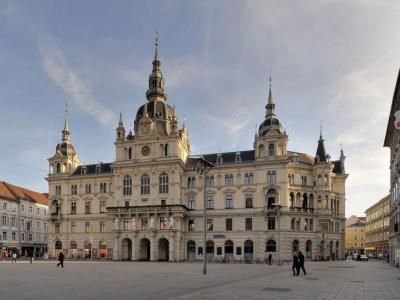
In 1550 the city administration of Graz moved themselves into a rather modest Town Hall, which was also used as a prison. In 1803 this building was exchanged for a newer, classical style model, sans prison. The Town Hall of today was designed by architects Wielemans and Reuter and built in 1893. The style is Historicist-Old German.
It was determined all the houses on the block set up for the new town hall would be demolished. Some owners resisted, however. Two houses stayed in place while the town hall grew around them. The stubborn narrow twosome can be found in the inner courtyard, jammed into the bulk of the enormous town hall.
The town hall was financed through a tax on wine. There are short corner towers on either side of the front of the four-level building. In the middle, the tall center tower has a dome and spire. Niches on the neoclassical facade hold statues of Austrians, emperors, and figures representing art, science, trade and industry.
Inside, the two-story session hall provides space for the city council. The chamber has a coffered ceiling and a gallery. Panelings, a chandelier and a wall clock are 19th century originals. On the left side of the main entrance is a 1971 painting of the Graz Town Hall evolving through time.
Up the staircase to the next level is the Wedding Hall. The Town Hall is a popular site for weddings. A webcam is used. Marriages can be witnessed around the world.
It was determined all the houses on the block set up for the new town hall would be demolished. Some owners resisted, however. Two houses stayed in place while the town hall grew around them. The stubborn narrow twosome can be found in the inner courtyard, jammed into the bulk of the enormous town hall.
The town hall was financed through a tax on wine. There are short corner towers on either side of the front of the four-level building. In the middle, the tall center tower has a dome and spire. Niches on the neoclassical facade hold statues of Austrians, emperors, and figures representing art, science, trade and industry.
Inside, the two-story session hall provides space for the city council. The chamber has a coffered ceiling and a gallery. Panelings, a chandelier and a wall clock are 19th century originals. On the left side of the main entrance is a 1971 painting of the Graz Town Hall evolving through time.
Up the staircase to the next level is the Wedding Hall. The Town Hall is a popular site for weddings. A webcam is used. Marriages can be witnessed around the world.
6) Hauptplatz (Main Square) (must see)
The Main Square of Graz has been a focal point and magnet for visitors and locals since 1160 when it was built by Duke Otakar III. The attractions and watering holes of Graz are easily accessible from the Main Square.
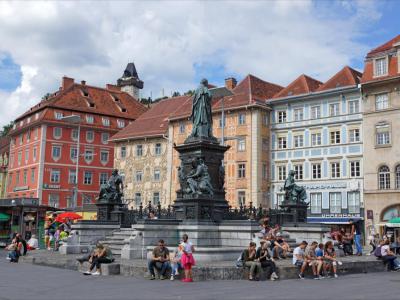
The Square is a trapezoid shaped market square surrounded by houses built in medieval and late Gothic styles. Some facades are Gothic, Baroque, and Biedermeier. Notable houses include: The White House (built in 1710); The Eagle Pharmacy (built in 1535); and the Citizens' Home to the Great Christoph (built in 17th century); numbers 3, 4, and 6, respectively.
The standout house is the Luegg House, with a grandiloquent stucco facade built in 15th century. The palace of the Sturgkh merchant family built 1532 is in various styles, including 20th century touches.
Since 1878 the Franz Ponninger fountain monument of Archduke Johann von Osterreich has dominated the square. The statue of the Archduke is flanked by four female figures. They represent the rivers Mur, Enns, Drava, and Sann. Fountain basins are on the corners. The base holds allegorical bronze reliefs.
Until the late 18th century the Square was also used for public punishments, including executions. Offenders could be pilloried before the town hall to amuse the innocent. Executions were big events. Commoners were done in the Square. Nobility were executed in the town hall, no tea with the Mayer.
Since 1965 the Square has been pedestrianized but some cycling is allowed. The Square is also served by prams (electric trolleys).
The Square is a trapezoid shaped market square surrounded by houses built in medieval and late Gothic styles. Some facades are Gothic, Baroque, and Biedermeier. Notable houses include: The White House (built in 1710); The Eagle Pharmacy (built in 1535); and the Citizens' Home to the Great Christoph (built in 17th century); numbers 3, 4, and 6, respectively.
The standout house is the Luegg House, with a grandiloquent stucco facade built in 15th century. The palace of the Sturgkh merchant family built 1532 is in various styles, including 20th century touches.
Since 1878 the Franz Ponninger fountain monument of Archduke Johann von Osterreich has dominated the square. The statue of the Archduke is flanked by four female figures. They represent the rivers Mur, Enns, Drava, and Sann. Fountain basins are on the corners. The base holds allegorical bronze reliefs.
Until the late 18th century the Square was also used for public punishments, including executions. Offenders could be pilloried before the town hall to amuse the innocent. Executions were big events. Commoners were done in the Square. Nobility were executed in the town hall, no tea with the Mayer.
Since 1965 the Square has been pedestrianized but some cycling is allowed. The Square is also served by prams (electric trolleys).
7) Lift im Berg
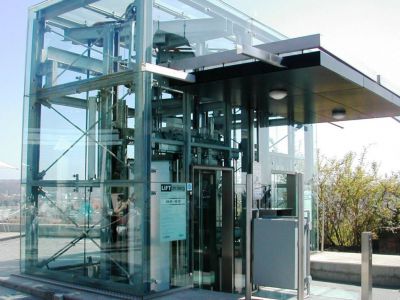
The "Lift im Berg" in Graz exemplifies how modern technology can harmonize with nature to create both functional and visually striking infrastructure. Designed by architect Reiner Schmid, this glass-enclosed elevator provides the quickest route to ascend Castle Mountain (Schlossberg), where the "Cathedral in the Mountain" (Dom im Berg) is located. Constructing this unique lift involved removing 5,000 cubic meters of material from the mountain, resulting in a 77-meter rise without the need for a conventional lift shaft. Instead, what emerged is a "panoramic lift in the mountain," integrating the shaft, stairs, and lift into a vertical transport axis that also serves as an immersive experience space.
The interior design is remarkable, showcasing the natural beauty of the mountain's rock formations and access tunnels, which create a cathedral-like ambiance. The careful selection of materials, meticulous attention to detail, and effective lighting design accentuate the overall structure, demonstrating that modern technology can indeed be aesthetically pleasing. The lift commenced operation on May 3, 2000, after just six months of construction.
With two cabins, each featuring glass viewing windows, the lift can accommodate up to 15 people per cabin and operates at a speed of 2.5 meters per second. This design not only ensures accessibility for individuals with disabilities but also provides three exit points: the Cathedral in the Mountain, the Clock Tower Casemates, and the Stadtgartenamt base. The "Lift im Berg" stands as a testament to innovative architectural and engineering solutions, seamlessly blending into its historical and natural surroundings while offering a unique and accessible means to explore Graz's Schlossberg.
The interior design is remarkable, showcasing the natural beauty of the mountain's rock formations and access tunnels, which create a cathedral-like ambiance. The careful selection of materials, meticulous attention to detail, and effective lighting design accentuate the overall structure, demonstrating that modern technology can indeed be aesthetically pleasing. The lift commenced operation on May 3, 2000, after just six months of construction.
With two cabins, each featuring glass viewing windows, the lift can accommodate up to 15 people per cabin and operates at a speed of 2.5 meters per second. This design not only ensures accessibility for individuals with disabilities but also provides three exit points: the Cathedral in the Mountain, the Clock Tower Casemates, and the Stadtgartenamt base. The "Lift im Berg" stands as a testament to innovative architectural and engineering solutions, seamlessly blending into its historical and natural surroundings while offering a unique and accessible means to explore Graz's Schlossberg.

8) Schloßbergrutsche
In the heart of Graz lies an architectural and engineering wonder nestled within the historic Schloßberg - the Schloßberg Slide (Schloßbergrutsche). Announced in mid-2017 and opened to the public in February 2019, it has swiftly become an iconic attraction. Notably, it holds the title of the tallest indoor slide globally, standing at 64 meters tall. This impressive structure is cleverly integrated into the mountain's landscape, winding around the Schloßberg lift within the lift shaft and culminating in a grand exit in the tunnel leading to the lift.
Stretching over a total length of 170 meters, the slide offers a thrilling 40-second ride where adventurers can reach average speeds of 25 km/h. This combination of speed, height, and the slide's winding path offers a unique thrill unmatched by any other slide globally.
A notable feature of the Schloßberg Slide is its innovative design, which includes a change in the direction of rotation of the downward spiral midway through the ride. This twist not only enhances the excitement but also demonstrates the thoughtful engineering behind the slide's construction.
Known as THE SLIDE GRAZ, this attraction transcends being merely a slide; it delivers an unforgettable experience. As participants zoom down multiple turns around the elevator shaft, they're treated to a rush like no other, all while enclosed within the historic Schloßberg. This fusion of history, adrenaline, and modern engineering makes the Schloßberg Slide a must-visit destination for thrill-seekers and culture enthusiasts alike, promising an adventure that will linger in the memory long after the ride concludes.
Stretching over a total length of 170 meters, the slide offers a thrilling 40-second ride where adventurers can reach average speeds of 25 km/h. This combination of speed, height, and the slide's winding path offers a unique thrill unmatched by any other slide globally.
A notable feature of the Schloßberg Slide is its innovative design, which includes a change in the direction of rotation of the downward spiral midway through the ride. This twist not only enhances the excitement but also demonstrates the thoughtful engineering behind the slide's construction.
Known as THE SLIDE GRAZ, this attraction transcends being merely a slide; it delivers an unforgettable experience. As participants zoom down multiple turns around the elevator shaft, they're treated to a rush like no other, all while enclosed within the historic Schloßberg. This fusion of history, adrenaline, and modern engineering makes the Schloßberg Slide a must-visit destination for thrill-seekers and culture enthusiasts alike, promising an adventure that will linger in the memory long after the ride concludes.
9) Schlossberg (Castle Hill) (must see)
A legend says the Devil made Castle Hill. He promised to make a high hill in exchange for one soul. He flew over the town carrying a huge rock. But it was Easter Sunday. He had no power to take a soul. Enraged, he threw the rock down. It was smashed. The biggest piece became Castle Hill.
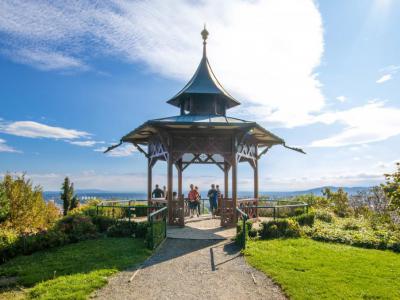
In the center of the city of Graz, the Castle Hill towers to 1,554 feet above sea level. The hill is forested and topped by a fortress. Today it is a public park with awesome views of things below. It is often the venue for entertainments, cafes and restaurants. Management is provided by Holding Graz, the city utility company.
As early as the 10th century there are mentions of the fortifications of Castle Hill. In the 15th century a 1,300 foot long fortification was built by architects from Italy. A cable lift was used to raise stones to the top of the hill. The castle was demolished in 1809 by order of Napoleon.
Ludwig von Welden turned the ruins of the castle in a park in 1839. The park holds the clock tower and two bastions from the old castle. A funicular railway has its terminus next to a hilltop restaurant with spectacular views. On the west side of the tower are two small cafes. One of the bastions has a open-air stage for performances.
The summit and tower can also be reached by elevator or by hiking up steep stairs one one side of the mountain or by a winding path on the other side.
Each year the Elevate Festival of music, art and politics takes place in various places around the Castle Hill. A tunnel through the Castle Hill connects to the elevator. A second tunnel runs parallel to the elevator tunnel. It connects Castle Hill to Karmeiter Square. In this tunnel is the fairytale Express, a train ride for children.
On the mountaintop is the Casemate Stage. This is a free venue for concerts. It has a retractable roof and a capacity for 1,310 happy fans.
In the center of the city of Graz, the Castle Hill towers to 1,554 feet above sea level. The hill is forested and topped by a fortress. Today it is a public park with awesome views of things below. It is often the venue for entertainments, cafes and restaurants. Management is provided by Holding Graz, the city utility company.
As early as the 10th century there are mentions of the fortifications of Castle Hill. In the 15th century a 1,300 foot long fortification was built by architects from Italy. A cable lift was used to raise stones to the top of the hill. The castle was demolished in 1809 by order of Napoleon.
Ludwig von Welden turned the ruins of the castle in a park in 1839. The park holds the clock tower and two bastions from the old castle. A funicular railway has its terminus next to a hilltop restaurant with spectacular views. On the west side of the tower are two small cafes. One of the bastions has a open-air stage for performances.
The summit and tower can also be reached by elevator or by hiking up steep stairs one one side of the mountain or by a winding path on the other side.
Each year the Elevate Festival of music, art and politics takes place in various places around the Castle Hill. A tunnel through the Castle Hill connects to the elevator. A second tunnel runs parallel to the elevator tunnel. It connects Castle Hill to Karmeiter Square. In this tunnel is the fairytale Express, a train ride for children.
On the mountaintop is the Casemate Stage. This is a free venue for concerts. It has a retractable roof and a capacity for 1,310 happy fans.
