Custom Walk in Matera, Italy by mh_mindicino_be777 created on 2025-06-28
Guide Location: Italy » Matera
Guide Type: Custom Walk
# of Sights: 10
Tour Duration: 2 Hour(s)
Travel Distance: 2.2 Km or 1.4 Miles
Share Key: NA4HT
Guide Type: Custom Walk
# of Sights: 10
Tour Duration: 2 Hour(s)
Travel Distance: 2.2 Km or 1.4 Miles
Share Key: NA4HT
How It Works
Please retrieve this walk in the GPSmyCity app. Once done, the app will guide you from one tour stop to the next as if you had a personal tour guide. If you created the walk on this website or come to the page via a link, please follow the instructions below to retrieve the walk in the app.
Retrieve This Walk in App
Step 1. Download the app "GPSmyCity: Walks in 1K+ Cities" on Apple App Store or Google Play Store.



Step 2. In the GPSmyCity app, download(or launch) the guide "Matera Map and Walking Tours".
Step 3. Tap the menu button located at upper right corner of the "Walks" screen and select "Retrieve custom walk". Enter the share key: NA4HT
1) Sassi di Matera (Stones of Matera Districts)
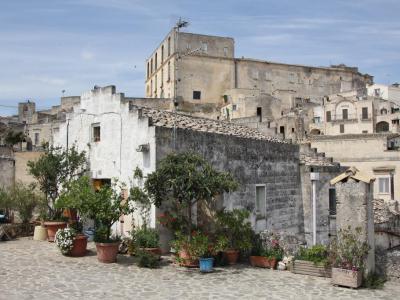
The Sassi di Matera, or “Stones of Matera,” form the most iconic and historic districts of the city, carved into the limestone cliffs of southern Italy’s Basilicata region. These ancient cave dwellings, some dating back to the Paleolithic period, are considered among the earliest examples of human settlement in Italy. Over the centuries, the caves evolved from simple shelters into a complex urban environment, complete with homes, chapels, cisterns, and even underground streets. Recognized as a UNESCO World Heritage Site in 1993, the Sassi stand today as a striking example of how humans adapted architecture to the natural landscape.
The Sassi are divided into two main areas: Sasso Caveoso and Sasso Barisano. Sasso Caveoso preserves the more traditional cave-dwelling structures, where visitors can see how families lived in rock-hewn houses until the mid-20th century. In contrast, Sasso Barisano developed into a district with more elaborate façades and palazzi built over the caves, reflecting centuries of social and architectural transformation. Both districts are interwoven with narrow stairways, winding alleys, and terraces that open to panoramic views of the Gravina canyon, creating a cityscape unlike any other in Europe.
Exploring the Sassi today offers a unique cultural experience. Many of the former cave homes have been restored and repurposed as museums, boutique hotels, artisan shops, and restaurants, allowing visitors to witness the balance between preservation and modern use. Walking through the labyrinthine streets, travelers encounter rock-hewn churches decorated with medieval frescoes, quiet courtyards, and striking viewpoints. The Sassi di Matera embody both history and resilience, offering an unforgettable journey into Italy’s ancient past while showcasing the city’s revival as a vibrant cultural destination.
The Sassi are divided into two main areas: Sasso Caveoso and Sasso Barisano. Sasso Caveoso preserves the more traditional cave-dwelling structures, where visitors can see how families lived in rock-hewn houses until the mid-20th century. In contrast, Sasso Barisano developed into a district with more elaborate façades and palazzi built over the caves, reflecting centuries of social and architectural transformation. Both districts are interwoven with narrow stairways, winding alleys, and terraces that open to panoramic views of the Gravina canyon, creating a cityscape unlike any other in Europe.
Exploring the Sassi today offers a unique cultural experience. Many of the former cave homes have been restored and repurposed as museums, boutique hotels, artisan shops, and restaurants, allowing visitors to witness the balance between preservation and modern use. Walking through the labyrinthine streets, travelers encounter rock-hewn churches decorated with medieval frescoes, quiet courtyards, and striking viewpoints. The Sassi di Matera embody both history and resilience, offering an unforgettable journey into Italy’s ancient past while showcasing the city’s revival as a vibrant cultural destination.
2) Piazza San Pietro Caveoso (San Pietro Caveoso Square)
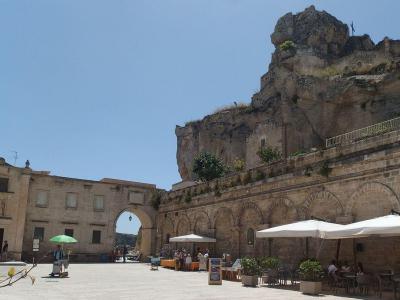
Saint Pietro Caveoso Square feels like a stage set where Matera’s history and landscape perform together. The square takes its name from the Church of Saints Peter and Paul, built in the 13th century and later dressed up with a Baroque outside and towers. From its perch on the cliff edge, the church commands attention, with the gorge of the Gravina river and the rocky plateau of the Murgia rolling away behind it. The result is a setting where stone, faith, and landscape intertwine.
For centuries, this square carried the rhythm of local life. Religious processions wound their way through it, markets filled the open space, and families from the cave dwellings of Sasso Caveoso mixed with those crossing in from the plateau. The surrounding rock-carved homes and palaces form a kind of natural amphitheater, pressing close around the plaza while opening dramatically toward the ravine. Walk a little further and paths lead into lamias-plain cave houses once shared by farmers, animals, and tools. These were the same dwellings branded as the “shame of Italy” in the 20th century, abandoned in poverty but still haunting in their raw authenticity.
Today, the square serves as both a gathering point and a vantage point. From here you can step toward rock churches like the Madonna of Idris or Saint Lucia alle Malve, or simply pause to take in the layered view of Matera’s past carved into stone. By day, the square is a hub for visitors; by night, the unlit alleys beyond make it better left to guided walks. Saint Pietro Caveoso Square remains a place where Matera’s contrasts-sacred and domestic, ruin and revival-are laid bare in one unforgettable panorama.
For centuries, this square carried the rhythm of local life. Religious processions wound their way through it, markets filled the open space, and families from the cave dwellings of Sasso Caveoso mixed with those crossing in from the plateau. The surrounding rock-carved homes and palaces form a kind of natural amphitheater, pressing close around the plaza while opening dramatically toward the ravine. Walk a little further and paths lead into lamias-plain cave houses once shared by farmers, animals, and tools. These were the same dwellings branded as the “shame of Italy” in the 20th century, abandoned in poverty but still haunting in their raw authenticity.
Today, the square serves as both a gathering point and a vantage point. From here you can step toward rock churches like the Madonna of Idris or Saint Lucia alle Malve, or simply pause to take in the layered view of Matera’s past carved into stone. By day, the square is a hub for visitors; by night, the unlit alleys beyond make it better left to guided walks. Saint Pietro Caveoso Square remains a place where Matera’s contrasts-sacred and domestic, ruin and revival-are laid bare in one unforgettable panorama.

3) Chiesa di Santa Maria di Idris (Church of Saint Maria of Idris) (must see)
The Church of Saint Maria of Idris is a rupestrian church in Matera. It is carved into a limestone rock of Monterrone that dominates the Sasso Caveoso. The beautiful location offers a unique view of the city. The church can be reached via stairs to the rock Church of Santa Lucia alle Malve. "Idris" is derived from the Greek "Odigitria," "who shows the way."
A facade of masonry is next to a small bell tower. The interior nave is uneven. Some frescoes have been removed for restoration. Once restored, they are kept at the Superintendency for Historical and Artistic Heritage of Matera. On the altar is a 17th-century tempera rendering of the Madonna and Child.
Santa Maria de Idris is connected to the rock crypt of San Giovanni in Monterrone via a tunnel. The tomb holds several precious frescoes from the 12th to the 17th century. A fresco of John the Baptist is in the tunnel. In a lunette above the crypt is a 12th-century Christ Pantocrator. The title is Greek, meaning "All-Powerful."
After the corridor is a large hall, a nave of San Giovanni in Monterrone. On the wall of the presbytery is a 12th-century Madonna and Child, Glykophilousa style (Virgin of the Sweet Kiss). Other saints stand in decorated niches.
A facade of masonry is next to a small bell tower. The interior nave is uneven. Some frescoes have been removed for restoration. Once restored, they are kept at the Superintendency for Historical and Artistic Heritage of Matera. On the altar is a 17th-century tempera rendering of the Madonna and Child.
Santa Maria de Idris is connected to the rock crypt of San Giovanni in Monterrone via a tunnel. The tomb holds several precious frescoes from the 12th to the 17th century. A fresco of John the Baptist is in the tunnel. In a lunette above the crypt is a 12th-century Christ Pantocrator. The title is Greek, meaning "All-Powerful."
After the corridor is a large hall, a nave of San Giovanni in Monterrone. On the wall of the presbytery is a 12th-century Madonna and Child, Glykophilousa style (Virgin of the Sweet Kiss). Other saints stand in decorated niches.
4) Casa Grotta di Vico Solitario (Cave House of Lonely Alley) (must see)
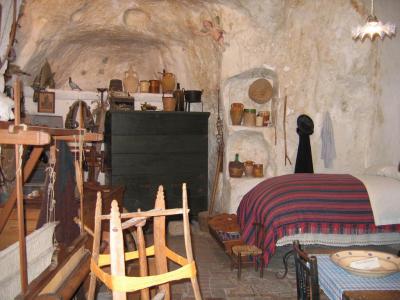
The Cave House of Lonely Alley pulls you straight into Matera’s past, before 1952, when the government declared the Sassi unfit for living and moved families out. While many of the old cave homes have since been polished into hotels and guesthouses, this one was left as it was-complete with tools, furniture, and the everyday traces of life carved into stone. It’s less a reconstruction than a freeze-frame, showing exactly how generations managed to live inside the rock.
The house itself is set in a natural hollow in the limestone, with additions made over the 18th century. Step through its wide archway and you enter a single chamber, where spaces were divided not by walls but by necessity. Light fell on the front rooms, so that’s where cooking, eating, and sleeping took place. A single table fed the family, a brazier provided heat, and a raised bed with a corn-stuffed mattress kept dampness at bay.
Move further in and the cave becomes more practical: a manger for the mule, a manure pit, and rough stables. Tools, pottery, and a loom remind us that work and domestic life were inseparable, while channels cut into the rock fed a cistern that captured every drop of precious rainwater.
When the Sassi were abandoned, the house-like many others-stood empty, part of what Italians called the “shame of Italy.” Today, it survives as a reminder of that era, complemented by nearby sites like the rock church of Saint Pietro Monterrone and a snow cave now showing old documentary footage.
The Cave House of Lonely Alley doesn’t romanticize the past-it lets you walk into it, stone walls and all, and see how people endured by turning bare rock into a home.
The house itself is set in a natural hollow in the limestone, with additions made over the 18th century. Step through its wide archway and you enter a single chamber, where spaces were divided not by walls but by necessity. Light fell on the front rooms, so that’s where cooking, eating, and sleeping took place. A single table fed the family, a brazier provided heat, and a raised bed with a corn-stuffed mattress kept dampness at bay.
Move further in and the cave becomes more practical: a manger for the mule, a manure pit, and rough stables. Tools, pottery, and a loom remind us that work and domestic life were inseparable, while channels cut into the rock fed a cistern that captured every drop of precious rainwater.
When the Sassi were abandoned, the house-like many others-stood empty, part of what Italians called the “shame of Italy.” Today, it survives as a reminder of that era, complemented by nearby sites like the rock church of Saint Pietro Monterrone and a snow cave now showing old documentary footage.
The Cave House of Lonely Alley doesn’t romanticize the past-it lets you walk into it, stone walls and all, and see how people endured by turning bare rock into a home.
5) Belvedere Piazzetta Pascoli (Pascoli Square Belvedere)
Pascoli Square Belvedere may be small in size, but it has long punched above its weight in Matera’s story. Tucked beside the 17th-century Lanfranchi Palace-once a Dominican seminary, now home to the National Museum of Medieval and Modern Art of Basilicata-it carries the name of poet Giovanni Pascoli, who briefly taught here in the 19th century. For a man of words, this outlook would have needed none: the view alone speaks volumes.
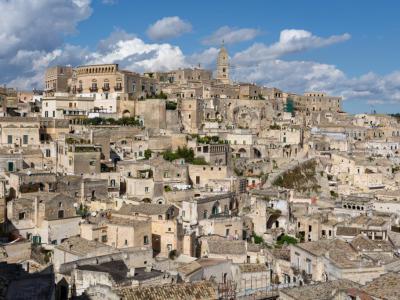
From the parapet, the Sassi districts stretch out in layers-Sasso Caveoso and Sasso Barisano clinging to the limestone cliffs, with the Gravina gorge plunging below and the Murgia plateau beyond. The cathedral rises on the ridge, rupestrian churches mark the cliffs, and at night the caves glitter with light, as if Matera itself were a constellation set into stone.
The square has also doubled as a stage for art and reflection. In 2011, Japanese sculptor Kengiro Azuma placed The Drop here, a bronze monument nearly three meters tall, a reminder that water has always been the lifeblood of the city carved into rock. Long before that, in the 17th and 18th centuries, this terrace was part of Matera’s baroque expansion, linking the civic quarter with the ancient cave districts below. By the 20th century, it had settled into the role of gathering ground, alive with markets, concerts, and public life.
Today, Pascoli Plaza balances past and present. It frames one of Matera’s most photographed panoramas while remaining a lived-in square, where everyday chatter mixes with centuries of history beneath the open sky.
From the parapet, the Sassi districts stretch out in layers-Sasso Caveoso and Sasso Barisano clinging to the limestone cliffs, with the Gravina gorge plunging below and the Murgia plateau beyond. The cathedral rises on the ridge, rupestrian churches mark the cliffs, and at night the caves glitter with light, as if Matera itself were a constellation set into stone.
The square has also doubled as a stage for art and reflection. In 2011, Japanese sculptor Kengiro Azuma placed The Drop here, a bronze monument nearly three meters tall, a reminder that water has always been the lifeblood of the city carved into rock. Long before that, in the 17th and 18th centuries, this terrace was part of Matera’s baroque expansion, linking the civic quarter with the ancient cave districts below. By the 20th century, it had settled into the role of gathering ground, alive with markets, concerts, and public life.
Today, Pascoli Plaza balances past and present. It frames one of Matera’s most photographed panoramas while remaining a lived-in square, where everyday chatter mixes with centuries of history beneath the open sky.
6) Via Ridola (Ridola Street)
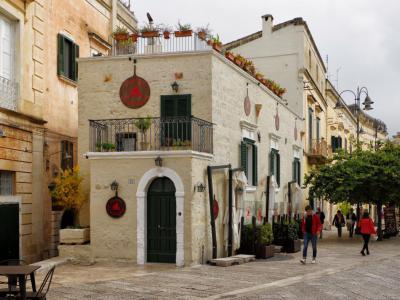
Ridola street might only run a couple of hundred meters through Matera, but it carries the weight of centuries. It’s named after Domenico Ridola, the physician-turned-amateur archaeologist who dug into local caves and revealed just how far back Matera’s story stretches. He was also mayor, senator, and the kind of citizen who leaves a permanent mark-his finds became the foundation of the Archaeological Museum that now bears his name. The museum, housed in the former Saint Chiara Convent, still displays everything from Neolithic tools to Greek relics, alongside Ridola’s own manuscripts.
The street itself took shape during the baroque makeover of Matera in the 17th and 18th centuries. Archbishop Antonio Del Ryos ordered a new district beyond the crowded Sassi, calling it the “New Houses,” and Ridola Street became its backbone. Palaces and churches rose along its edges, setting the stage for a new civic quarter that contrasted with the ancient caves below. Walking today, you’ll pass the façade of the Church of Purgatorio, with skulls carved into its stonework, and the Church of San Francesco, a baroque flourish in an otherwise austere landscape. Lanfranchi Palace, built as a seminary in 1672, now serves as the National Museum of Medieval and Modern Art of Basilicata, housing sacred art, Neapolitan canvases, and works by Carlo Levi, the artist and writer who turned Matera into a symbol of resilience.
The walk ends at Pascoli Belvedere Square, where the land suddenly opens up to reveal the cathedral on the ridge, the Sassi spilling into the Gravina gorge, and the plateau beyond. Ridola street, in that sense, is more than a street-it’s Matera’s timeline, condensed into one elegant stroll.
The street itself took shape during the baroque makeover of Matera in the 17th and 18th centuries. Archbishop Antonio Del Ryos ordered a new district beyond the crowded Sassi, calling it the “New Houses,” and Ridola Street became its backbone. Palaces and churches rose along its edges, setting the stage for a new civic quarter that contrasted with the ancient caves below. Walking today, you’ll pass the façade of the Church of Purgatorio, with skulls carved into its stonework, and the Church of San Francesco, a baroque flourish in an otherwise austere landscape. Lanfranchi Palace, built as a seminary in 1672, now serves as the National Museum of Medieval and Modern Art of Basilicata, housing sacred art, Neapolitan canvases, and works by Carlo Levi, the artist and writer who turned Matera into a symbol of resilience.
The walk ends at Pascoli Belvedere Square, where the land suddenly opens up to reveal the cathedral on the ridge, the Sassi spilling into the Gravina gorge, and the plateau beyond. Ridola street, in that sense, is more than a street-it’s Matera’s timeline, condensed into one elegant stroll.
7) Palombaro Lungo (Palombaro Lungo Cistern) (must see)
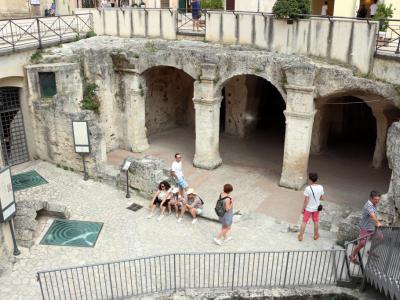
Beneath Matera’s Vittorio Veneto Square lies the Palombaro Lungo, a cistern of such scale and ambition that locals began calling it a water cathedral. The project began in the 16th century, when natural caves were stitched together to form part of the city’s water network, though the final push to complete it only came in 1832. By then, the underground chamber stretched long and deep, able to hold nearly five million liters of water collected from rainfall and nearby springs-an immense reservoir for a town where rivers were scarce and every drop mattered. Expansion continued into the 1880s, ensuring that Matera’s residents had a steady supply long before modern pipelines arrived.
The very name tells its story. Some link Palombaro to the Latin for a bird of prey diving toward its target, others to plumbarius, a term for water collectors, while Lungo simply nods to its enormous size. Step inside and the atmosphere justifies the reputation: arches and stone columns rise like the supports of a great basilica, their reflections dancing in the still water below. For generations, this hidden structure fed the square’s fountain above and supplied Matera’s households, until the Apulian Aqueduct, completed in 1920, finally made it redundant.
For decades, the cistern sat sealed and forgotten until 1991, when students climbed in with a dinghy and revealed what lay below. Their discovery, followed by careful restoration, offered the city not just a reclaimed monument but proof of its historic ingenuity-evidence that helped Matera secure its UNESCO World Heritage designation.
Today, raised walkways guide visitors across this immense chamber. With dim lighting, mirrored waters, and soaring vaults, the Palombaro Lungo feels both monumental and intimate-a reminder that Matera’s survival was literally carved out of stone.
The very name tells its story. Some link Palombaro to the Latin for a bird of prey diving toward its target, others to plumbarius, a term for water collectors, while Lungo simply nods to its enormous size. Step inside and the atmosphere justifies the reputation: arches and stone columns rise like the supports of a great basilica, their reflections dancing in the still water below. For generations, this hidden structure fed the square’s fountain above and supplied Matera’s households, until the Apulian Aqueduct, completed in 1920, finally made it redundant.
For decades, the cistern sat sealed and forgotten until 1991, when students climbed in with a dinghy and revealed what lay below. Their discovery, followed by careful restoration, offered the city not just a reclaimed monument but proof of its historic ingenuity-evidence that helped Matera secure its UNESCO World Heritage designation.
Today, raised walkways guide visitors across this immense chamber. With dim lighting, mirrored waters, and soaring vaults, the Palombaro Lungo feels both monumental and intimate-a reminder that Matera’s survival was literally carved out of stone.
8) Piazza Vittorio Veneto (Vittorio Veneto Square)
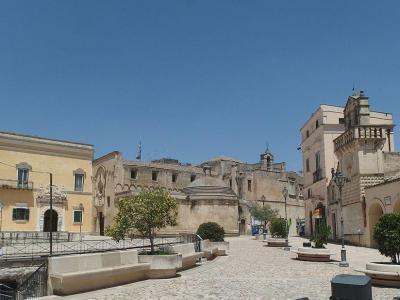
Vittorio Veneto Square in Matera has worn several names and carried just as many roles across the centuries. Today it honors the Italian victory over Austria-Hungary in 1918 at Vittorio Veneto, but earlier it was Plebiscite Square, marking the annexation of Rome in 1870, and before that Fontana Square, centered on a fountain restored in 1832 under King Ferdinando II. Every name leaves a trace of political and civic shifts, layered much like the city itself.
By the 18th and 19th centuries, as Matera grew beyond its cave dwellings, the square became the stage for modern life. Neoclassical façades and arcades framed it, while the Annunziata Palace and the Church of Saint Domenico kept watch. The belvedere, with its round arches and terraces, offered a vantage point to the cathedral and the Sassi below, as if the city itself were pausing to admire its past carved into stone.
The most extraordinary story, though, runs beneath the paving stones. In 1832, the Palombaro Lungo was hewed into the rock: an immense underground cistern with stone columns and soaring arches, often called a “water cathedral.” It gathered and stored rainwater, sustaining Matera until the Apulian Aqueduct was completed in the 20th century. What looks like an elegant square above is, in fact, sitting on centuries of ingenious engineering below.
Today the plaza balances daily bustle with historic weight. Markets, cafes, and events fill the open space, while its terraces give clear views into the Sassi, linking Matera’s ancient stone labyrinth with its modern rhythms. Here, civic life and deep history continue to meet in plain sight.
By the 18th and 19th centuries, as Matera grew beyond its cave dwellings, the square became the stage for modern life. Neoclassical façades and arcades framed it, while the Annunziata Palace and the Church of Saint Domenico kept watch. The belvedere, with its round arches and terraces, offered a vantage point to the cathedral and the Sassi below, as if the city itself were pausing to admire its past carved into stone.
The most extraordinary story, though, runs beneath the paving stones. In 1832, the Palombaro Lungo was hewed into the rock: an immense underground cistern with stone columns and soaring arches, often called a “water cathedral.” It gathered and stored rainwater, sustaining Matera until the Apulian Aqueduct was completed in the 20th century. What looks like an elegant square above is, in fact, sitting on centuries of ingenious engineering below.
Today the plaza balances daily bustle with historic weight. Markets, cafes, and events fill the open space, while its terraces give clear views into the Sassi, linking Matera’s ancient stone labyrinth with its modern rhythms. Here, civic life and deep history continue to meet in plain sight.
9) Cattedrale di Matera (Matera Cathedral) (must see)
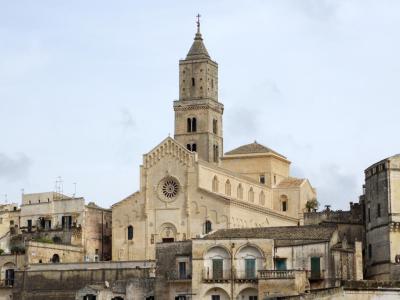
The Matera Cathedral crowns the city from the highest ridge between the Sassi districts, a position that has made it both a landmark and a watchful presence for nearly eight centuries. Work began around 1230, on the ruins of a Benedictine monastery, and by 1270 the new cathedral was ready-first dedicated to Saint Eustace, then later to the Dark-skinned Madonna, who became Matera’s most beloved protector. From the outside, the building still carries the clean lines of the 13th century, while the interior reveals a far more layered history of alteration and embellishment.
Look closely at the façade: a rose window with sixteen rays bursts out from the stone, framed above by Archangel Michael trampling a dragon. Below, an Atlas figure strains under the weight of the design, while a row of lemons-twelve in all-quietly symbolize the apostles. Lions, saints, and prophets guard the portal, while a 170-foot bell tower rises beside it, visible from every corner of the Sassi.
Step inside and the mood shifts. A Byzantine fresco of the Dark-skinned Madonna survives from the 13th century, while later centuries gilded the space with painted ceilings, elaborate plasterwork, and golden altars. The wooden choir stalls, Persio’s Nativity, and Santoro’s paintings all speak to Matera’s artistic lineage. The Chapel of the Annunciation, with its coffered ceiling and sculpted Virgin, completes the ensemble.
Neglect, earthquakes, and restorations have all left their trace, but since reopening in 2016 the cathedral has returned to its role as both parish church and symbol of civic pride. From its terrace, the view sweeps down over the Sassi, making the cathedral as much a vantage point on Matera’s history as it is a place of worship.
Look closely at the façade: a rose window with sixteen rays bursts out from the stone, framed above by Archangel Michael trampling a dragon. Below, an Atlas figure strains under the weight of the design, while a row of lemons-twelve in all-quietly symbolize the apostles. Lions, saints, and prophets guard the portal, while a 170-foot bell tower rises beside it, visible from every corner of the Sassi.
Step inside and the mood shifts. A Byzantine fresco of the Dark-skinned Madonna survives from the 13th century, while later centuries gilded the space with painted ceilings, elaborate plasterwork, and golden altars. The wooden choir stalls, Persio’s Nativity, and Santoro’s paintings all speak to Matera’s artistic lineage. The Chapel of the Annunciation, with its coffered ceiling and sculpted Virgin, completes the ensemble.
Neglect, earthquakes, and restorations have all left their trace, but since reopening in 2016 the cathedral has returned to its role as both parish church and symbol of civic pride. From its terrace, the view sweeps down over the Sassi, making the cathedral as much a vantage point on Matera’s history as it is a place of worship.
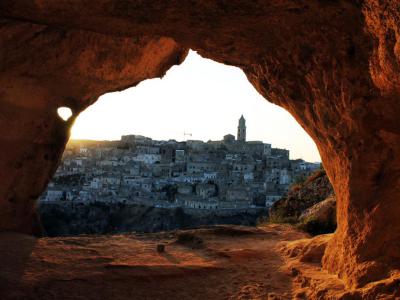
10) Casa Noha (Noha House) (must see)
Noha House doesn’t just stand quietly in Matera’s Civita district-it speaks. Built in the 15th century as the residence of the noble Noha family, it once anchored a patchwork of gardens and estates that even included their own bridge, linking their property to the Saint Paolo quarter. Unlike their peers, who chose more stable terrain, the Nohas built their home directly over an erosion channel. To shore it up, they recycled ruins as foundations, unintentionally unearthing traces of Bronze and Iron Age life, along with Greek, Roman, and medieval layers. In short, Noha House was perched above a cross-section of Matera’s entire past.
Architecturally, it mirrors the Sassi themselves-half-carved into the rock, half-built above ground. A courtyard framed by service rooms, an external staircase climbing toward the living quarters, and stone details give the house its distinctive form. For centuries it remained a private residence, until it was donated to the Italian Environmental Fund, an organization dedicated to preserving Italy’s heritage. Acquired in 2004, it was carefully restored and transformed from a family home into a cultural threshold for the city.
Step inside and you won’t find display cases or shelves of artifacts. Instead, the house itself becomes the stage for The Invisible Stones, a thirty-minute immersive presentation. Film, archival images, and narration flood the walls, guiding visitors through Matera’s story-from its earliest cave settlements to its medieval faith, from the abandonment and stigma of the 20th century to the UNESCO recognition and cultural revival that redefined its future.
Noha House now acts as both a preserved piece of Matera’s fabric and a lens through which the city is understood. By sitting in its cool stone rooms, visitors gain not only orientation but perspective: the journey of a city once dismissed as a national embarrassment, reborn as a European Capital of Culture, carved permanently into the rock of memory.
Architecturally, it mirrors the Sassi themselves-half-carved into the rock, half-built above ground. A courtyard framed by service rooms, an external staircase climbing toward the living quarters, and stone details give the house its distinctive form. For centuries it remained a private residence, until it was donated to the Italian Environmental Fund, an organization dedicated to preserving Italy’s heritage. Acquired in 2004, it was carefully restored and transformed from a family home into a cultural threshold for the city.
Step inside and you won’t find display cases or shelves of artifacts. Instead, the house itself becomes the stage for The Invisible Stones, a thirty-minute immersive presentation. Film, archival images, and narration flood the walls, guiding visitors through Matera’s story-from its earliest cave settlements to its medieval faith, from the abandonment and stigma of the 20th century to the UNESCO recognition and cultural revival that redefined its future.
Noha House now acts as both a preserved piece of Matera’s fabric and a lens through which the city is understood. By sitting in its cool stone rooms, visitors gain not only orientation but perspective: the journey of a city once dismissed as a national embarrassment, reborn as a European Capital of Culture, carved permanently into the rock of memory.
