Custom Walk in Seoul, South Korea by robertpatchak_ee996 created on 2025-07-08
Guide Location: South Korea » Seoul
Guide Type: Custom Walk
# of Sights: 6
Tour Duration: 1 Hour(s)
Travel Distance: 2.8 Km or 1.7 Miles
Share Key: HGK84
Guide Type: Custom Walk
# of Sights: 6
Tour Duration: 1 Hour(s)
Travel Distance: 2.8 Km or 1.7 Miles
Share Key: HGK84
How It Works
Please retrieve this walk in the GPSmyCity app. Once done, the app will guide you from one tour stop to the next as if you had a personal tour guide. If you created the walk on this website or come to the page via a link, please follow the instructions below to retrieve the walk in the app.
Retrieve This Walk in App
Step 1. Download the app "GPSmyCity: Walks in 1K+ Cities" on Apple App Store or Google Play Store.



Step 2. In the GPSmyCity app, download(or launch) the guide "Seoul Map and Walking Tours".
Step 3. Tap the menu button located at upper right corner of the "Walks" screen and select "Retrieve custom walk". Enter the share key: HGK84
1) Gyeongbokgung Palace (must see)
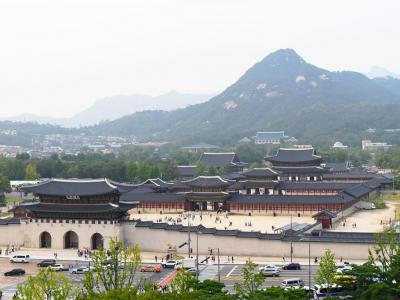
Gyeongbokgung Palace was built in 1395 by the Joseon Dynasty. This impressive complex served as the Joseon Dynasty's main palace and is the largest of the Five Grand Palaces.
It was destroyed by fire during the Imjin War in 1592 and sat abandoned for over two centuries. In 1867, the palace was reconstructed with 330 buildings and 5,792 rooms. In 1895, Japanese agents assassinated Empress Myeongseong. Emperor Gojong, her husband, left the palace and never returned.
In the early 20th century, Japan's colonial government destroyed palace buildings and constructed the enormous Japanese General Government Building outside the throne hall.
Only a few 19th-century buildings survived the Japanese government and the Korean War. These buildings include Geunjeongjeon (the Imperial Throne Hall), Hyangwonjeong Pavilion, Gyeonghoeru Pavilion, Sujeongjeon Hall, Jagyeongjeon Hall, Sajeongjeon Hall, and Jibokjae Hall.
In 1989, reconstruction began to restore the palace to its former glory. About 40 percent of the building have since been reconstructed or restored.
Geunjeongjeon, the Imperial Throne Hall, is truly impressive. Its constructed mainly of wood and sits in a courtyard lined with stones. Known as rank stones, they indicated where officials of different ranks could stand during ceremonies. The entire courtyard is cloistered.
Gyeongbokgung Palace features dozens of architecturally interesting buildings. Hyangwonjeong, a beautiful hexagonal pavilion, sits attractively on an island.
Why You Should Visit:
Gyeongbokgung Palace is the largest and grandest of the Five Grand Palaces. Visit the National Folk Museum of Korea on the palace grounds to learn about the history of the Korean people. The National Palace Museum of Korea is also located on the palace grounds and houses priceless 14th century Joseon dynasty treasures.
Tips:
You can rent traditional costumes to immerse yourself in 14th-century royal Korea.
For a memorable experience, sign up for a night tour and see the palace lit up. Gyeonghoeru looks spectacular as its warm lights are reflected in the pond.
For a once in a lifetime experience, take part in a Gyeongbokgung Royal Dining event. Sample royal food and watch a traditional performance.
It was destroyed by fire during the Imjin War in 1592 and sat abandoned for over two centuries. In 1867, the palace was reconstructed with 330 buildings and 5,792 rooms. In 1895, Japanese agents assassinated Empress Myeongseong. Emperor Gojong, her husband, left the palace and never returned.
In the early 20th century, Japan's colonial government destroyed palace buildings and constructed the enormous Japanese General Government Building outside the throne hall.
Only a few 19th-century buildings survived the Japanese government and the Korean War. These buildings include Geunjeongjeon (the Imperial Throne Hall), Hyangwonjeong Pavilion, Gyeonghoeru Pavilion, Sujeongjeon Hall, Jagyeongjeon Hall, Sajeongjeon Hall, and Jibokjae Hall.
In 1989, reconstruction began to restore the palace to its former glory. About 40 percent of the building have since been reconstructed or restored.
Geunjeongjeon, the Imperial Throne Hall, is truly impressive. Its constructed mainly of wood and sits in a courtyard lined with stones. Known as rank stones, they indicated where officials of different ranks could stand during ceremonies. The entire courtyard is cloistered.
Gyeongbokgung Palace features dozens of architecturally interesting buildings. Hyangwonjeong, a beautiful hexagonal pavilion, sits attractively on an island.
Why You Should Visit:
Gyeongbokgung Palace is the largest and grandest of the Five Grand Palaces. Visit the National Folk Museum of Korea on the palace grounds to learn about the history of the Korean people. The National Palace Museum of Korea is also located on the palace grounds and houses priceless 14th century Joseon dynasty treasures.
Tips:
You can rent traditional costumes to immerse yourself in 14th-century royal Korea.
For a memorable experience, sign up for a night tour and see the palace lit up. Gyeonghoeru looks spectacular as its warm lights are reflected in the pond.
For a once in a lifetime experience, take part in a Gyeongbokgung Royal Dining event. Sample royal food and watch a traditional performance.
2) Gwanghwamun Gate
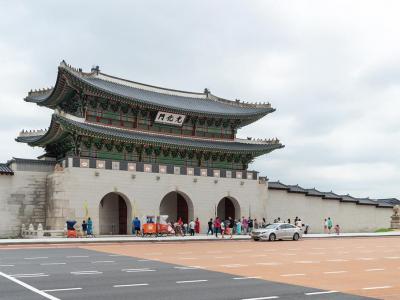
Gwanghwamun Gate is main entrance into Gyeongbokgung Palace, and so it is also the largest and most imposing of the four gates. It features three grand arched gates--the center gate was reserved for use by the king, while the crown prince and royal officials used the other two smaller arches.
The tall granite structure of the gate supports the ornately decorated wooden gate tower, which watches over the city. The pavilon housed a bell that announced the time of the day to the city. Two majestic Haetae sculptures guard the gate. These mythical lion-like beasts were stationed there to protect the palace against fire.
Gwanghwamun Gate was one of only four gates constructed in the palace walls. They were originally constructed in 1395 during the reign of King Taejo of the Joseon Dynasty. But the gates and walls have been through many cycles of destruction and reconstruction.
It was destroyed by fire during the Imjin Wars in 1592 and laid in ruins until it was rebuilt in 1867. In 1926, the Japanese government moved Gwanghwamun Gate. The double-roofed wooden pavilion on the gate was destroyed during the Korean War. The gate was moved again in 1968.
Gwanghwamun Gate was moved back to its original location in 2006, and the restoration was completed in 2010. The restoration included recreating the base with traditional materials, recreating the original wooden pavilion structure with Korean pine, and recreating the wooden nameplate.
The area in front of Gwanghwamun Gate is known as Gwanghwamun Plaza. Here, visitors can watch the impressive royal changing of the guard ceremony. This ceremony is held daily, every hour, on the hour, from 10:00 to 15:00.
Tip:
The square housing the gate contains fountains, statues and sculptures that are also definitely worth seeing, plus an underground museum dedicated to Sejong the Great, the 4th king of the Joseon Dynasty.
The tall granite structure of the gate supports the ornately decorated wooden gate tower, which watches over the city. The pavilon housed a bell that announced the time of the day to the city. Two majestic Haetae sculptures guard the gate. These mythical lion-like beasts were stationed there to protect the palace against fire.
Gwanghwamun Gate was one of only four gates constructed in the palace walls. They were originally constructed in 1395 during the reign of King Taejo of the Joseon Dynasty. But the gates and walls have been through many cycles of destruction and reconstruction.
It was destroyed by fire during the Imjin Wars in 1592 and laid in ruins until it was rebuilt in 1867. In 1926, the Japanese government moved Gwanghwamun Gate. The double-roofed wooden pavilion on the gate was destroyed during the Korean War. The gate was moved again in 1968.
Gwanghwamun Gate was moved back to its original location in 2006, and the restoration was completed in 2010. The restoration included recreating the base with traditional materials, recreating the original wooden pavilion structure with Korean pine, and recreating the wooden nameplate.
The area in front of Gwanghwamun Gate is known as Gwanghwamun Plaza. Here, visitors can watch the impressive royal changing of the guard ceremony. This ceremony is held daily, every hour, on the hour, from 10:00 to 15:00.
Tip:
The square housing the gate contains fountains, statues and sculptures that are also definitely worth seeing, plus an underground museum dedicated to Sejong the Great, the 4th king of the Joseon Dynasty.
3) Jogyesa Temple
Jogyesa Temple serves as the spiritual headquarters of the Jogye Order, the main sect of Korean Buddhism. Though the temple's lineage traces back to the Joseon era, the present complex was established in 1910, originally named Gakhwangsa, and adopted the name Jogyesa in 1954 as a symbol of Korean religious independence after Japanese colonial rule. It was the first modern temple built inside Seoul’s four historic city gates.
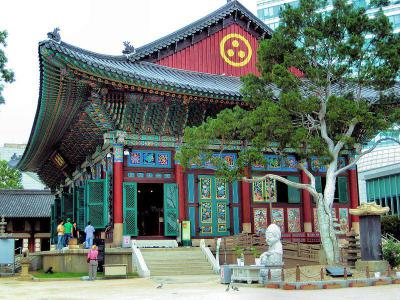
Upon entering the temple grounds through the One-Pillar Gate, visitors are welcomed by the courtyard adorned with lotus lanterns and ancient trees, including a 500‑year-old white pine and a towering Chinese Scholar tree-both designated natural monuments for their cultural and environmental significance. The richly painted Main Buddha Hall, built in 1938, houses three magnificent golden Buddha statues and is surrounded by other notable buildings like Paradise Hall and a towering stone pagoda holding relics of Shakyamuni Buddha.
Jogyesa is not only a place of worship but also a cultural venue. Its Dharma Hall hosts year‑round lectures, rituals, and ceremonies, and the temple is a central site for the Lotus Lantern Festival each spring in celebration of Buddha’s birthday-when the grounds glow with thousands of illuminated lanterns and festive energy. For those looking to immerse more deeply, Jogyesa offers Templestay programs that include meditation, tea ceremonies, and communal meals.
Upon entering the temple grounds through the One-Pillar Gate, visitors are welcomed by the courtyard adorned with lotus lanterns and ancient trees, including a 500‑year-old white pine and a towering Chinese Scholar tree-both designated natural monuments for their cultural and environmental significance. The richly painted Main Buddha Hall, built in 1938, houses three magnificent golden Buddha statues and is surrounded by other notable buildings like Paradise Hall and a towering stone pagoda holding relics of Shakyamuni Buddha.
Jogyesa is not only a place of worship but also a cultural venue. Its Dharma Hall hosts year‑round lectures, rituals, and ceremonies, and the temple is a central site for the Lotus Lantern Festival each spring in celebration of Buddha’s birthday-when the grounds glow with thousands of illuminated lanterns and festive energy. For those looking to immerse more deeply, Jogyesa offers Templestay programs that include meditation, tea ceremonies, and communal meals.
4) Insadong Shopping Street (must see)
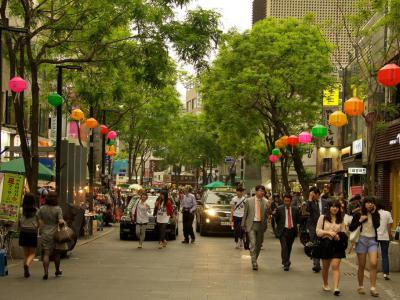
The abundance of wooden tea houses (nearly 40), boutique galleries and street vendors offering traditional Korean snacks makes Insa-dong street in Seoul a true magnet for visitors of the Korean capital. Alongside the free entertainment the area is famous for, Insa-dong is also one of the key destinations in the city for buying traditional Korean art, products and souvenirs, such as hanbok (traditional clothing), hanji (traditional paper), traditional teas, pottery, and folk crafts.
There is a plethora of antique shops (more than 50), art galleries (80+), traditional stationery shops, handicraft shops, pottery and porcelain shops, bookstores, and art supply stores. On top of that, there are almost 100 restaurants specialized in traditional Korean cuisine. With such a variety on offer, one is really bound to be spoilt for choice here.
On Sundays the street turns pedestrian-only and is flooded with street performers, buskers and the lively crowds of young and old rushing to enjoy one of Seoul’s most exiting and creative neighborhoods. The tastefully decorated traditional teashops invite passers-by to relax in a calm zen-like atmosphere. For those interested in Korean traditional culture and crafts, Insa-dong is undoubtedly a must-see attraction which will leave imprint of Seoul in one's memory for the years to come.
There is a plethora of antique shops (more than 50), art galleries (80+), traditional stationery shops, handicraft shops, pottery and porcelain shops, bookstores, and art supply stores. On top of that, there are almost 100 restaurants specialized in traditional Korean cuisine. With such a variety on offer, one is really bound to be spoilt for choice here.
On Sundays the street turns pedestrian-only and is flooded with street performers, buskers and the lively crowds of young and old rushing to enjoy one of Seoul’s most exiting and creative neighborhoods. The tastefully decorated traditional teashops invite passers-by to relax in a calm zen-like atmosphere. For those interested in Korean traditional culture and crafts, Insa-dong is undoubtedly a must-see attraction which will leave imprint of Seoul in one's memory for the years to come.
5) Bosingak Pavilion
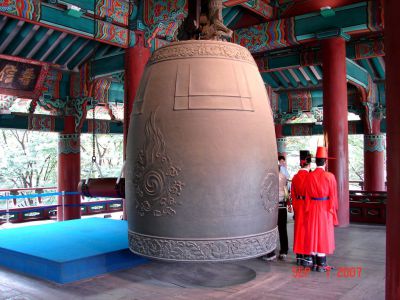
Bosingak Pavilion is a historic bell pavilion that gave its name to the surrounding district of Jongno, which translates to “Bell Street” in reference to the pavilion’s original function. Originally constructed in 1396 during the Joseon Dynasty, Bosingak has been rebuilt multiple times across centuries, most recently in 1979. The original 1468 bronze bell is now housed at the National Museum of Korea, while a faithful modern replica takes its place today.
This pavilion once served as Seoul’s public clock: during the Joseon era, the bell was struck to signal the opening of the city gates at 4 am and closing at 10 pm, with 33 tolls marking each event. It also functioned as a fire and danger alarm for residents. Today, the bell is rung only on special occasions, most notably at midnight on New Year’s Eve, when crowds gather to hear its powerful 33 strikes ushering in the next year in a cherished city-wide tradition.
Beyond New Year’s Eve, visitors can occasionally experience a bell ringing at noon-an echo of its former role in keeping time for the entire city. While entry into the pavilion interior is generally restricted, the ornate two-tiered wooden structure-with elegant dancheong painted patterns and a raised platform-offers a contrast set against modern high-rises.
This pavilion once served as Seoul’s public clock: during the Joseon era, the bell was struck to signal the opening of the city gates at 4 am and closing at 10 pm, with 33 tolls marking each event. It also functioned as a fire and danger alarm for residents. Today, the bell is rung only on special occasions, most notably at midnight on New Year’s Eve, when crowds gather to hear its powerful 33 strikes ushering in the next year in a cherished city-wide tradition.
Beyond New Year’s Eve, visitors can occasionally experience a bell ringing at noon-an echo of its former role in keeping time for the entire city. While entry into the pavilion interior is generally restricted, the ornate two-tiered wooden structure-with elegant dancheong painted patterns and a raised platform-offers a contrast set against modern high-rises.
6) Cheonggye Plaza and Stream (must see)
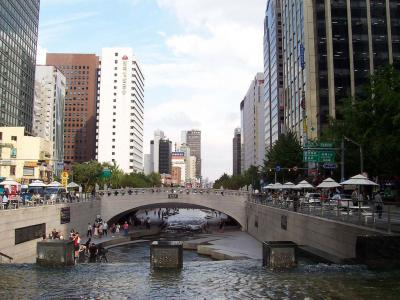
Cheonggyecheon Stream flows through downtown Seoul. The stream was covered up with concrete for many decades. In 2003, work to remove the elevated highway and restore the stream began. The stream was officially re-opened in 2005.
The stream runs under 22 bridges and flows into the Hangang River. Gwangtonggyo Bridge was one of the busiest and most important bridges of the Joseon Dynasty. It was also buried for 100 years during Seoul's economic boom. Now restored, it's one of the most scenic places on the Cheonggyecheon Stream.
Cheonggye Plaza is located at the head of Cheonggyecheon Stream. The plaza celebrates the re-opening of the stream. The vibrant red and blue Spring Sculpture dominates the plaza. The sculpture's design is reminiscent of a shell rising like a pagoda. The colorful ribbons represent traditional Korean wrapping cloth known as a bojagi.
The Candlelight Fountain at the plaza is a stunning two-tiered, four-meter (13-foot) tall waterfall. It's stunning at night when the lights of Seoul are reflected in the water.
The stream runs under 22 bridges and flows into the Hangang River. Gwangtonggyo Bridge was one of the busiest and most important bridges of the Joseon Dynasty. It was also buried for 100 years during Seoul's economic boom. Now restored, it's one of the most scenic places on the Cheonggyecheon Stream.
Cheonggye Plaza is located at the head of Cheonggyecheon Stream. The plaza celebrates the re-opening of the stream. The vibrant red and blue Spring Sculpture dominates the plaza. The sculpture's design is reminiscent of a shell rising like a pagoda. The colorful ribbons represent traditional Korean wrapping cloth known as a bojagi.
The Candlelight Fountain at the plaza is a stunning two-tiered, four-meter (13-foot) tall waterfall. It's stunning at night when the lights of Seoul are reflected in the water.
