Custom Walk in Hanoi, Vietnam by janelle_heinritz_3653a created on 2025-08-26
Guide Location: Vietnam » Hanoi
Guide Type: Custom Walk
# of Sights: 6
Tour Duration: 2 Hour(s)
Travel Distance: 5.5 Km or 3.4 Miles
Share Key: BWGCZ
Guide Type: Custom Walk
# of Sights: 6
Tour Duration: 2 Hour(s)
Travel Distance: 5.5 Km or 3.4 Miles
Share Key: BWGCZ
How It Works
Please retrieve this walk in the GPSmyCity app. Once done, the app will guide you from one tour stop to the next as if you had a personal tour guide. If you created the walk on this website or come to the page via a link, please follow the instructions below to retrieve the walk in the app.
Retrieve This Walk in App
Step 1. Download the app "GPSmyCity: Walks in 1K+ Cities" on Apple App Store or Google Play Store.



Step 2. In the GPSmyCity app, download(or launch) the guide "Hanoi Map and Walking Tours".
Step 3. Tap the menu button located at upper right corner of the "Walks" screen and select "Retrieve custom walk". Enter the share key: BWGCZ
1) Hanoi Ceramic Mosaic Mural
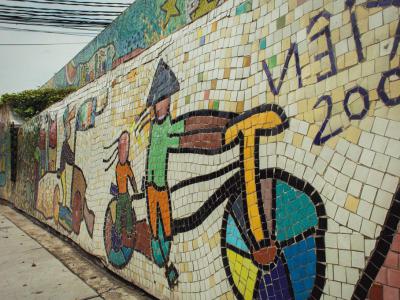
The Hanoi Ceramic Mosaic Mural, also known as the Hanoi Ceramic Road, is a remarkable public art installation in Hanoi. It extends along the dike system of the Red River, showcasing a rich tapestry of Vietnam's cultural history through vibrant ceramic mosaics. The concept for the mural was developed by journalist Nguyễn Thu Thủy, who aimed to beautify the city's dike system while celebrating its historical and cultural heritage.
Thủy's vision won her a prize in a local architecture contest, and the project commenced in 2007. The mural stretches approximately 6 kilometers, culminating at the Long Biên Bridge pier. This extensive artwork was strategically completed in 2010 to commemorate the Millennial Anniversary of Hanoi.
Funding for the initial 450 meters of the mural was provided by the Ford Foundation, which also supported necessary planning, training, and infrastructure. The tiles used in the mural are sourced from Bát Tràng, a village renowned for its exquisite porcelain, ensuring the use of local materials and traditional craftsmanship.
The mural features a variety of designs that reflect different eras in Vietnamese history. Modern artworks, paintings depicting Hanoi, and children's drawings are also interspersed throughout the mosaic, creating a blend of historical and contemporary art.
In recognition of its scale and artistic value, the mural was awarded a Guinness World Record on October 5, 2010, as the world's largest ceramic mosaic. The adjudication confirmed the mural's size at 3,850 linear meters, solidifying its place in record books.
The project has continued to evolve, with new segments being added over the years, including contributions from international artists like Chilean Alexandro Mono Gonzalez and cultural representations from various countries such as Sri Lanka. Plans are underway to expand the mural further, despite challenges such as graffiti on newly built segments of the dike.
The Hanoi Ceramic Mosaic Mural stands as a testament to cultural pride, international cooperation, and the transformative power of art in public spaces, continuing to captivate both residents and visitors of Hanoi.
Thủy's vision won her a prize in a local architecture contest, and the project commenced in 2007. The mural stretches approximately 6 kilometers, culminating at the Long Biên Bridge pier. This extensive artwork was strategically completed in 2010 to commemorate the Millennial Anniversary of Hanoi.
Funding for the initial 450 meters of the mural was provided by the Ford Foundation, which also supported necessary planning, training, and infrastructure. The tiles used in the mural are sourced from Bát Tràng, a village renowned for its exquisite porcelain, ensuring the use of local materials and traditional craftsmanship.
The mural features a variety of designs that reflect different eras in Vietnamese history. Modern artworks, paintings depicting Hanoi, and children's drawings are also interspersed throughout the mosaic, creating a blend of historical and contemporary art.
In recognition of its scale and artistic value, the mural was awarded a Guinness World Record on October 5, 2010, as the world's largest ceramic mosaic. The adjudication confirmed the mural's size at 3,850 linear meters, solidifying its place in record books.
The project has continued to evolve, with new segments being added over the years, including contributions from international artists like Chilean Alexandro Mono Gonzalez and cultural representations from various countries such as Sri Lanka. Plans are underway to expand the mural further, despite challenges such as graffiti on newly built segments of the dike.
The Hanoi Ceramic Mosaic Mural stands as a testament to cultural pride, international cooperation, and the transformative power of art in public spaces, continuing to captivate both residents and visitors of Hanoi.
2) Ngoc Son Temple
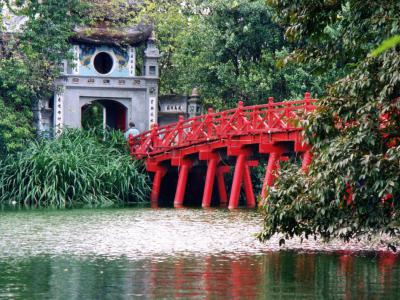
The Ncog Son temple stands on an island of the Hoan Kiem Lake. There was a temple at the location from the 14th century. The present structure was built in the 18th century. A three passage gate called the Tam Quan stands at one end of a red wooden bridge called The Huc (Rising Sun bridge). The Huc connects the Island with the mainland.
The Ncog Son temple is dedicated to many heroes. The main altar is dedicated to the hero Tran Hung Dao, who defeated and army of 300,000 invaders from the Chinese Yuan dynasty. Other altars are dedicated to La To, the patron saint of physicians, the scholar Van Xuong and Nguyen Van Sieu, a Confucian scholar who voluntarily restored the temple and its surroundings in 1864.
Nguyen Van Sieu added the Thap But, a 30 foot stone obelisk with a tip that resembles a paintbrush found to the left of the gates and Dai Nghien, a hollowed rock in the shape of a peach called the writing pad to the temple complex.
The temple has a pavilion in front of the altars and many souvenir shops for tourists. Elderly Vietnamese gather at the courtyard of the temple to play danh co tuong or Chinese Chess.
The Ncog Son temple is dedicated to many heroes. The main altar is dedicated to the hero Tran Hung Dao, who defeated and army of 300,000 invaders from the Chinese Yuan dynasty. Other altars are dedicated to La To, the patron saint of physicians, the scholar Van Xuong and Nguyen Van Sieu, a Confucian scholar who voluntarily restored the temple and its surroundings in 1864.
Nguyen Van Sieu added the Thap But, a 30 foot stone obelisk with a tip that resembles a paintbrush found to the left of the gates and Dai Nghien, a hollowed rock in the shape of a peach called the writing pad to the temple complex.
The temple has a pavilion in front of the altars and many souvenir shops for tourists. Elderly Vietnamese gather at the courtyard of the temple to play danh co tuong or Chinese Chess.
3) Hoàn Kiếm Lake (must see)
Hoàn Kiếm Lake holds a storied place at the heart of Hanoi. Also known as Sword Lake, this 12-hectare freshwater lake is a central feature of the city's public and historical life. Located in Hanoi's historical center, the lake is not only a major scenic spot but also a focal point for the city's public life, surrounded by vibrant streets and bustling local markets.
Originally named Green Water Lake (Hồ Lục Thủy) for its distinctive watercolor, the lake's present name, which means "Lake of the Returned Sword," is derived from a legendary event. The tale recounts that Emperor Lê Lợi, after defeating Ming China, was approached by a Golden Turtle God (Kim Qui) while boating on the lake. The turtle god requested the return of a magical sword, Heaven's Will, given to Lợi by the Dragon King (Long Vương) to aid in his battle against the Chinese. Acknowledging that his mission was accomplished, Lợi returned the sword to the turtle. This pivotal event led to the renaming of the lake to commemorate the sword's return.
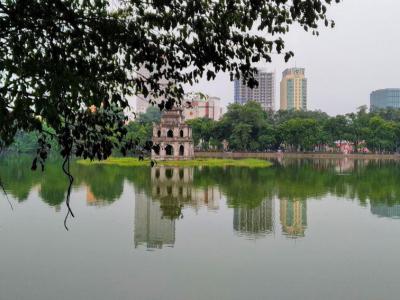
The Turtle Tower (Tháp Rùa), situated on a small island near the center of the lake, is a prominent landmark associated with this legend. It stands as a silent reminder of the lake's mythological past. The lake was once home to the large soft-shell turtle species Rafetus leloi, named in honor of the emperor. Although the last known specimen was found deceased in 2016, the species remains emblematic of the lake's rich biodiversity.
To the north, the Jade Islet is connected to the lake's shore by the striking vermilion-red Thê Húc Bridge, which means "Perch of the Morning Sunlight". Atop the islet sits the Temple of the Jade Mountain (Ngoc Son), erected in the 18th century. This temple honors notable historical figures such as Tran Hung Dao, a military leader known for his victories over Mongol invaders; Van Xuong, a revered scholar; and Nguyen Van Sieu, a renowned writer who refurbished the temple in 1864, lending it its current appearance.
Today, Hoàn Kiếm Lake remains a vital part of Hanoi’s cultural fabric, attracting visitors with its serene beauty and rich history, encapsulating a blend of natural charm and cultural significance.
Originally named Green Water Lake (Hồ Lục Thủy) for its distinctive watercolor, the lake's present name, which means "Lake of the Returned Sword," is derived from a legendary event. The tale recounts that Emperor Lê Lợi, after defeating Ming China, was approached by a Golden Turtle God (Kim Qui) while boating on the lake. The turtle god requested the return of a magical sword, Heaven's Will, given to Lợi by the Dragon King (Long Vương) to aid in his battle against the Chinese. Acknowledging that his mission was accomplished, Lợi returned the sword to the turtle. This pivotal event led to the renaming of the lake to commemorate the sword's return.
The Turtle Tower (Tháp Rùa), situated on a small island near the center of the lake, is a prominent landmark associated with this legend. It stands as a silent reminder of the lake's mythological past. The lake was once home to the large soft-shell turtle species Rafetus leloi, named in honor of the emperor. Although the last known specimen was found deceased in 2016, the species remains emblematic of the lake's rich biodiversity.
To the north, the Jade Islet is connected to the lake's shore by the striking vermilion-red Thê Húc Bridge, which means "Perch of the Morning Sunlight". Atop the islet sits the Temple of the Jade Mountain (Ngoc Son), erected in the 18th century. This temple honors notable historical figures such as Tran Hung Dao, a military leader known for his victories over Mongol invaders; Van Xuong, a revered scholar; and Nguyen Van Sieu, a renowned writer who refurbished the temple in 1864, lending it its current appearance.
Today, Hoàn Kiếm Lake remains a vital part of Hanoi’s cultural fabric, attracting visitors with its serene beauty and rich history, encapsulating a blend of natural charm and cultural significance.
4) St. Joseph Cathedral
Saint Joseph's Cathedral in Hanoi serves as the seat of the Roman Catholic Archdiocese of Hanoi. Constructed in 1886 during French colonial rule, it is the oldest church in the city. Locally known as the "Big Church," it is situated on Nha Chung Street, close to the Ho Hoan Kiem, also known as the Lake of the Returned Sword.
The cathedral's location has a significant historical backdrop, as it was built on the site of the demolished Bao Thien Pagoda, a 12th-century temple constructed by the Ly Dynasty and formerly a vital place of worship for the local populace. This decision by the French to replace the pagoda highlighted their influence and architectural ambitions in Hanoi during their colonial tenure.
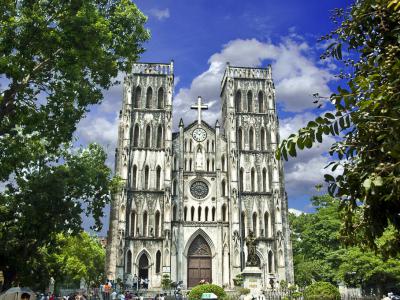
Saint Joseph's Cathedral was consecrated on Christmas Day, 1886, and features a neo-Gothic architectural style, mirroring the iconic Notre Dame Cathedral in Paris. This style is evident in its facade, characterized by twin towers flanked by impressive stained glass windows. These windows allow light to filter through in a myriad of colors, creating a visually captivating effect.
In front of the cathedral stands the Regina Pacis (Queen of Peace) statue of the Virgin Mary, adding to its spiritual and architectural significance. Inside, the cathedral is renowned for its beautiful interiors, which visitors can admire through a side door entry.
Mass is conducted twice daily at Saint Joseph's Cathedral, with increased attendance on Sundays and holidays, reflecting its central role in the religious life of the community. The cathedral remains a popular destination for both worshippers and tourists, offering a glimpse into the spiritual and colonial history of Hanoi.
The cathedral's location has a significant historical backdrop, as it was built on the site of the demolished Bao Thien Pagoda, a 12th-century temple constructed by the Ly Dynasty and formerly a vital place of worship for the local populace. This decision by the French to replace the pagoda highlighted their influence and architectural ambitions in Hanoi during their colonial tenure.
Saint Joseph's Cathedral was consecrated on Christmas Day, 1886, and features a neo-Gothic architectural style, mirroring the iconic Notre Dame Cathedral in Paris. This style is evident in its facade, characterized by twin towers flanked by impressive stained glass windows. These windows allow light to filter through in a myriad of colors, creating a visually captivating effect.
In front of the cathedral stands the Regina Pacis (Queen of Peace) statue of the Virgin Mary, adding to its spiritual and architectural significance. Inside, the cathedral is renowned for its beautiful interiors, which visitors can admire through a side door entry.
Mass is conducted twice daily at Saint Joseph's Cathedral, with increased attendance on Sundays and holidays, reflecting its central role in the religious life of the community. The cathedral remains a popular destination for both worshippers and tourists, offering a glimpse into the spiritual and colonial history of Hanoi.
5) The Train Street
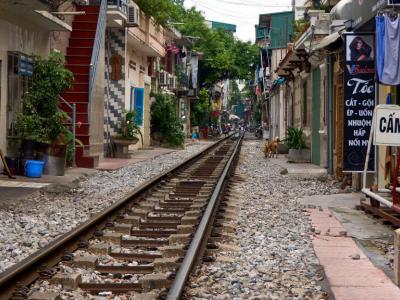
Ngõ 224 Lê Duẩn, situated within Hanoi’s Old Quarter, is famously dubbed as "The Train Street". This narrow alley witnesses a speeding train passing by twice a day, perilously close to the buildings flanking the tracks, which almost entirely occupy the alley. Constructed by the French in 1902, this railway line remains operational as of 2019.
The train whizzes through at 3 pm and 7 pm daily, traversing the route between Hanoi and Ho Chi Minh City to the south. Due to the alley's cramped dimensions, residents are compelled to clear away their personal belongings, including bicycles and even children, before the train's passage. It's a common sight to see locals leisurely seated on the tracks, savoring tea and engaging in games of checkers.
This peculiar street has garnered attention as a tourist attraction in Hanoi. However, in October 2019, local authorities, citing safety concerns and the potential for grave accidents, barred tourists from accessing the area. Tourists frequently halted to capture photographs for social media amidst the narrow confines of the alley. Over time, the street had become a residence for squatters and a haunt for drug addicts, alongside the presence of numerous cafes and residential buildings. The congestion eventually led to the rerouting of a local train on October 6, 2019, prompting the closure of the alley.
To cater to the bustling tourist influx, local cafes have flourished along the street. Owners fret over the impending loss of business due to the closure. According to the VN Express newspaper, a train driver recounted three near-misses with tourists on the tracks, narrowly averting catastrophe, with one incident involving a woman engrossed in photographing the passing train.
For tourists seeking a safe vantage point, outdoor seating areas of the local cafes offer a secure option. Cafe proprietors typically shift their stools closer to the walls and advise patrons to do the same as the train approaches. Many cafes also display train schedules on chalkboards for the convenience of their customers.
The train whizzes through at 3 pm and 7 pm daily, traversing the route between Hanoi and Ho Chi Minh City to the south. Due to the alley's cramped dimensions, residents are compelled to clear away their personal belongings, including bicycles and even children, before the train's passage. It's a common sight to see locals leisurely seated on the tracks, savoring tea and engaging in games of checkers.
This peculiar street has garnered attention as a tourist attraction in Hanoi. However, in October 2019, local authorities, citing safety concerns and the potential for grave accidents, barred tourists from accessing the area. Tourists frequently halted to capture photographs for social media amidst the narrow confines of the alley. Over time, the street had become a residence for squatters and a haunt for drug addicts, alongside the presence of numerous cafes and residential buildings. The congestion eventually led to the rerouting of a local train on October 6, 2019, prompting the closure of the alley.
To cater to the bustling tourist influx, local cafes have flourished along the street. Owners fret over the impending loss of business due to the closure. According to the VN Express newspaper, a train driver recounted three near-misses with tourists on the tracks, narrowly averting catastrophe, with one incident involving a woman engrossed in photographing the passing train.
For tourists seeking a safe vantage point, outdoor seating areas of the local cafes offer a secure option. Cafe proprietors typically shift their stools closer to the walls and advise patrons to do the same as the train approaches. Many cafes also display train schedules on chalkboards for the convenience of their customers.
6) Thong Nhat Park
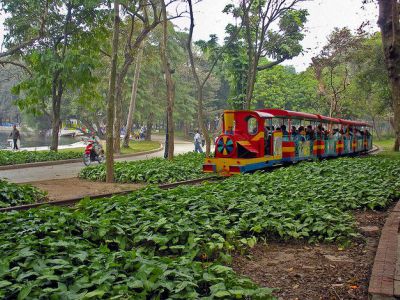
The Thong Nhat Park or United Park is a tranquil green space surrounded by bustling streets in Hanoi. Locals and visitors come to the park for jogging, strolls or to take a boat ride on the lake amidst serene natural surroundings in the middle of the city.
The Thong Nhat Park was a waste disposal area under French colonial rule. The area was cleared and the park was built in 1958. It was opened to the public in 1960. At the time of inauguration, Vietnam was divided into two countries. The name Thong Nhat meaning United was given to the park to express the desire of the people to unite the country that was divided as North and South Vietnam at the time. In 1980, the Park was called Lenin Park to commemorate the Russian revolutionary leader’s 110th birthday. Later, a park on Dien Bien Phu street was called Lenin Park and park was given the name Thong Nhat again.
Thong Nhat Park is an oasis of greenery and fresh air surrounded by the bustling Tran Nhan Dong, Le Duan, Dai Co Viet and Nguyen Dien Chieu streets. The park spans an area of 50 hectares and is on the bank of a 7 hectare lake called the Bay Mau Lake. Children will enjoy the driving carts, mirror house and the train ride. The Spring Flower Festival is held during the Tet or Full moon festival and stalls sell food and garments from all the regions of Vietnam.
The Thong Nhat Park was a waste disposal area under French colonial rule. The area was cleared and the park was built in 1958. It was opened to the public in 1960. At the time of inauguration, Vietnam was divided into two countries. The name Thong Nhat meaning United was given to the park to express the desire of the people to unite the country that was divided as North and South Vietnam at the time. In 1980, the Park was called Lenin Park to commemorate the Russian revolutionary leader’s 110th birthday. Later, a park on Dien Bien Phu street was called Lenin Park and park was given the name Thong Nhat again.
Thong Nhat Park is an oasis of greenery and fresh air surrounded by the bustling Tran Nhan Dong, Le Duan, Dai Co Viet and Nguyen Dien Chieu streets. The park spans an area of 50 hectares and is on the bank of a 7 hectare lake called the Bay Mau Lake. Children will enjoy the driving carts, mirror house and the train ride. The Spring Flower Festival is held during the Tet or Full moon festival and stalls sell food and garments from all the regions of Vietnam.
