Custom Walk in Prague, Czech Republic by cocobcoco61_59759 created on 2025-09-02
Guide Location: Czech Republic » Prague
Guide Type: Custom Walk
# of Sights: 5
Tour Duration: 2 Hour(s)
Travel Distance: 3.5 Km or 2.2 Miles
Share Key: E6GJZ
Guide Type: Custom Walk
# of Sights: 5
Tour Duration: 2 Hour(s)
Travel Distance: 3.5 Km or 2.2 Miles
Share Key: E6GJZ
How It Works
Please retrieve this walk in the GPSmyCity app. Once done, the app will guide you from one tour stop to the next as if you had a personal tour guide. If you created the walk on this website or come to the page via a link, please follow the instructions below to retrieve the walk in the app.
Retrieve This Walk in App
Step 1. Download the app "GPSmyCity: Walks in 1K+ Cities" on Apple App Store or Google Play Store.



Step 2. In the GPSmyCity app, download(or launch) the guide "Prague Map and Walking Tours".
Step 3. Tap the menu button located at upper right corner of the "Walks" screen and select "Retrieve custom walk". Enter the share key: E6GJZ
1) Mirror Maze
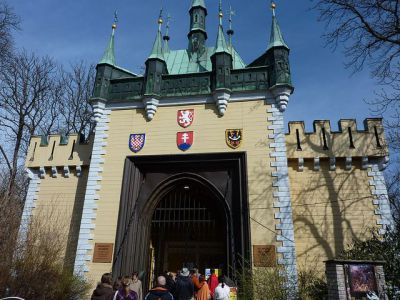
As you make your way up the slopes of Petřín Hill, one little structure is bound to catch your eye-a fairy-tale-like building in neo-Gothic style, complete with turrets and even a mock drawbridge. It might look like a toy castle, but it’s actually a charming replica of a gate from the ancient Vyšehrad fortress. Step inside, and you’ll find one of Prague’s most whimsical attractions.
Originally built for the Jubilee Exhibition in 1891, the Mirror Maze has since become a beloved spot for families, school groups, and anyone in the mood for a good laugh. Open daily from April to October, it offers affordable fun in a setting that feels like a cross between a carnival and a storybook.
The adventure begins with a maze of 31 mirrors designed to trick your sense of direction-and your sense of self. Reflections bounce from wall to wall, turning a simple walk into a playful challenge. Beyond the maze, you’re also treated to a large-scale diorama depicting the historic Battle of Charles Bridge in 1648, when local students and townspeople famously defended Prague from invading Swedish forces. Spanning 80 square meters, this dramatic scene was painted in just 50 days by brothers Adolf and Karel Liebscher. The level of detail makes it feel more like a stage set than a static image.
And then there’s the grand finale-the Laughter Hall. Here, 14 curved mirrors bend and stretch your reflection into all sorts of comical proportions. Tall becomes tiny, wide turns narrow, and everyone leaves with a smile.
Originally built for the Jubilee Exhibition in 1891, the Mirror Maze has since become a beloved spot for families, school groups, and anyone in the mood for a good laugh. Open daily from April to October, it offers affordable fun in a setting that feels like a cross between a carnival and a storybook.
The adventure begins with a maze of 31 mirrors designed to trick your sense of direction-and your sense of self. Reflections bounce from wall to wall, turning a simple walk into a playful challenge. Beyond the maze, you’re also treated to a large-scale diorama depicting the historic Battle of Charles Bridge in 1648, when local students and townspeople famously defended Prague from invading Swedish forces. Spanning 80 square meters, this dramatic scene was painted in just 50 days by brothers Adolf and Karel Liebscher. The level of detail makes it feel more like a stage set than a static image.
And then there’s the grand finale-the Laughter Hall. Here, 14 curved mirrors bend and stretch your reflection into all sorts of comical proportions. Tall becomes tiny, wide turns narrow, and everyone leaves with a smile.
2) Tyrs House (Michna Palace)
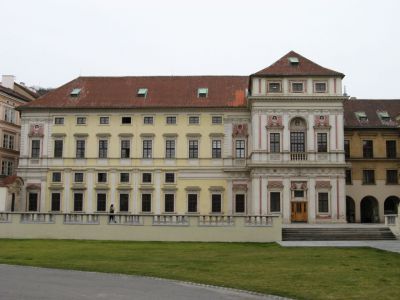
The Tyrš House, also known as Michna Palace, stands as one of Prague's grandest palaces. Situated adjacent to Kampa Park in Lesser Town, near the River Vltava, this early baroque structure boasts a rich history. Originally conceived as a summer retreat, it was purchased by Pavel Michna of Vacínov in 1623. Seeking to emulate the nearby Wallenstein Palace, Michna and his son commissioned architects Francesco Caratti and Pietro Colombo to design a grand edifice reminiscent of 16th-century Roman palaces. The resulting construction featured five wings, an imposing decorative buttress, a spacious forecourt, and an inner courtyard adorned with loggias. Inside, the halls were adorned with intricate stucco work, reflecting the palace's noble heritage.
Over the years, ownership of the palace changed hands until 1767 when the Austrian administration acquired it for military purposes, converting it into an armory and subjecting it to significant alterations. However, in 1921, the Czechoslovak Sokol Society purchased the property and embarked on a gradual restoration to return it to its former glory.
The restoration efforts included the construction of a new building within the garden, along with the establishment of two gymnastics halls, a winter swimming pool, and dormitories. A statue of Dr. Miroslav Tyrš, the founder of the Sokol movement, sculpted by Ladislav Šalun in 1926, was installed in the courtyard, honoring the legacy of physical education and cultural enlightenment.
Over the years, ownership of the palace changed hands until 1767 when the Austrian administration acquired it for military purposes, converting it into an armory and subjecting it to significant alterations. However, in 1921, the Czechoslovak Sokol Society purchased the property and embarked on a gradual restoration to return it to its former glory.
The restoration efforts included the construction of a new building within the garden, along with the establishment of two gymnastics halls, a winter swimming pool, and dormitories. A statue of Dr. Miroslav Tyrš, the founder of the Sokol movement, sculpted by Ladislav Šalun in 1926, was installed in the courtyard, honoring the legacy of physical education and cultural enlightenment.
3) Franz Kafka's Rotating Head (must see)
Despite writing in German and experiencing minimal publication during his lifetime, Franz Kafka embodies the essence of Prague. Many of his unsettling novels appear to anticipate the Communist era, and his profound influence extends to other artists in the city.
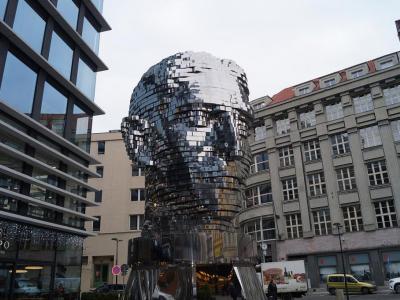
Keep an eye out for the colossal Kafka head located outside the Quadrio shopping center, crafted by David Černý. This kinetic sculpture, standing at 11 meters tall and composed of 42 rotating panels, rotates for 15 minutes at the top of each hour. Each layer operates independently, rendering it one of the most futuristic art installations across Europe.
Tip:
Arrive 10 minutes early to secure a prime spot for photography or filming!
Keep an eye out for the colossal Kafka head located outside the Quadrio shopping center, crafted by David Černý. This kinetic sculpture, standing at 11 meters tall and composed of 42 rotating panels, rotates for 15 minutes at the top of each hour. Each layer operates independently, rendering it one of the most futuristic art installations across Europe.
Tip:
Arrive 10 minutes early to secure a prime spot for photography or filming!
4) Grand Hotel Evropa
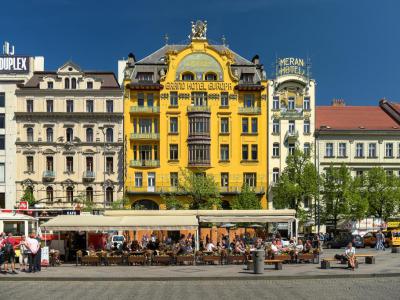
Perched on the edge of the renowned Wenceslas Square, this building stands as one of Prague's most striking architectural landmarks. Originally constructed in 1872 in the neo-Renaissance style, subsequent renovations in 1903–05 saw it transformed into a geometric Art Nouveau masterpiece, reflecting the trends of the time. Notably, Franz Kafka hosted his only author reading in Prague here in 1912.
In 1924, restaurateur Karel Šroubek acquired the property, renaming it Hotel Šroubek. It quickly gained renown throughout Czechoslovakia and beyond as a prestigious, luxurious, and modern establishment. After nationalization three decades later, it became known as Grand Hotel Evropa; however, over time, it fell into disrepair until its denationalization in 1989.
Since 2016, extensive reconstruction has been underway, including the addition of a new eight-story building in the courtyard, aimed at expanding its capacity. This expansion includes conference facilities, a wellness complex, and a panoramic restaurant. Despite these changes, the building's symmetrical Art Nouveau facade remains beautifully preserved, adorned with intricate plant motifs and topped with a golden sculpture bearing a globe-shaped lamp symbolizing Europe.
The hotel's ornate interior, beloved by filmmakers, has been featured in various movies, including "Titanic" and "Mission Impossible."
In 1924, restaurateur Karel Šroubek acquired the property, renaming it Hotel Šroubek. It quickly gained renown throughout Czechoslovakia and beyond as a prestigious, luxurious, and modern establishment. After nationalization three decades later, it became known as Grand Hotel Evropa; however, over time, it fell into disrepair until its denationalization in 1989.
Since 2016, extensive reconstruction has been underway, including the addition of a new eight-story building in the courtyard, aimed at expanding its capacity. This expansion includes conference facilities, a wellness complex, and a panoramic restaurant. Despite these changes, the building's symmetrical Art Nouveau facade remains beautifully preserved, adorned with intricate plant motifs and topped with a golden sculpture bearing a globe-shaped lamp symbolizing Europe.
The hotel's ornate interior, beloved by filmmakers, has been featured in various movies, including "Titanic" and "Mission Impossible."
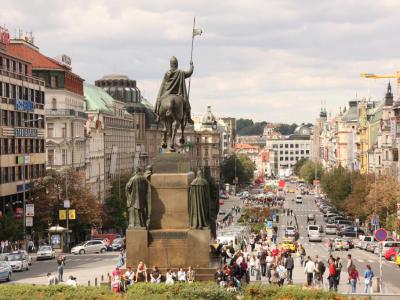
5) Wenceslas Square
A prominent symbol of Czech identity, Wenceslas Square stretches like a lengthy rectangle, traversing from the northwest edge of the New Town to the neo-Renaissance-style National Museum at its southeastern tip.
Originating in the 14th century alongside the establishment of the New Town by Charles IV, the square initially served as a horse market. In the 19th century national revival, it received its current name along with a very fine statue of Saint Wenceslas (“The Good King”) atop his steed, encircled by figures of Saint Agnes of Bohemia, Saint Prokop, Saint Adalbert of Prague, and Saint Ludmila.
Due to its historical significance and central location, Wenceslas Square has been a gathering point for various events throughout history, from Nazi demonstrations to national celebrations and pivotal moments like the Velvet Revolution of 1989.
Today, the square is as busy a spot is ever, attracting locals and tourists alike to visit landmarks such as the National Museum and Prague State Opera, as well as a plethora of offices, hotels, shops, clubs, and eateries flanking its sides.
Tip:
For the quintessential photo of Wenceslas Square, position yourself with Saint Wenceslas' statue behind you. Keep an eye out for the Marks & Spencer shop sign, too, as it marks the balcony where Václav Havel addressed the crowds during the Velvet Revolution in 1989.
Originating in the 14th century alongside the establishment of the New Town by Charles IV, the square initially served as a horse market. In the 19th century national revival, it received its current name along with a very fine statue of Saint Wenceslas (“The Good King”) atop his steed, encircled by figures of Saint Agnes of Bohemia, Saint Prokop, Saint Adalbert of Prague, and Saint Ludmila.
Due to its historical significance and central location, Wenceslas Square has been a gathering point for various events throughout history, from Nazi demonstrations to national celebrations and pivotal moments like the Velvet Revolution of 1989.
Today, the square is as busy a spot is ever, attracting locals and tourists alike to visit landmarks such as the National Museum and Prague State Opera, as well as a plethora of offices, hotels, shops, clubs, and eateries flanking its sides.
Tip:
For the quintessential photo of Wenceslas Square, position yourself with Saint Wenceslas' statue behind you. Keep an eye out for the Marks & Spencer shop sign, too, as it marks the balcony where Václav Havel addressed the crowds during the Velvet Revolution in 1989.
