Custom Walk in Gdansk, Poland by annmarieb_7dc46 created on 2025-09-12
Guide Location: Poland » Gdansk
Guide Type: Custom Walk
# of Sights: 14
Tour Duration: 2 Hour(s)
Travel Distance: 1.8 Km or 1.1 Miles
Share Key: 8AEYE
Guide Type: Custom Walk
# of Sights: 14
Tour Duration: 2 Hour(s)
Travel Distance: 1.8 Km or 1.1 Miles
Share Key: 8AEYE
How It Works
Please retrieve this walk in the GPSmyCity app. Once done, the app will guide you from one tour stop to the next as if you had a personal tour guide. If you created the walk on this website or come to the page via a link, please follow the instructions below to retrieve the walk in the app.
Retrieve This Walk in App
Step 1. Download the app "GPSmyCity: Walks in 1K+ Cities" on Apple App Store or Google Play Store.



Step 2. In the GPSmyCity app, download(or launch) the guide "Gdansk Map and Walking Tours".
Step 3. Tap the menu button located at upper right corner of the "Walks" screen and select "Retrieve custom walk". Enter the share key: 8AEYE
1) Golden Gate
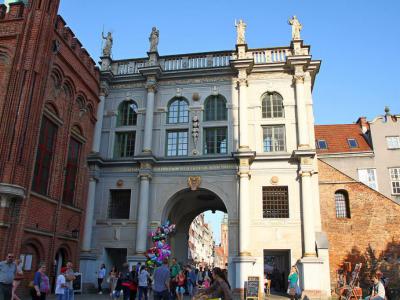
The Golden Gate straddles Long Street at the inland entrance to the Royal Route of Gdansk. It was built in 1614 to replace a 13th century Gothic Gate called Long Street Gate. The Golden Gate forms part of the old city fortifications, together with The Highland Gate and the Prison Tower, also located on Long Street.
The Golden gate was designed by architect Abraham van den Blocke of Holland. The style is Dutch Mannerist. Each side of the Gate has attiques with figures representing civic values. The values are: Peace, Freedom, Fortune, Fame, Concord, Justice, Piety and Wisdom.
A Latin inscription declares small republics prosper in concord and fail in discord. Badly damaged in World War II, the Gate was restored completely in 1957. More comprehensive restoration works, including the facade decor of murals and gilding were carried out in 1998.
The Golden gate was designed by architect Abraham van den Blocke of Holland. The style is Dutch Mannerist. Each side of the Gate has attiques with figures representing civic values. The values are: Peace, Freedom, Fortune, Fame, Concord, Justice, Piety and Wisdom.
A Latin inscription declares small republics prosper in concord and fail in discord. Badly damaged in World War II, the Gate was restored completely in 1957. More comprehensive restoration works, including the facade decor of murals and gilding were carried out in 1998.
2) Great Armory
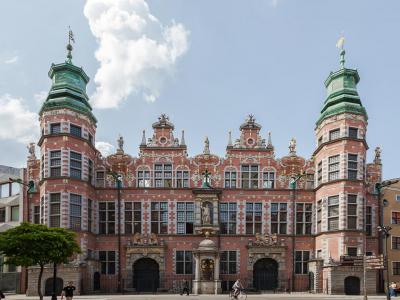
The Great armory, part of the defensive walls of the Main Town, was built in 1605. The design is Dutch Mannerist.
The building was used as an arsenal until the end of the World War I. During the Free City era between World War I and II, the ground floor was converted to a shopping arcade. The upper floors were for goods storage. In 1945 the interior of the building was consumed by fire. The roofs, interiors, gables and domes were restored by 1954.
The Armory is a perfect example of Dutch renaissance architecture. It has two octagonal towers on the eastern facade. There are two facades and four gabled roofs parallel to each other. The corner turrets have domes and spires. The basement has a barrel vault with lunettes and pillars. The ground floor has four naves with six bays.
The west face is designed with four tenement house facades. The portals have arches with quoins. The Mannerist decorations are lush in the upper facades.
In May, 1954 the Armory became the home of the Academy of Fine Arts. Work continued on the facades and interiors up to 2005. Today the building is dedicated to "exhibition, education, promotion and archiving." It is considered an "Armory of Art."
The building was used as an arsenal until the end of the World War I. During the Free City era between World War I and II, the ground floor was converted to a shopping arcade. The upper floors were for goods storage. In 1945 the interior of the building was consumed by fire. The roofs, interiors, gables and domes were restored by 1954.
The Armory is a perfect example of Dutch renaissance architecture. It has two octagonal towers on the eastern facade. There are two facades and four gabled roofs parallel to each other. The corner turrets have domes and spires. The basement has a barrel vault with lunettes and pillars. The ground floor has four naves with six bays.
The west face is designed with four tenement house facades. The portals have arches with quoins. The Mannerist decorations are lush in the upper facades.
In May, 1954 the Armory became the home of the Academy of Fine Arts. Work continued on the facades and interiors up to 2005. Today the building is dedicated to "exhibition, education, promotion and archiving." It is considered an "Armory of Art."
3) Brama Wyżynna (Upland Gate)
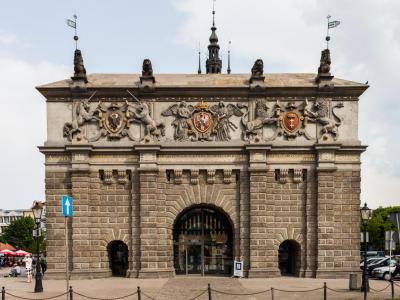
The Upland Gate (Brama Wyżynna) in Gdańsk, built in the 16th century, served as the main entrance to the Old Town and marked the beginning of The Royal Way. Its strategic upland location above the water level is reflected in its name, 'Upland Gate'. This positioning was significant, as it was constructed in relation to the moat that surrounded the city, emphasizing its defensive function.
The Upland Gate is renowned for its architectural beauty, featuring the Mannerist style typical of its era. It was once a part of Gdańsk's defensive ramparts and was originally accessed via a drawbridge over a moat, showcasing the city's medieval defensive strategies. The system's details, like the metal pulleys for the drawbridge, remain visible under Poland, Prussia, and Gdańsk's coats of arms, providing insight into the gate's history.
Significantly, the gate has long been a site of ceremonial significance, where visiting monarchs were welcomed with keys to the city, symbolizing their access and high esteem. This tradition highlights the gate's role as a symbol of power and hospitality.
The Upland Gate was designed and supervised by Hans Kramer from Dresden, with the artistic contributions of Willem Van Den Blocke, who crafted the sculpted leaves adorning the walls. These elements contribute to the gate's aesthetic and historical significance.
In modern times, the gate has been subject to major renovation work and now houses a tourist information point, making it an essential stop for visitors exploring Gdańsk. Walking through the Upland Gate is akin to retracing the steps of historical figures, offering a tangible connection to the past. This gate is not only an architectural marvel but also a testament to Gdańsk's historical importance and resilience.
The Upland Gate is renowned for its architectural beauty, featuring the Mannerist style typical of its era. It was once a part of Gdańsk's defensive ramparts and was originally accessed via a drawbridge over a moat, showcasing the city's medieval defensive strategies. The system's details, like the metal pulleys for the drawbridge, remain visible under Poland, Prussia, and Gdańsk's coats of arms, providing insight into the gate's history.
Significantly, the gate has long been a site of ceremonial significance, where visiting monarchs were welcomed with keys to the city, symbolizing their access and high esteem. This tradition highlights the gate's role as a symbol of power and hospitality.
The Upland Gate was designed and supervised by Hans Kramer from Dresden, with the artistic contributions of Willem Van Den Blocke, who crafted the sculpted leaves adorning the walls. These elements contribute to the gate's aesthetic and historical significance.
In modern times, the gate has been subject to major renovation work and now houses a tourist information point, making it an essential stop for visitors exploring Gdańsk. Walking through the Upland Gate is akin to retracing the steps of historical figures, offering a tangible connection to the past. This gate is not only an architectural marvel but also a testament to Gdańsk's historical importance and resilience.
4) Ulica Długa (Long Street) (must see)
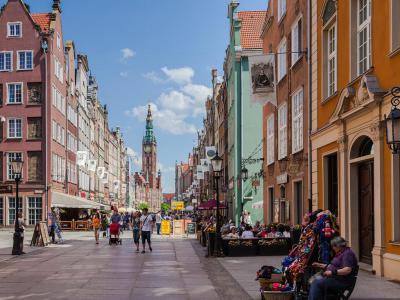
Long Street is among the city's oldest avenues. Guarded by the Golden Gate, it extends in a gentle curve into an area of the old burgher houses. The colorful houses are known for their Gothic Rococo styled doorways, terraces and porticos.
Curiously, the house numbers run opposite on each side of the street. This is a system commonly used on the older Gdansk streets. Some of the addresses are especially notable. Number 12 is a Museum of Burgher interiors. Number 71, opposite, is a survivor of Soviet barrages in the war. It still has its 15th century mouldings.
Ferber's House (Dom Ferberow), dates from 1560. It displays fine sculptures and coats of arms. The baroque facade of number 29 is graced with the figures of Roman emperors. King Wladyslaw IV held receptions at the Lion's Castle, number 35. Number 45, the House of the Polish Kings, has niches of Greek gods. The Town Hall is at the east end.
Long Street reaches through most of the "Royal Route." The street is cobbled and pedestrianized. There are several outdoor cafes, shops, restaurants and pubs. Behind the striking Renaissance facade of the Uphagen Mansion one can catch glimpses of the old time opulence of Gdansk.
There was an extensive rebuilding program in Gdansk after the end of the World War II. A limited amount of rebuilding was scheduled for areas around Long Street. Reconstruction was informed by old architectural plans, historical records and photographs. An accurate representation was achieved.
When one thinks about Europe, something like Long Street comes to mind. A vision of perfect, ornately constructed buildings lining ancient streets. Outdoor cafes, medieval gates, fountains, monuments, shopping, tourists; all this is somehow joyful.
Curiously, the house numbers run opposite on each side of the street. This is a system commonly used on the older Gdansk streets. Some of the addresses are especially notable. Number 12 is a Museum of Burgher interiors. Number 71, opposite, is a survivor of Soviet barrages in the war. It still has its 15th century mouldings.
Ferber's House (Dom Ferberow), dates from 1560. It displays fine sculptures and coats of arms. The baroque facade of number 29 is graced with the figures of Roman emperors. King Wladyslaw IV held receptions at the Lion's Castle, number 35. Number 45, the House of the Polish Kings, has niches of Greek gods. The Town Hall is at the east end.
Long Street reaches through most of the "Royal Route." The street is cobbled and pedestrianized. There are several outdoor cafes, shops, restaurants and pubs. Behind the striking Renaissance facade of the Uphagen Mansion one can catch glimpses of the old time opulence of Gdansk.
There was an extensive rebuilding program in Gdansk after the end of the World War II. A limited amount of rebuilding was scheduled for areas around Long Street. Reconstruction was informed by old architectural plans, historical records and photographs. An accurate representation was achieved.
When one thinks about Europe, something like Long Street comes to mind. A vision of perfect, ornately constructed buildings lining ancient streets. Outdoor cafes, medieval gates, fountains, monuments, shopping, tourists; all this is somehow joyful.
5) Piwna Street
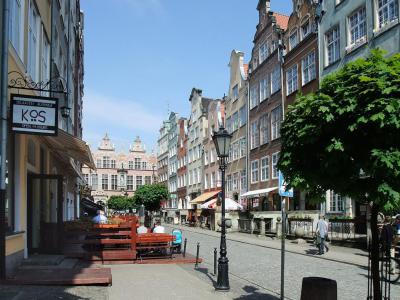
Piwna Street is an extension of Chlebnicka Street, starting at the Chlebnicka Gate. At the street's conclusion, you'll find the Great Armory, which was constructed in the early 17th century and originally served as the city's arsenal. Nowadays, it has been repurposed for commercial use. Prior to 1945, this street was known as Jopengasse in German, named after a famous Gdańsk-brewed strong beer known throughout Europe as Jopean beer.
One of the most notable residents of Gdańsk who lived on Piwna Street was the architect Jan Strakowski, who resided there during the late 16th and early 17th centuries. Around 1897, the U.S. consular agency had its offices at Piwna Street 2. In the 1930s, Albert Forster, the leader of the Gdańsk branch of the NSDAP (National Socialist German Workers' Party), occupied buildings numbered 8-11. On September 19, 1939, Forster hosted a visit from Adolf Hitler at this location. During that period, the tenement house at number 11 featured a stylized eagle carved from sandstone with a swastika encircled by oak leaves, which was the emblem of the NSDAP.
Since 2008, during the tourist season, Piwna Street has been closed to vehicular traffic and transformed into a pedestrian promenade.
One of the most notable residents of Gdańsk who lived on Piwna Street was the architect Jan Strakowski, who resided there during the late 16th and early 17th centuries. Around 1897, the U.S. consular agency had its offices at Piwna Street 2. In the 1930s, Albert Forster, the leader of the Gdańsk branch of the NSDAP (National Socialist German Workers' Party), occupied buildings numbered 8-11. On September 19, 1939, Forster hosted a visit from Adolf Hitler at this location. During that period, the tenement house at number 11 featured a stylized eagle carved from sandstone with a swastika encircled by oak leaves, which was the emblem of the NSDAP.
Since 2008, during the tourist season, Piwna Street has been closed to vehicular traffic and transformed into a pedestrian promenade.
6) St. Mary's Church (must see)
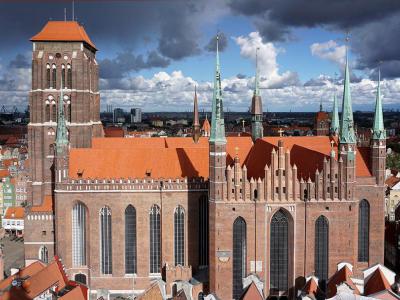
The formal name for Saint Mary's is Basilica of the Assumption of the Blessed Virgin Mary. Between 1536 and 1572 the church had been used jointly by Catholics and Lutherans. From the late 16th century until 1945 it was the second largest Lutheran church in the world. The church has been Catholic since 1945.
The church is an aisled hall church with transept. It is 346 feet long. The nave is 217 feet wide. It can hold up to 25,000 souls at one time. The first stone for the church was laid in 1343. It so happened to be the feast of the Assumption. The original basilica had six bays and a low turret. It was finished in 1360.
The current building was started in 1379 by architect Heinrich Ungeradin. The primary building material was brick. This was common to Gothic style churches of Flanders and the Netherlands. The church was finished and the tower raised by 1466. The nave core and vaulting was done by 1500, just in time for the Protestant Reformation.
No serious structural changes were carried out under Lutheran auspices. There was heavy damage to the church during World War II. Restoration began again in 1946. The church is frequently called the "Crown of Gdansk." It is considered to be the largest brick temple in Europe and the finest among the towns of the old Hanseatic League.
Inside the church is a wealth of medieval artifacts. There is a stone Pieta from 1410, and a copy of The Last Judgement made in 1472 by Hans Memling. An astronomical clock made in 1467 by Hans Duringer is here. The main altar was built in 1510-1517. The church does hold services. It is open to visitors year-round.
The church is an aisled hall church with transept. It is 346 feet long. The nave is 217 feet wide. It can hold up to 25,000 souls at one time. The first stone for the church was laid in 1343. It so happened to be the feast of the Assumption. The original basilica had six bays and a low turret. It was finished in 1360.
The current building was started in 1379 by architect Heinrich Ungeradin. The primary building material was brick. This was common to Gothic style churches of Flanders and the Netherlands. The church was finished and the tower raised by 1466. The nave core and vaulting was done by 1500, just in time for the Protestant Reformation.
No serious structural changes were carried out under Lutheran auspices. There was heavy damage to the church during World War II. Restoration began again in 1946. The church is frequently called the "Crown of Gdansk." It is considered to be the largest brick temple in Europe and the finest among the towns of the old Hanseatic League.
Inside the church is a wealth of medieval artifacts. There is a stone Pieta from 1410, and a copy of The Last Judgement made in 1472 by Hans Memling. An astronomical clock made in 1467 by Hans Duringer is here. The main altar was built in 1510-1517. The church does hold services. It is open to visitors year-round.

7) Artus Court
The Artus Court was built by 1350. Today it is a branch of the Gdansk History Museum. The name Artus is derived from the legend of English King Arthur. Wherever knights and nobility would meet in Europe the name Arthur was often used as a sign of chivalry. Artus Courts in Poland were founded and used by the bourgeoisie.
The old court burned down in 1476. There were several restorations and in 1617 the court was rebuilt by Abraham van den Blocke. The style, as with the much of Gdansk buildings, is Dutch Mannerism. Statues of ancient heroes adorn the building. Scipio Africanus, Themistocles, Marcus Camillus and Judas Maccabeus stand guard.
The goddess Fortuna and allegories of strength and justice are on the gable. On each side of the portal are busts of King Sigismund III and Wladyslaw IV. The interior is an enormous Gothic hall. The walls are wainscoted with friezes of mythological and historical themes. There are paintings and tapestries, ship models and armor.
There is a 36 foot high furnace built in 1546. It is covered with more than five hundred tiles showing prominent European leaders of the time. Currently the court is open to the public along with the department of the Gdansk History Museum.
The old court burned down in 1476. There were several restorations and in 1617 the court was rebuilt by Abraham van den Blocke. The style, as with the much of Gdansk buildings, is Dutch Mannerism. Statues of ancient heroes adorn the building. Scipio Africanus, Themistocles, Marcus Camillus and Judas Maccabeus stand guard.
The goddess Fortuna and allegories of strength and justice are on the gable. On each side of the portal are busts of King Sigismund III and Wladyslaw IV. The interior is an enormous Gothic hall. The walls are wainscoted with friezes of mythological and historical themes. There are paintings and tapestries, ship models and armor.
There is a 36 foot high furnace built in 1546. It is covered with more than five hundred tiles showing prominent European leaders of the time. Currently the court is open to the public along with the department of the Gdansk History Museum.
8) Gdańsk Town Hall
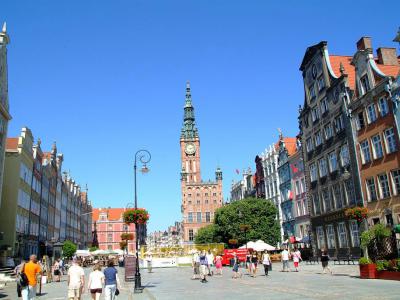
The Main Town Hall of Gdansk is on the Royal Route, on the corner of Long Street and Kaletnicza Street. It is really a building complex of various additions. It is the second highest building of the Old City after Saint Mary's Church. Long Street is closed to all but pedestrian traffic year-round. The Hall is reached by walking.
In 1346 the city of Gdansk replaced Lubeck law with the so-called Kulm law. This change divided government into two parts, the council and the judiciary. Each division required its own hall. Reconstructions occurred in 1382, 1457, 1488, and 1492. There were fires in 1494 and 1556. After the 1556 fire, the hall was rebuilt and enlarged.
The post 1556 rebuild was done by Dutch architects and master-builders Wilhem van den Meer, Dirk Daniels, and Anthonis van Obberghen. A golden statue of King Sigismund II was mounted on top of the tower and a carillon was placed inside.
At present, the Town Hall is home to the Historical Museum of the City of Gdansk. In the summer season one may visit the observation gallery of the tower. There is an admission charge.
In 1346 the city of Gdansk replaced Lubeck law with the so-called Kulm law. This change divided government into two parts, the council and the judiciary. Each division required its own hall. Reconstructions occurred in 1382, 1457, 1488, and 1492. There were fires in 1494 and 1556. After the 1556 fire, the hall was rebuilt and enlarged.
The post 1556 rebuild was done by Dutch architects and master-builders Wilhem van den Meer, Dirk Daniels, and Anthonis van Obberghen. A golden statue of King Sigismund II was mounted on top of the tower and a carillon was placed inside.
At present, the Town Hall is home to the Historical Museum of the City of Gdansk. In the summer season one may visit the observation gallery of the tower. There is an admission charge.
9) Neptune's Fountain
In 1606 Mayor Bartholomaus Schachmann of Gdansk decided the city needed a monumental fountain. The fountain would be near the site of an old well, not far from the river Motlawa and before the facade of Artus Court. The 14th century Town Hall would be seen in the background. The Artus Court is now a branch of the Gdansk History Museum.
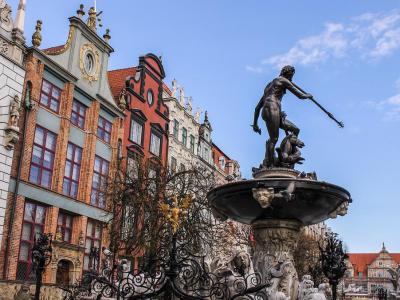
Construction began in 1606. The statue of the god faces the royal residences, posed in a deferential bow and wielding his famous trident. The sculpture project was under the direction of Abraham van den Blocke. The statue was made by Flemish sculptor Peter Husen. Neptune is made of bronze, cast in the local guild by Gerdt Benning.
The statue stem is black volcanic tuff. The style is related to Flemish Mannerism. There were delays, such as the Polish-Swedish War, the death of Herr Blocke and the renovation of the Artus Court. The fountain was opened in 1633. In 1634 it was enclosed in a fence with golden Polish eagles. Nazis removed the eagles in World War II.
The fountain was renovated and back in operation with the eagles restored by 1957. In 1988 the god's genitals were covered with a fig leaf. The fountain was fully renovated in 2012.
Construction began in 1606. The statue of the god faces the royal residences, posed in a deferential bow and wielding his famous trident. The sculpture project was under the direction of Abraham van den Blocke. The statue was made by Flemish sculptor Peter Husen. Neptune is made of bronze, cast in the local guild by Gerdt Benning.
The statue stem is black volcanic tuff. The style is related to Flemish Mannerism. There were delays, such as the Polish-Swedish War, the death of Herr Blocke and the renovation of the Artus Court. The fountain was opened in 1633. In 1634 it was enclosed in a fence with golden Polish eagles. Nazis removed the eagles in World War II.
The fountain was renovated and back in operation with the eagles restored by 1957. In 1988 the god's genitals were covered with a fig leaf. The fountain was fully renovated in 2012.
10) Long Market Square
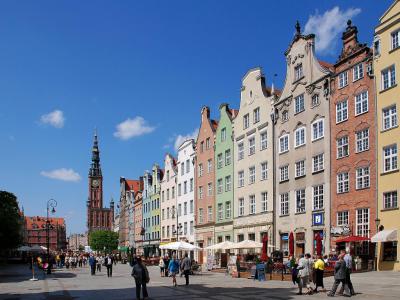
Crossing over the Green bridge in Gdansk, one may pass through the riverside arches of the Green Gate. Emerging from the arches, one finds oneself in the restored medieval Long Market Square.
As early as 1552, Polish monarchs would formally enter the city through the Green Gate. The visiting royalty would be lavishly entertained at the wealthy tenements lining the square. There were feasts and fireworks galore.
The square was often a venue for more than feasting. Executions of witches, heretics and criminals took place here as well. After World War II the street was restored to its former glory. The Dutch and Flemish Mannerist tenements once more line the square.
Hewel House was the 17th century dwelling of shipbuilder Georg Hewel. Author Reinhold Curicke lived at number 9. Johannes Uphagen built his mansion at No. 1776. The 1560 Faber House was built for Mayor Constantin Farber. The Lion Castle houses the Russian Center of Science and Culture.
Other sights are the Schumann House, also known as the King's House. The Town Hall, rebuilt in 1561, has a golden statue of King Sigismund. Neptune's Fountain, created in 1617 by A. van den Blocke and surrounded by Polish eagles, flows again. Artus Court, built in 1350, is a branch of Gdansk History Museum.
The noble tenants are gone, but the historical square lives on replete with shops, restaurants, and cafes. It is a memorable, exciting stroll.
As early as 1552, Polish monarchs would formally enter the city through the Green Gate. The visiting royalty would be lavishly entertained at the wealthy tenements lining the square. There were feasts and fireworks galore.
The square was often a venue for more than feasting. Executions of witches, heretics and criminals took place here as well. After World War II the street was restored to its former glory. The Dutch and Flemish Mannerist tenements once more line the square.
Hewel House was the 17th century dwelling of shipbuilder Georg Hewel. Author Reinhold Curicke lived at number 9. Johannes Uphagen built his mansion at No. 1776. The 1560 Faber House was built for Mayor Constantin Farber. The Lion Castle houses the Russian Center of Science and Culture.
Other sights are the Schumann House, also known as the King's House. The Town Hall, rebuilt in 1561, has a golden statue of King Sigismund. Neptune's Fountain, created in 1617 by A. van den Blocke and surrounded by Polish eagles, flows again. Artus Court, built in 1350, is a branch of Gdansk History Museum.
The noble tenants are gone, but the historical square lives on replete with shops, restaurants, and cafes. It is a memorable, exciting stroll.
11) Green Gate
The Royal Route of Gdansk had been the traditional path of procession for Polish sovereigns. One may walk from end to end of Long Street and Long Market, passing through the three elaborate city gates. Highland Gate, Golden Gate, and the Mannerist royal residence, the Green Gate.
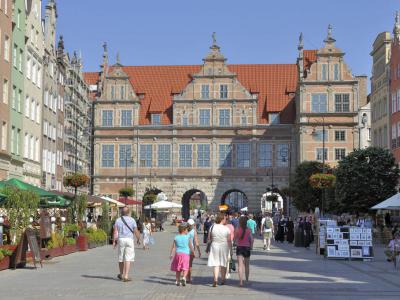
The Green Gate is green because its mullioned windows are green. Built around 1570, it spans Long Market and Long Street. It was designed by Dutch Architect Reiner van Amsterdam. The actual construction was by Hans Kramer from Dresden.
Marie Louise Gonzaga, Grand Duchess of Lithuania, became Queen of Poland in 1646. She was an absolutely absolutist monarch and would absolutely not live at the Green Gate residence. Perhaps it was too drafty.
The Green Gate is located between Long Market and the River Motlawa. The building faces the river and straddles the long Market streets leading to the Green Bridge. Four rounded arches span the Long market as seen from the bridge. The building has two stories with one story above the arches.
Three ornate mannerist gables are set against the dormer roof. The construction was powerfully influenced by the design of the Antwerp City Hall. From 1746 to 1846 the Green Gate was home to the Nature Society, also known as the Experimental Physics Society. Today the Gate houses the National Museum and the office of former president Lech Walesa.
The Green Gate is green because its mullioned windows are green. Built around 1570, it spans Long Market and Long Street. It was designed by Dutch Architect Reiner van Amsterdam. The actual construction was by Hans Kramer from Dresden.
Marie Louise Gonzaga, Grand Duchess of Lithuania, became Queen of Poland in 1646. She was an absolutely absolutist monarch and would absolutely not live at the Green Gate residence. Perhaps it was too drafty.
The Green Gate is located between Long Market and the River Motlawa. The building faces the river and straddles the long Market streets leading to the Green Bridge. Four rounded arches span the Long market as seen from the bridge. The building has two stories with one story above the arches.
Three ornate mannerist gables are set against the dormer roof. The construction was powerfully influenced by the design of the Antwerp City Hall. From 1746 to 1846 the Green Gate was home to the Nature Society, also known as the Experimental Physics Society. Today the Gate houses the National Museum and the office of former president Lech Walesa.
12) Dlugie Pobrzeze (Long Embankment Street) (must see)
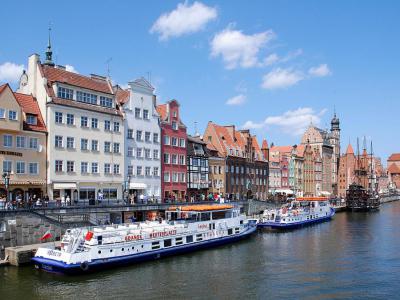
The Long embankment Street of Gdansk stretches almost 1/3 mile along the Motlawa River. Until the 19th century the piers and quays on the embankment served as the port of Gdansk and the river Motlawa provided easy sheltered access to the sea. Not many of the old port facilities remain. The medieval heavy lift crane is now a museum piece.
The pedestrianized area along the west riverfront originated in the 14th century. A series of mostly wooden goods platforms were replaced in the 17th century with a unified walkway. In the rebuilding of the city after World War II the area was refinished with concrete and marble.
The buildings along the promenade were utterly destroyed in the war. The ancient crane and water gates were rebuilt following medieval styles and plans. New underwater walls were installed. A new lower level quayside extended from the Green Gate to the old Crane Gate to accommodate passenger vessels.
By the 1980s the Hanseatic Mannerist style tenements along the promenade were recreated according to views of 1900. The rebuilt homes house cafes, restaurants and shops. The Crane building is attached to the new Maritime Cultural Center.
The pedestrianized area along the west riverfront originated in the 14th century. A series of mostly wooden goods platforms were replaced in the 17th century with a unified walkway. In the rebuilding of the city after World War II the area was refinished with concrete and marble.
The buildings along the promenade were utterly destroyed in the war. The ancient crane and water gates were rebuilt following medieval styles and plans. New underwater walls were installed. A new lower level quayside extended from the Green Gate to the old Crane Gate to accommodate passenger vessels.
By the 1980s the Hanseatic Mannerist style tenements along the promenade were recreated according to views of 1900. The rebuilt homes house cafes, restaurants and shops. The Crane building is attached to the new Maritime Cultural Center.
13) Mariacka Street (must see)
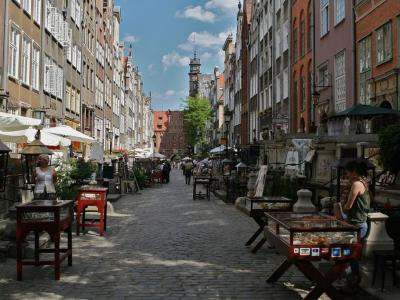
Mariacka Street takes its name from Saint Mary's Church. The cobblestoned street is short and narrow, lined with old burgher houses with mini-terraces, gargoyles and fantastic beasts. It lies between the church and Saint Mary's gate by the river Moltawa. The gargoyles guard against evil and spit rainwater away from the walls.
The medieval spirit is alive on Mariacka Street. The original wooden church at the end of the street was founded by Swietopelk II, Duke of Pomerania in the 13th century. The original name of the street says in Latin: "Our Lady's Street."
Saint Mary's Gate, the 15th century water gate, is at the opposite end of the street. The gate bears the coats of arms Gdansk and Prussia and Poland. Mariacka Street was once the home of workshops and stalls. The burgher houses are embellished with scenes from the Bible, e.g., The Dream of Jacob, the Annunciation, and the Good Samaritan.
Gdansk is the home of Baltic amber and Mariacka Street is the go-to street in Gdansk for amber. The most well-known and respected dealers in amber will be found here. Looking for the best coffee? You are in luck. Some of the best coffee shops and cafes are here as well. Let's not overlook Wine Bar Literacka, it has over 100 wines and fine food.
Next to Saint Mary's Gate is the Archeological Museum with its viewing tower. During Saint Dominic's Fair for three weeks in August, the street is crowded with tourists, bands, cartoonists and vendors. Many times however, Mariacka Street appears empty, pensive and serene.
The medieval spirit is alive on Mariacka Street. The original wooden church at the end of the street was founded by Swietopelk II, Duke of Pomerania in the 13th century. The original name of the street says in Latin: "Our Lady's Street."
Saint Mary's Gate, the 15th century water gate, is at the opposite end of the street. The gate bears the coats of arms Gdansk and Prussia and Poland. Mariacka Street was once the home of workshops and stalls. The burgher houses are embellished with scenes from the Bible, e.g., The Dream of Jacob, the Annunciation, and the Good Samaritan.
Gdansk is the home of Baltic amber and Mariacka Street is the go-to street in Gdansk for amber. The most well-known and respected dealers in amber will be found here. Looking for the best coffee? You are in luck. Some of the best coffee shops and cafes are here as well. Let's not overlook Wine Bar Literacka, it has over 100 wines and fine food.
Next to Saint Mary's Gate is the Archeological Museum with its viewing tower. During Saint Dominic's Fair for three weeks in August, the street is crowded with tourists, bands, cartoonists and vendors. Many times however, Mariacka Street appears empty, pensive and serene.
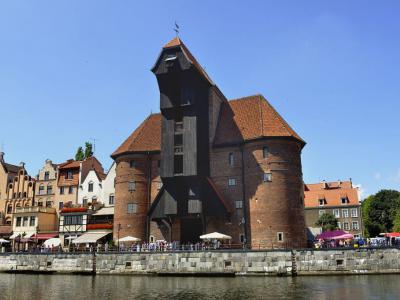
14) Brama Żuraw (Crane Gate) (must see)
The silhouette of the great waterfront Crane of Gdansk is a well known symbol of the city. The first wooden crane at the foot of Szeroka Street dates from at least 1367. This structure was destroyed by fire in the 15th century. The replacement brick crane of today was erected in 1444. The brick western facade was not completed until 1483.
The Crane was the largest water gate in the city by far and it still is. The huge crane structure is flanked by two fortified rounded towers. The ground floor of the crane had cannon emplacements. Firing embrasures mark the upper floors.
The lifting mechanism of the crane was made of two pairs of treadwheels on one shaft. Four workers powered each treadwheel. The men walked inside the wheel like human hamsters. This system provided enough muscle power to lift two tons of load to a height of almost 120 feet. The crane was in ever dwindling use until 1944.
The crane gate was again damaged by fire in 1945. It was rebuilt by 1965 and it has been donated to the Polish Maritime Museum. Inside the crane building today are permanent collections, especially one of ordinary life in the port from the 16th to the 18th centuries. Another fun attraction is the two monstrous drive wheels.
There is admission charged for the granaries, the Crane and the Cultural Centre. Admission to the granaries is free on Wednesdays.
The Crane was the largest water gate in the city by far and it still is. The huge crane structure is flanked by two fortified rounded towers. The ground floor of the crane had cannon emplacements. Firing embrasures mark the upper floors.
The lifting mechanism of the crane was made of two pairs of treadwheels on one shaft. Four workers powered each treadwheel. The men walked inside the wheel like human hamsters. This system provided enough muscle power to lift two tons of load to a height of almost 120 feet. The crane was in ever dwindling use until 1944.
The crane gate was again damaged by fire in 1945. It was rebuilt by 1965 and it has been donated to the Polish Maritime Museum. Inside the crane building today are permanent collections, especially one of ordinary life in the port from the 16th to the 18th centuries. Another fun attraction is the two monstrous drive wheels.
There is admission charged for the granaries, the Crane and the Cultural Centre. Admission to the granaries is free on Wednesdays.
