Custom Walk in Barcelona, Spain by donna6441_398d2 created on 2025-10-06
Guide Location: Spain » Barcelona
Guide Type: Custom Walk
# of Sights: 14
Tour Duration: 3 Hour(s)
Travel Distance: 5.4 Km or 3.4 Miles
Share Key: ZZREG
Guide Type: Custom Walk
# of Sights: 14
Tour Duration: 3 Hour(s)
Travel Distance: 5.4 Km or 3.4 Miles
Share Key: ZZREG
How It Works
Please retrieve this walk in the GPSmyCity app. Once done, the app will guide you from one tour stop to the next as if you had a personal tour guide. If you created the walk on this website or come to the page via a link, please follow the instructions below to retrieve the walk in the app.
Retrieve This Walk in App
Step 1. Download the app "GPSmyCity: Walks in 1K+ Cities" on Apple App Store or Google Play Store.



Step 2. In the GPSmyCity app, download(or launch) the guide "Barcelona Map and Walking Tours".
Step 3. Tap the menu button located at upper right corner of the "Walks" screen and select "Retrieve custom walk". Enter the share key: ZZREG
1) Mirador de Colom (Columbus Monument)
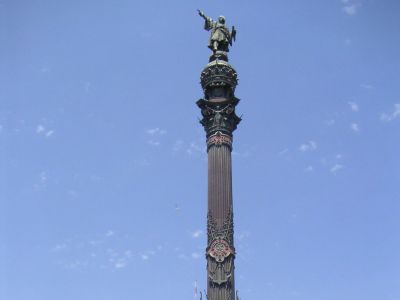
The 60-meter Columbus Monument at the lower end of Barcelona's La Rambla was built for the 1888 Barcelona Universal Exposition. Honoring Christopher Columbus’ first voyage to the Americas, the monument symbolizes his return to Barcelona, upon which he reported to Queen Isabella I and King Ferdinand V.
The structure features a 7.2-meter bronze statue of Columbus atop a 40-meter Corinthian column. Originally intended to face west, towards the Americas, Columbus is instead depicted pointing east – reportedly towards his birthplace of Genoa, Italy. Others, however, believe that it simply strikes a dramatic pose toward the sea, symbolizing Columbus’ achievements in naval exploration. The statue stands on a base inscribed with the word "Tierra," which means “land”. Below it, the column is supported by an octagonal pedestal adorned with bronze victories, griffins, and medallions representing figures related to Columbus.
The pedestal’s base includes sculptures of historical figures, such as cartographer Jaume Ferrer and Catholic preacher Father Bernat de Boïl, along with bas-relief panels that illustrate significant moments from Columbus’ voyage, including his departure from Palos de la Frontera and his meeting with the King and Queen in Barcelona. Additionally, the monument’s base features coats-of-arms from locations that Columbus visited, such as Puerto Rico and Cuba.
The idea for the monument originated in 1856. Funded mostly through private donations, it was completed in 1888. The monument is exclusively a Catalan endeavor, with all the labor and materials sourced from the region, thus symbolizing the Catalans' recognition of Christopher Columbus as one of their own, despite his Italian origins.
Tip:
Take the time to go around the monument and observe the sculptures showcased at its base.
Inside the column, visitors can take an elevator to a viewing platform for a sweeping panorama of the surrounding area.
Also, check out the wine bar at the monument's cellar and a boutique offering unique souvenirs and gifts that surpass the mass-produced items found at street vendors.
A combined ticket for both the lift ride and wine tasting can be obtained at the base of the monument.
Viewing Platform:
Daily: 8:30 am–2:30 pm
The structure features a 7.2-meter bronze statue of Columbus atop a 40-meter Corinthian column. Originally intended to face west, towards the Americas, Columbus is instead depicted pointing east – reportedly towards his birthplace of Genoa, Italy. Others, however, believe that it simply strikes a dramatic pose toward the sea, symbolizing Columbus’ achievements in naval exploration. The statue stands on a base inscribed with the word "Tierra," which means “land”. Below it, the column is supported by an octagonal pedestal adorned with bronze victories, griffins, and medallions representing figures related to Columbus.
The pedestal’s base includes sculptures of historical figures, such as cartographer Jaume Ferrer and Catholic preacher Father Bernat de Boïl, along with bas-relief panels that illustrate significant moments from Columbus’ voyage, including his departure from Palos de la Frontera and his meeting with the King and Queen in Barcelona. Additionally, the monument’s base features coats-of-arms from locations that Columbus visited, such as Puerto Rico and Cuba.
The idea for the monument originated in 1856. Funded mostly through private donations, it was completed in 1888. The monument is exclusively a Catalan endeavor, with all the labor and materials sourced from the region, thus symbolizing the Catalans' recognition of Christopher Columbus as one of their own, despite his Italian origins.
Tip:
Take the time to go around the monument and observe the sculptures showcased at its base.
Inside the column, visitors can take an elevator to a viewing platform for a sweeping panorama of the surrounding area.
Also, check out the wine bar at the monument's cellar and a boutique offering unique souvenirs and gifts that surpass the mass-produced items found at street vendors.
A combined ticket for both the lift ride and wine tasting can be obtained at the base of the monument.
Viewing Platform:
Daily: 8:30 am–2:30 pm
2) La Rambla (must see)
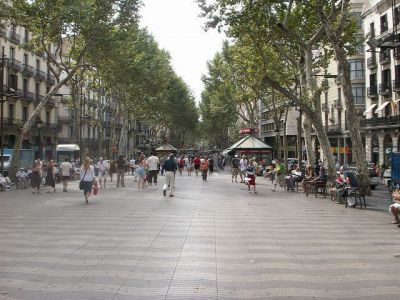
Pulsating with energy, particularly during the peak tourist season, La Rambla is the most famous street in Barcelona and one of Europe’s most lively urban promenades. Stretching 1.2 kilometers from Catalonia Square to the Christopher Columbus Monument at the Old Port, it cuts through the Gothic Quarter and El Raval neighborhoods. Legendary Spanish poet Federico García Lorca famously described this bustling thoroughfare, teeming with colorful shops, charming pavement cafes, souvenir kiosks, and an eclectic mix of visitors, as “the only street in the world which I wish would never end.”
La Rambla is composed of several smaller sections, known collectively as “Les Rambles.” These include Canaletes Rambla, known for its fountain; Rambla of Studies, the site of a former Jesuit university; Rambla of Saint Joseph, home to a flower market; Rambla of the Capuchins, featuring the Liceu opera house; and Rambla of Santa Mònica, named after a local convent.
Originally a sewage-filled stream, La Rambla’s name comes from the Arabic word for "sand," dating back to the times when it functioned as a rainwater drain. By the late 14th century, the city expanded its walls to include La Rambla, which later transformed into a lively promenade.
Over time, La Rambla became a hub for festivals and commerce. Trees were planted along its path in 1703, with plane trees, in particular, added in 1859. Notable local landmarks include the Liceu Grand Theatre, Barcelona's renowned opera house, and the Palace of the Viceroy, a Baroque mansion now hosting exhibitions and events. The street also features a Joan Miró pavement mosaic and connects to the famous La Boqueria market, offering a plethora of local delicacies, as well as the Royal Square popular for its nightlife.
Prices at La Rambla are a bit steeper than elsewhere in the city, but then again, excitement comes at a price, and La Rambla sure gives tonnes of it.
Tip:
As you stroll along, remain vigilant against the occasional presence of pickpockets-keeping your eyes open is always a good idea.
For excellent food at more affordable prices and the opportunity to savor your meal in a relaxed setting, venture to the Santa Caterina market, just a 10-minute walk away from La Boqueria.
La Rambla is composed of several smaller sections, known collectively as “Les Rambles.” These include Canaletes Rambla, known for its fountain; Rambla of Studies, the site of a former Jesuit university; Rambla of Saint Joseph, home to a flower market; Rambla of the Capuchins, featuring the Liceu opera house; and Rambla of Santa Mònica, named after a local convent.
Originally a sewage-filled stream, La Rambla’s name comes from the Arabic word for "sand," dating back to the times when it functioned as a rainwater drain. By the late 14th century, the city expanded its walls to include La Rambla, which later transformed into a lively promenade.
Over time, La Rambla became a hub for festivals and commerce. Trees were planted along its path in 1703, with plane trees, in particular, added in 1859. Notable local landmarks include the Liceu Grand Theatre, Barcelona's renowned opera house, and the Palace of the Viceroy, a Baroque mansion now hosting exhibitions and events. The street also features a Joan Miró pavement mosaic and connects to the famous La Boqueria market, offering a plethora of local delicacies, as well as the Royal Square popular for its nightlife.
Prices at La Rambla are a bit steeper than elsewhere in the city, but then again, excitement comes at a price, and La Rambla sure gives tonnes of it.
Tip:
As you stroll along, remain vigilant against the occasional presence of pickpockets-keeping your eyes open is always a good idea.
For excellent food at more affordable prices and the opportunity to savor your meal in a relaxed setting, venture to the Santa Caterina market, just a 10-minute walk away from La Boqueria.
3) Mercat de la Boqueria (La Boqueria Market) (must see)
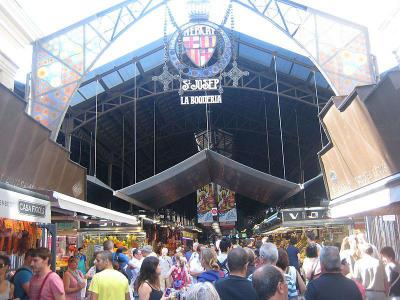
Situated to the north of La Rambla and a few blocks south of Catalonia Square, the Market of Saint Joseph de La Boqueria is extremely busy no matter what time of day or season you come. Colloquially referred to simply as La Boqueria, this large public market is one of Barcelona's foremost tourist landmarks with a broad choice of goods on offer.
Initially, the area was an unofficial extension of the New Square market. The name "Boqueria" possibly originates from the Catalan word "boc" for goat, indicating a place for selling goat meat. Indeed, the first mention of La Boqueria, as the meat market near the old city gate, dates back to 1217. By 1470, it was renamed “pig market” and afterward remained known as a straw market, up until 1794.
In 1826, the market gained an official status, and in 1835, plans were made for a formal structure on La Rambla. Construction began in 1840 and the market officially opened the same year. After several modifications, the building was inaugurated in 1853. A new fish market was added in 1911, and the current metal roof was installed in 1914, giving the market its present look.
Despite the constant flow of visitors, the experienced vendors efficiently handle the crowds, and the market's spacious layout helps ensure an enjoyable shopping experience. La Boqueria offers a fantastic opportunity to explore traditional Catalan cuisine. Here, you can take yourself on a tapas tour, sample exquisite jamón with cheese, purchase the world's freshest saffron (sold in various-sized small boxes), and enjoy local seafood (except for Sundays and Mondays when no fish is sold), plus discover many other culinary delights.
Also, don't miss the chance to try the freshly cooked fish at Kiosko Universal (a sit-down counter and bar-like place) or indulge in the wide variety of olives and delicious fresh fruits. Venture deep into the market to find the best stalls and taste a little bit of everything – you won't be disappointed.
Tip:
Keep in mind that the area is known for pickpocketing incidents, so whether you're alone or with friends, it is recommended to be vigilant and keep a close eye on your belongings.
Initially, the area was an unofficial extension of the New Square market. The name "Boqueria" possibly originates from the Catalan word "boc" for goat, indicating a place for selling goat meat. Indeed, the first mention of La Boqueria, as the meat market near the old city gate, dates back to 1217. By 1470, it was renamed “pig market” and afterward remained known as a straw market, up until 1794.
In 1826, the market gained an official status, and in 1835, plans were made for a formal structure on La Rambla. Construction began in 1840 and the market officially opened the same year. After several modifications, the building was inaugurated in 1853. A new fish market was added in 1911, and the current metal roof was installed in 1914, giving the market its present look.
Despite the constant flow of visitors, the experienced vendors efficiently handle the crowds, and the market's spacious layout helps ensure an enjoyable shopping experience. La Boqueria offers a fantastic opportunity to explore traditional Catalan cuisine. Here, you can take yourself on a tapas tour, sample exquisite jamón with cheese, purchase the world's freshest saffron (sold in various-sized small boxes), and enjoy local seafood (except for Sundays and Mondays when no fish is sold), plus discover many other culinary delights.
Also, don't miss the chance to try the freshly cooked fish at Kiosko Universal (a sit-down counter and bar-like place) or indulge in the wide variety of olives and delicious fresh fruits. Venture deep into the market to find the best stalls and taste a little bit of everything – you won't be disappointed.
Tip:
Keep in mind that the area is known for pickpocketing incidents, so whether you're alone or with friends, it is recommended to be vigilant and keep a close eye on your belongings.
4) Basilica de Santa Maria del Pi (Basilica of St. Mary of the Pine)
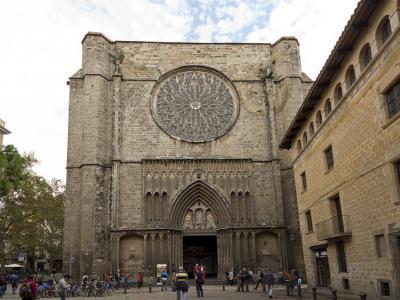
The Basilica of Saint Mary of the Pine, a quintessential 15th-century Gothic church in Barcelona, has weathered the passage of time, surviving natural disasters, wars, and deliberate destruction.
Initially documented in 987 as a small Romanesque church, it was dedicated to the Blessed Lady of the Pine Tree, which is one of the titles of the Virgin Mary. Others say that the church's name also derives from the solitary pine tree that once stood in the marshy lowland beyond the 4th-century Roman walls. The present church was constructed between 1319 and 1391 and was consecrated in 1453. Its design is noted for its Catalan Gothic style characterized by a stark, ornament-free single nave. The bell tower, initiated by Peter the Ceremonious, King of Aragon, in 1379, was completed almost 120 years later.
The catastrophic earthquake of 1428 and the early 18th-century bombings during the War of the Spanish Succession caused extensive damage to the church's facade, presbytery, main altarpiece, and stained glass windows. Restoration efforts, begun in 1717 and continued up until 1915, resulted in the removal of many Baroque decorations.
Another devastating event occurred in 1936 when anarchists set the church ablaze, seeking to destroy it. However, the church was meticulously restored after the Civil War. The restoration included the Gothic arch marking the main entrance and the large front façade rose window, destroyed by fire and replaced by a replica in 1940. The side façade displays prominent buttresses and lancet windows, while the rear façade continues this theme and includes an ancient door from 1578. The oldest surviving windows in the church date back to 1718.
Internally, the church's nave extends 54 meters in length and is defined by vaulted ceilings and side chapels. Upon entering, two interesting features await – the original wooden choir loft and the painting of "Our Lady of the Helpless" by the 18th-century Spanish artist Ramón Amadeu. The latter is said to have used his wife and children as models for the Virgin and children in the painting.
Presently, the church frequently hosts classical guitar concerts by renowned soloists. Guided tours of the basilica and the bell tower are available in English, with prior reservation.
Tip:
If you visit early or late, admission to the church is free (otherwise, there is a nominal fee). For a few extra euros, you can ascend the bell tower and enjoy a panoramic 360-degree view of the city. However, do take note of the timing, as the tower closes after dusk.
Initially documented in 987 as a small Romanesque church, it was dedicated to the Blessed Lady of the Pine Tree, which is one of the titles of the Virgin Mary. Others say that the church's name also derives from the solitary pine tree that once stood in the marshy lowland beyond the 4th-century Roman walls. The present church was constructed between 1319 and 1391 and was consecrated in 1453. Its design is noted for its Catalan Gothic style characterized by a stark, ornament-free single nave. The bell tower, initiated by Peter the Ceremonious, King of Aragon, in 1379, was completed almost 120 years later.
The catastrophic earthquake of 1428 and the early 18th-century bombings during the War of the Spanish Succession caused extensive damage to the church's facade, presbytery, main altarpiece, and stained glass windows. Restoration efforts, begun in 1717 and continued up until 1915, resulted in the removal of many Baroque decorations.
Another devastating event occurred in 1936 when anarchists set the church ablaze, seeking to destroy it. However, the church was meticulously restored after the Civil War. The restoration included the Gothic arch marking the main entrance and the large front façade rose window, destroyed by fire and replaced by a replica in 1940. The side façade displays prominent buttresses and lancet windows, while the rear façade continues this theme and includes an ancient door from 1578. The oldest surviving windows in the church date back to 1718.
Internally, the church's nave extends 54 meters in length and is defined by vaulted ceilings and side chapels. Upon entering, two interesting features await – the original wooden choir loft and the painting of "Our Lady of the Helpless" by the 18th-century Spanish artist Ramón Amadeu. The latter is said to have used his wife and children as models for the Virgin and children in the painting.
Presently, the church frequently hosts classical guitar concerts by renowned soloists. Guided tours of the basilica and the bell tower are available in English, with prior reservation.
Tip:
If you visit early or late, admission to the church is free (otherwise, there is a nominal fee). For a few extra euros, you can ascend the bell tower and enjoy a panoramic 360-degree view of the city. However, do take note of the timing, as the tower closes after dusk.
5) El Corte Ingles
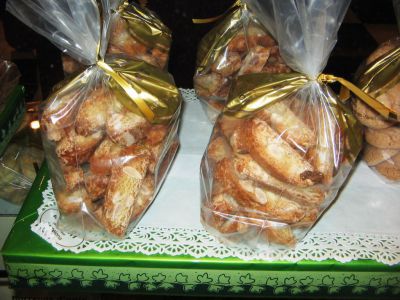
El Corte Inglés, a Spanish institution that originated in Madrid, has expanded to include numerous department stores throughout Barcelona, with the largest one being found in Plaça de Catalunya. Often compared to Selfridges or Macy's, the store offers a wide range of products, from makeup to leather goods to everyday essentials like tinned beans.
This particular location exudes a classic Spanish charm, appealing to those seeking a nostalgic shopping experience. On the 9th floor, a cafeteria provides reasonably priced food options and boasts fantastic views of the city.
Here's a breakdown of what you can find on each floor of El Corte Inglés:
~ Second Basement: Car Park / Foreign Exchange Counter / Passport Photograph Machine
~ Basement: Supermercado – the store's supermarket / El Gourmet Club – the store's luxury delicatessen area / Pharmacy / Tobacconist / Opticians / Shoe repair
~ Ground Floor: Perfumes and Cosmetics / Accessories – jewellery, watches, bags, handkerchiefs, umbrellas / Information Desk
Mon-Fri: 9am–9:30pm; Sat, Sun: 12–8pm
This particular location exudes a classic Spanish charm, appealing to those seeking a nostalgic shopping experience. On the 9th floor, a cafeteria provides reasonably priced food options and boasts fantastic views of the city.
Here's a breakdown of what you can find on each floor of El Corte Inglés:
~ Second Basement: Car Park / Foreign Exchange Counter / Passport Photograph Machine
~ Basement: Supermercado – the store's supermarket / El Gourmet Club – the store's luxury delicatessen area / Pharmacy / Tobacconist / Opticians / Shoe repair
~ Ground Floor: Perfumes and Cosmetics / Accessories – jewellery, watches, bags, handkerchiefs, umbrellas / Information Desk
Mon-Fri: 9am–9:30pm; Sat, Sun: 12–8pm
6) Casa Lleo Morera (Lleo Morera House)
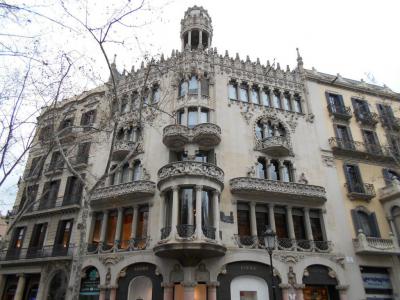
Lleó Morera House, at Number 35 on Gràcia Boulevard, was designed by renowned Catalan Modernist architect Lluís Domènech i Montaner. Commissioned in 1902 by Francesca Morera, the building was named after her son, Albert Lleó i Morera, following her death two years later.
This property forms part of the so-called "Block of Discord" that features the works of Barcelona's top four Catalan Modernist architects, Lluís Domènech i Montaner, Antoni Gaudí, Josep Puig i Cadafalch, and Enric Sagnier. Less extravagant than the other two local landmarks – Batlló and Amatller houses – but no less opulent when it comes to the richly decorated balconies and facade, Lleó Morera House was the only one on the block to win Barcelona’s Arts Building Annual Award in 1906.
The edifice stands out with its distinctive egg-shaped rooftop and intricately ornamented round-shaped balcony. Domènech i Montaner collaborated with various artists to incorporate natural and organic motifs into the building’s design. Lluís Bru and Mario Maragliano worked on mosaics, Eusebi Arnau on sculptures, Antoni Serra on ceramics, and Gaspar Homar on interior decoration and furniture. Upon closer inspection, one can notice the building's name, "Lleó Morera," depicted on the facade, which translates from Catalan to "lion" and "mulberry". The mulberry tree motif, symbolizing the Morera family name, is a recurrent decorative element, seen in door handles, patio designs, and ceramics.
The building’s façade and ground floor originally featured modernist sculptures by Arnau, which included feminine figures symbolizing technological advancements of the time like the light bulb, phonograph, and telephone. However, modifications in the 1940s removed some of these elements. Many sculptures were lost, while others were later acquired by Salvador Dalí.
The dining room showcases stained-glass windows, exquisite woodwork, and marble details, complete with the eight ceramic mosaic wall panels depicting idyllic countryside scenes. The staircase in the house is also notably unique for European buildings of that period.
In the mid-1980s and early 1990s, restoration efforts were made to recover the building’s damaged elements, including the tempietto, destroyed during the Spanish Civil War. In 2007, Lleó Morera House was included in the Art Nouveau European Route. Guided tours of the building are available for a fee, making it an excellent choice for passionate modernist enthusiasts and architecture buffs who won't be disappointed by the experience.
This property forms part of the so-called "Block of Discord" that features the works of Barcelona's top four Catalan Modernist architects, Lluís Domènech i Montaner, Antoni Gaudí, Josep Puig i Cadafalch, and Enric Sagnier. Less extravagant than the other two local landmarks – Batlló and Amatller houses – but no less opulent when it comes to the richly decorated balconies and facade, Lleó Morera House was the only one on the block to win Barcelona’s Arts Building Annual Award in 1906.
The edifice stands out with its distinctive egg-shaped rooftop and intricately ornamented round-shaped balcony. Domènech i Montaner collaborated with various artists to incorporate natural and organic motifs into the building’s design. Lluís Bru and Mario Maragliano worked on mosaics, Eusebi Arnau on sculptures, Antoni Serra on ceramics, and Gaspar Homar on interior decoration and furniture. Upon closer inspection, one can notice the building's name, "Lleó Morera," depicted on the facade, which translates from Catalan to "lion" and "mulberry". The mulberry tree motif, symbolizing the Morera family name, is a recurrent decorative element, seen in door handles, patio designs, and ceramics.
The building’s façade and ground floor originally featured modernist sculptures by Arnau, which included feminine figures symbolizing technological advancements of the time like the light bulb, phonograph, and telephone. However, modifications in the 1940s removed some of these elements. Many sculptures were lost, while others were later acquired by Salvador Dalí.
The dining room showcases stained-glass windows, exquisite woodwork, and marble details, complete with the eight ceramic mosaic wall panels depicting idyllic countryside scenes. The staircase in the house is also notably unique for European buildings of that period.
In the mid-1980s and early 1990s, restoration efforts were made to recover the building’s damaged elements, including the tempietto, destroyed during the Spanish Civil War. In 2007, Lleó Morera House was included in the Art Nouveau European Route. Guided tours of the building are available for a fee, making it an excellent choice for passionate modernist enthusiasts and architecture buffs who won't be disappointed by the experience.
7) Casa Batllo (Batllo House) (must see)
Batlló House, located in the heart of Barcelona's prestigious Gràcia Boulevard, is one of Gaudí’s most celebrated architectural masterpieces. Originally built in 1877 by Lluís Sala Sánchez, the building underwent a radical transformation in 1904 when textile industrialist Josep Batlló hired Antoni Gaudí to renovate it. Gaudí expanded the structure, creating new floors and adding his signature audacious design, which turned this previously unremarkable building into a landmark of Modernist architecture.
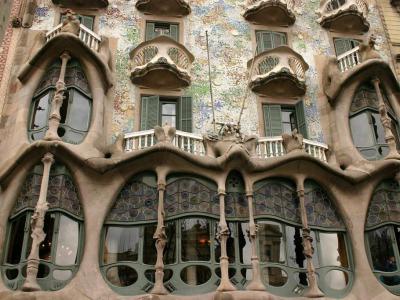
Batlló House is often referred to as the "House of Bones" due to its skeletal-like balconies and organic forms. Another local name for it is the "House of the Dragon," as its arched roof, covered in colorful mosaic tiles, is said to resemble the spine of a dragon. This symbolism aligns with the legend of Saint George (Catalonia’s patron saint), whose lance is represented by the turret and cross atop the roof.
The building's façade is divided into three sections and adorned with vibrant broken ceramic tiles in shades transitioning from orange to greenish-blue. Gaudí’s use of curves, irregular windows, and sculpted stonework avoids straight lines, enhancing the structure’s flowing, dynamic feel. Inside, the loft space, with its catenary arches, imitates a ribcage, while the central atrium features blue tiles that create an underwater-like light distribution.
The rooftop is a highlight of Batlló House, with its chimneys resembling twisted, tiled sculptures. The entire structure integrates symbolism and decorative elements that showcase Gaudí’s innovative approach to form and function. After the Batlló family left in the 1950s, the house changed ownership several times and was refurbished before becoming a venue for events in 1995. In 2005, Batlló House was designated a UNESCO World Heritage Site, cementing its status as a masterpiece of modernist architecture.
Tip:
For a fee, you can have your photo taken on the small balcony at the front of the building (as you descend from the rooftop), receiving both a printed copy and an electronic version for a memorable keepsake.
Batlló House is often referred to as the "House of Bones" due to its skeletal-like balconies and organic forms. Another local name for it is the "House of the Dragon," as its arched roof, covered in colorful mosaic tiles, is said to resemble the spine of a dragon. This symbolism aligns with the legend of Saint George (Catalonia’s patron saint), whose lance is represented by the turret and cross atop the roof.
The building's façade is divided into three sections and adorned with vibrant broken ceramic tiles in shades transitioning from orange to greenish-blue. Gaudí’s use of curves, irregular windows, and sculpted stonework avoids straight lines, enhancing the structure’s flowing, dynamic feel. Inside, the loft space, with its catenary arches, imitates a ribcage, while the central atrium features blue tiles that create an underwater-like light distribution.
The rooftop is a highlight of Batlló House, with its chimneys resembling twisted, tiled sculptures. The entire structure integrates symbolism and decorative elements that showcase Gaudí’s innovative approach to form and function. After the Batlló family left in the 1950s, the house changed ownership several times and was refurbished before becoming a venue for events in 1995. In 2005, Batlló House was designated a UNESCO World Heritage Site, cementing its status as a masterpiece of modernist architecture.
Tip:
For a fee, you can have your photo taken on the small balcony at the front of the building (as you descend from the rooftop), receiving both a printed copy and an electronic version for a memorable keepsake.
8) Casa Amatller (Amatller House)
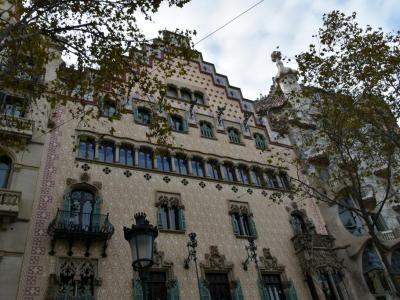
Amatller House is yet another Modernisme landmark in Barcelona, known for its blend of neo-Gothic and Art Nouveau influences. Along with the Batlló and Lleó Morera houses, it forms part of the so-called "Block of Discord" (named so for the contrasting styles of its modernist buildings). Designed by Josep Puig i Cadafalch between 1898 and 1900 for the wealthy chocolatier Antoni Amatller Costa, it features a distinctive stepped gable inspired by Dutch architecture, vibrant ceramic tiles, and a wrought-iron balcony.
The building's façade includes sculptures by Eusebi Arnau i Mascort, depicting biblical themes and medieval legends. The grand entrance showcases motifs of Saint George fighting the dragon, as well as allegories representing music, painting, architecture, and sculpture. The façade’s pinkish color alludes to Amatller’s profession, while the gallery on the fourth floor is adorned with Gothic-inspired columns.
Declared a national monument in 1976, the house remains remarkably well-preserved, thanks to continuous ownership by the Amatller family. Today, it functions as a historic house museum, café, and the Amatller Institute for Hispanic Art. Visitors can explore the interior, which retains its original furnishings, including the dining room, bedrooms, music room, and scullery. The Catalan Art Nouveau decor is visible in the building's main staircase, lobby, and inner courtyard.
The Amatller Institute, located on the upper floors, houses an extensive library dedicated to Spanish art. The mansion is open for guided tours, complete with multilingual audio guides that provide insight into its history, architecture, and the Amatller family legacy.
Tip:
Having explored the house, you can unwind at the café on the ground floor, indulging in a cup of coffee or a light snack – or better yet, a nice cup of hot chocolate paired with a soft bread toast. There's plenty of chocolate to choose from, from chocolate bars to chocolate-coated nuts to cute little boxes of chocolate candies and more – a perfect edible souvenir from Barcelona for a sweet tooth waiting for you back home!
The building's façade includes sculptures by Eusebi Arnau i Mascort, depicting biblical themes and medieval legends. The grand entrance showcases motifs of Saint George fighting the dragon, as well as allegories representing music, painting, architecture, and sculpture. The façade’s pinkish color alludes to Amatller’s profession, while the gallery on the fourth floor is adorned with Gothic-inspired columns.
Declared a national monument in 1976, the house remains remarkably well-preserved, thanks to continuous ownership by the Amatller family. Today, it functions as a historic house museum, café, and the Amatller Institute for Hispanic Art. Visitors can explore the interior, which retains its original furnishings, including the dining room, bedrooms, music room, and scullery. The Catalan Art Nouveau decor is visible in the building's main staircase, lobby, and inner courtyard.
The Amatller Institute, located on the upper floors, houses an extensive library dedicated to Spanish art. The mansion is open for guided tours, complete with multilingual audio guides that provide insight into its history, architecture, and the Amatller family legacy.
Tip:
Having explored the house, you can unwind at the café on the ground floor, indulging in a cup of coffee or a light snack – or better yet, a nice cup of hot chocolate paired with a soft bread toast. There's plenty of chocolate to choose from, from chocolate bars to chocolate-coated nuts to cute little boxes of chocolate candies and more – a perfect edible souvenir from Barcelona for a sweet tooth waiting for you back home!
9) Placa de Catalunya (Catalonia Square)
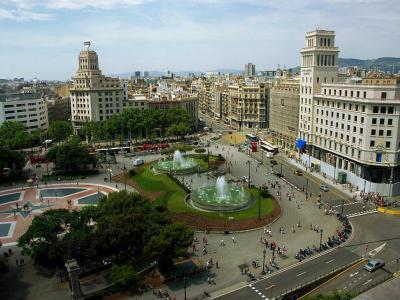
Catalonia Square, a meeting place between the historic Old Town and the modern upscale Eixample district of Barcelona, is rightfully considered the city's central point. Several of Barcelona’s main arteries converge here, such as Gràcia Boulevard, La Rambla, Rambla de Catalunya, and the Angel's Gate, making it a significant urban hub. Covering approximately 50,000 square meters, the square is known for its fountains, statues, and numerous pigeons.
Catalonia Square began to take shape after the medieval city walls were demolished in the 19th century, starting its initial development in 1902. Further urbanization occurred in 1929 for the Barcelona International Exposition, based on designs by architect Francesc de Paula Nebot. During the Spanish Civil War in the 1930s, the square witnessed some key moments in Barcelona’s history, including the so-called May Days, a series of clashes between 3 and 8 May 1937 during which factions on the Republican side of the Spanish Civil War engaged one another in street battles.
Today, the square is home to several prominent sculptures such as “Deessa” by Josep Clarà and “Pastor de Pau” by Pablo Gargallo, along with a monument dedicated to Catalan politician Francesc Macià.
The Barcelona Telephone Exchange, situated nearby, features stained glass windows by artist Brian Clarke, created in 1991 to celebrate the 1992 Olympic Games. The underground mosaics were designed by students of Massana School.
Although historically Catalonia Square has hosted various theaters, none of them remains today. Similarly, many of the famous cafes that once attracted writers and artists disappeared during the Spanish Civil War. Café Zurich is one of the few surviving establishments. Presently, the square is surrounded by shopping centers like El Corte Inglés, FNAC, and El Triangle, as well as several hotels.
As a major transportation hub, Catalonia Square connects different parts of the city through its extensive above-ground and underground networks, making it an essential point for locals and tourists alike.
Tip:
While the fountains are beautiful during the day, make sure to witness their display at night when they come alive with alternating colored lights.
Catalonia Square began to take shape after the medieval city walls were demolished in the 19th century, starting its initial development in 1902. Further urbanization occurred in 1929 for the Barcelona International Exposition, based on designs by architect Francesc de Paula Nebot. During the Spanish Civil War in the 1930s, the square witnessed some key moments in Barcelona’s history, including the so-called May Days, a series of clashes between 3 and 8 May 1937 during which factions on the Republican side of the Spanish Civil War engaged one another in street battles.
Today, the square is home to several prominent sculptures such as “Deessa” by Josep Clarà and “Pastor de Pau” by Pablo Gargallo, along with a monument dedicated to Catalan politician Francesc Macià.
The Barcelona Telephone Exchange, situated nearby, features stained glass windows by artist Brian Clarke, created in 1991 to celebrate the 1992 Olympic Games. The underground mosaics were designed by students of Massana School.
Although historically Catalonia Square has hosted various theaters, none of them remains today. Similarly, many of the famous cafes that once attracted writers and artists disappeared during the Spanish Civil War. Café Zurich is one of the few surviving establishments. Presently, the square is surrounded by shopping centers like El Corte Inglés, FNAC, and El Triangle, as well as several hotels.
As a major transportation hub, Catalonia Square connects different parts of the city through its extensive above-ground and underground networks, making it an essential point for locals and tourists alike.
Tip:
While the fountains are beautiful during the day, make sure to witness their display at night when they come alive with alternating colored lights.
10) Catedral de Barcelona (Barcelona Cathedral) (must see)
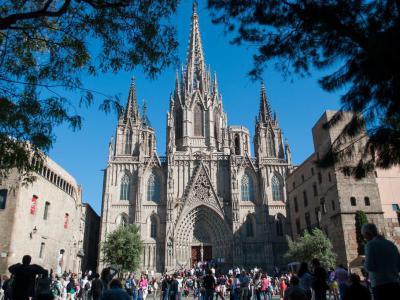
The Cathedral of the Holy Cross and Saint Eulalia, commonly known as Barcelona Cathedral, is a delightful combination of a church, mini-park, and a house of prayer, offering a serene alternative to the renowned La Sagrada Família. As the seat of the Archbishop of Barcelona, it was primarily constructed between the 13th and 15th centuries.
The cathedral has a pseudo-basilica layout with five aisles and a raised high altar. It is dedicated to Saint Eulalia, a young martyr whose relics are housed in the white marble sarcophagus inside the crypt. An intriguing feature is the presence of 13 geese in the cloister, symbolizing Saint Eulàlia's age at the time of her death.
Inside, the cathedral showcases choir stalls adorned with the coats-of-arms of the Order of the Golden Fleece. The Chapel of the Holy Sacrament contains a cross associated with the 1571 Battle of Lepanto and has been reconstructed to hold the tomb of San Olegarius, a former bishop of Barcelona.
The cathedral’s origins trace back to an early Christian and Visigothic complex that was damaged during a Muslim attack on Barcelona in 985. It was replaced with a Romanesque church in 1046 before the current Gothic cathedral began construction in 1298. The cathedral took 150 years to complete yet its neo-Gothic façade, featuring gargoyles and other mythical creatures, was finished only in 1913. Unlike many other churches in Barcelona destroyed during the Civil War, this Gothic temple was spared.
An exemplary piece of Catalan Gothic architecture, emphasizing balanced proportions over verticality, the cathedral measures 93 meters long, 40 meters wide, and 28 meters high at its central nave, with bell towers reaching 54 meters and the central peak at 70 meters.
The Cathedral of Barcelona is also famous for giving rise to the unique Catalan tradition of "dancing egg." Observed during the feast of Corpus Christi (also known as the Solemnity of the Most Holy Body and Blood of Christ), this tradition features an egg balanced on a water fountain’s jet.
The cathedral's cloister contains a gift shop. Cellular phones have been banned from the Chapel of Lepanto and other chapels. While exploring the cathedral's interior, make sure to venture up to the lofty roof terrace. You will be rewarded with views of the cathedral's towers, pinnacles, cimborio, and the Cloister, and a 360-degree view of the city!
Tip:
Cathedral Visit (including Choir entrance + Access to the rooftop, Chapter hall, and Virtual Audio guide) is €9.00.
Cathedral + Museum (including Choir entrance + Access to the rooftop + Chapter hall + Virtual Audio guide + Museum) is €15.00.
The cathedral has a pseudo-basilica layout with five aisles and a raised high altar. It is dedicated to Saint Eulalia, a young martyr whose relics are housed in the white marble sarcophagus inside the crypt. An intriguing feature is the presence of 13 geese in the cloister, symbolizing Saint Eulàlia's age at the time of her death.
Inside, the cathedral showcases choir stalls adorned with the coats-of-arms of the Order of the Golden Fleece. The Chapel of the Holy Sacrament contains a cross associated with the 1571 Battle of Lepanto and has been reconstructed to hold the tomb of San Olegarius, a former bishop of Barcelona.
The cathedral’s origins trace back to an early Christian and Visigothic complex that was damaged during a Muslim attack on Barcelona in 985. It was replaced with a Romanesque church in 1046 before the current Gothic cathedral began construction in 1298. The cathedral took 150 years to complete yet its neo-Gothic façade, featuring gargoyles and other mythical creatures, was finished only in 1913. Unlike many other churches in Barcelona destroyed during the Civil War, this Gothic temple was spared.
An exemplary piece of Catalan Gothic architecture, emphasizing balanced proportions over verticality, the cathedral measures 93 meters long, 40 meters wide, and 28 meters high at its central nave, with bell towers reaching 54 meters and the central peak at 70 meters.
The Cathedral of Barcelona is also famous for giving rise to the unique Catalan tradition of "dancing egg." Observed during the feast of Corpus Christi (also known as the Solemnity of the Most Holy Body and Blood of Christ), this tradition features an egg balanced on a water fountain’s jet.
The cathedral's cloister contains a gift shop. Cellular phones have been banned from the Chapel of Lepanto and other chapels. While exploring the cathedral's interior, make sure to venture up to the lofty roof terrace. You will be rewarded with views of the cathedral's towers, pinnacles, cimborio, and the Cloister, and a 360-degree view of the city!
Tip:
Cathedral Visit (including Choir entrance + Access to the rooftop, Chapter hall, and Virtual Audio guide) is €9.00.
Cathedral + Museum (including Choir entrance + Access to the rooftop + Chapter hall + Virtual Audio guide + Museum) is €15.00.
11) Placa de Sant Felip Neri (St. Philip Neri Square)
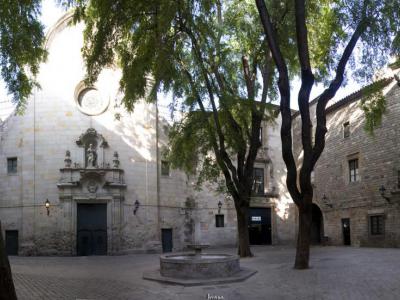
Tucked away in Barcelona's Gothic Quarter, the square of Saint Philip Neri is a picturesque spot exuding a romantic charm, often overlooked by many. The square is named after the Church of Saint Philip Neri which dominates the area. Adjacent to it is the school of the same name, utilizing the square as a playground, and a house occupied by the Oratory of Saint Philip Neri. Central to the square is an octagonal fountain, symbolizing life, surrounded by buildings of Renaissance and Baroque styles.
Historically, this land was the cemetery for the Cathedral of Barcelona's parishioners, guild members, and even condemned criminals. Known as the Nazareth Pit by the 17th century, it became overcrowded during the 1653 Black Death epidemic and served as a mass grave for various tragedies, including a galley wreck in 1684. In 1809, it became the final resting place for patriots executed in an anti-Napoleonic plot. However, burials ceased in 1816 when an old decree to eliminate parish cemeteries was enforced, leading to the transformation of the cemetery into a smaller square.
Curiously enough, at some point, the square housed a unique smugglers' museum in one of the buildings, which is now gone, displaying some 300 objects used for smuggling.
A tragic chapter in the square's history unfolded during the Spanish Civil War. A bomb dropped on January 30, 1938, killed 42 people, mostly children from the adjacent school and refugees from Madrid sheltered at a makeshift orphanage within the church. The second bomb, hitting the square during rescue operations, caused further destruction.
The remnants of these bombings are evident in the pockmarked walls of the church. Post-war, Francoist propaganda misleadingly attributed these marks to bullets from anarchists executing church priests, obscuring the true cause. Today, the Church of Saint Philip Neri is a favored venue for classical concerts due to its unique acoustics.
After the war, the area's rebuilding incorporated Renaissance facades from demolished buildings. A 2009 archaeological survey unearthed a medieval wall, hinting at the site's extensive historical layers, dating back before the 18th-century church and convent constructions.
Presently, despite its turbulent past, Saint Philip Neri Square enjoys a peaceful atmosphere, starkly contrasting its history of violence. This blend of historical depth and cultural vibrancy makes it a profound symbol of Barcelona's layered history and its capacity for renewal and remembrance.
Historically, this land was the cemetery for the Cathedral of Barcelona's parishioners, guild members, and even condemned criminals. Known as the Nazareth Pit by the 17th century, it became overcrowded during the 1653 Black Death epidemic and served as a mass grave for various tragedies, including a galley wreck in 1684. In 1809, it became the final resting place for patriots executed in an anti-Napoleonic plot. However, burials ceased in 1816 when an old decree to eliminate parish cemeteries was enforced, leading to the transformation of the cemetery into a smaller square.
Curiously enough, at some point, the square housed a unique smugglers' museum in one of the buildings, which is now gone, displaying some 300 objects used for smuggling.
A tragic chapter in the square's history unfolded during the Spanish Civil War. A bomb dropped on January 30, 1938, killed 42 people, mostly children from the adjacent school and refugees from Madrid sheltered at a makeshift orphanage within the church. The second bomb, hitting the square during rescue operations, caused further destruction.
The remnants of these bombings are evident in the pockmarked walls of the church. Post-war, Francoist propaganda misleadingly attributed these marks to bullets from anarchists executing church priests, obscuring the true cause. Today, the Church of Saint Philip Neri is a favored venue for classical concerts due to its unique acoustics.
After the war, the area's rebuilding incorporated Renaissance facades from demolished buildings. A 2009 archaeological survey unearthed a medieval wall, hinting at the site's extensive historical layers, dating back before the 18th-century church and convent constructions.
Presently, despite its turbulent past, Saint Philip Neri Square enjoys a peaceful atmosphere, starkly contrasting its history of violence. This blend of historical depth and cultural vibrancy makes it a profound symbol of Barcelona's layered history and its capacity for renewal and remembrance.
12) Pont del Bisbe (Bishop's Bridge)
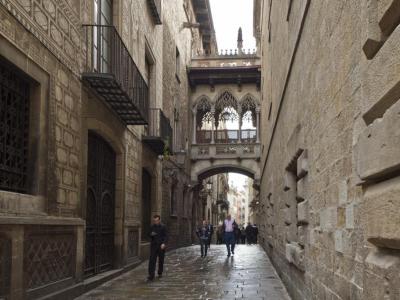
Despite its medieval, centuries-old appearance, Bishop's Bridge is a modern addition to the Gothic Quarter. Constructed in 1928 on the narrow street bearing the same name, the bridge seamlessly blends with the prevalent architectural style of the Gothic Quarter. It was designed by Catalan architect Joan Rubió during his tenure as the official architect of Barcelona in the 1920s.
The neo-Gothic marvel showcases striking architectural elements, such as arched windows, columns, gargoyles, and elaborate stone tracery, making it one of the most photogenic spots in the city. The idea of the bridge connecting the Palace of the Generalitat to the Canons House on the opposite side of the street was inspired by the Bridge of Sighs in Venice.
Joan Rubió, a keen disciple of Antoni Gaudí, had previously worked with the master until 1905. He took part in several iconic projects such as the Sagrada Família, the Batlló House, and Park Güell. Rubió's broader vision to remodel the Gothic Quarter in a neo-Gothic style for the 1929 International Exposition was ultimately rejected by the Barcelona City Council, limiting his influence to this single structure.
A notable feature of the bridge is an eerie skull with a dagger pierced through it, positioned at the bottom of the structure. This grim decoration, added by Rubió in defiance of the council's rejections, has birthed various urban legends. One such myth suggests that Barcelona will fall if the dagger is removed, whereas the other claims that walking backward while looking at the skull grants the viewer a wish. These legends add an element of mystique and allure to the bridge, enhancing its appeal as a curiosity worth visiting in Barcelona.
Tip:
For the best photo opportunities, visit the bridge in the morning or late afternoon when the lighting conditions are favorable.
The neo-Gothic marvel showcases striking architectural elements, such as arched windows, columns, gargoyles, and elaborate stone tracery, making it one of the most photogenic spots in the city. The idea of the bridge connecting the Palace of the Generalitat to the Canons House on the opposite side of the street was inspired by the Bridge of Sighs in Venice.
Joan Rubió, a keen disciple of Antoni Gaudí, had previously worked with the master until 1905. He took part in several iconic projects such as the Sagrada Família, the Batlló House, and Park Güell. Rubió's broader vision to remodel the Gothic Quarter in a neo-Gothic style for the 1929 International Exposition was ultimately rejected by the Barcelona City Council, limiting his influence to this single structure.
A notable feature of the bridge is an eerie skull with a dagger pierced through it, positioned at the bottom of the structure. This grim decoration, added by Rubió in defiance of the council's rejections, has birthed various urban legends. One such myth suggests that Barcelona will fall if the dagger is removed, whereas the other claims that walking backward while looking at the skull grants the viewer a wish. These legends add an element of mystique and allure to the bridge, enhancing its appeal as a curiosity worth visiting in Barcelona.
Tip:
For the best photo opportunities, visit the bridge in the morning or late afternoon when the lighting conditions are favorable.
13) Temple d'August - MUHBA (Temple of Augustus)
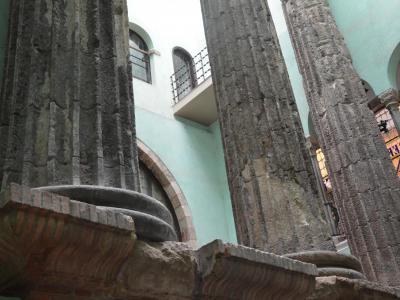
The Temple of Augustus, formerly a central piece of the Roman colony of Bàrcino, is a significant historical site preserved within the headquarters of the Excursionist Center of Catalonia. Embedded within a Gothic-period building, it features four Corinthian columns, remnants of the only known temple in Roman Barcino. Believed to have been dedicated to Emperor Augustus, the temple occupied the highest position of the ancient city, near the current Saint James's Square.
At some point, it was demolished, and its remains were hidden until the late 19th century when three of its columns emerged at the construction site of Catalonia's Hiking Club. Subsequently, a fourth column was revealed at King's Square and later incorporated into the structure, as it stands today.
According to research, the temple was originally surrounded by 11 columns on each side, including corner columns, with six columns at the front and another six at the rear. The entire building would have measured 17.5 by 44 meters, elevated on a podium approximately one-third the height of the columns. Noted for their fluted design and Corinthian capitals, the columns have been documented since the 14th century, although their origin is subject to various interpretations. Historical figures, from mythical kings to suggestions of aqueduct parts, have been proposed as explanations for their presence.
Although initially misattributed to the Carthaginians, later studies by Modernist architect Josep Puig reaffirmed the temple’s dedication to Emperor Augustus, placing its construction in the early Roman Empire, which indeed correlates with Barcino’s founding during Augustus's rule.
When visiting this site, keep an eye out for helpful photographs and recreations of this ancient landmark.
At some point, it was demolished, and its remains were hidden until the late 19th century when three of its columns emerged at the construction site of Catalonia's Hiking Club. Subsequently, a fourth column was revealed at King's Square and later incorporated into the structure, as it stands today.
According to research, the temple was originally surrounded by 11 columns on each side, including corner columns, with six columns at the front and another six at the rear. The entire building would have measured 17.5 by 44 meters, elevated on a podium approximately one-third the height of the columns. Noted for their fluted design and Corinthian capitals, the columns have been documented since the 14th century, although their origin is subject to various interpretations. Historical figures, from mythical kings to suggestions of aqueduct parts, have been proposed as explanations for their presence.
Although initially misattributed to the Carthaginians, later studies by Modernist architect Josep Puig reaffirmed the temple’s dedication to Emperor Augustus, placing its construction in the early Roman Empire, which indeed correlates with Barcino’s founding during Augustus's rule.
When visiting this site, keep an eye out for helpful photographs and recreations of this ancient landmark.
14) Placa de Sant Jaume (St. James's Square)
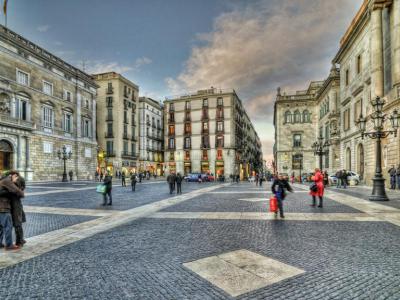
Saint James's Square is the administrative heart of Barcelona, housing both the Government of Catalonia and the Barcelona City Council. It also serves as an excellent landmark for navigating the intricate streets of the Gothic Quarter.
The area's historic roots trace back to the Roman colony of Bàrcino as a crossroads of the main Roman thoroughfares, where the Forum and the Temple of Augustus once stood. Four columns from the Temple have been preserved and can still be seen atop the hill known as Mont Taber.
The square itself has been in existence since at least 1261. A porch where city councilors convened for meetings, the precursor of the future headquarters of the municipal government, was added in the 14th century. In 1598, the Generalitat Palace was enlarged, subsequently extending the square too. Further major transformations occurred in the 19th century when the City Council decided to demolish adjacent buildings to create a larger square, which was inaugurated in 1840 as Constitution Square-a name it held until 2013.
Throughout the 19th century, the square became a vibrant spot with a flea market operating three times a week. It also emerged as a crucial cultural hub for the Castellers of Barcelona, a group of acrobatic performers who climb on top of each other, creating human towers – or “castles” – reaching up to several storeys high.
In 2004, an archaeological dig in the area unearthed remains of ancient walls, providing a glimpse into the square’s layered past.
Today, the square's architecture remains a prominent feature, with two striking buildings vying for attention. The City Council presides on the one side, while the Catalonian government building, known as the Generalitat, commands attention on the other. The square also continues to be a traditional gathering place for demonstrations and festivals.
Tip:
With many restaurants open until midnight and a constant buzz of activity, Saint James's Square is one of the liveliest parts of Barcelona during late hours. However, it is important to exercise caution here as pedestrians share the space with cars and bicycles.
The area's historic roots trace back to the Roman colony of Bàrcino as a crossroads of the main Roman thoroughfares, where the Forum and the Temple of Augustus once stood. Four columns from the Temple have been preserved and can still be seen atop the hill known as Mont Taber.
The square itself has been in existence since at least 1261. A porch where city councilors convened for meetings, the precursor of the future headquarters of the municipal government, was added in the 14th century. In 1598, the Generalitat Palace was enlarged, subsequently extending the square too. Further major transformations occurred in the 19th century when the City Council decided to demolish adjacent buildings to create a larger square, which was inaugurated in 1840 as Constitution Square-a name it held until 2013.
Throughout the 19th century, the square became a vibrant spot with a flea market operating three times a week. It also emerged as a crucial cultural hub for the Castellers of Barcelona, a group of acrobatic performers who climb on top of each other, creating human towers – or “castles” – reaching up to several storeys high.
In 2004, an archaeological dig in the area unearthed remains of ancient walls, providing a glimpse into the square’s layered past.
Today, the square's architecture remains a prominent feature, with two striking buildings vying for attention. The City Council presides on the one side, while the Catalonian government building, known as the Generalitat, commands attention on the other. The square also continues to be a traditional gathering place for demonstrations and festivals.
Tip:
With many restaurants open until midnight and a constant buzz of activity, Saint James's Square is one of the liveliest parts of Barcelona during late hours. However, it is important to exercise caution here as pedestrians share the space with cars and bicycles.
