Custom Walk in Cartagena, Spain by lschoelen1001_a8c38 created on 2025-11-05
Guide Location: Spain » Cartagena
Guide Type: Custom Walk
# of Sights: 5
Tour Duration: 1 Hour(s)
Travel Distance: 1.6 Km or 1 Miles
Share Key: VNGX5
Guide Type: Custom Walk
# of Sights: 5
Tour Duration: 1 Hour(s)
Travel Distance: 1.6 Km or 1 Miles
Share Key: VNGX5
How It Works
Please retrieve this walk in the GPSmyCity app. Once done, the app will guide you from one tour stop to the next as if you had a personal tour guide. If you created the walk on this website or come to the page via a link, please follow the instructions below to retrieve the walk in the app.
Retrieve This Walk in App
Step 1. Download the app "GPSmyCity: Walks in 1K+ Cities" on Apple App Store or Google Play Store.



Step 2. In the GPSmyCity app, download(or launch) the guide "Cartagena Map and Walking Tours".
Step 3. Tap the menu button located at upper right corner of the "Walks" screen and select "Retrieve custom walk". Enter the share key: VNGX5

1) Roman Theatre (must see)
The Roman Theater is a remarkable archaeological site that carries a rich history dating back to the first century BC. It was constructed between 5 and 1 BC, dedicated to Gaius and Lucius Caesar, the grandsons of Emperor Augustus, who intended them to be his successors.
Throughout the centuries, the theater witnessed various transformations. In the 3rd century, a market was erected above it, cleverly reusing its materials and maintaining a semi-circular layout reminiscent of the theater's orchestra. It wasn't until 1988 that the first remains of the theater were rediscovered during the construction of the Regional Crafts Center.
The Roman Theater was ingeniously carved into the rocks, particularly in its central section, where it presides over a series of vaulted galleries. This magnificent structure could accommodate around 6,000 spectators and was divided horizontally into three parts: the lower, the middle, and the upper seating tiers. Radial sectors were created by a network of staircases, with five in the upper section, seven in the medium and upper tiers.
Two side passages served as entry points for the audience, revealing inscriptions dedicated to the theater's benefactors. The orchestra boasted a semicircular design and featured three rows of wooden seats for dignitaries. The scaenae frons, the stage backdrop, was adorned with three semicircular recessed niches and adorned with two orders of columns.
The stage edifice reached a towering height of more than 14 meters and featured notable elements, including three round altars dedicated to the Capitoline Triad and Apollo's associated divinities, such as the Graces, Muses, and Horae. Statues of Apollo playing the lyre and Rhea Silvia were also found nearby. Situated behind the stage building was a portico, featuring a double gallery encircling a central garden.
Throughout the centuries, the theater witnessed various transformations. In the 3rd century, a market was erected above it, cleverly reusing its materials and maintaining a semi-circular layout reminiscent of the theater's orchestra. It wasn't until 1988 that the first remains of the theater were rediscovered during the construction of the Regional Crafts Center.
The Roman Theater was ingeniously carved into the rocks, particularly in its central section, where it presides over a series of vaulted galleries. This magnificent structure could accommodate around 6,000 spectators and was divided horizontally into three parts: the lower, the middle, and the upper seating tiers. Radial sectors were created by a network of staircases, with five in the upper section, seven in the medium and upper tiers.
Two side passages served as entry points for the audience, revealing inscriptions dedicated to the theater's benefactors. The orchestra boasted a semicircular design and featured three rows of wooden seats for dignitaries. The scaenae frons, the stage backdrop, was adorned with three semicircular recessed niches and adorned with two orders of columns.
The stage edifice reached a towering height of more than 14 meters and featured notable elements, including three round altars dedicated to the Capitoline Triad and Apollo's associated divinities, such as the Graces, Muses, and Horae. Statues of Apollo playing the lyre and Rhea Silvia were also found nearby. Situated behind the stage building was a portico, featuring a double gallery encircling a central garden.
2) Museo Foro Romano Molinete (Roman Forum Molinete Museum) (must see)
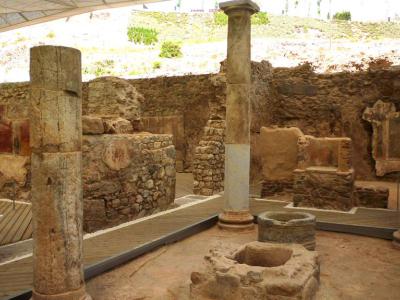
The Roman Forum Molinete Museum occupies the slopes of Molinete Hill, preserving one of the most important archaeological areas of the ancient Roman city of Carthago Nova. Discovered and excavated in recent decades, this complex reveals the civic and religious heart of the Roman settlement, dating mainly from the 1st century BC to the 3rd century AD. Today, the museum combines indoor interpretation with an open-air archaeological walk, allowing visitors to move directly through the remains of the ancient forum.
Your visit begins inside the modern museum building, where introductory galleries explain the urban layout of Roman Cartagena. From here, follow the clearly marked route downward toward the south and outward onto the archaeological walk, which forms the core of the experience. As you step outside, continue along the designated path that winds across the hillside, generally leading westward while descending, offering a gradual transition through different sections of the site.
One of the first major highlights you will encounter along this route is the thermal baths complex. Continue forward along the main path, keeping to your left as the terrain slopes down, to reach this area, where you can identify heated rooms, service corridors, and sections of flooring that once formed part of a sophisticated bathing system. From here, follow the path as it curves to the right and slightly north, leading you toward the Atrium Building, a large structure organized around a central open courtyard.
Continuing along the same route, proceed forward and slightly upward to the northwest, where you will arrive at the Sanctuary of Isis, one of the most distinctive elements of the site. Dedicated to the Egyptian goddess Isis, this area reflects the cultural diversity of Roman Cartagena and its Mediterranean connections. From here, continue northward, and the path opens into the area of the Colonial Forum, the civic center of the ancient city.
Your visit begins inside the modern museum building, where introductory galleries explain the urban layout of Roman Cartagena. From here, follow the clearly marked route downward toward the south and outward onto the archaeological walk, which forms the core of the experience. As you step outside, continue along the designated path that winds across the hillside, generally leading westward while descending, offering a gradual transition through different sections of the site.
One of the first major highlights you will encounter along this route is the thermal baths complex. Continue forward along the main path, keeping to your left as the terrain slopes down, to reach this area, where you can identify heated rooms, service corridors, and sections of flooring that once formed part of a sophisticated bathing system. From here, follow the path as it curves to the right and slightly north, leading you toward the Atrium Building, a large structure organized around a central open courtyard.
Continuing along the same route, proceed forward and slightly upward to the northwest, where you will arrive at the Sanctuary of Isis, one of the most distinctive elements of the site. Dedicated to the Egyptian goddess Isis, this area reflects the cultural diversity of Roman Cartagena and its Mediterranean connections. From here, continue northward, and the path opens into the area of the Colonial Forum, the civic center of the ancient city.

3) Calle Mayor (Main Street) (must see)
Main Street is a charming pedestrian-only avenue that offers a captivating experience of the city's vibrant essence. It stands as the primary retail district in Cartagena, boasting an array of shopping opportunities. As you wander down this picturesque street, you'll come across department stores, fashionable boutiques, and jewelry shops, making it a shopaholic's paradise. The blue marble tiles that pave the street are reserved for pedestrians, encouraging leisurely exploration.
The allure of Main Street extends beyond shopping. It is home to a plethora of restaurants, cafes, and bars, many of which offer outdoor terraces where you can sit and savor local cuisine while basking in the city's lively atmosphere. The architectural backdrop enhances the overall experience, with elegant Modernista-style buildings framing the street.
As you stand on Main Street facing south toward the harbor, two of Cartagena’s most elegant buildings appear immediately on your left: the richly decorated Cartagena Casino and the Modernist Cervantes House. On the opposite side of the street stands the Birthplace of Spanish naval officer Antonio de Escaño, who was the commander of the Spanish fleet in the Battle of Trafalfar and is regarded as one of the best naval tacticians of the 18th century. As you walk south along the street, look up to notice the distinctive Balconies of Main Street, whose ornate ironwork and glass enclosures reflect the city’s architectural prosperity at the turn of the 20th century.
If instead you walk north along Main Street, additional historic sites appear along the route. On the right stands the Chapel of Jesus the Nazarene, followed further along by the Military Church of Saint Dominic. On the left side of the street, archaeological remains mark part of the ancient harbor infrastructure: the Roman Port Wharf Remains, fragments of the port facilities that once served the Roman city of Carthago Nova.
While Main Street is undoubtedly the heart of the action, don't forget to venture into the narrow side streets that branch off from it. These charming alleys often hide hidden gems, from quaint shops to cozy cafes, each with its unique character waiting to be discovered.
The allure of Main Street extends beyond shopping. It is home to a plethora of restaurants, cafes, and bars, many of which offer outdoor terraces where you can sit and savor local cuisine while basking in the city's lively atmosphere. The architectural backdrop enhances the overall experience, with elegant Modernista-style buildings framing the street.
As you stand on Main Street facing south toward the harbor, two of Cartagena’s most elegant buildings appear immediately on your left: the richly decorated Cartagena Casino and the Modernist Cervantes House. On the opposite side of the street stands the Birthplace of Spanish naval officer Antonio de Escaño, who was the commander of the Spanish fleet in the Battle of Trafalfar and is regarded as one of the best naval tacticians of the 18th century. As you walk south along the street, look up to notice the distinctive Balconies of Main Street, whose ornate ironwork and glass enclosures reflect the city’s architectural prosperity at the turn of the 20th century.
If instead you walk north along Main Street, additional historic sites appear along the route. On the right stands the Chapel of Jesus the Nazarene, followed further along by the Military Church of Saint Dominic. On the left side of the street, archaeological remains mark part of the ancient harbor infrastructure: the Roman Port Wharf Remains, fragments of the port facilities that once served the Roman city of Carthago Nova.
While Main Street is undoubtedly the heart of the action, don't forget to venture into the narrow side streets that branch off from it. These charming alleys often hide hidden gems, from quaint shops to cozy cafes, each with its unique character waiting to be discovered.

4) Museo Del Teatro Romano (Roman Theater Museum of Cartagena)
The Roman Theater Museum is dedicated to the excavation, restoration, and preservation of the Roman theater of Cartagena. Designed by Rafael Moneo and opened in 2008, the museum forms part of a larger project that brought the long-buried Roman Theatre of Cartagena back into public view after its rediscovery in 1988. The theatre had remained hidden for centuries beneath layers of later construction, including parts of the old cathedral.
Rather than presenting the theatre as a standalone monument, the project integrates exhibition spaces, underground passages, and the site itself into a single experience. The visit begins at the Riquelme Palace, located opposite Cartagena City Hall. After entering, proceed through the reception area and continue into the first set of rooms on the ground floor, with introductory panels.
From here, follow the designated path downward through a descending corridor that connects the palace to the modern museum building. This passage transitions you from the historic entrance into the main exhibition space. Once inside, continue forward into the first gallery, where models and visual displays explain the original structure of the theater, including its seating layout and stage design.
Moving ahead, the route leads you through a sequence of connected exhibition rooms, generally arranged in a linear progression. On either side, you will find displays of sculptural fragments, columns, inscriptions, and decorative elements recovered from the site. Continue straight through these galleries, where audiovisual presentations and reconstructed models provide additional context.
Continue along the main route until you reach a larger transitional hall, where partial views of the archaeological remains begin to appear. From here, follow the clearly marked exit passage, which leads you outward and slightly downward. The final section opens directly onto the Roman theater. From this point, you can walk along the restored steps and approach the stage area.
Rather than presenting the theatre as a standalone monument, the project integrates exhibition spaces, underground passages, and the site itself into a single experience. The visit begins at the Riquelme Palace, located opposite Cartagena City Hall. After entering, proceed through the reception area and continue into the first set of rooms on the ground floor, with introductory panels.
From here, follow the designated path downward through a descending corridor that connects the palace to the modern museum building. This passage transitions you from the historic entrance into the main exhibition space. Once inside, continue forward into the first gallery, where models and visual displays explain the original structure of the theater, including its seating layout and stage design.
Moving ahead, the route leads you through a sequence of connected exhibition rooms, generally arranged in a linear progression. On either side, you will find displays of sculptural fragments, columns, inscriptions, and decorative elements recovered from the site. Continue straight through these galleries, where audiovisual presentations and reconstructed models provide additional context.
Continue along the main route until you reach a larger transitional hall, where partial views of the archaeological remains begin to appear. From here, follow the clearly marked exit passage, which leads you outward and slightly downward. The final section opens directly onto the Roman theater. From this point, you can walk along the restored steps and approach the stage area.

5) National Museum of Subaquatic Archaeology (must see)
The National Museum of Underwater Archaeology opened in 2008 on the city’s waterfront and serves both as a public exhibition space and as a national research center for underwater archaeology. Its collections present the long maritime history of the Mediterranean coast, displaying artifacts recovered from shipwrecks and submerged sites dating from the Phoenician period through the Roman era and into the early modern age.
Among the museum’s highlights are amphorae used in ancient maritime trade, navigational instruments, anchors, ceramics, and personal objects recovered from vessels that once sailed across the Mediterranean. These finds illustrate the intense commercial networks that connected Iberia with Phoenician, Greek, and Roman ports. The museum also explains the techniques used in underwater excavation and conservation, offering visitors insight into how archaeologists document and preserve fragile objects that have spent centuries beneath the sea.
One of the museum’s most remarkable acquisitions arrived in 2012, when it received a vast cargo of gold and silver coins recovered from the wreck of the Spanish frigate Our Lady of Mercy. The vessel sank in 1804 after a naval encounter with British forces near the coast of Portugal while, was returned to Spain following a lengthy international legal case and was entrusted to the museum for cataloguing, conservation, and scholarly study before being placed on display.
Today, the museum offers visitors a compelling glimpse into the hidden history preserved beneath the waves. Through its exhibitions, research programmes, and conservation laboratories, it reveals how shipwrecks and submerged landscapes help illuminate centuries of maritime trade, naval conflict, and cultural exchange across the Mediterranean world.
Among the museum’s highlights are amphorae used in ancient maritime trade, navigational instruments, anchors, ceramics, and personal objects recovered from vessels that once sailed across the Mediterranean. These finds illustrate the intense commercial networks that connected Iberia with Phoenician, Greek, and Roman ports. The museum also explains the techniques used in underwater excavation and conservation, offering visitors insight into how archaeologists document and preserve fragile objects that have spent centuries beneath the sea.
One of the museum’s most remarkable acquisitions arrived in 2012, when it received a vast cargo of gold and silver coins recovered from the wreck of the Spanish frigate Our Lady of Mercy. The vessel sank in 1804 after a naval encounter with British forces near the coast of Portugal while, was returned to Spain following a lengthy international legal case and was entrusted to the museum for cataloguing, conservation, and scholarly study before being placed on display.
Today, the museum offers visitors a compelling glimpse into the hidden history preserved beneath the waves. Through its exhibitions, research programmes, and conservation laboratories, it reveals how shipwrecks and submerged landscapes help illuminate centuries of maritime trade, naval conflict, and cultural exchange across the Mediterranean world.
