Custom Walk in Gdansk, Poland by tracey_butler4625 created on 2025-12-08
Guide Location: Poland » Gdansk
Guide Type: Custom Walk
# of Sights: 8
Tour Duration: 4 Hour(s)
Travel Distance: 11 Km or 6.8 Miles
Share Key: NH7EZ
Guide Type: Custom Walk
# of Sights: 8
Tour Duration: 4 Hour(s)
Travel Distance: 11 Km or 6.8 Miles
Share Key: NH7EZ
How It Works
Please retrieve this walk in the GPSmyCity app. Once done, the app will guide you from one tour stop to the next as if you had a personal tour guide. If you created the walk on this website or come to the page via a link, please follow the instructions below to retrieve the walk in the app.
Retrieve This Walk in App
Step 1. Download the app "GPSmyCity: Walks in 1K+ Cities" on Apple App Store or Google Play Store.



Step 2. In the GPSmyCity app, download(or launch) the guide "Gdansk Map and Walking Tours".
Step 3. Tap the menu button located at upper right corner of the "Walks" screen and select "Retrieve custom walk". Enter the share key: NH7EZ
1) Great Armory
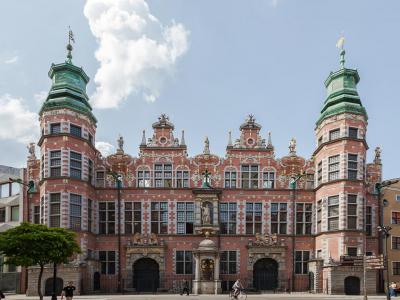
The Great armory, part of the defensive walls of the Main Town, was built in 1605. The design is Dutch Mannerist.
The building was used as an arsenal until the end of the World War I. During the Free City era between World War I and II, the ground floor was converted to a shopping arcade. The upper floors were for goods storage. In 1945 the interior of the building was consumed by fire. The roofs, interiors, gables and domes were restored by 1954.
The Armory is a perfect example of Dutch renaissance architecture. It has two octagonal towers on the eastern facade. There are two facades and four gabled roofs parallel to each other. The corner turrets have domes and spires. The basement has a barrel vault with lunettes and pillars. The ground floor has four naves with six bays.
The west face is designed with four tenement house facades. The portals have arches with quoins. The Mannerist decorations are lush in the upper facades.
In May, 1954 the Armory became the home of the Academy of Fine Arts. Work continued on the facades and interiors up to 2005. Today the building is dedicated to "exhibition, education, promotion and archiving." It is considered an "Armory of Art."
The building was used as an arsenal until the end of the World War I. During the Free City era between World War I and II, the ground floor was converted to a shopping arcade. The upper floors were for goods storage. In 1945 the interior of the building was consumed by fire. The roofs, interiors, gables and domes were restored by 1954.
The Armory is a perfect example of Dutch renaissance architecture. It has two octagonal towers on the eastern facade. There are two facades and four gabled roofs parallel to each other. The corner turrets have domes and spires. The basement has a barrel vault with lunettes and pillars. The ground floor has four naves with six bays.
The west face is designed with four tenement house facades. The portals have arches with quoins. The Mannerist decorations are lush in the upper facades.
In May, 1954 the Armory became the home of the Academy of Fine Arts. Work continued on the facades and interiors up to 2005. Today the building is dedicated to "exhibition, education, promotion and archiving." It is considered an "Armory of Art."
2) Golden Gate
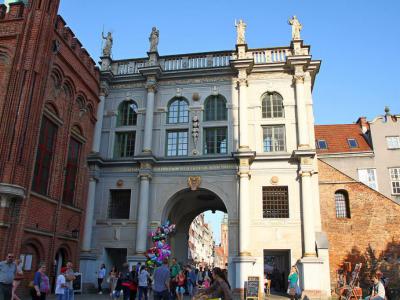
The Golden Gate straddles Long Street at the inland entrance to the Royal Route of Gdansk. It was built in 1614 to replace a 13th century Gothic Gate called Long Street Gate. The Golden Gate forms part of the old city fortifications, together with The Highland Gate and the Prison Tower, also located on Long Street.
The Golden gate was designed by architect Abraham van den Blocke of Holland. The style is Dutch Mannerist. Each side of the Gate has attiques with figures representing civic values. The values are: Peace, Freedom, Fortune, Fame, Concord, Justice, Piety and Wisdom.
A Latin inscription declares small republics prosper in concord and fail in discord. Badly damaged in World War II, the Gate was restored completely in 1957. More comprehensive restoration works, including the facade decor of murals and gilding were carried out in 1998.
The Golden gate was designed by architect Abraham van den Blocke of Holland. The style is Dutch Mannerist. Each side of the Gate has attiques with figures representing civic values. The values are: Peace, Freedom, Fortune, Fame, Concord, Justice, Piety and Wisdom.
A Latin inscription declares small republics prosper in concord and fail in discord. Badly damaged in World War II, the Gate was restored completely in 1957. More comprehensive restoration works, including the facade decor of murals and gilding were carried out in 1998.
3) Brama Wyżynna (Upland Gate)
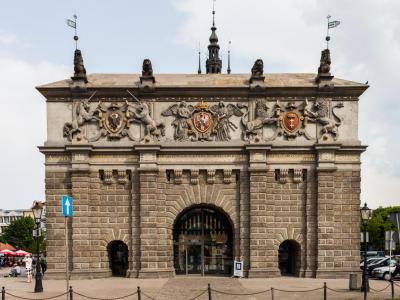
The Upland Gate (Brama Wyżynna) in Gdańsk, built in the 16th century, served as the main entrance to the Old Town and marked the beginning of The Royal Way. Its strategic upland location above the water level is reflected in its name, 'Upland Gate'. This positioning was significant, as it was constructed in relation to the moat that surrounded the city, emphasizing its defensive function.
The Upland Gate is renowned for its architectural beauty, featuring the Mannerist style typical of its era. It was once a part of Gdańsk's defensive ramparts and was originally accessed via a drawbridge over a moat, showcasing the city's medieval defensive strategies. The system's details, like the metal pulleys for the drawbridge, remain visible under Poland, Prussia, and Gdańsk's coats of arms, providing insight into the gate's history.
Significantly, the gate has long been a site of ceremonial significance, where visiting monarchs were welcomed with keys to the city, symbolizing their access and high esteem. This tradition highlights the gate's role as a symbol of power and hospitality.
The Upland Gate was designed and supervised by Hans Kramer from Dresden, with the artistic contributions of Willem Van Den Blocke, who crafted the sculpted leaves adorning the walls. These elements contribute to the gate's aesthetic and historical significance.
In modern times, the gate has been subject to major renovation work and now houses a tourist information point, making it an essential stop for visitors exploring Gdańsk. Walking through the Upland Gate is akin to retracing the steps of historical figures, offering a tangible connection to the past. This gate is not only an architectural marvel but also a testament to Gdańsk's historical importance and resilience.
The Upland Gate is renowned for its architectural beauty, featuring the Mannerist style typical of its era. It was once a part of Gdańsk's defensive ramparts and was originally accessed via a drawbridge over a moat, showcasing the city's medieval defensive strategies. The system's details, like the metal pulleys for the drawbridge, remain visible under Poland, Prussia, and Gdańsk's coats of arms, providing insight into the gate's history.
Significantly, the gate has long been a site of ceremonial significance, where visiting monarchs were welcomed with keys to the city, symbolizing their access and high esteem. This tradition highlights the gate's role as a symbol of power and hospitality.
The Upland Gate was designed and supervised by Hans Kramer from Dresden, with the artistic contributions of Willem Van Den Blocke, who crafted the sculpted leaves adorning the walls. These elements contribute to the gate's aesthetic and historical significance.
In modern times, the gate has been subject to major renovation work and now houses a tourist information point, making it an essential stop for visitors exploring Gdańsk. Walking through the Upland Gate is akin to retracing the steps of historical figures, offering a tangible connection to the past. This gate is not only an architectural marvel but also a testament to Gdańsk's historical importance and resilience.
4) Jailing Museum
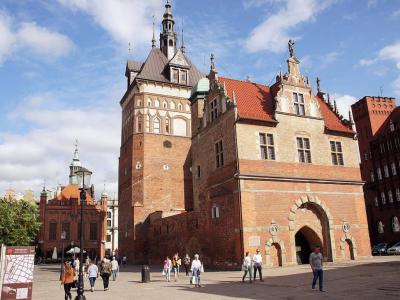
The Jailing Museum in Gdańsk offers a unique and somewhat macabre journey through the annals of crime and punishment. Housed in ancient buildings that date back to the Middle Ages, these structures have a long history, initially serving as defense posts for the city. In the mid-1600s, they underwent renovations and took on a new role as a prison and execution site, a function that left a lasting imprint on their walls and the museum's overall ambiance.
Opened in 1983, the Jailing Museum provides a comprehensive look at the evolution of crime, punishment, and law enforcement over the centuries. Its exhibits are both fascinating and chilling, featuring a range of artifacts that include weapons used by city guards, an array of torture devices, and tools used for execution. These macabre exhibits offer a glimpse into the darker aspects of human history and are not for the faint-hearted.
Additionally, the museum displays a variety of police weapons, objects, and evidence linked to historical crimes, shedding light on the methods used in crime detection and prevention. This spans from the defensive systems of the Middle Ages to the more modern approaches to policing and criminal investigation.
One of the most intriguing aspects of the Jailing Museum is its collection of criminal gadgetry. This includes tools and devices used by criminal masterminds, juxtaposed with the machines and technologies developed to counteract their activities and bring them to justice. This aspect of the museum offers a unique perspective on the perpetual struggle between lawbreakers and law enforcers.
Opened in 1983, the Jailing Museum provides a comprehensive look at the evolution of crime, punishment, and law enforcement over the centuries. Its exhibits are both fascinating and chilling, featuring a range of artifacts that include weapons used by city guards, an array of torture devices, and tools used for execution. These macabre exhibits offer a glimpse into the darker aspects of human history and are not for the faint-hearted.
Additionally, the museum displays a variety of police weapons, objects, and evidence linked to historical crimes, shedding light on the methods used in crime detection and prevention. This spans from the defensive systems of the Middle Ages to the more modern approaches to policing and criminal investigation.
One of the most intriguing aspects of the Jailing Museum is its collection of criminal gadgetry. This includes tools and devices used by criminal masterminds, juxtaposed with the machines and technologies developed to counteract their activities and bring them to justice. This aspect of the museum offers a unique perspective on the perpetual struggle between lawbreakers and law enforcers.
5) Gdańsk Town Hall
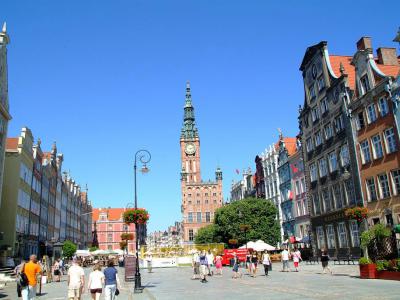
The Main Town Hall of Gdansk is on the Royal Route, on the corner of Long Street and Kaletnicza Street. It is really a building complex of various additions. It is the second highest building of the Old City after Saint Mary's Church. Long Street is closed to all but pedestrian traffic year-round. The Hall is reached by walking.
In 1346 the city of Gdansk replaced Lubeck law with the so-called Kulm law. This change divided government into two parts, the council and the judiciary. Each division required its own hall. Reconstructions occurred in 1382, 1457, 1488, and 1492. There were fires in 1494 and 1556. After the 1556 fire, the hall was rebuilt and enlarged.
The post 1556 rebuild was done by Dutch architects and master-builders Wilhem van den Meer, Dirk Daniels, and Anthonis van Obberghen. A golden statue of King Sigismund II was mounted on top of the tower and a carillon was placed inside.
At present, the Town Hall is home to the Historical Museum of the City of Gdansk. In the summer season one may visit the observation gallery of the tower. There is an admission charge.
In 1346 the city of Gdansk replaced Lubeck law with the so-called Kulm law. This change divided government into two parts, the council and the judiciary. Each division required its own hall. Reconstructions occurred in 1382, 1457, 1488, and 1492. There were fires in 1494 and 1556. After the 1556 fire, the hall was rebuilt and enlarged.
The post 1556 rebuild was done by Dutch architects and master-builders Wilhem van den Meer, Dirk Daniels, and Anthonis van Obberghen. A golden statue of King Sigismund II was mounted on top of the tower and a carillon was placed inside.
At present, the Town Hall is home to the Historical Museum of the City of Gdansk. In the summer season one may visit the observation gallery of the tower. There is an admission charge.
6) Neptune's Fountain
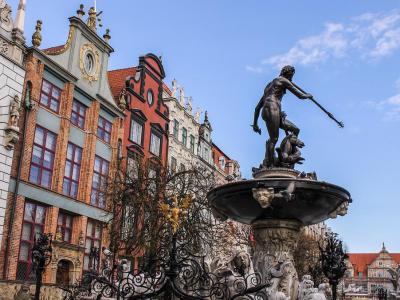
In 1606 Mayor Bartholomaus Schachmann of Gdansk decided the city needed a monumental fountain. The fountain would be near the site of an old well, not far from the river Motlawa and before the facade of Artus Court. The 14th century Town Hall would be seen in the background. The Artus Court is now a branch of the Gdansk History Museum.
Construction began in 1606. The statue of the god faces the royal residences, posed in a deferential bow and wielding his famous trident. The sculpture project was under the direction of Abraham van den Blocke. The statue was made by Flemish sculptor Peter Husen. Neptune is made of bronze, cast in the local guild by Gerdt Benning.
The statue stem is black volcanic tuff. The style is related to Flemish Mannerism. There were delays, such as the Polish-Swedish War, the death of Herr Blocke and the renovation of the Artus Court. The fountain was opened in 1633. In 1634 it was enclosed in a fence with golden Polish eagles. Nazis removed the eagles in World War II.
The fountain was renovated and back in operation with the eagles restored by 1957. In 1988 the god's genitals were covered with a fig leaf. The fountain was fully renovated in 2012.
Construction began in 1606. The statue of the god faces the royal residences, posed in a deferential bow and wielding his famous trident. The sculpture project was under the direction of Abraham van den Blocke. The statue was made by Flemish sculptor Peter Husen. Neptune is made of bronze, cast in the local guild by Gerdt Benning.
The statue stem is black volcanic tuff. The style is related to Flemish Mannerism. There were delays, such as the Polish-Swedish War, the death of Herr Blocke and the renovation of the Artus Court. The fountain was opened in 1633. In 1634 it was enclosed in a fence with golden Polish eagles. Nazis removed the eagles in World War II.
The fountain was renovated and back in operation with the eagles restored by 1957. In 1988 the god's genitals were covered with a fig leaf. The fountain was fully renovated in 2012.
7) Mariacka Street (must see)
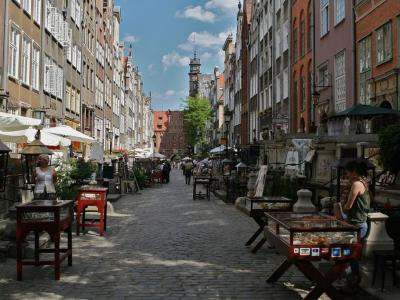
Mariacka Street takes its name from Saint Mary's Church. The cobblestoned street is short and narrow, lined with old burgher houses with mini-terraces, gargoyles and fantastic beasts. It lies between the church and Saint Mary's gate by the river Moltawa. The gargoyles guard against evil and spit rainwater away from the walls.
The medieval spirit is alive on Mariacka Street. The original wooden church at the end of the street was founded by Swietopelk II, Duke of Pomerania in the 13th century. The original name of the street says in Latin: "Our Lady's Street."
Saint Mary's Gate, the 15th century water gate, is at the opposite end of the street. The gate bears the coats of arms Gdansk and Prussia and Poland. Mariacka Street was once the home of workshops and stalls. The burgher houses are embellished with scenes from the Bible, e.g., The Dream of Jacob, the Annunciation, and the Good Samaritan.
Gdansk is the home of Baltic amber and Mariacka Street is the go-to street in Gdansk for amber. The most well-known and respected dealers in amber will be found here. Looking for the best coffee? You are in luck. Some of the best coffee shops and cafes are here as well. Let's not overlook Wine Bar Literacka, it has over 100 wines and fine food.
Next to Saint Mary's Gate is the Archeological Museum with its viewing tower. During Saint Dominic's Fair for three weeks in August, the street is crowded with tourists, bands, cartoonists and vendors. Many times however, Mariacka Street appears empty, pensive and serene.
The medieval spirit is alive on Mariacka Street. The original wooden church at the end of the street was founded by Swietopelk II, Duke of Pomerania in the 13th century. The original name of the street says in Latin: "Our Lady's Street."
Saint Mary's Gate, the 15th century water gate, is at the opposite end of the street. The gate bears the coats of arms Gdansk and Prussia and Poland. Mariacka Street was once the home of workshops and stalls. The burgher houses are embellished with scenes from the Bible, e.g., The Dream of Jacob, the Annunciation, and the Good Samaritan.
Gdansk is the home of Baltic amber and Mariacka Street is the go-to street in Gdansk for amber. The most well-known and respected dealers in amber will be found here. Looking for the best coffee? You are in luck. Some of the best coffee shops and cafes are here as well. Let's not overlook Wine Bar Literacka, it has over 100 wines and fine food.
Next to Saint Mary's Gate is the Archeological Museum with its viewing tower. During Saint Dominic's Fair for three weeks in August, the street is crowded with tourists, bands, cartoonists and vendors. Many times however, Mariacka Street appears empty, pensive and serene.
8) Oliwa Cathedral
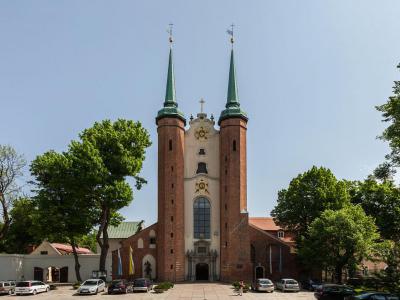
Oliwa Cathedral, formally known as the Archcathedral Basilica of the Holy Trinity, is a prominent church in Gdańsk. This magnificent edifice stands out as a three-nave basilica featuring a transept and a multisided closed presbytery, complete with an ambulatory. The cathedral's striking façade is adorned with two slender 46-meter-tall towers with sharply-edged helmets, a Baroque portal from 1688, varied-sized windows, and three cartouches. A notable feature of the cathedral is its bell tower, a characteristic element of Cistercian architecture.
Remarkably, the cathedral is 17.7 meters high, 19 meters wide, and 107 meters long, with the interior spanning 97.6 meters, making it the longest Cistercian church in the world. The cathedral's interior is a treasure trove of art from the Renaissance, Baroque, Rococo, and Classical periods, reflecting immense artistic value.
There are 23 altars within the cathedral, each of historical significance and mainly crafted in the Baroque and Rococo styles, with some made of marble. Their iconography reflects the principles of the post-Trent church. The most significant altar is the High Altar from 1688, celebrated as the finest Baroque artwork in Pomerania. Additionally, there is a noteworthy Netherland Renaissance style altar which served as the main altar until 1688. The cathedral's paintings, created by renowned 17th-century artists add to its grandeur.
The interior also houses Rococo chapels dedicated to the Holy Cross and Saint John of Nepomuk, an ambo, tombstones, epitaphs, and the tombs of the Pomeranian Dukes and the Kos family. Additionally, it contains a bishop's crypt, antique chandeliers, canopies, and numerous other antiquities. Of particular note is a feretory depicting Our Lady of Oliwa with the Infant Jesus, a revered object carried during the annual pilgrimage to the Calvary of Wejherowo.
Remarkably, the cathedral is 17.7 meters high, 19 meters wide, and 107 meters long, with the interior spanning 97.6 meters, making it the longest Cistercian church in the world. The cathedral's interior is a treasure trove of art from the Renaissance, Baroque, Rococo, and Classical periods, reflecting immense artistic value.
There are 23 altars within the cathedral, each of historical significance and mainly crafted in the Baroque and Rococo styles, with some made of marble. Their iconography reflects the principles of the post-Trent church. The most significant altar is the High Altar from 1688, celebrated as the finest Baroque artwork in Pomerania. Additionally, there is a noteworthy Netherland Renaissance style altar which served as the main altar until 1688. The cathedral's paintings, created by renowned 17th-century artists add to its grandeur.
The interior also houses Rococo chapels dedicated to the Holy Cross and Saint John of Nepomuk, an ambo, tombstones, epitaphs, and the tombs of the Pomeranian Dukes and the Kos family. Additionally, it contains a bishop's crypt, antique chandeliers, canopies, and numerous other antiquities. Of particular note is a feretory depicting Our Lady of Oliwa with the Infant Jesus, a revered object carried during the annual pilgrimage to the Calvary of Wejherowo.
