Custom Walk in Rome, Italy by drnance_7764a3 created on 2026-01-25
Guide Location: Italy » Rome
Guide Type: Custom Walk
# of Sights: 9
Tour Duration: 2 Hour(s)
Travel Distance: 4.3 Km or 2.7 Miles
Share Key: 4GTFD
Guide Type: Custom Walk
# of Sights: 9
Tour Duration: 2 Hour(s)
Travel Distance: 4.3 Km or 2.7 Miles
Share Key: 4GTFD
How It Works
Please retrieve this walk in the GPSmyCity app. Once done, the app will guide you from one tour stop to the next as if you had a personal tour guide. If you created the walk on this website or come to the page via a link, please follow the instructions below to retrieve the walk in the app.
Retrieve This Walk in App
Step 1. Download the app "GPSmyCity: Walks in 1K+ Cities" on Apple App Store or Google Play Store.



Step 2. In the GPSmyCity app, download(or launch) the guide "Rome Map and Walking Tours".
Step 3. Tap the menu button located at upper right corner of the "Walks" screen and select "Retrieve custom walk". Enter the share key: 4GTFD
1) Museo Nazionale di Castel Sant'Angelo (National Museum of the Holy Angel Castle) (must see)
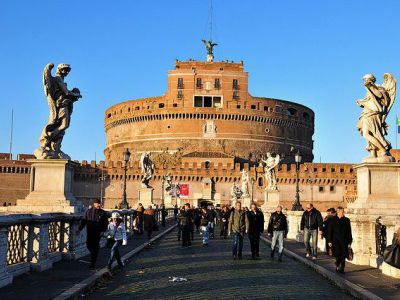
The Mausoleum of Hadrian, commonly known as the Castle of the Holy Angel, is a cylindrical tower in Rome’s Adriano Park. Commissioned by Emperor Hadrian between 134 and 139 AD as a family mausoleum, it was once the tallest building in Rome.
Initially, the mausoleum housed the ashes of Hadrian, his wife Sabina, and subsequent emperors, ending with Caracalla in 217. The structure was adorned with a garden-topped cylinder and a golden quadriga. Hadrian also built the nearby Pons Aelius bridge, which still offers a scenic route adorned with Baroque angel statues.
In 401, the mausoleum was converted into a fortress and incorporated into Rome's Aurelian Walls. Over centuries, its treasures and urns were scattered, including during the Visigoth sack of Rome in 410. The building also served as a defense during the Gothic siege in 537, with statues thrown down on attackers. Some remnants, like a capstone from Hadrian's urn, found their way into significant structures such as Saint Peter’s Basilica.
Legend holds that Archangel Michael appeared over the building in 590, signaling the end of a plague and inspiring the castle's current name. The statue of Michael atop the castle, first sculpted in 1536 and replaced by a bronze version in 1753, commemorates this event.
The popes transformed the structure into a fortress and residence. Pope Nicholas III linked it to Saint Peter's Basilica with the fortified Borgo Passage, while Clement VII used it as a refuge during the 1527 Sack of Rome (by the mutinous troops of the Holy Roman Emperor, Charles V). The castle also became a prison, housing figures like the Italian philosopher and astrologer Giordano Bruno. Executions occurred in its courtyard, and the structure was immortalized in Puccini’s opera Tosca.
Decommissioned as a fortress in 1901, the castle now operates as a museum, attracting over a million visitors per year. It offers a fascinating display, featuring cannons, armor, and ornately decorated papal apartments. A highlight is the hidden passageway connecting the Vatican to the castle.
Visitors can enjoy coffee with incredible views of Saint Peter's Basilica at the on-site café. For breathtaking panoramas of Rome and Vatican City, head to the rooftop terrace, ideal on clear days or evenings to experience the city's vibrant nighttime charm. While there is some walking involved, the museum is easily navigable and offers a memorable blend of history, architecture, and stunning vistas.
Initially, the mausoleum housed the ashes of Hadrian, his wife Sabina, and subsequent emperors, ending with Caracalla in 217. The structure was adorned with a garden-topped cylinder and a golden quadriga. Hadrian also built the nearby Pons Aelius bridge, which still offers a scenic route adorned with Baroque angel statues.
In 401, the mausoleum was converted into a fortress and incorporated into Rome's Aurelian Walls. Over centuries, its treasures and urns were scattered, including during the Visigoth sack of Rome in 410. The building also served as a defense during the Gothic siege in 537, with statues thrown down on attackers. Some remnants, like a capstone from Hadrian's urn, found their way into significant structures such as Saint Peter’s Basilica.
Legend holds that Archangel Michael appeared over the building in 590, signaling the end of a plague and inspiring the castle's current name. The statue of Michael atop the castle, first sculpted in 1536 and replaced by a bronze version in 1753, commemorates this event.
The popes transformed the structure into a fortress and residence. Pope Nicholas III linked it to Saint Peter's Basilica with the fortified Borgo Passage, while Clement VII used it as a refuge during the 1527 Sack of Rome (by the mutinous troops of the Holy Roman Emperor, Charles V). The castle also became a prison, housing figures like the Italian philosopher and astrologer Giordano Bruno. Executions occurred in its courtyard, and the structure was immortalized in Puccini’s opera Tosca.
Decommissioned as a fortress in 1901, the castle now operates as a museum, attracting over a million visitors per year. It offers a fascinating display, featuring cannons, armor, and ornately decorated papal apartments. A highlight is the hidden passageway connecting the Vatican to the castle.
Visitors can enjoy coffee with incredible views of Saint Peter's Basilica at the on-site café. For breathtaking panoramas of Rome and Vatican City, head to the rooftop terrace, ideal on clear days or evenings to experience the city's vibrant nighttime charm. While there is some walking involved, the museum is easily navigable and offers a memorable blend of history, architecture, and stunning vistas.
2) Fontana dei Quattro Fiumi (Fountain of the Four Rivers) (must see)
The focal point of Navona Square, the Fountain of the Four Rivers has been in place since the 17th century. While Rome has a longstanding affinity for fountains, dating back to antiquity, the Baroque era brought a new dimension to these water features, showcasing the generosity of the papacy.
In the case of the Fountain of the Four Rivers, Pope Innocent X, whose family seat – the Pamphili Palace – overlooks the square, entrusted the task to one of the most groundbreaking artists of the time, Gian Lorenzo Bernini. Created in 1651, the fountain was Rome's pinnacle achievement in fountain design, a symbolic masterpiece brimming with the dynamic and dramatic elements sought after by Baroque artists. Its central Egyptian obelisk is crowned with the Pamphili emblem, a dove with an olive twig.
Pope Innocent X chose Bernini after being secretly shown his model. The fountain was innovative, combining sculpture and architecture in a way unmatched by previous Roman fountains.
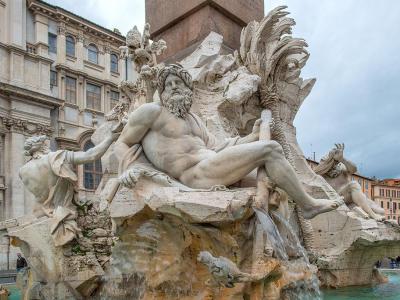
Here, the travertine base supports sculptures of four river gods, representing the major rivers of the continents over which papal authority had extended at that time. These include the Nile (for Africa), the Danube (for Europe), the Ganges (for Asia), and the Plate (for the Americas). Each figure conveys symbolic details: the Ganges is depicted holding a long oar, symbolizing the river's navigability; the Nile's veiled head signifies its unknown source; the Danube, the largest river near Rome touches the Pope's coat of arms; and the Plate sits atop a pile of coins, reflecting America’s wealth.
The fountain's unveiling on June 12, 1651, was marked by grand celebrations orchestrated by the Pamphili family. Allegorical figures of Fame and Curiosity paraded the streets, urging Romans to witness the reveal. The crowd marveled at the lifelike sculptures and water features, described as naturalistic and astonishing.
However, the project faced significant public opposition. Critics condemned its expense during the famine of 1646 to 1648, expressing their discontent through pasquinades demanding "Bread, not fountains." Street vendors and Roman Jews lamented their displacement from the square's market, which was closed to enhance its splendor.
Despite the controversy, the Fountain of the Four Rivers remains a cornerstone of Rome’s cultural and architectural legacy, blending mythology, artistry, and geographical narratives.
Tip:
To capture the essence of this fountain in photographs, it is recommended to shoot from various angles and positions, so as to get as much detail as possible. With ample space surrounding the fountain, take your time to find the perfect shot-or perhaps even multiple perfect shots.
In the case of the Fountain of the Four Rivers, Pope Innocent X, whose family seat – the Pamphili Palace – overlooks the square, entrusted the task to one of the most groundbreaking artists of the time, Gian Lorenzo Bernini. Created in 1651, the fountain was Rome's pinnacle achievement in fountain design, a symbolic masterpiece brimming with the dynamic and dramatic elements sought after by Baroque artists. Its central Egyptian obelisk is crowned with the Pamphili emblem, a dove with an olive twig.
Pope Innocent X chose Bernini after being secretly shown his model. The fountain was innovative, combining sculpture and architecture in a way unmatched by previous Roman fountains.
Here, the travertine base supports sculptures of four river gods, representing the major rivers of the continents over which papal authority had extended at that time. These include the Nile (for Africa), the Danube (for Europe), the Ganges (for Asia), and the Plate (for the Americas). Each figure conveys symbolic details: the Ganges is depicted holding a long oar, symbolizing the river's navigability; the Nile's veiled head signifies its unknown source; the Danube, the largest river near Rome touches the Pope's coat of arms; and the Plate sits atop a pile of coins, reflecting America’s wealth.
The fountain's unveiling on June 12, 1651, was marked by grand celebrations orchestrated by the Pamphili family. Allegorical figures of Fame and Curiosity paraded the streets, urging Romans to witness the reveal. The crowd marveled at the lifelike sculptures and water features, described as naturalistic and astonishing.
However, the project faced significant public opposition. Critics condemned its expense during the famine of 1646 to 1648, expressing their discontent through pasquinades demanding "Bread, not fountains." Street vendors and Roman Jews lamented their displacement from the square's market, which was closed to enhance its splendor.
Despite the controversy, the Fountain of the Four Rivers remains a cornerstone of Rome’s cultural and architectural legacy, blending mythology, artistry, and geographical narratives.
Tip:
To capture the essence of this fountain in photographs, it is recommended to shoot from various angles and positions, so as to get as much detail as possible. With ample space surrounding the fountain, take your time to find the perfect shot-or perhaps even multiple perfect shots.
3) Piazza Navona (Navona Square) (must see)
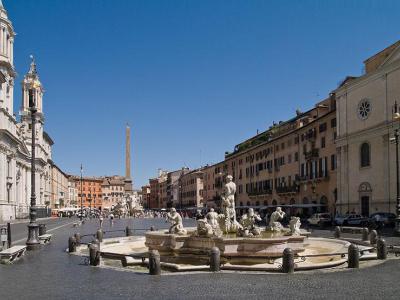
Navona Square, one of Rome’s most iconic places, is built on the site of the ancient (1st-century AD) Stadium of Domitian. The stadium’s elongated oval shape defines the square’s layout, which was originally designed for Roman games (or agones). Over time, the name evolved from Circus Agonalis (which means “competition arena”) to Navona. After the fall of the Roman Empire, the stadium fell into ruin and was quarried for materials, leaving few remnants today.
In the late 15th century, Navona Square was designated a public space when the city market moved there from Capitoline Hill. It became a celebrated example of Baroque architecture and art during the mid-17th century under Pope Innocent X, whose family property, the Pamphili Palace, overlooks the square. The latter also features several masterpieces, including Gian Lorenzo Bernini’s Fountain of the Four Rivers at its center, crowned by the Obelisk of Domitian. The renowned Church of Saint Agnes in Agone with its impressive dome further highlights the area's artistic significance. Also noteworthy are the Braschi Palace, presently home to the Museum of Rome, and the Cupis Palace, which now offers pre-booked accommodations.
Navona Square is also home to two additional fountains. The Fountain of the Moor, at the southern end, was originally sculpted by Giacomo della Porta in 1575, with Bernini adding a statue of a Moor wrestling a dolphin in 1673. At the northern end, the Fountain of Neptune, also by della Porta (created in 1574), gained its central Neptune statue in 1878.
The square has a rich cultural history, hosting theatrical performances and festivals, including a popular annual Christmas market, from December to January.
Navona Square made an appearance in several movies, including “Angels & Demons” (of 2008, starring Tom Hanks), “Yesterday, Today and Tomorrow” (with Sophie Loren, made in 1964), and “The Talented Mr. Ripley” (directed in 1999 by Anthony Minghella, featuring Matt Damon). The atmosphere in Navona Square exudes a cool and relaxed vibe which, complete with its cinematic and architectural appeal, makes it an ideal spot for photography.
Tip:
In the evenings, when the central fountain is illuminated, the square becomes particularly scenic.
If looking for more intimate and more value-for-money meals and refreshments, consider venturing onto one of the side streets adjacent to the square, filled with multiple eateries and cafes.
In the late 15th century, Navona Square was designated a public space when the city market moved there from Capitoline Hill. It became a celebrated example of Baroque architecture and art during the mid-17th century under Pope Innocent X, whose family property, the Pamphili Palace, overlooks the square. The latter also features several masterpieces, including Gian Lorenzo Bernini’s Fountain of the Four Rivers at its center, crowned by the Obelisk of Domitian. The renowned Church of Saint Agnes in Agone with its impressive dome further highlights the area's artistic significance. Also noteworthy are the Braschi Palace, presently home to the Museum of Rome, and the Cupis Palace, which now offers pre-booked accommodations.
Navona Square is also home to two additional fountains. The Fountain of the Moor, at the southern end, was originally sculpted by Giacomo della Porta in 1575, with Bernini adding a statue of a Moor wrestling a dolphin in 1673. At the northern end, the Fountain of Neptune, also by della Porta (created in 1574), gained its central Neptune statue in 1878.
The square has a rich cultural history, hosting theatrical performances and festivals, including a popular annual Christmas market, from December to January.
Navona Square made an appearance in several movies, including “Angels & Demons” (of 2008, starring Tom Hanks), “Yesterday, Today and Tomorrow” (with Sophie Loren, made in 1964), and “The Talented Mr. Ripley” (directed in 1999 by Anthony Minghella, featuring Matt Damon). The atmosphere in Navona Square exudes a cool and relaxed vibe which, complete with its cinematic and architectural appeal, makes it an ideal spot for photography.
Tip:
In the evenings, when the central fountain is illuminated, the square becomes particularly scenic.
If looking for more intimate and more value-for-money meals and refreshments, consider venturing onto one of the side streets adjacent to the square, filled with multiple eateries and cafes.
4) Pantheon (must see)
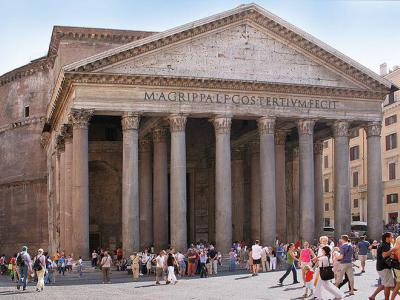
The Pantheon is one of Rome’s most iconic landmarks, renowned for its architectural brilliance. Originally a Roman temple, its name comes from the Ancient Greek "pan theos," which means dedication to all gods. Built on the site of a temple commissioned by consul Marcus Agrippa during Augustus’ reign, the current structure was completed under Emperor Hadrian around 126 AD. It was transformed into a Catholic Church of Saint Mary and the Martyrs in 609 AD, ensuring its preservation through centuries.
The Pantheon’s unique design combines a classical portico supported by Corinthian granite columns with a domed cylindrical structure (called a rotunda). The unsupported concrete dome, still the largest of its kind in the world, features a central oculus that provides natural light, ventilation, and symbolic celestial connections. The rotunda's harmonious dimensions-43 meters in both height and diameter-epitomize Roman engineering excellence, while its original massive bronze doors, each weighing over 20 tons, and intricate drainage system (allowing to effectively divert rainwater) highlight the ingenuity of its creators.
Throughout its history, the Pantheon has been a vibrant part of Roman life. It served as a burial site during the Renaissance, housing notable figures like painter Raphael and Italian kings Victor Emmanuel II and Umberto I. Its materials, such as bronze, have been repurposed for other projects like Bernini’s baldachin above the high altar of Saint Peter's Basilica. However, its core structure remains remarkably intact. Today, the church still host religious ceremonies, including masses, weddings, and Pentecost celebrations.
The Pantheon’s influence extends far beyond Rome. Its dome inspired architectural marvels like the Florence Cathedral and Rotunda of the U.S. Capital in Washington D.C., while its combination of classical and modern elements shaped countless government and academic buildings worldwide.
With over six million annual visitors, the Pantheon remains a symbol of Roman ingenuity and artistic achievement. Tourists can enjoy free entry to this historic site or soak in its splendor from Rotonda Square, savoring gelato while marveling at its timeless beauty.
Tip:
Incredible at night (from the outside), it is especially so if you enjoy musicians with talent and engagement... but beware of pickpockets.
The Pantheon’s unique design combines a classical portico supported by Corinthian granite columns with a domed cylindrical structure (called a rotunda). The unsupported concrete dome, still the largest of its kind in the world, features a central oculus that provides natural light, ventilation, and symbolic celestial connections. The rotunda's harmonious dimensions-43 meters in both height and diameter-epitomize Roman engineering excellence, while its original massive bronze doors, each weighing over 20 tons, and intricate drainage system (allowing to effectively divert rainwater) highlight the ingenuity of its creators.
Throughout its history, the Pantheon has been a vibrant part of Roman life. It served as a burial site during the Renaissance, housing notable figures like painter Raphael and Italian kings Victor Emmanuel II and Umberto I. Its materials, such as bronze, have been repurposed for other projects like Bernini’s baldachin above the high altar of Saint Peter's Basilica. However, its core structure remains remarkably intact. Today, the church still host religious ceremonies, including masses, weddings, and Pentecost celebrations.
The Pantheon’s influence extends far beyond Rome. Its dome inspired architectural marvels like the Florence Cathedral and Rotunda of the U.S. Capital in Washington D.C., while its combination of classical and modern elements shaped countless government and academic buildings worldwide.
With over six million annual visitors, the Pantheon remains a symbol of Roman ingenuity and artistic achievement. Tourists can enjoy free entry to this historic site or soak in its splendor from Rotonda Square, savoring gelato while marveling at its timeless beauty.
Tip:
Incredible at night (from the outside), it is especially so if you enjoy musicians with talent and engagement... but beware of pickpockets.
5) Basilica di Santa Maria sopra Minerva (Basilica of Saint Mary above Minerva) (must see)
Tucked away just behind the Pantheon in Minerva Square, Santa Maria above Minerva is a Dominican church and a hidden gem of both religious and architectural importance. This is the only surviving example of original Gothic religious architecture in Rome, as most medieval churches were modified with Baroque designs.
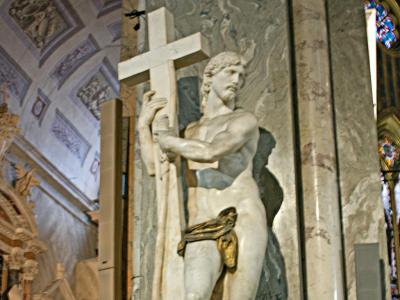
Despite its somewhat unassuming facade, the Santa Maria above Minerva – formerly the Dominican order's headquarters – also boasts an intriguing history and some truly magnificent artistic treasures. Chief among them are Michelangelo’s Christ the Redeemer sculpture and the Carafa Chapel's frescoes.
The former is found to the left of the main altar. The sculpture's first version, begun in 1515, was abandoned due to a flaw in the marble. The one we see today, completed in 1521, received acclaim for its artistry, particularly its lifelike knees. Originally, Michelangelo depicted Christ unclothed to symbolize his triumph over sin, however, a bronze loincloth was added in 1546.
The Carafa Chapel, commissioned by Cardinal Oliviero Carafa in honor of Saint Thomas Aquinas, was inaugurated in 1493. Lavishly adorned with frescoes by Florentine painter Filippino Lippi, it shows the scenes of Saint Thomas's life, including him debating with heretics, as well as some allegorical ones like him presenting Cardinal Carafa to the Virgin Mary. These frescoes are widely recognized as the best Renaissance painting in Rome outside the Sistine Chapel.
Looking up, you can't fail to notice the stunning deep blue painted ceiling and the round stained glass windows, rightfully regarded as the finest in the city.
The basilica also holds the remains of the Saint Catherine of Siena and early Renaissance painter Fra Angelico.
In 1628, the Convent of Minerva became the seat of the Congregation of the Holy Office, where the Roman Inquisition held trials, including that of Galileo Galilei. In 1633, Galileo was tried for heresy for supporting the theory that the Earth revolves around the Sun. Facing interrogation under threat of torture, he was found "vehemently suspect of heresy" and forced to recant. Galileo was sentenced to house arrest for life, and his works were banned. His trial marked a defining moment in the conflict between science and religion. Legend claims that, after his abjuration, Galileo allegedly muttered the rebellious phrase: "and yet it moves..."
Despite its somewhat unassuming facade, the Santa Maria above Minerva – formerly the Dominican order's headquarters – also boasts an intriguing history and some truly magnificent artistic treasures. Chief among them are Michelangelo’s Christ the Redeemer sculpture and the Carafa Chapel's frescoes.
The former is found to the left of the main altar. The sculpture's first version, begun in 1515, was abandoned due to a flaw in the marble. The one we see today, completed in 1521, received acclaim for its artistry, particularly its lifelike knees. Originally, Michelangelo depicted Christ unclothed to symbolize his triumph over sin, however, a bronze loincloth was added in 1546.
The Carafa Chapel, commissioned by Cardinal Oliviero Carafa in honor of Saint Thomas Aquinas, was inaugurated in 1493. Lavishly adorned with frescoes by Florentine painter Filippino Lippi, it shows the scenes of Saint Thomas's life, including him debating with heretics, as well as some allegorical ones like him presenting Cardinal Carafa to the Virgin Mary. These frescoes are widely recognized as the best Renaissance painting in Rome outside the Sistine Chapel.
Looking up, you can't fail to notice the stunning deep blue painted ceiling and the round stained glass windows, rightfully regarded as the finest in the city.
The basilica also holds the remains of the Saint Catherine of Siena and early Renaissance painter Fra Angelico.
In 1628, the Convent of Minerva became the seat of the Congregation of the Holy Office, where the Roman Inquisition held trials, including that of Galileo Galilei. In 1633, Galileo was tried for heresy for supporting the theory that the Earth revolves around the Sun. Facing interrogation under threat of torture, he was found "vehemently suspect of heresy" and forced to recant. Galileo was sentenced to house arrest for life, and his works were banned. His trial marked a defining moment in the conflict between science and religion. Legend claims that, after his abjuration, Galileo allegedly muttered the rebellious phrase: "and yet it moves..."
6) Galleria Doria Pamphilj (Doria Pamphilj Gallery) (must see)
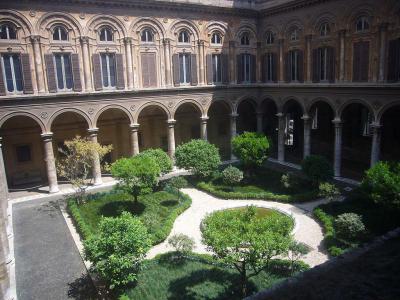
The Doria Pamphilj Gallery is a prestigious private art collection housed in the historic Doria Pamphilj Palace. While the Vatican Museums hold global fame and are highly popular, this impressive palace offers one of the most captivating and rewarding artistic experiences in Rome.
Still owned by the princely Doria Pamphilj family, the palace was constructed in 1505 by a Catholic cardinal. It later came under the ownership of another cardinal, whose niece, in turn, married Camillo Pamphilj, nephew of Pope Innocent X.
The collection was significantly enriched by the Pope, who bequeathed artistic treasures to his nephew. Its highlights include Diego Velázquez's Portrait of Innocent X which captures the Pope’s controversial character with striking realism. This celebrated painting is housed in a dedicated room with a bust of the Pope created by Italian sculptor and architect Gian Lorenzo Bernini.
The collection, amassed over centuries by the Doria, Pamphilj, Landi, and Aldobrandini families, features masterpieces from the Renaissance and Baroque periods, with a focus on the 16th and 17th centuries. The palace's stately rooms feature vaulted ceilings and exquisite decorations, showcasing a vast array of Medieval and Byzantine art. One wing houses the Aldobrandini Gallery, which displays an eclectic mix of paintings and garden statues.
The palace itself has evolved over time. In the 17th century, Camillo Pamphilj and his wife Olimpia Borghese expanded it substantially, despite local opposition. Its renovations continued under the supervision of Camillo’s descendants, including Anna Pamphilj and her husband. In the 18th century, frescoes by renowned Italian artists adorned the staterooms.
In the 20th century, Princess Orietta Pogson Doria Pamphilj and her English husband, Commander Frank Pogson, restored the gallery and opened it to the public. Today, her adopted children, Jonathan and Gesine Doria Pamphilj, oversee its care. The collection, one of the largest private art troves in Rome, remains a testament to the family’s legacy.
The Doria Pamphilj Palace offers a serene visit with its Gallery of Mirrors, featuring French-imported mirrors and Hercules-themed frescoes tied to the Pamphilj lineage. The Primitives Room displays wooden-panel paintings. Visitors can enjoy a free audio guide, numbered exhibits, a relaxing cafeteria, and a bookshop, avoiding Rome's typical tourist crowds.
Tip:
For personal (non-commercial) use, you can acquire a 'Photo Pass' from the bookshop, allowing you to capture memories of your visit.
Still owned by the princely Doria Pamphilj family, the palace was constructed in 1505 by a Catholic cardinal. It later came under the ownership of another cardinal, whose niece, in turn, married Camillo Pamphilj, nephew of Pope Innocent X.
The collection was significantly enriched by the Pope, who bequeathed artistic treasures to his nephew. Its highlights include Diego Velázquez's Portrait of Innocent X which captures the Pope’s controversial character with striking realism. This celebrated painting is housed in a dedicated room with a bust of the Pope created by Italian sculptor and architect Gian Lorenzo Bernini.
The collection, amassed over centuries by the Doria, Pamphilj, Landi, and Aldobrandini families, features masterpieces from the Renaissance and Baroque periods, with a focus on the 16th and 17th centuries. The palace's stately rooms feature vaulted ceilings and exquisite decorations, showcasing a vast array of Medieval and Byzantine art. One wing houses the Aldobrandini Gallery, which displays an eclectic mix of paintings and garden statues.
The palace itself has evolved over time. In the 17th century, Camillo Pamphilj and his wife Olimpia Borghese expanded it substantially, despite local opposition. Its renovations continued under the supervision of Camillo’s descendants, including Anna Pamphilj and her husband. In the 18th century, frescoes by renowned Italian artists adorned the staterooms.
In the 20th century, Princess Orietta Pogson Doria Pamphilj and her English husband, Commander Frank Pogson, restored the gallery and opened it to the public. Today, her adopted children, Jonathan and Gesine Doria Pamphilj, oversee its care. The collection, one of the largest private art troves in Rome, remains a testament to the family’s legacy.
The Doria Pamphilj Palace offers a serene visit with its Gallery of Mirrors, featuring French-imported mirrors and Hercules-themed frescoes tied to the Pamphilj lineage. The Primitives Room displays wooden-panel paintings. Visitors can enjoy a free audio guide, numbered exhibits, a relaxing cafeteria, and a bookshop, avoiding Rome's typical tourist crowds.
Tip:
For personal (non-commercial) use, you can acquire a 'Photo Pass' from the bookshop, allowing you to capture memories of your visit.
7) Vittoriano (Victor Emmanuel II National Monument) (must see)
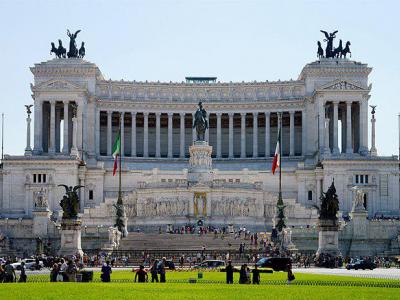
The Victor Emmanuel II National Monument, also known as the Altar of the Fatherland, honors Italy’s first king and symbolizes the nation’s unification. Constructed from 1885 to 1935, its design was inspired by the Roman Forum. The neoclassical monument blends Hellenistic influences with modern urban design, featuring grand staircases, Corinthian columns, fountains, and statues, including a striking equestrian statue of Victor Emmanuel II.
Its dimensions are imposing, with a width of 135 meters and a height of 81 meters, including statues of the goddess Victoria atop quadrigas. Also adding to its grandeur are the two colossal Italian tricolors at the sides.
The monument's key features include the Tomb of the Unknown Soldier, inaugurated in 1921. Its eternal flames perpetually guarded by soldiers reflect classical traditions of remembrance. Sculptures like The Thought and The Action are complemented by allegorical decorations and mosaics highlighting Italian virtues, sciences, and intellectual achievements. The site also honors Italy's pre-unification legacy through sculptures of 14 historic capitals and other artistic elements.
Ascending the central staircase rewards visitors with a view of the monument itself but also a panoramic vista over the city. This elevated spot offers an ideal opportunity for capturing memorable photos. For added convenience, a lift was installed in 2007, enabling visitors to reach the rooftop and enjoy a bird's-eye panorama of Rome (please note that there is a small fee for the ride).
Flanking Venice Square, the Fountains of the Two Seas symbolize Italy's geographical unity, representing the Adriatic and Tyrrhenian Seas. Beneath the monument lies a crypt built with materials from World War I battlefields, creating a sacred space for reflection.
At the base of the complex, visitors can explore the Central Museum of Italian Unification, which chronicles the country’s history from the late 18th century to World War I, and the Shrine of the Flags, showcasing military flags and artifacts. The admission is free.
The monument is a centerpiece for national celebrations like Republic Day and Liberation Day. Although initially met with controversy and subjected to derogatory nicknames like the "wedding cake," it has become one of the city's most popular attractions after the Vatican and the Roman Ruins. Despite some locals considering it tacky, there is an undeniable allure in witnessing triumphal architecture that aspires to rival the grandeur of ancient structures.
Tip:
Visit the monument at night when it is beautifully illuminated.
Its dimensions are imposing, with a width of 135 meters and a height of 81 meters, including statues of the goddess Victoria atop quadrigas. Also adding to its grandeur are the two colossal Italian tricolors at the sides.
The monument's key features include the Tomb of the Unknown Soldier, inaugurated in 1921. Its eternal flames perpetually guarded by soldiers reflect classical traditions of remembrance. Sculptures like The Thought and The Action are complemented by allegorical decorations and mosaics highlighting Italian virtues, sciences, and intellectual achievements. The site also honors Italy's pre-unification legacy through sculptures of 14 historic capitals and other artistic elements.
Ascending the central staircase rewards visitors with a view of the monument itself but also a panoramic vista over the city. This elevated spot offers an ideal opportunity for capturing memorable photos. For added convenience, a lift was installed in 2007, enabling visitors to reach the rooftop and enjoy a bird's-eye panorama of Rome (please note that there is a small fee for the ride).
Flanking Venice Square, the Fountains of the Two Seas symbolize Italy's geographical unity, representing the Adriatic and Tyrrhenian Seas. Beneath the monument lies a crypt built with materials from World War I battlefields, creating a sacred space for reflection.
At the base of the complex, visitors can explore the Central Museum of Italian Unification, which chronicles the country’s history from the late 18th century to World War I, and the Shrine of the Flags, showcasing military flags and artifacts. The admission is free.
The monument is a centerpiece for national celebrations like Republic Day and Liberation Day. Although initially met with controversy and subjected to derogatory nicknames like the "wedding cake," it has become one of the city's most popular attractions after the Vatican and the Roman Ruins. Despite some locals considering it tacky, there is an undeniable allure in witnessing triumphal architecture that aspires to rival the grandeur of ancient structures.
Tip:
Visit the monument at night when it is beautifully illuminated.
8) Musei Capitolini (Capitoline Museums) (must see)
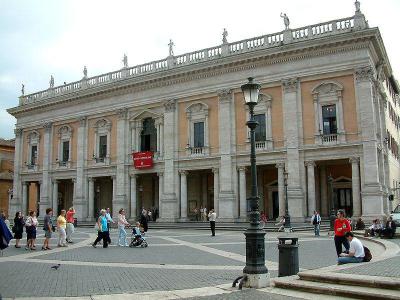
The Capitoline Museums in Rome are among the city's most prestigious art and archaeology institutions, second in prominence only to the Vatican Museums. Established in 1471 by Pope Sixtus IV, who donated significant bronze sculptures to the city, it is recognized as the world's oldest public museum. Designed by Michelangelo in 1536, the museum spans two main buildings: the Conservators' Palace and the New Palace, housing artifacts from ancient, medieval, and Renaissance periods.
Significant expansions occurred in 1734 under Pope Clement XII, who added Cardinal Albani’s antiquities to prevent their export. Rodolfo Lanciani’s 19th-century reorganization emphasized the archaeological context. The collection now covers nearly 13,000 square meters and includes modern additions such as the Central Montemartini branch and the Exedra of Marcus Aurelius.
Local highlights include the Equestrian Statue of Marcus Aurelius, moved indoors in 1990 (its place in the square is now taken by a replica), and the iconic Capitoline Wolf, a bronze sculpture potentially dating to the 5th century BC or the medieval period. The Colossus of Constantine, the Hercules of the Forum Boarium, and the Boy with Thorn are among other bronze masterpieces found here. Also noteworthy are The Dying Gaul and Arnolfo di Cambio’s Portrait of Charles I of Anjou made in the 13th century, Europe’s earliest lifelike portrait of a living figure.
Historical artifacts include the Protomoteca, busts relocated from the Pantheon, and the Conaccordo Gallery, which connects the palaces and leads to the Tabularium and the Temple of Veiovis. The Conservators' Palace features the Hall of the Horatii and Curiatii with 16th-century frescoes, and the Pinacoteca Capitolina which displays Renaissance works by Caravaggio, Titian, and Tintoretto. Its corridor showcases an Epigraphic Collection, while a staircase leading to the Tabularium gallery affords breathtaking views of the Roman Forum.
With a full-day ticket, visitors can leisurely explore both palaces, culminating in a panoramic view of ancient Rome.
The Capitoline Museums also hold historical significance as the venue where the 1957 Treaties of Rome, a cornerstone of the European Union, were signed.
Tip:
The Terrazza Caffarelli café atop the Capitoline Museums offers stunning panoramic views of Rome's rooftops and ancient ruins, especially at sunset. Enjoy excellent coffee, cakes, or an aperitivo with snacks. Accessible via Piazzale Caffarelli, the café welcomes all, even those without museum admission, for a memorable culinary and scenic experience.
Significant expansions occurred in 1734 under Pope Clement XII, who added Cardinal Albani’s antiquities to prevent their export. Rodolfo Lanciani’s 19th-century reorganization emphasized the archaeological context. The collection now covers nearly 13,000 square meters and includes modern additions such as the Central Montemartini branch and the Exedra of Marcus Aurelius.
Local highlights include the Equestrian Statue of Marcus Aurelius, moved indoors in 1990 (its place in the square is now taken by a replica), and the iconic Capitoline Wolf, a bronze sculpture potentially dating to the 5th century BC or the medieval period. The Colossus of Constantine, the Hercules of the Forum Boarium, and the Boy with Thorn are among other bronze masterpieces found here. Also noteworthy are The Dying Gaul and Arnolfo di Cambio’s Portrait of Charles I of Anjou made in the 13th century, Europe’s earliest lifelike portrait of a living figure.
Historical artifacts include the Protomoteca, busts relocated from the Pantheon, and the Conaccordo Gallery, which connects the palaces and leads to the Tabularium and the Temple of Veiovis. The Conservators' Palace features the Hall of the Horatii and Curiatii with 16th-century frescoes, and the Pinacoteca Capitolina which displays Renaissance works by Caravaggio, Titian, and Tintoretto. Its corridor showcases an Epigraphic Collection, while a staircase leading to the Tabularium gallery affords breathtaking views of the Roman Forum.
With a full-day ticket, visitors can leisurely explore both palaces, culminating in a panoramic view of ancient Rome.
The Capitoline Museums also hold historical significance as the venue where the 1957 Treaties of Rome, a cornerstone of the European Union, were signed.
Tip:
The Terrazza Caffarelli café atop the Capitoline Museums offers stunning panoramic views of Rome's rooftops and ancient ruins, especially at sunset. Enjoy excellent coffee, cakes, or an aperitivo with snacks. Accessible via Piazzale Caffarelli, the café welcomes all, even those without museum admission, for a memorable culinary and scenic experience.
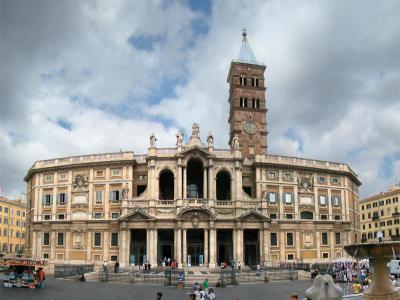
9) Basilica di Santa Maria Maggiore (Basilica of Saint Mary Major) (must see)
As the largest among the 26 churches in Rome dedicated to the Virgin Mary, the Basilica of Saint Mary Major holds a significant place in history. Originally constructed by Pope Liberius in the 4th century, the grandiose church has undergone renovations and enhancements by successive popes while still retaining its early medieval structure. The colonnaded nave, an integral part of the original 5th-century building, offers a glimpse into its ancient origins. The medieval era contributed the captivating Cosmatesque marble floor and the delightful Romanesque bell tower adorned with intricate blue ceramic roundels. During the Renaissance, a new coffered ceiling was introduced, while the Baroque period left its imprint with twin domes and grand facades at the front and rear. All in all, it’s a most successful blend of different architectural styles.
However, the true splendor of Saint Mary Major lies in its mosaics, which are among the oldest in Rome. The biblical scenes adorning the aisles date back to the 5th century, captivating visitors with their artistic depiction. The mosaics on the triumphal arch are particularly breathtaking, showcasing the skill and craftsmanship of the time. Among other medieval highlights is a magnificent 13th-century mosaic featuring an enthroned Christ in the loggia, adding to the artistic treasures within.
In 2001, Pope John Paul II inaugurated the Basilica Museum, dedicated to the church's history and the spread of Catholicism throughout the world. Here you will see ecclesiastical paintings, ritual vestments, scores from the choir and various manuscripts.
Tips: When visiting, be sure to take advantage of the small tours available to explore the church's hidden treasures. Additionally, don't miss the opportunity to visit the balcony loggia, which offers a unique perspective and allows you to admire more of the church's architecture. As evening sets in, find a serene spot by the fountain and marvel at the illuminated beauty of the building.
However, the true splendor of Saint Mary Major lies in its mosaics, which are among the oldest in Rome. The biblical scenes adorning the aisles date back to the 5th century, captivating visitors with their artistic depiction. The mosaics on the triumphal arch are particularly breathtaking, showcasing the skill and craftsmanship of the time. Among other medieval highlights is a magnificent 13th-century mosaic featuring an enthroned Christ in the loggia, adding to the artistic treasures within.
In 2001, Pope John Paul II inaugurated the Basilica Museum, dedicated to the church's history and the spread of Catholicism throughout the world. Here you will see ecclesiastical paintings, ritual vestments, scores from the choir and various manuscripts.
Tips: When visiting, be sure to take advantage of the small tours available to explore the church's hidden treasures. Additionally, don't miss the opportunity to visit the balcony loggia, which offers a unique perspective and allows you to admire more of the church's architecture. As evening sets in, find a serene spot by the fountain and marvel at the illuminated beauty of the building.
