Custom Walk in Alexandria, Egypt by johamel_38cbfe created on 2026-01-26
Guide Location: Egypt » Alexandria
Guide Type: Custom Walk
# of Sights: 8
Tour Duration: 9 Hour(s)
Travel Distance: 25.8 Km or 16 Miles
Share Key: YVAHA
Guide Type: Custom Walk
# of Sights: 8
Tour Duration: 9 Hour(s)
Travel Distance: 25.8 Km or 16 Miles
Share Key: YVAHA
How It Works
Please retrieve this walk in the GPSmyCity app. Once done, the app will guide you from one tour stop to the next as if you had a personal tour guide. If you created the walk on this website or come to the page via a link, please follow the instructions below to retrieve the walk in the app.
Retrieve This Walk in App
Step 1. Download the app "GPSmyCity: Walks in 1K+ Cities" on Apple App Store or Google Play Store.



Step 2. In the GPSmyCity app, download(or launch) the guide "Alexandria Map and Walking Tours".
Step 3. Tap the menu button located at upper right corner of the "Walks" screen and select "Retrieve custom walk". Enter the share key: YVAHA
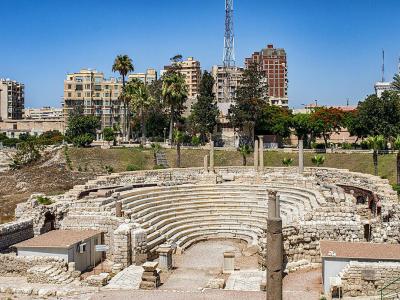
1) Ancient Roman Amphitheater (must see)
Roman amphitheaters are large, circular or oval open-air venues with raised seating – built by the Ancient Romans. Built in the IV century AD, Ancient Roman Amphitheater in Alexandria is an amazing work of art with a capacity of 800 seats. It was a place for wonderful musical performances and various contests. The Gladiator games were also held here. The theater was built with materials from all over the world. It features great surroundings, marvelous trees and plants.
Sight description based on Wikipedia.
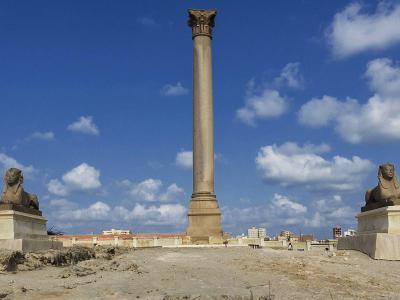
2) Pompey's Pillar (must see)
The largest Roman triumphal column constructed outside of the imperial capitals of Rome and Constantinople, Pompey's Pillar is one of the best-known ancient monuments still standing in Alexandria today. The only known free-standing column in Roman Egypt which was not composed of drums, it is one of the largest ancient monoliths and one of the largest monolithic columns ever erected. It is located on Alexandria's ancient acropolis - a modest hill located adjacent to the city's Arab cemetery-and was originally part of a temple colonnade. Including its pedestal, it is 30 meters high; the shaft is of polished red granite, 2.7 meters in diameter at the base, tapering to 2.4 meters at the top. The shaft is 27 meters high made out of a single piece of granite. Pompey's Pillar may have been erected using the same methods that were used to erect the ancient obelisks. The structure was plundered and demolished in the 4th century when a bishop decreed that Paganism must be eradicated. "Pompey's Pillar" is a misnomer, as it has nothing to do with Pompey, having been erected in 293 for Diocletian, possibly in memory of the rebellion of Domitius Domitianus.
Sight description based on Wikipedia.
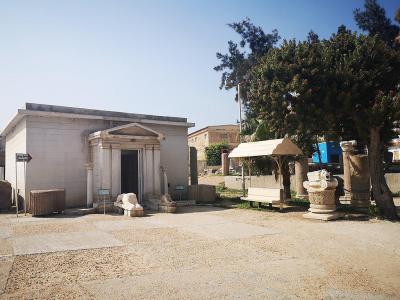
3) Catacombs of Kom el Shoqafa (must see)
A historical archaeological site, the Catacombs of Kom el Shoqafa lie on the western necropolis of Alexandria and consist of three levels cut through solid rock, the third level being now completely underwater. It houses a series of Alexandrian tombs, statues and archaeological objects of the Pharaonic funeral cult with Hellenistic and early Imperial Roman influences. The Catacombs were named Kom El Shoqafa, meaning Mound of Shards, because the area used to contain a mound of shards of terra cotta which mostly consisted of jars and objects made of clay belonging to those visiting the tombs, who would bring food and wine for their consumption during the visit, but didn't wish to carry them back home from this place of death so they would break them.
The Catacombs of Kom el Shoqafa is, according to some lists, also one of the seven medieval wonders of the world. One of the more gruesome features of the catacombs is the so called Hall of Caracalla. According to tradition, this is a mass burial chamber for the humans and animals massacred by order of the Emperor Caracalla.
Due to the time period, many of the features of the Catacombs of Kom el Shoqafa merge Roman, Greek and Egyptian cultural points; some statues are Egyptian in style, yet bear Roman clothes and hair style whilst other features share a similar style. A circular staircase, which was often used to transport deceased bodies down the middle of it, leads down into the tombs that were tunneled into the bedrock during the age of the Antonine emperors. The facility was then used as a burial chamber from the 2nd century to the 4th century, before being rediscovered in 1900 when a donkey accidentally fell into the access shaft. It is believed that the catacombs were only intended for a single family, but it is unclear why the site was expanded in order to house numerous other individuals.
The Catacombs of Kom el Shoqafa is, according to some lists, also one of the seven medieval wonders of the world. One of the more gruesome features of the catacombs is the so called Hall of Caracalla. According to tradition, this is a mass burial chamber for the humans and animals massacred by order of the Emperor Caracalla.
Due to the time period, many of the features of the Catacombs of Kom el Shoqafa merge Roman, Greek and Egyptian cultural points; some statues are Egyptian in style, yet bear Roman clothes and hair style whilst other features share a similar style. A circular staircase, which was often used to transport deceased bodies down the middle of it, leads down into the tombs that were tunneled into the bedrock during the age of the Antonine emperors. The facility was then used as a burial chamber from the 2nd century to the 4th century, before being rediscovered in 1900 when a donkey accidentally fell into the access shaft. It is believed that the catacombs were only intended for a single family, but it is unclear why the site was expanded in order to house numerous other individuals.
Sight description based on Wikipedia.
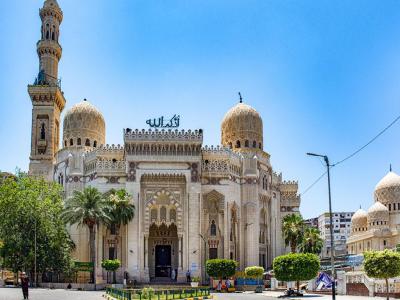
4) Abu el-Abbas el-Mursi Mosque (must see)
One of the most significant and marvelous mosques in the city of Alexandria, Abu El Abbas El Mursi, was built in 1775 by Algerians. The mosque was constructed over the tomb of Murcia Andalusanal-Abbas Saint. Abu el-Abbas el-Mursi Mosque is 23 meters high and has a wonderful minaret. It is located on the beautiful Mosque Square that overlooks the Eastern Harbour. The mosque can be seen clearly from the sea.
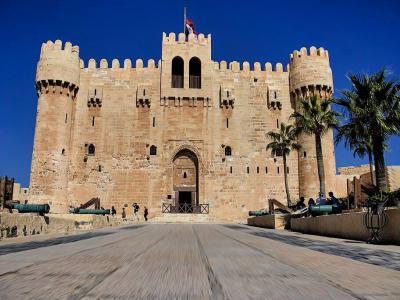
5) Citadel of Qaitbay (must see)
The Citadel of Qaitbay is a 15th century defensive fortress located on the Mediterranean sea coast, built upon/from the ruins of the Lighthouse of Alexandria. It was established in 1477 AD by Sultan Al-Ashraf Sayf al-Din Qa'it Bay. The Qaitbay Citadel in Alexandria is considered one of the most important defensive strongholds, not only in Egypt, but also along the Mediterranean Sea coast. It was erected on the exact site of the famous Lighthouse of Alexandria, which was one of the Seven Wonders of the Ancient World. It formulated an important part of the fortification system of Alexandria in the 15th century AD.
The British fleet bombarded Alexandria violently on 11 July 1882 and damaged a large part of the city, especially in the area of the Citadel. This attack cracked the fortress, causing great damage. The north and western facades were severely damaged as a result of cannon explosions, aimed directly at the structure. The western facade was completely destroyed, leaving large gaps in it. Unfortunately, the Citadel then remained neglected, until 1904 when the Ministry of Defence restored the Upper floors. After the revolution of 1952 the Egyptian Naval troops turned the building to a Maritime Museum. The biggest restoration work dates back to 1984, when the Egyptian Antiquities Organization made ambitious plans to restore the fort.
The British fleet bombarded Alexandria violently on 11 July 1882 and damaged a large part of the city, especially in the area of the Citadel. This attack cracked the fortress, causing great damage. The north and western facades were severely damaged as a result of cannon explosions, aimed directly at the structure. The western facade was completely destroyed, leaving large gaps in it. Unfortunately, the Citadel then remained neglected, until 1904 when the Ministry of Defence restored the Upper floors. After the revolution of 1952 the Egyptian Naval troops turned the building to a Maritime Museum. The biggest restoration work dates back to 1984, when the Egyptian Antiquities Organization made ambitious plans to restore the fort.
Sight description based on Wikipedia.
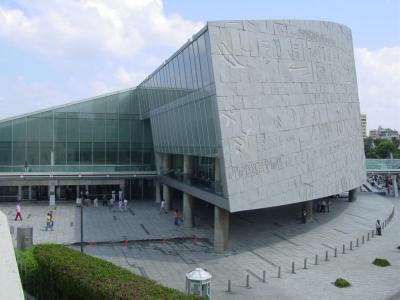
6) Bibliotheca Alexandrina (must see)
The Bibliotheca Alexandrina is a major library and cultural center located on the shore of the Mediterranean Sea. It is both a commemoration of the Library of Alexandria that was lost in antiquity, and an attempt to rekindle something of the brilliance that this earlier center of study and erudition represented. The idea of reviving the old library dates back to 1974, when a committee set up by Alexandria University selected a plot of land for its new library, between the campus and the seafront, close to where the ancient library once stood.
The Bibliotheca Alexandrina is trilingual, containing books in Arabic, English and French. In 2010, the library received a generous donation of 500,000 books from the National Library of France which makes it the sixth-largest Francophone library in the world. The main reading room stands beneath a 32-meter-high glass-paneled roof, tilted out toward the sea like a sundial, and measuring some 160 m in diameter. The walls are of gray Aswan granite, carved with characters from 120 different human scripts. The dimensions of the project are vast: the library has shelf space for eight million books, with the main reading room covering 70,000 sq.m. (750,000 sq ft) on eleven cascading levels. The complex also houses a conference center; specialized libraries for maps, multimedia, the blind and visually impaired, young people, and for children; four museums; four art galleries for temporary exhibitions; 15 permanent exhibitions; a planetarium; and a manuscript restoration laboratory. The library's architecture is equally striking.
The Bibliotheca Alexandrina is trilingual, containing books in Arabic, English and French. In 2010, the library received a generous donation of 500,000 books from the National Library of France which makes it the sixth-largest Francophone library in the world. The main reading room stands beneath a 32-meter-high glass-paneled roof, tilted out toward the sea like a sundial, and measuring some 160 m in diameter. The walls are of gray Aswan granite, carved with characters from 120 different human scripts. The dimensions of the project are vast: the library has shelf space for eight million books, with the main reading room covering 70,000 sq.m. (750,000 sq ft) on eleven cascading levels. The complex also houses a conference center; specialized libraries for maps, multimedia, the blind and visually impaired, young people, and for children; four museums; four art galleries for temporary exhibitions; 15 permanent exhibitions; a planetarium; and a manuscript restoration laboratory. The library's architecture is equally striking.
Sight description based on Wikipedia.

7) Stanley Bridge (must see)
Constructed over Stanley Bay, Stanley Bridge is a magnificent landmark that must be seen. It was built as an extension of Corniche with a total length of 400 meters with 6 spans. Tourists can enjoy beautiful panoramic views of the bay and the sea, as well as one of the most beautiful beaches in Alexandria.
Sight description based on Wikipedia.
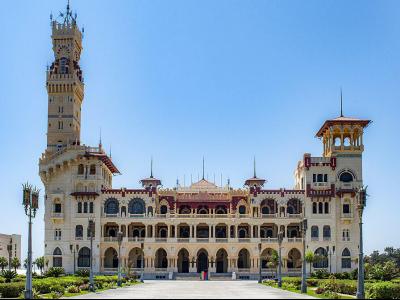
8) Montaza Palace (must see)
One of the most popular touristic points in Egypt, Montaza Palace is a palace and extensive gardens built on a low plateau east of central Alexandria overlooking a beach on the Mediterranean Sea. It was one of the palaces of the former Egyptian royal family (the descendants of Muhammad Ali) located in Alexandria, Egypt. The extensive Montaza Palace grounds first had the Salamlek Palace, built in 1892 by Khedive Abbas II, the last Muhammad Ali Dynasty ruler to hold the Khedive title over the Khedivate of Egypt and Sudan. It was used as a hunting lodge and residence for his companion. The larger Al-Haramlik Palace and royal gardens were added to the Montaza Palace grounds, being built by King Fuad I in 1932, as a summer palace. It is in a mixture of Turkish and Florentine styles, with has two towers, one rising distinctively high above with elaborated Italian Renaissance design details. The palace has long open arcades facing the sea along each floor.
The Al-Montaza Park, the former expansive royal gardens of 150 acres (61 ha), are open as a public landscape park and forest reserve. The Al-Haramlik-Montaza Palace is a public museum of the Muhammad Ali Dynasty family history and objects d'art. The Salamlek Palace is now an adjacent hotel.
The Al-Montaza Park, the former expansive royal gardens of 150 acres (61 ha), are open as a public landscape park and forest reserve. The Al-Haramlik-Montaza Palace is a public museum of the Muhammad Ali Dynasty family history and objects d'art. The Salamlek Palace is now an adjacent hotel.
Sight description based on Wikipedia.
