Custom Walk in Glasgow, Scotland by kbattan_29acb created on 2026-02-02
Guide Location: Scotland » Glasgow
Guide Type: Custom Walk
# of Sights: 8
Tour Duration: 2 Hour(s)
Travel Distance: 3.5 Km or 2.2 Miles
Share Key: 96TBU
Guide Type: Custom Walk
# of Sights: 8
Tour Duration: 2 Hour(s)
Travel Distance: 3.5 Km or 2.2 Miles
Share Key: 96TBU
How It Works
Please retrieve this walk in the GPSmyCity app. Once done, the app will guide you from one tour stop to the next as if you had a personal tour guide. If you created the walk on this website or come to the page via a link, please follow the instructions below to retrieve the walk in the app.
Retrieve This Walk in App
Step 1. Download the app "GPSmyCity: Walks in 1K+ Cities" on Apple App Store or Google Play Store.



Step 2. In the GPSmyCity app, download(or launch) the guide "Glasgow Map and Walking Tours".
Step 3. Tap the menu button located at upper right corner of the "Walks" screen and select "Retrieve custom walk". Enter the share key: 96TBU
1) Kibble Palace and Glasgow Botanic Gardens (must see)
Glasgow Botanic Gardens, located just off the Great Western Road, was established in 1817 by William Hooker, who later became the director of Kew Gardens in London. This lovely arboretum and public park is managed and maintained by the Royal Botanic Institute of Glasgow.
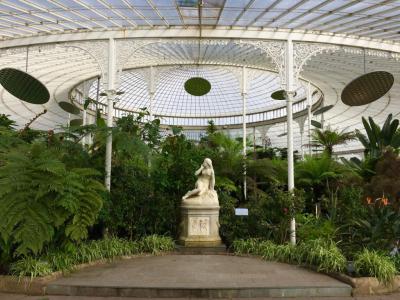
Within the gardens, you'll find several greenhouses, with the most famous being the Kibble Palace. Inside, visitors can admire rare orchids, various types of begonias, tree ferns, and tropical plants. This expansive greenhouse, covering an area of 2137 square meters, was originally constructed by John Kibble in 1863 as a conservatory on his property near Loch Long. In 1870, it was dismantled and transported up the River Clyde by barge to its current location, where it was reassembled in 1871.
The Kibble Palace is a striking structure made of glass panels set within curved wrought iron frames crafted by Walter MacFarlane. It is supported by ornate columns and sits on cast iron foundations with a stone base. In 2003, the palace underwent extensive and costly restoration work. Since its restoration, it has been open to the public, and during the summer, small concerts are often held in a central area surrounded by an impressive collection of orchids, carnivorous plants, and tree ferns.
In addition to the Kibble Palace, the Hopkirk Building serves as a venue for exhibitions, concerts, and lectures by renowned horticulturists. Workshops and a children's arts and crafts center are also available on the premises. As you explore the grounds, you'll come across a disused railway station that closed down several years ago, which is preserved as an example of such structures.
The gardens themselves are designed with various themes, including a Chronological Garden, a Flower Garden showcasing diverse plant varieties, a Herb Garden, a Rose Garden, and a garden highlighting rare vegetables. Furthermore, the arboretum boasts numerous ancient trees, including a 200-year-old weeping Ash tree.
Within the gardens, you'll find several greenhouses, with the most famous being the Kibble Palace. Inside, visitors can admire rare orchids, various types of begonias, tree ferns, and tropical plants. This expansive greenhouse, covering an area of 2137 square meters, was originally constructed by John Kibble in 1863 as a conservatory on his property near Loch Long. In 1870, it was dismantled and transported up the River Clyde by barge to its current location, where it was reassembled in 1871.
The Kibble Palace is a striking structure made of glass panels set within curved wrought iron frames crafted by Walter MacFarlane. It is supported by ornate columns and sits on cast iron foundations with a stone base. In 2003, the palace underwent extensive and costly restoration work. Since its restoration, it has been open to the public, and during the summer, small concerts are often held in a central area surrounded by an impressive collection of orchids, carnivorous plants, and tree ferns.
In addition to the Kibble Palace, the Hopkirk Building serves as a venue for exhibitions, concerts, and lectures by renowned horticulturists. Workshops and a children's arts and crafts center are also available on the premises. As you explore the grounds, you'll come across a disused railway station that closed down several years ago, which is preserved as an example of such structures.
The gardens themselves are designed with various themes, including a Chronological Garden, a Flower Garden showcasing diverse plant varieties, a Herb Garden, a Rose Garden, and a garden highlighting rare vegetables. Furthermore, the arboretum boasts numerous ancient trees, including a 200-year-old weeping Ash tree.
2) Byres Road (must see)
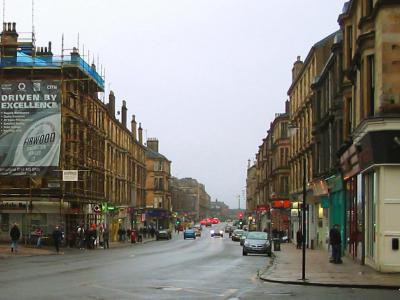
Byres Road, located in the Hillhead area of Glasgow, serves as a vital thoroughfare in the city's West End. This street encompasses a diverse blend of commercial enterprises, shopping outlets, and high-end residential properties, primarily characterized by traditional sandstone tenements. These buildings typically feature retail spaces on their ground floors and three stories of residential apartments above. Notably, its proximity to the University of Glasgow has resulted in a significant student population in the surrounding West End of Glasgow.
Prominent Glasgow artist Alasdair Gray has embellished several establishments along Byres Road with his murals, including the Ubiquitous Chip, the Oxfam Bookshop, and the Oran Mor bars.
Stretching from the Botanic Gardens, adjacent to Great Western Road in the north, to Partick Cross at Dumbarton Road in the south, the road initially traversed a relatively rural region known as the Byres of Partick, also referred to as Bishop's Byres. One of the area's oldest pubs is Curler's, dating back to the 17th century. Legend has it that King Charles II granted this establishment a seven-day license, and it was originally situated beside a pond used for the sport of curling.
The neighboring lanes and byways have thrived thanks to the commerce generated by Byres Road, now hosting a diverse range of small businesses, from tapas bars to second-hand record stores. Among these, Ashton Lane stands out as the most renowned, featuring bars, restaurants, and even a cinema.
Prominent Glasgow artist Alasdair Gray has embellished several establishments along Byres Road with his murals, including the Ubiquitous Chip, the Oxfam Bookshop, and the Oran Mor bars.
Stretching from the Botanic Gardens, adjacent to Great Western Road in the north, to Partick Cross at Dumbarton Road in the south, the road initially traversed a relatively rural region known as the Byres of Partick, also referred to as Bishop's Byres. One of the area's oldest pubs is Curler's, dating back to the 17th century. Legend has it that King Charles II granted this establishment a seven-day license, and it was originally situated beside a pond used for the sport of curling.
The neighboring lanes and byways have thrived thanks to the commerce generated by Byres Road, now hosting a diverse range of small businesses, from tapas bars to second-hand record stores. Among these, Ashton Lane stands out as the most renowned, featuring bars, restaurants, and even a cinema.
3) Ashton Lane
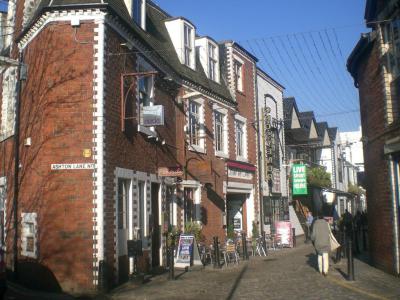
Tucked away just off Byres Road in Glasgow’s lively West End, Ashton Lane is a cobbled backstreet that feels like it belongs to another era. By day, the lane’s string of ivy-covered brick buildings and fairy-light-strewn facades make it a picturesque escape from the bustle of the city. By night, it transforms into one of Glasgow’s most atmospheric gathering spots, drawing students, locals, and visitors alike with its warm glow and convivial spirit. Though it may be small in size, Ashton Lane has earned a big reputation as one of the city’s most distinctive and charming destinations.
The street’s character is rooted in its past. Once a run of mews buildings and stables behind grand Victorian townhouses, Ashton Lane began to flourish in the 1970s when artists and entrepreneurs started opening cafés and bars in the disused spaces. Over time, it grew into a hub for alternative culture, offering an inviting contrast to the more polished main streets of the West End. The cobblestones that remain underfoot are a reminder of its older, humbler origins.
Today, Ashton Lane is best known for its eclectic mix of venues. The much-loved Ubiquitous Chip has been serving Scottish cuisine here since the early 1970s, becoming something of a local institution. Independent bars and pubs spill out onto the lane, filling the air with music and conversation, while the Grosvenor Cinema-one of the oldest cinemas in Scotland-adds a touch of nostalgia and entertainment.
A visit to Ashton Lane is less about ticking off a landmark and more about soaking in the atmosphere of Glasgow’s West End. With its glowing fairy lights overhead, laughter spilling from traditional pubs, and the scent of hearty Scottish dishes drifting from open doorways, the lane captures the city’s sociable, creative energy. It is an ideal spot to linger, toast the night, and experience the unique rhythm of Glasgow life.
The street’s character is rooted in its past. Once a run of mews buildings and stables behind grand Victorian townhouses, Ashton Lane began to flourish in the 1970s when artists and entrepreneurs started opening cafés and bars in the disused spaces. Over time, it grew into a hub for alternative culture, offering an inviting contrast to the more polished main streets of the West End. The cobblestones that remain underfoot are a reminder of its older, humbler origins.
Today, Ashton Lane is best known for its eclectic mix of venues. The much-loved Ubiquitous Chip has been serving Scottish cuisine here since the early 1970s, becoming something of a local institution. Independent bars and pubs spill out onto the lane, filling the air with music and conversation, while the Grosvenor Cinema-one of the oldest cinemas in Scotland-adds a touch of nostalgia and entertainment.
A visit to Ashton Lane is less about ticking off a landmark and more about soaking in the atmosphere of Glasgow’s West End. With its glowing fairy lights overhead, laughter spilling from traditional pubs, and the scent of hearty Scottish dishes drifting from open doorways, the lane captures the city’s sociable, creative energy. It is an ideal spot to linger, toast the night, and experience the unique rhythm of Glasgow life.
4) University of Glasgow (must see)
The United Kingdom is home to several prestigious and ancient universities that enjoy global renown. Among these institutions, the University of Glasgow holds a significant position as the fourth oldest in English-speaking countries.
Its establishment can be traced back to 1451 when it received formal recognition through a Papal Bull issued during the papacy of Pope Nicholas V. Subsequently, King James II granted permission to Bishop William Turnbill to integrate the university with the city's cathedral. However, during the Reformation period, both the Mace and the Bull were transported to France. While the Mace eventually found its way back, the fate of the Bull remains uncertain, possibly lost or stolen.
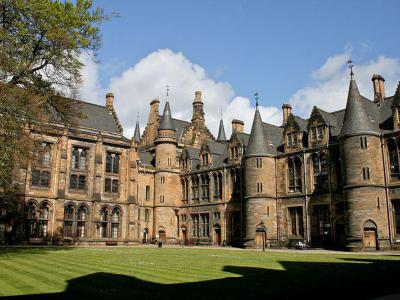
In 1870, Sir George Scott oversaw the construction of the university's main campus on Gilmorehill, adopting a Gothic architectural style and featuring a twin-quadrangle design with an open undercroft. A spire was later added to the bell tower in 1887. The university's various departments are dispersed across different buildings within the city and across the country.
During the 18th century, the University of Glasgow played a central role in the Scottish Enlightenment movement, while in the 19th century, it broadened its admissions, welcoming students beyond the privileged upper classes. Children of merchants enrolled to pursue studies in fields such as law, medicine, education, engineering, science, and theology.
Within the campus, visitors can explore the impressive Hunterian Museum & Gallery, as well as the Mackintosh House, offering enriching cultural experiences.
Its establishment can be traced back to 1451 when it received formal recognition through a Papal Bull issued during the papacy of Pope Nicholas V. Subsequently, King James II granted permission to Bishop William Turnbill to integrate the university with the city's cathedral. However, during the Reformation period, both the Mace and the Bull were transported to France. While the Mace eventually found its way back, the fate of the Bull remains uncertain, possibly lost or stolen.
In 1870, Sir George Scott oversaw the construction of the university's main campus on Gilmorehill, adopting a Gothic architectural style and featuring a twin-quadrangle design with an open undercroft. A spire was later added to the bell tower in 1887. The university's various departments are dispersed across different buildings within the city and across the country.
During the 18th century, the University of Glasgow played a central role in the Scottish Enlightenment movement, while in the 19th century, it broadened its admissions, welcoming students beyond the privileged upper classes. Children of merchants enrolled to pursue studies in fields such as law, medicine, education, engineering, science, and theology.
Within the campus, visitors can explore the impressive Hunterian Museum & Gallery, as well as the Mackintosh House, offering enriching cultural experiences.
5) Kelvingrove Park
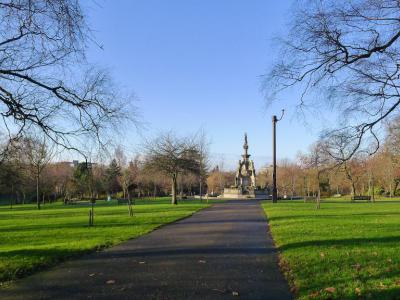
Kelvingrove Park is one of Glasgow’s most beloved green spaces, a sweeping Victorian park that blends natural beauty with history and culture. Opened in 1852 along the banks of the River Kelvin, it was designed by Sir Joseph Paxton, the landscape architect behind London’s Crystal Palace. Today, its 85 acres of rolling lawns, wooded groves, and winding paths offer a tranquil escape from the lively streets of the West End, just a short stroll from the University of Glasgow’s grand spire.
The park is not only a place for leisure but also a showcase of Glasgow’s rich heritage. Monuments and statues dot the grounds, honoring figures such as Field Marshal Lord Roberts and physicist William Thomson, better known as Lord Kelvin, for whom the park and river are named. The elegant Stewart Memorial Fountain, unveiled in 1872, commemorates Lord Provost Robert Stewart and the completion of the Loch Katrine water supply scheme, which transformed the city’s public health.
At the heart of the park stands the magnificent Kelvingrove Art Gallery and Museum, a red sandstone masterpiece that houses world-class collections ranging from European Old Masters to Scottish art and natural history exhibits. Nearby, the open-air Kelvingrove Bandstand-lovingly restored in recent years-hosts concerts, festivals, and cultural events that bring the community together throughout the year. Families will also find ample playgrounds, sports facilities, and open spaces for picnicking.
Interested in art, history, or just a leisurely walk amid greenery, visitors will find Kelvingrove Park a refreshing blend of culture and nature. It remains a favourite meeting place for locals and a must-see destination for visitors eager to experience the character and charm of Glasgow’s West End.
The park is not only a place for leisure but also a showcase of Glasgow’s rich heritage. Monuments and statues dot the grounds, honoring figures such as Field Marshal Lord Roberts and physicist William Thomson, better known as Lord Kelvin, for whom the park and river are named. The elegant Stewart Memorial Fountain, unveiled in 1872, commemorates Lord Provost Robert Stewart and the completion of the Loch Katrine water supply scheme, which transformed the city’s public health.
At the heart of the park stands the magnificent Kelvingrove Art Gallery and Museum, a red sandstone masterpiece that houses world-class collections ranging from European Old Masters to Scottish art and natural history exhibits. Nearby, the open-air Kelvingrove Bandstand-lovingly restored in recent years-hosts concerts, festivals, and cultural events that bring the community together throughout the year. Families will also find ample playgrounds, sports facilities, and open spaces for picnicking.
Interested in art, history, or just a leisurely walk amid greenery, visitors will find Kelvingrove Park a refreshing blend of culture and nature. It remains a favourite meeting place for locals and a must-see destination for visitors eager to experience the character and charm of Glasgow’s West End.
6) Lord Kelvin Statue
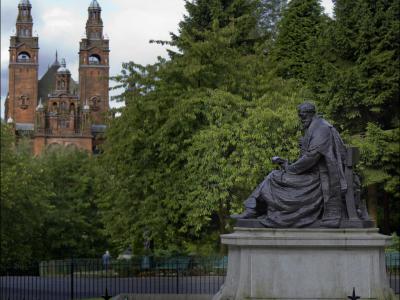
The Lord Kelvin Statue is a tribute to one of the city’s most celebrated scientific minds, William Thomson, better known as Lord Kelvin. Born in Belfast in 1824 but raised and educated in Glasgow, Kelvin became a pioneering physicist, engineer, and mathematician. His name is forever associated with the Kelvin scale of absolute temperature, but his influence extended far beyond that. From advances in thermodynamics to his role in laying the first successful transatlantic telegraph cable, Kelvin was instrumental in shaping modern science and technology. Glasgow, where he spent much of his life teaching at the University, honors his legacy with this distinguished monument.
Unveiled in 1913, the statue was sculpted by Archibald Macfarlane Shannan and stands prominently in Kelvingrove Park, near the university that shaped much of Kelvin’s career. The figure depicts Lord Kelvin seated, dressed in academic robes, holding a globe to symbolize his wide-ranging contributions to global science and communication. The statue’s elevated position, overlooking the park, gives it both a sense of dignity and approachability, reflecting Kelvin’s role as both a groundbreaking thinker and a beloved teacher.
Visitors will find the statue surrounded by the greenery of Kelvingrove Park, making it not only a place to reflect on Kelvin’s achievements but also a pleasant stop on a stroll through the West End. Nearby, the University of Glasgow houses the Hunterian Museum and collections that further illuminate Kelvin’s work. Taken together, the statue and its setting make for a fitting reminder of Glasgow’s important place in scientific history.
Unveiled in 1913, the statue was sculpted by Archibald Macfarlane Shannan and stands prominently in Kelvingrove Park, near the university that shaped much of Kelvin’s career. The figure depicts Lord Kelvin seated, dressed in academic robes, holding a globe to symbolize his wide-ranging contributions to global science and communication. The statue’s elevated position, overlooking the park, gives it both a sense of dignity and approachability, reflecting Kelvin’s role as both a groundbreaking thinker and a beloved teacher.
Visitors will find the statue surrounded by the greenery of Kelvingrove Park, making it not only a place to reflect on Kelvin’s achievements but also a pleasant stop on a stroll through the West End. Nearby, the University of Glasgow houses the Hunterian Museum and collections that further illuminate Kelvin’s work. Taken together, the statue and its setting make for a fitting reminder of Glasgow’s important place in scientific history.
7) Lord Lister Monument
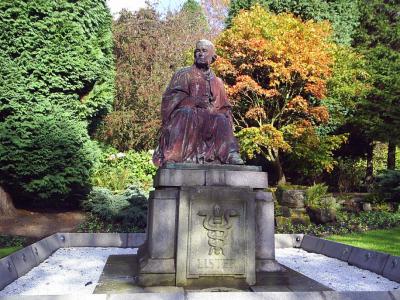
The Lord Lister Monument is a tribute to one of the city’s most influential figures in the field of medicine, Joseph Lister. Often hailed as the “father of modern surgery,” Lister revolutionized surgical practice in the 19th century by introducing antiseptic methods, drastically reducing infection and mortality rates in hospitals. His pioneering use of carbolic acid to sterilize instruments and clean wounds set new standards for medical practice worldwide. Glasgow, where Lister carried out much of his groundbreaking research at the University of Glasgow, honours him with this striking monument.
Erected in 1924, the monument stands proudly in Kelvingrove Park, not far from the university where Lister once taught. Designed by sculptor George Henry Paulin, it presents a dignified bronze statue of Lister in academic robes, reflecting both his role as a scientist and a teacher. The figure is elevated on a stone plinth inscribed with his name, ensuring that passersby can recognize and reflect on his contributions to global health. Its location amid the park’s green landscape offers a peaceful setting, making it a spot of quiet admiration rather than a bustling tourist hub.
For visitors, the monument offers more than just a glimpse into Glasgow’s architectural heritage-it also highlights the city’s role in advancing medical science. Standing before the statue, one is reminded of how innovations born in Glasgow influenced hospitals across the world, saving countless lives. Combined with the surrounding beauty of Kelvingrove Park, the Lord Lister Monument makes for a meaningful stop on any cultural or historical exploration of the city.
Erected in 1924, the monument stands proudly in Kelvingrove Park, not far from the university where Lister once taught. Designed by sculptor George Henry Paulin, it presents a dignified bronze statue of Lister in academic robes, reflecting both his role as a scientist and a teacher. The figure is elevated on a stone plinth inscribed with his name, ensuring that passersby can recognize and reflect on his contributions to global health. Its location amid the park’s green landscape offers a peaceful setting, making it a spot of quiet admiration rather than a bustling tourist hub.
For visitors, the monument offers more than just a glimpse into Glasgow’s architectural heritage-it also highlights the city’s role in advancing medical science. Standing before the statue, one is reminded of how innovations born in Glasgow influenced hospitals across the world, saving countless lives. Combined with the surrounding beauty of Kelvingrove Park, the Lord Lister Monument makes for a meaningful stop on any cultural or historical exploration of the city.
8) Tenement House
The Tenement House is a historic house museum, operated by the National Trust for Scotland. It stands as a testament to the architectural and social history of tenements in Scotland. Tenements, commonly found across the British Isles, are multi-dwelling buildings with flats or apartments on each floor, sharing a common entrance and stairway. These structures are particularly notable in Scotland, with historic examples in Edinburgh's medieval Old Town, like Gladstone's Land, where each apartment was treated as a separate house stacked atop another.
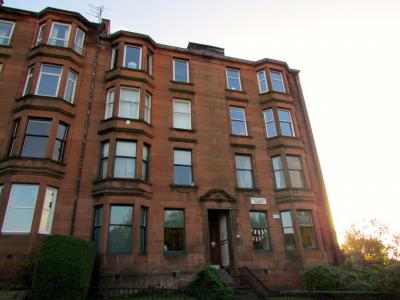
This particular tenement, situated near Charing Cross railway station and Cowcaddens subway station, dates back to 1892. The museum showcases a flat within this building, meticulously preserved to reflect its state from the early 20th century. Agnes Toward, a shorthand typist, owned and lived in this flat from 1911 until 1965. Her dedication to preserving her belongings and furniture has rendered the Tenement House a veritable time capsule, offering visitors an authentic glimpse into Glasgow's past.
On the exterior, the Tenement House appears as a typical middle-class tenement of the late 19th century. However, stepping inside reveals a world seemingly frozen in time. The four restored rooms showcase the everyday life of an early 20th-century Glaswegian. Agnes Toward's extensive personal archive, comprising various items that many would have discarded, now serves as a valuable historical resource. This collection not only reflects the domestic life of the period but also highlights the life of an 'independent woman' in that era.
This particular tenement, situated near Charing Cross railway station and Cowcaddens subway station, dates back to 1892. The museum showcases a flat within this building, meticulously preserved to reflect its state from the early 20th century. Agnes Toward, a shorthand typist, owned and lived in this flat from 1911 until 1965. Her dedication to preserving her belongings and furniture has rendered the Tenement House a veritable time capsule, offering visitors an authentic glimpse into Glasgow's past.
On the exterior, the Tenement House appears as a typical middle-class tenement of the late 19th century. However, stepping inside reveals a world seemingly frozen in time. The four restored rooms showcase the everyday life of an early 20th-century Glaswegian. Agnes Toward's extensive personal archive, comprising various items that many would have discarded, now serves as a valuable historical resource. This collection not only reflects the domestic life of the period but also highlights the life of an 'independent woman' in that era.
