Custom Walk in Delhi, India by whitep_7d3e87 created on 2026-02-07
Guide Location: India » Delhi
Guide Type: Custom Walk
# of Sights: 6
Tour Duration: 5 Hour(s)
Travel Distance: 14.1 Km or 8.8 Miles
Share Key: DZRJY
Guide Type: Custom Walk
# of Sights: 6
Tour Duration: 5 Hour(s)
Travel Distance: 14.1 Km or 8.8 Miles
Share Key: DZRJY
How It Works
Please retrieve this walk in the GPSmyCity app. Once done, the app will guide you from one tour stop to the next as if you had a personal tour guide. If you created the walk on this website or come to the page via a link, please follow the instructions below to retrieve the walk in the app.
Retrieve This Walk in App
Step 1. Download the app "GPSmyCity: Walks in 1K+ Cities" on Apple App Store or Google Play Store.



Step 2. In the GPSmyCity app, download(or launch) the guide "Delhi Map and Walking Tours".
Step 3. Tap the menu button located at upper right corner of the "Walks" screen and select "Retrieve custom walk". Enter the share key: DZRJY
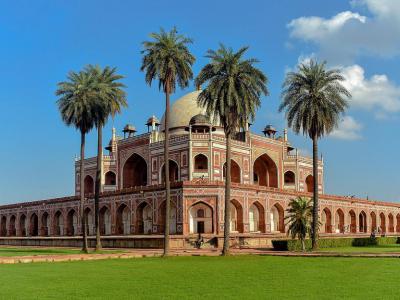
1) Humayun's Tomb (must see)
Humayun's Tomb stands as a must-visit destination in New Delhi, making it an ideal starting point for your Delhi itinerary. It holds immense importance in the evolution of Mughal architecture and was constructed in the 16th century to serve as the final resting place for the Mughal Emperor Humayun. Recognized by UNESCO as a heritage site, this complex boasts a magnificent blend of red sandstone and white marble, adorned with intricate carvings, arches, and domes, showcasing the grandeur of Mughal India.
Arriving in Delhi can be overwhelming due to its vibrant intensity. To ease into the city's charm, consider devoting your first day to the serene ambiance of Humayun's Tomb, where peaceful gardens, fountains, and pleasant walks await you. Enclosed by four monumental gates, this palace complex has undergone restoration, justifying the slightly higher ticket price.
By opting for this tranquil oasis initially, you can save the hustle and bustle of Old Delhi's Jama Masjid or Red Fort for later exploration. Embrace the splendor of Mughal history and architecture at Humayun's Tomb before immersing yourself in the bustling energy of Delhi's vibrant streets.
Why You Should Visit:
Whether or not you're visiting the Taj Mahal in Agra, exploring its red equivalent in Delhi will leave you mesmerized with architectural beauty.
Tip:
Be sure to buy tickets online, or else stand in the much shorter line for foreigners.
It is worth attending with a tour guide to explain the history of the building.
There are loads of mosquitos about so applying some repellant helps.
Opening Times:
Sunrise-Sunset.
Arriving in Delhi can be overwhelming due to its vibrant intensity. To ease into the city's charm, consider devoting your first day to the serene ambiance of Humayun's Tomb, where peaceful gardens, fountains, and pleasant walks await you. Enclosed by four monumental gates, this palace complex has undergone restoration, justifying the slightly higher ticket price.
By opting for this tranquil oasis initially, you can save the hustle and bustle of Old Delhi's Jama Masjid or Red Fort for later exploration. Embrace the splendor of Mughal history and architecture at Humayun's Tomb before immersing yourself in the bustling energy of Delhi's vibrant streets.
Why You Should Visit:
Whether or not you're visiting the Taj Mahal in Agra, exploring its red equivalent in Delhi will leave you mesmerized with architectural beauty.
Tip:
Be sure to buy tickets online, or else stand in the much shorter line for foreigners.
It is worth attending with a tour guide to explain the history of the building.
There are loads of mosquitos about so applying some repellant helps.
Opening Times:
Sunrise-Sunset.
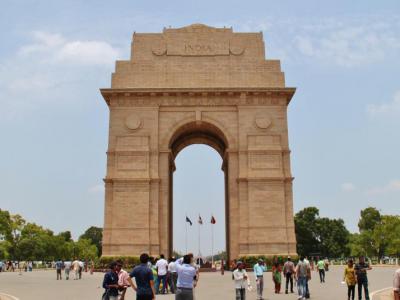
2) India Gate & Rajpath (must see)
Rajpath is a road in Delhi that runs between the Rashtrapati Bhavan and Delhi's National Stadium. It is considered to be one of the most important boulevards in India.
Rajpath was conceived in 1911 by Sir Edwin Lutyens. He envisioned the road to be the center of all of British India. Many of the buildings that flank the road are government buildings that were also designed by Lutyens. Landmarks include the Secretariat Building, Vijay Chowk, the National War Memorial and India Gate.
The street also takes tourists near the Indira Gandhi Centre for the Arts and Exhibition Hall, the National Museum and Parliament House.
India Gate is a symbolic memorial east of Rajpath. The gate stands in recognition of the more than 70,000 soldiers who died during World War I and the third Anglo-Afghan War.
Like many of the buildings and memorials near Rajpath, India Gate was designed by Sir Edwin Lutyens. He modeled the gate after the Arc de Triomphe in Paris and the Arch of Constantine in Rome. India Gate was established in 1921 and completed 10 years later.
East of India Gate is the Canopy. This 73-foot cupola once held a statue of George V. It was removed in 1968 and eventually placed in Coronation Park.
Visitors will also see Amar Jawan Jyoti, or the Flame of the Immortal Soldier. The black marble plinth is located inside the gate as a dedication to unknown soldiers. Amar Jawan Jyoti was added to the structure in 1972 at the request of Prime Minister Indira Gandhi.
Rajpath was conceived in 1911 by Sir Edwin Lutyens. He envisioned the road to be the center of all of British India. Many of the buildings that flank the road are government buildings that were also designed by Lutyens. Landmarks include the Secretariat Building, Vijay Chowk, the National War Memorial and India Gate.
The street also takes tourists near the Indira Gandhi Centre for the Arts and Exhibition Hall, the National Museum and Parliament House.
India Gate is a symbolic memorial east of Rajpath. The gate stands in recognition of the more than 70,000 soldiers who died during World War I and the third Anglo-Afghan War.
Like many of the buildings and memorials near Rajpath, India Gate was designed by Sir Edwin Lutyens. He modeled the gate after the Arc de Triomphe in Paris and the Arch of Constantine in Rome. India Gate was established in 1921 and completed 10 years later.
East of India Gate is the Canopy. This 73-foot cupola once held a statue of George V. It was removed in 1968 and eventually placed in Coronation Park.
Visitors will also see Amar Jawan Jyoti, or the Flame of the Immortal Soldier. The black marble plinth is located inside the gate as a dedication to unknown soldiers. Amar Jawan Jyoti was added to the structure in 1972 at the request of Prime Minister Indira Gandhi.
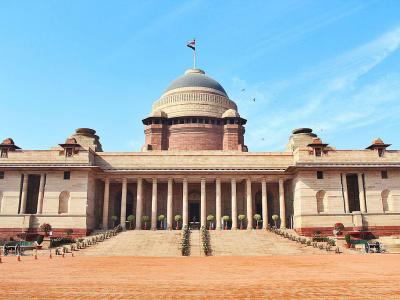
3) Rashtrapati Bhawan (must see)
Situated at Raisina Hills in New Delhi, the Bhawan is the authorized abode of the president of India. It is also one of the major tourist attractions in New Delhi. Rashtrapati Bhawan once served as the dwelling place of Governor General of India during the British rule. Sir Edwin Lutyens designed this building which was completed in 1929 and inaugurated in 1931. You will find an interesting mix of Indian, Mughal and European colonial architectural features.
Spread over 20,000 square feet, Rashtrapati Bhawan has 340 luxurious rooms that include the State Drawing room, State Library, State Ball room and so on. The Darbar room is used for prize awarding ceremonies. There is a beautiful Mughal garden to the west of the Bhawan where varieties of roses are grown. This garden is open to public between February and March every year. You must take permission officially to visit this Bhawan.
A chandelier weighing two tons adorns the main hall. This chandelier adds to the grandeur and elegance of the interiors. The hall is used for official ceremonies. Interior of the Rashtrapati Bhawan is simple and elegant. Heavy stone works and shapes used in the building lend an ornamental appearance. Do not miss out the eight lions spilling water into the basins near the Viceroy’s stairs at the Bhavan.
Spread over 20,000 square feet, Rashtrapati Bhawan has 340 luxurious rooms that include the State Drawing room, State Library, State Ball room and so on. The Darbar room is used for prize awarding ceremonies. There is a beautiful Mughal garden to the west of the Bhawan where varieties of roses are grown. This garden is open to public between February and March every year. You must take permission officially to visit this Bhawan.
A chandelier weighing two tons adorns the main hall. This chandelier adds to the grandeur and elegance of the interiors. The hall is used for official ceremonies. Interior of the Rashtrapati Bhawan is simple and elegant. Heavy stone works and shapes used in the building lend an ornamental appearance. Do not miss out the eight lions spilling water into the basins near the Viceroy’s stairs at the Bhavan.
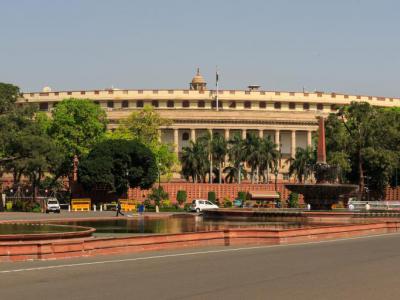
4) Parliament House
Parliament House is the center of government in India. It is home to Lok Sobha (House of the People) and Rajya Sabha (Council of States). It is located near the office and residence of the prime minister as well as a number of other administrative and ministerial buildings.
Construction on Parliament House began in 1921 and was completed in 1927. It was designed by Sir Edwin Lutyens and Sir Herbert Baker. The architectural style of the building is the unique Lutyens' Delhi, which combines Neo-Classical architecture with Mughal and Buddhist influences.
The building is circular and surrounded by 144 columns. Visitors can get an excellent view of this architecture and the gardens when they visit the Parliament Museum that is held within the library building. It is open from 11 AM through 5 PM Tuesday through Saturday.
A new parliament building is under construction. Once that building is completed, Parliament House will be turned into a permanent museum.
Construction on Parliament House began in 1921 and was completed in 1927. It was designed by Sir Edwin Lutyens and Sir Herbert Baker. The architectural style of the building is the unique Lutyens' Delhi, which combines Neo-Classical architecture with Mughal and Buddhist influences.
The building is circular and surrounded by 144 columns. Visitors can get an excellent view of this architecture and the gardens when they visit the Parliament Museum that is held within the library building. It is open from 11 AM through 5 PM Tuesday through Saturday.
A new parliament building is under construction. Once that building is completed, Parliament House will be turned into a permanent museum.
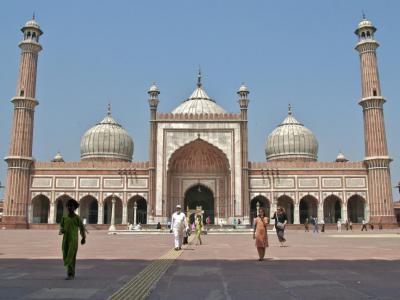
5) Jama Masjid (Friday Mosque) (must see)
Built in 1656 by the Mughal Emperor, Shah Jahan, this mosque has survived the ravages of time. It stands as an example of the emperor’s passion for elegant architectural design. It took six years, more than 5,000 workers to complete.
The exterior of this Masjid has alternating stripes of white marble and red sandstone lending a magical charm to the structure. The Masjid features verses from the Holy Quran and intricate carvings inscribed on the walls. The mosque contains several interesting artifacts such as a replica of the original Quran written on a deer skin, footprint of prophet Muhammed, his sandals and a beard hair. While the minarets made of red sandstone and white marble with black color stripes are the most important attractions, the combination of wide staircases, marble domes and arched gateways make this place of worship stand out even more.
Jama Masjid is a blend of the best of Hindu and Muslim architectural styles. You can reach the mosque through the gateways at the north or south. The main entrance gate in the east remains closed on most of the days. Footwear is left at the entrance for a small fee and is looked after by workers; garments are offered to cover up at the entrance to respect the custom of decency.
Why You Should Visit:
Even if you've seen a mosque before, the size of everything here will still catch you off guard!
Tip:
Instead of going into the mosque, go around the corner to the spice market and climb to the rooftop of the building. You will have an amazing view of the inside of the mosque.
You can also climb on the southern Minar for a nominal entrance fee and have an overlook view of Old Delhi from the top. Note that it's steep and very narrow in there, though.
Photos are allowed inside so do carry a camera and capture your moments in and around. If you really wish to sense something different, then do come prior to evening Azaan.
The exterior of this Masjid has alternating stripes of white marble and red sandstone lending a magical charm to the structure. The Masjid features verses from the Holy Quran and intricate carvings inscribed on the walls. The mosque contains several interesting artifacts such as a replica of the original Quran written on a deer skin, footprint of prophet Muhammed, his sandals and a beard hair. While the minarets made of red sandstone and white marble with black color stripes are the most important attractions, the combination of wide staircases, marble domes and arched gateways make this place of worship stand out even more.
Jama Masjid is a blend of the best of Hindu and Muslim architectural styles. You can reach the mosque through the gateways at the north or south. The main entrance gate in the east remains closed on most of the days. Footwear is left at the entrance for a small fee and is looked after by workers; garments are offered to cover up at the entrance to respect the custom of decency.
Why You Should Visit:
Even if you've seen a mosque before, the size of everything here will still catch you off guard!
Tip:
Instead of going into the mosque, go around the corner to the spice market and climb to the rooftop of the building. You will have an amazing view of the inside of the mosque.
You can also climb on the southern Minar for a nominal entrance fee and have an overlook view of Old Delhi from the top. Note that it's steep and very narrow in there, though.
Photos are allowed inside so do carry a camera and capture your moments in and around. If you really wish to sense something different, then do come prior to evening Azaan.
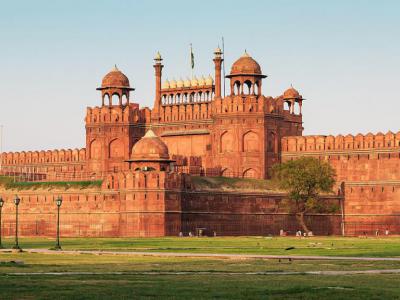
6) Red Fort (must see)
The historic Red Fort in Delhi was once home to the Mughal emperors of India. It was commissioned by Shah Jahan in 1638 when the capital moved to Delhi from Agra. It is so named due to the red sandstone walls that surround the structures.
The Red Fort architect was Ustad Ahmad Lahori, who was also architect of the Taj Mahal. It was designed in Indo-Islamic architectural style, but many of the buildings have Mughal influences that combine Hindu, Persian and Timurid styles.
The fort has suffered from theft and destruction over the years. For example, the Diwan-i-Khas once had a ceiling made from silver, but it was removed and melted in 1760. Most of the marble structures in the fort were destroyed during the Revolt of 1857.
Red Fort once held a large amount of jewels and artwork. Nearly all of these valuables were stolen and now belong to private collectors or reside in British museums.
Despite all of the plundering and warfare that has taken place over the years, the defensive walls have remained mostly intact. The Red Fort Complex has now been named a UNESCO World Heritage Site. As it is the largest monument in Delhi, it is also one of the most popular tourist destinations.
The structures still standing at Red Fort are Lahori Gate, Delhi Gate, Chhatta Chowk, Naubat Khana and a number of halls, homes and apartments. There is also a bath house, a step-well, a reservoir and the Pearl Mosque.
There is a light and sound show displayed each evening that describes Mughal history. The show takes place at 6 PM and is in both English and Hindi.
Why You Should Visit:
- To see Delhi's largest monument
- To explore a historic fort that still has many building intact
Tips:
Red Fort is open from sunrise to sunset. The entry fee is 950 rupees (approximately $13 USD), though this amount may fluctuate. There is an additional, nominal fee for the light show. Red Fort is closed on Mondays.
The Red Fort architect was Ustad Ahmad Lahori, who was also architect of the Taj Mahal. It was designed in Indo-Islamic architectural style, but many of the buildings have Mughal influences that combine Hindu, Persian and Timurid styles.
The fort has suffered from theft and destruction over the years. For example, the Diwan-i-Khas once had a ceiling made from silver, but it was removed and melted in 1760. Most of the marble structures in the fort were destroyed during the Revolt of 1857.
Red Fort once held a large amount of jewels and artwork. Nearly all of these valuables were stolen and now belong to private collectors or reside in British museums.
Despite all of the plundering and warfare that has taken place over the years, the defensive walls have remained mostly intact. The Red Fort Complex has now been named a UNESCO World Heritage Site. As it is the largest monument in Delhi, it is also one of the most popular tourist destinations.
The structures still standing at Red Fort are Lahori Gate, Delhi Gate, Chhatta Chowk, Naubat Khana and a number of halls, homes and apartments. There is also a bath house, a step-well, a reservoir and the Pearl Mosque.
There is a light and sound show displayed each evening that describes Mughal history. The show takes place at 6 PM and is in both English and Hindi.
Why You Should Visit:
- To see Delhi's largest monument
- To explore a historic fort that still has many building intact
Tips:
Red Fort is open from sunrise to sunset. The entry fee is 950 rupees (approximately $13 USD), though this amount may fluctuate. There is an additional, nominal fee for the light show. Red Fort is closed on Mondays.
