Custom Walk in Montreal, Canada by nanette_guerin2338 created on 2026-02-12
Guide Location: Canada » Montreal
Guide Type: Custom Walk
# of Sights: 9
Tour Duration: 2 Hour(s)
Travel Distance: 2.9 Km or 1.8 Miles
Share Key: NCKF9
Guide Type: Custom Walk
# of Sights: 9
Tour Duration: 2 Hour(s)
Travel Distance: 2.9 Km or 1.8 Miles
Share Key: NCKF9
How It Works
Please retrieve this walk in the GPSmyCity app. Once done, the app will guide you from one tour stop to the next as if you had a personal tour guide. If you created the walk on this website or come to the page via a link, please follow the instructions below to retrieve the walk in the app.
Retrieve This Walk in App
Step 1. Download the app "GPSmyCity: Walks in 1K+ Cities" on Apple App Store or Google Play Store.



Step 2. In the GPSmyCity app, download(or launch) the guide "Montreal Map and Walking Tours".
Step 3. Tap the menu button located at upper right corner of the "Walks" screen and select "Retrieve custom walk". Enter the share key: NCKF9
1) 1000 de la Gauchetiere
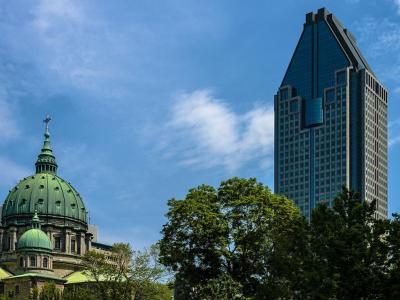
Located in Montreal, 1000 de la Gauchetière stands out among the city's skyscrapers as the tallest, reaching the approved height limit of 205 meters. With its impressive stature of 673 feet and 51 floors, this building has become a renowned tourist destination, drawing visitors with its notable feature-a sprawling atrium housing an expansive skating rink.
Constructed in 1992, 1000 de la Gauchetière exemplifies postmodern architecture, comparable to the JPMorgan Chase Tower in Dallas, Texas. Notably, the building boasts a distinctive street-level design that projects outward in a unique style.
The building's structural core is composed of concrete, complemented by steel floor plates throughout the rest of its construction. A total of 22 elevators facilitate vertical movement, while each floor accommodates up to 12 corner offices. Shoppers delight in the abundance of shops and malls available, attracting a diverse crowd of tourists, window shoppers, and avid consumers.
Undoubtedly, the main attraction within 1000 de la Gauchetière is its indoor skating rink. Additionally, the facility also houses a fitness center, catering to those seeking physical activity. Conveniently accessible, the building enjoys excellent connectivity to the downtown bus terminal and metro stations, allowing visitors to easily reach their desired destination.
Constructed in 1992, 1000 de la Gauchetière exemplifies postmodern architecture, comparable to the JPMorgan Chase Tower in Dallas, Texas. Notably, the building boasts a distinctive street-level design that projects outward in a unique style.
The building's structural core is composed of concrete, complemented by steel floor plates throughout the rest of its construction. A total of 22 elevators facilitate vertical movement, while each floor accommodates up to 12 corner offices. Shoppers delight in the abundance of shops and malls available, attracting a diverse crowd of tourists, window shoppers, and avid consumers.
Undoubtedly, the main attraction within 1000 de la Gauchetière is its indoor skating rink. Additionally, the facility also houses a fitness center, catering to those seeking physical activity. Conveniently accessible, the building enjoys excellent connectivity to the downtown bus terminal and metro stations, allowing visitors to easily reach their desired destination.
2) Cathedrale Marie-Reine-du-Monde (Mary, Queen of the World Cathedral) (must see)
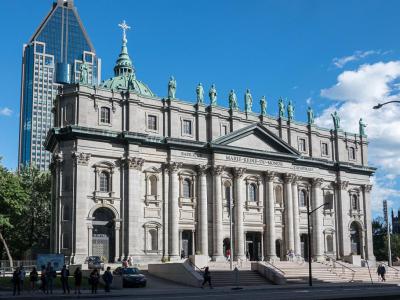
If you think skyscrapers have the last word in downtown Montreal, look up. Rising confidently among the glass and steel is a dome that feels suspiciously Roman.
This is Mary, Queen of the World Cathedral, and yes, that dome is modeled on Saint Peter's Basilica. Think of it as Rome’s greatest architectural hit—re-recorded in Québec. Slightly scaled down, perhaps, but impressively faithful, right down to the red copper baldachin above the altar, hand-carved in Rome itself. No shortcuts here...
Completed in the 1890s, the cathedral somehow manages to look older than it is, while also feeling more streamlined than many of its European cousins. Compared to Notre-Dame Basilica of Montreal, its interior feels lighter, calmer, and almost minimalist.
The design is clean, the lines are clear, and the colours lean toward soft pastels rather than dramatic flourishes. On a sunny day, the stained glass comes alive, casting shifting light across the ceiling, the altar, and the organ pipes at the rear. It's the kind of place where you instinctively lower your voice.
Take a moment near the baptismal font and look up: a striking stucco crucifix crowns it—one of Québec’s most significant religious sculptures. Around you, Italian marble stretches across floors and walls, adding a quiet sense of grandeur. The artwork pays tribute not just to biblical figures but to Montreal’s own spiritual history, including Marguerite Bourgeoys and Marguerite d’Youville, founder of the Grey Nuns. This cathedral tells the city’s story as much as it echoes Rome’s.
Step outside and glance at the façade. You’ll notice 13 statues—just like at Saint Peter’s—but with a local twist. Instead of Jesus and the 12 apostles, these figures represent patron saints from parishes that supported the diocese, including Saint Hyacinthe, Saint Francis of Assisi, and Saint John the Baptist. A European silhouette, a distinctly Canadian cast...
The overall effect is peaceful, dignified, and unexpectedly transportive. For a moment, downtown Montreal fades away, and you could almost believe you’ve wandered into an old basilica somewhere in Europe—just with better maple syrup nearby...
And before you leave, have a look at the gift shop. It carries distinctive jewellery and religious keepsakes—small reminders that Rome may be far away, but its architectural spirit has clearly made itself at home here.
This is Mary, Queen of the World Cathedral, and yes, that dome is modeled on Saint Peter's Basilica. Think of it as Rome’s greatest architectural hit—re-recorded in Québec. Slightly scaled down, perhaps, but impressively faithful, right down to the red copper baldachin above the altar, hand-carved in Rome itself. No shortcuts here...
Completed in the 1890s, the cathedral somehow manages to look older than it is, while also feeling more streamlined than many of its European cousins. Compared to Notre-Dame Basilica of Montreal, its interior feels lighter, calmer, and almost minimalist.
The design is clean, the lines are clear, and the colours lean toward soft pastels rather than dramatic flourishes. On a sunny day, the stained glass comes alive, casting shifting light across the ceiling, the altar, and the organ pipes at the rear. It's the kind of place where you instinctively lower your voice.
Take a moment near the baptismal font and look up: a striking stucco crucifix crowns it—one of Québec’s most significant religious sculptures. Around you, Italian marble stretches across floors and walls, adding a quiet sense of grandeur. The artwork pays tribute not just to biblical figures but to Montreal’s own spiritual history, including Marguerite Bourgeoys and Marguerite d’Youville, founder of the Grey Nuns. This cathedral tells the city’s story as much as it echoes Rome’s.
Step outside and glance at the façade. You’ll notice 13 statues—just like at Saint Peter’s—but with a local twist. Instead of Jesus and the 12 apostles, these figures represent patron saints from parishes that supported the diocese, including Saint Hyacinthe, Saint Francis of Assisi, and Saint John the Baptist. A European silhouette, a distinctly Canadian cast...
The overall effect is peaceful, dignified, and unexpectedly transportive. For a moment, downtown Montreal fades away, and you could almost believe you’ve wandered into an old basilica somewhere in Europe—just with better maple syrup nearby...
And before you leave, have a look at the gift shop. It carries distinctive jewellery and religious keepsakes—small reminders that Rome may be far away, but its architectural spirit has clearly made itself at home here.
3) St. Patrick's Basilica (must see)
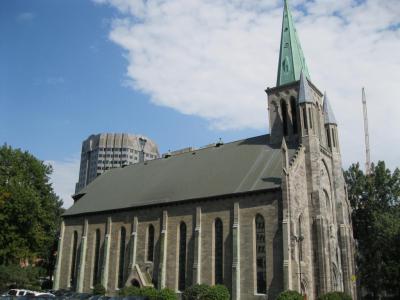
Completed in 1847, in the thick of the Irish Famine migration, Saint Patrick’s rose as a spiritual anchor for Montreal’s English-speaking Catholics — much as Notre-Dame Basilica serves the city’s French-speaking faithful. It stands as one of Canada’s purest expressions of the Gothic Revival style, later recognized as both a historic monument and a National Historic Site. In other words, this isn’t just another church. It’s a statement in stone.
Now, if you’re expecting the gilded drama of Notre-Dame, adjust your expectations. Saint Patrick’s is lighter, brighter, and more restrained. The woodwork is rich without being overwhelming, the Gothic lines clean and confident.
On a clear afternoon, the interior doesn’t merely glow — it performs. Golden light filters through stained-glass windows that line the walls like pages in an illuminated manuscript. Colour spills across the floor, climbs the columns, and settles into every carved detail. And those tall, slender columns — they may look like marble, but are actually pine logs bound together and carefully finished to create the illusion of stone. A little architectural theatre, executed beautifully...
Then there’s the showstopper overhead: a hanging sanctuary lamp weighing in at 1,800 pounds. Suspended high above, ringed by six angels, it’s less a fixture and more a floating sculpture. It commands attention without saying a word — which, in a church, feels appropriate.
Drop by after lunch, and you might hear the organist rehearsing, the notes rolling through the nave long before a service begins. And if the main doors are closed, try a side entrance — one is often left open, as if the building itself prefers to keep things welcoming rather than grand.
There’s also a quiet benefit: it’s free to enter, and chances are you won’t be elbowing through crowds either. You may even find yourself alone, with time to sit, breathe, and let the colours settle.
Now, if you’re expecting the gilded drama of Notre-Dame, adjust your expectations. Saint Patrick’s is lighter, brighter, and more restrained. The woodwork is rich without being overwhelming, the Gothic lines clean and confident.
On a clear afternoon, the interior doesn’t merely glow — it performs. Golden light filters through stained-glass windows that line the walls like pages in an illuminated manuscript. Colour spills across the floor, climbs the columns, and settles into every carved detail. And those tall, slender columns — they may look like marble, but are actually pine logs bound together and carefully finished to create the illusion of stone. A little architectural theatre, executed beautifully...
Then there’s the showstopper overhead: a hanging sanctuary lamp weighing in at 1,800 pounds. Suspended high above, ringed by six angels, it’s less a fixture and more a floating sculpture. It commands attention without saying a word — which, in a church, feels appropriate.
Drop by after lunch, and you might hear the organist rehearsing, the notes rolling through the nave long before a service begins. And if the main doors are closed, try a side entrance — one is often left open, as if the building itself prefers to keep things welcoming rather than grand.
There’s also a quiet benefit: it’s free to enter, and chances are you won’t be elbowing through crowds either. You may even find yourself alone, with time to sit, breathe, and let the colours settle.
4) Place d'Armes (Arms' Square)
One of the oldest public spaces in Montreal, Arms' Square has a rather epic history to it, dating back over 300 years. The name itself sounds dramatic, and rightly so. “Pláce d'Armes” was the classic French term for a military gathering ground, a place where defenders assembled in uncertain times. This is actually the third spot in Montreal to carry this title, and it wears it well.
But the square didn’t always go by such a bold name. When it first appeared in 1693, it was called Place de la Fabrique—or Factory Square—before being renamed, in 1721, for having hosted drills and military parades. Then came a surprising career change: from 1781 to 1813, it operated as a hay and wood market. By 1836, the city acquired it, turned it into a Victorian garden, and by 1850—once Notre-Dame Street was completed—the square settled into the shape we recognize today.
At the centre of it stands Paul de Chomedey de Maisonneuve, founder of the city, cast in bronze since 1895. Sword in hand, he commemorates the defense of the early Ville-Marie settlement against the Iroquois Indians.
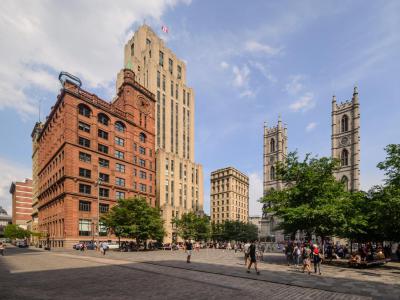
Still, the real show isn’t the paving stones. It’s the architecture forming a perfect historical surround-sound. On one side rises the majestic Notre-Dame Basilica. Nearby, stands the Saint-Sulpice Seminary, dating to the 1680s and considered Montreal’s oldest building.
Across the square, the Bank of Montreal headquarters—Canada’s first bank—opened in 1859. Then came the New York Life Building in 1887, Montreal’s first skyscraper, proudly equipped with what was then a thrilling novelty: an elevator.
The skyline continued evolving with the Royal Trust, the Duluth Building (sitting to the left of the basilica), and in 1931, the Art Deco Aldred Building, designed to let sunlight reach the street below. By 1968, the modern National Bank Tower—all glass and steel—added a post-war punctuation mark to the timeline.
And just when you think it’s all solemn history, two sculptures break the tension: a rather haughty English gentleman with his pug, and a French lady with her poodle. The dogs seem ready to make friends; their owners, not so much. It’s a playful nod to centuries of rivalry—played out in stone and fur.
Today, horse-drawn carriages depart from the square, benches invite you to linger, and cafés tempt you to pause. So, do sit here for a moment. Around you, three centuries of Montreal are quietly arguing—and getting along just fine...
But the square didn’t always go by such a bold name. When it first appeared in 1693, it was called Place de la Fabrique—or Factory Square—before being renamed, in 1721, for having hosted drills and military parades. Then came a surprising career change: from 1781 to 1813, it operated as a hay and wood market. By 1836, the city acquired it, turned it into a Victorian garden, and by 1850—once Notre-Dame Street was completed—the square settled into the shape we recognize today.
At the centre of it stands Paul de Chomedey de Maisonneuve, founder of the city, cast in bronze since 1895. Sword in hand, he commemorates the defense of the early Ville-Marie settlement against the Iroquois Indians.
Still, the real show isn’t the paving stones. It’s the architecture forming a perfect historical surround-sound. On one side rises the majestic Notre-Dame Basilica. Nearby, stands the Saint-Sulpice Seminary, dating to the 1680s and considered Montreal’s oldest building.
Across the square, the Bank of Montreal headquarters—Canada’s first bank—opened in 1859. Then came the New York Life Building in 1887, Montreal’s first skyscraper, proudly equipped with what was then a thrilling novelty: an elevator.
The skyline continued evolving with the Royal Trust, the Duluth Building (sitting to the left of the basilica), and in 1931, the Art Deco Aldred Building, designed to let sunlight reach the street below. By 1968, the modern National Bank Tower—all glass and steel—added a post-war punctuation mark to the timeline.
And just when you think it’s all solemn history, two sculptures break the tension: a rather haughty English gentleman with his pug, and a French lady with her poodle. The dogs seem ready to make friends; their owners, not so much. It’s a playful nod to centuries of rivalry—played out in stone and fur.
Today, horse-drawn carriages depart from the square, benches invite you to linger, and cafés tempt you to pause. So, do sit here for a moment. Around you, three centuries of Montreal are quietly arguing—and getting along just fine...
5) Notre-Dame Basilica (must see)
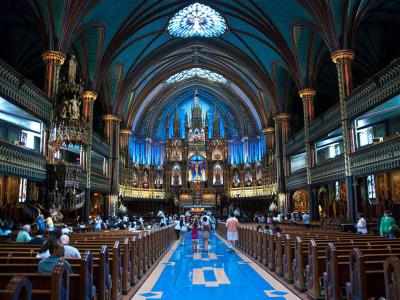
Notre-Dame Basilica of Montreal is a church that doesn’t whisper modestly from the sidelines. It steps confidently into the spotlight as one of the grand showpieces of Gothic Revival architecture in North America. Designed by Irish-American architect James O'Donnell and largely completed in 1829, this temple proves that Montreal doesn’t do subtle when it comes to sacred spaces.
Its sanctuary was constructed a year later, and then came the towers—because, apparently, one dramatic silhouette wasn’t enough. The West Tower, known as La Persévérance, houses a bourdon bell affectionately called Jean-Baptiste. Cast in 1848 and weighing a polite 10,900 kilograms, it doesn’t ring for just anything. Funerals, major religious festivals, Christmas Eve—Jean-Baptiste has standards. Across the façade, the East Tower, called La Tempérance, contains a ten-bell carillon, also from the 1840s, ready to chime with considerably more enthusiasm.
By 1865, the façade was complete, crowned with three statues—of the Virgin Mary for Montreal, Saint John the Baptist for Quebec, and Saint Joseph for Canada—created by French sculptor Henri Bouriché. It’s practically a stone family portrait of the nation...
Once inside, any expectation of restraint disappears. The interior is a riot of colour, carved wood, painted columns, statues, and stained glass. And here’s the twist: the windows don’t focus on biblical scenes. Instead, they tell stories from Montreal’s own history. It’s less “Old Testament” and more “local greatest hits.”
Then, there’s the magnificent pipe organ by Casavant Frères, installed in 1891. Four keyboards. Around 7,000 pipes. It doesn’t accompany music—it commands it.
In 1982, Pope John Paul II elevated the church to minor basilica status, and in 1989, it became a National Historic Site of Canada. Today, more than 11 million visitors pass through its doors each year. Even the ten-dollar admission fee fails to discourage the crowds—because grandeur, apparently, is recession-proof.
This basilica has also seen its share of headline moments: Céline Dion married here in 1994, and former Prime Minister Pierre Trudeau was honoured here in 2000. From pop royalty to political royalty, the guest list is impressive...
If you enjoy choral and organ music, keep an ear out for performances—including Handel’s Messiah at Christmas. The on-site brochure doubles as a handy self-guide, and there’s a free 20-minute English or French tour at entry. And if you can, book ahead for the “AURA” light show. Sit somewhere in the middle. Rest assured—when 7,000 pipes meet immersive light, you’ll want the full effect...
Its sanctuary was constructed a year later, and then came the towers—because, apparently, one dramatic silhouette wasn’t enough. The West Tower, known as La Persévérance, houses a bourdon bell affectionately called Jean-Baptiste. Cast in 1848 and weighing a polite 10,900 kilograms, it doesn’t ring for just anything. Funerals, major religious festivals, Christmas Eve—Jean-Baptiste has standards. Across the façade, the East Tower, called La Tempérance, contains a ten-bell carillon, also from the 1840s, ready to chime with considerably more enthusiasm.
By 1865, the façade was complete, crowned with three statues—of the Virgin Mary for Montreal, Saint John the Baptist for Quebec, and Saint Joseph for Canada—created by French sculptor Henri Bouriché. It’s practically a stone family portrait of the nation...
Once inside, any expectation of restraint disappears. The interior is a riot of colour, carved wood, painted columns, statues, and stained glass. And here’s the twist: the windows don’t focus on biblical scenes. Instead, they tell stories from Montreal’s own history. It’s less “Old Testament” and more “local greatest hits.”
Then, there’s the magnificent pipe organ by Casavant Frères, installed in 1891. Four keyboards. Around 7,000 pipes. It doesn’t accompany music—it commands it.
In 1982, Pope John Paul II elevated the church to minor basilica status, and in 1989, it became a National Historic Site of Canada. Today, more than 11 million visitors pass through its doors each year. Even the ten-dollar admission fee fails to discourage the crowds—because grandeur, apparently, is recession-proof.
This basilica has also seen its share of headline moments: Céline Dion married here in 1994, and former Prime Minister Pierre Trudeau was honoured here in 2000. From pop royalty to political royalty, the guest list is impressive...
If you enjoy choral and organ music, keep an ear out for performances—including Handel’s Messiah at Christmas. The on-site brochure doubles as a handy self-guide, and there’s a free 20-minute English or French tour at entry. And if you can, book ahead for the “AURA” light show. Sit somewhere in the middle. Rest assured—when 7,000 pipes meet immersive light, you’ll want the full effect...
6) Old Montreal (must see)
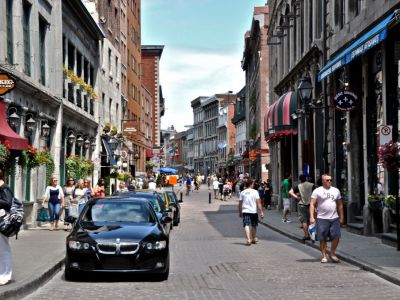
Transporting you back to the era of New France, Old Montreal stands as one of the most ancient districts frequented by tourists. Positioned ideally within Ville-Marie's borough, this neighborhood is bordered by Ruelle des Fortifications to the north, McGill Street to the west, the majestic Saint Lawrence River to the south, and Berri Street to the east.
Ville-Marie borough remains vibrant and dynamic, fueled by its perpetually lively neighborhoods, including the bustling downtown core, McGill Ghetto, Latin Quarter, Chinatown, Gay Village, and Old Montreal. Visitors revel in exploring this area using public transportation, indulging in shopping, dining at exquisite restaurants, and exploring renowned museums within Ville-Marie.
Should you find yourself in Old Montreal between July and October, an enthralling experience awaits you-the renowned Montreal Ghost Walks. Led by a local storyteller, this captivating journey uncovers the darker aspects of the area's history, guiding you through haunted locations that will send chills down your spine. You have the option to embark on either the west or east side walking tour. Undoubtedly, Old Montreal offers an unparalleled visitor experience, leaving a lasting impression.
Why You Should Visit:
A stroll through Old Montreal will give you a feel of European charm in North America. The cobblestone streets, the architecture, the restaurants and art galleries – all make an irresistible combination.
Tip:
You can walk from one end to the other of what is Old Montreal in 15-20 minutes, but there is a lot packed into that small section so you can easily spend 2 to 3 days exploring it.
Ville-Marie borough remains vibrant and dynamic, fueled by its perpetually lively neighborhoods, including the bustling downtown core, McGill Ghetto, Latin Quarter, Chinatown, Gay Village, and Old Montreal. Visitors revel in exploring this area using public transportation, indulging in shopping, dining at exquisite restaurants, and exploring renowned museums within Ville-Marie.
Should you find yourself in Old Montreal between July and October, an enthralling experience awaits you-the renowned Montreal Ghost Walks. Led by a local storyteller, this captivating journey uncovers the darker aspects of the area's history, guiding you through haunted locations that will send chills down your spine. You have the option to embark on either the west or east side walking tour. Undoubtedly, Old Montreal offers an unparalleled visitor experience, leaving a lasting impression.
Why You Should Visit:
A stroll through Old Montreal will give you a feel of European charm in North America. The cobblestone streets, the architecture, the restaurants and art galleries – all make an irresistible combination.
Tip:
You can walk from one end to the other of what is Old Montreal in 15-20 minutes, but there is a lot packed into that small section so you can easily spend 2 to 3 days exploring it.
7) Bonsecours Market (Marche Bonsecours)
Bonsecours Market (Marché Bonsecours) owes its name to the adjacent Chapel of Our Lady of Good Help (Notre-Dame-de-Bon-Secours).
Inaugurated in 1847, for over a century this was the primary agricultural market for the Montreal area. Also, for a brief period – just one session, in 1849 – the building housed the Legislative Assembly (Parliament) of United Canada and, throughout 1852-1878, accommodated the Montreal City Hall.
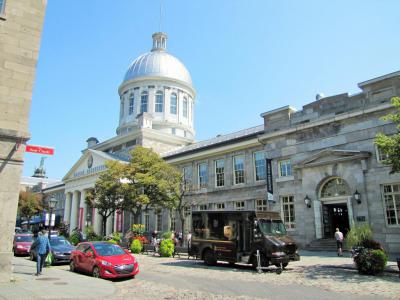
The elongated two-story Neoclassical edifice with a tin-plated dome and columns is considered one of the main achievements of Canadian architecture. In 1984, it was designated a National Historic Site of Canada. The design – by British architect William Footner – was influenced by Dublin's Customs House. Further additions, including a 900-square-meter concert and banquet hall, completed in 1860, were designed by Irish-born Montreal architect George Browne.
The building continued to serve as the farmer's central market, as well as a venue for banquets, exhibitions, and festivals until it was closed in 1963. After standing idle for a few years, it was slated for demolition.
Luckily, the property was later transformed into a multi-purpose facility with a mall incorporating outdoor cafés, restaurants, and exclusive boutiques selling authentic Canadian crafts such as jewelry, leather, and hand-blown glass – all made in Quebec. Those keen on maple tree products will be particularly delighted to find here a huge variety of relevant merchandise including beer, wine, butter, and even lollipops.
However, if shopping isn't your prime interest, you may just as well walk around the site and find some pretty angles to photograph the building's grand-looking exterior. Or, perhaps, grab yourself a seat in one of the cafés and restaurants lining the facade and have a good time.
Inaugurated in 1847, for over a century this was the primary agricultural market for the Montreal area. Also, for a brief period – just one session, in 1849 – the building housed the Legislative Assembly (Parliament) of United Canada and, throughout 1852-1878, accommodated the Montreal City Hall.
The elongated two-story Neoclassical edifice with a tin-plated dome and columns is considered one of the main achievements of Canadian architecture. In 1984, it was designated a National Historic Site of Canada. The design – by British architect William Footner – was influenced by Dublin's Customs House. Further additions, including a 900-square-meter concert and banquet hall, completed in 1860, were designed by Irish-born Montreal architect George Browne.
The building continued to serve as the farmer's central market, as well as a venue for banquets, exhibitions, and festivals until it was closed in 1963. After standing idle for a few years, it was slated for demolition.
Luckily, the property was later transformed into a multi-purpose facility with a mall incorporating outdoor cafés, restaurants, and exclusive boutiques selling authentic Canadian crafts such as jewelry, leather, and hand-blown glass – all made in Quebec. Those keen on maple tree products will be particularly delighted to find here a huge variety of relevant merchandise including beer, wine, butter, and even lollipops.
However, if shopping isn't your prime interest, you may just as well walk around the site and find some pretty angles to photograph the building's grand-looking exterior. Or, perhaps, grab yourself a seat in one of the cafés and restaurants lining the facade and have a good time.
8) Chapelle Notre-Dame-de-Bon-Secours (Chapel of Our Lady of Good Help)
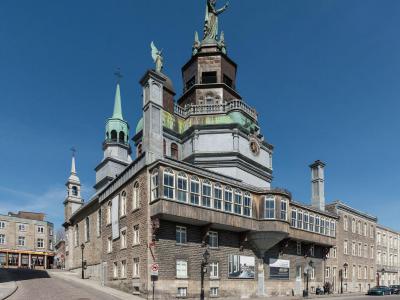
Down by Montreal’s Old Port, where ships once arrived after long, uncertain Atlantic crossings, sailors had a habit of saying thank you properly. In 1771, they built the Chapel of Our Lady of Good Help (that is, if you want the full poetic version), as a pilgrimage site to honour the Virgin for her “good help” in getting them across the ocean in one piece. Today, it still stands as the oldest surviving chapel in the Old Town—not bad for a building that has already outlived one predecessor...
Because yes—this chapel has layers. It sits directly on top of an earlier church from 1675 that didn’t survive a fire. Head down into the crypt, and you’re not merely underground; you’re stepping into centuries. Excavations have revealed the foundations of that first temple, along with artifacts from both First Nations indigenous communities and the French colonial era—including fragments of Montreal’s early fortifications. In essence, this basement serves more as a “time capsule,” enhanced by the audio tour that fills in the stories behind the stones.
Considering its prime harbour address, it’s no surprise that the chapel picked up the nickname “the Sailors’ Church.” Inside, the decor is simple but quietly striking. Lift your eyes, and you will spot delicate model ships suspended from the ceiling—ex-votos offered in gratitude, tiny wooden thank-you notes from those who made it safely home.
And if you're feeling energetic, climb the wooden staircase into the spire. From there, the view opens wide with the Old Port, the Saint Lawrence River, the harbour, and the remnants of the Expo 67 exhibition. You may also spot the statue of Our Lady of the Harbour, famously name-checked in Leonard Cohen’s “Suzanne” song, where “the sun pours down like honey.” Up close, you can even inspect the rooftop angels keeping watch over the city.
The chapel also houses the Marguerite Bourgeoys Museum, dedicated to the saintly founder of the Notre-Dame congregation. Her remains were returned here in 2005, resting in the sanctuary she helped shape.
So, ultimately, what looks like a pretty stop by the water is in fact a story of fire and survival, voyages and gratitude, saints and sailors—all tucked into one remarkably resilient little chapel...
Because yes—this chapel has layers. It sits directly on top of an earlier church from 1675 that didn’t survive a fire. Head down into the crypt, and you’re not merely underground; you’re stepping into centuries. Excavations have revealed the foundations of that first temple, along with artifacts from both First Nations indigenous communities and the French colonial era—including fragments of Montreal’s early fortifications. In essence, this basement serves more as a “time capsule,” enhanced by the audio tour that fills in the stories behind the stones.
Considering its prime harbour address, it’s no surprise that the chapel picked up the nickname “the Sailors’ Church.” Inside, the decor is simple but quietly striking. Lift your eyes, and you will spot delicate model ships suspended from the ceiling—ex-votos offered in gratitude, tiny wooden thank-you notes from those who made it safely home.
And if you're feeling energetic, climb the wooden staircase into the spire. From there, the view opens wide with the Old Port, the Saint Lawrence River, the harbour, and the remnants of the Expo 67 exhibition. You may also spot the statue of Our Lady of the Harbour, famously name-checked in Leonard Cohen’s “Suzanne” song, where “the sun pours down like honey.” Up close, you can even inspect the rooftop angels keeping watch over the city.
The chapel also houses the Marguerite Bourgeoys Museum, dedicated to the saintly founder of the Notre-Dame congregation. Her remains were returned here in 2005, resting in the sanctuary she helped shape.
So, ultimately, what looks like a pretty stop by the water is in fact a story of fire and survival, voyages and gratitude, saints and sailors—all tucked into one remarkably resilient little chapel...
9) Old Port (Vieux-Port) (must see)
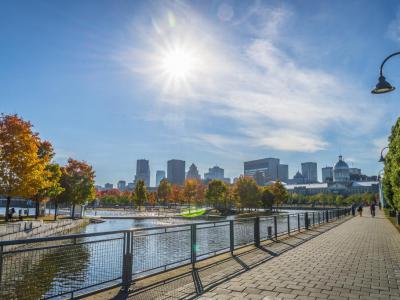
Located on the north bank of the Saint Lawrence River, the historic Old Port of Montreal (Vieux-Port de Montréal) stretches for over two kilometers (1.2 miles) south of Old Montreal, in a natural harbor that was once frequented by Amerindian canoes and then by barges and ships of French fur traders and others.
In service from as early as 1611, the port bore witness to the economic and cultural development of Montreal and remained in use until 1976, when the present Port of Montreal was launched further east. In the early 1990s, the territory was redeveloped and in 2005 changed its name to The Quays of the Old Port of Montreal. Today, it serves as a recreational and historical area, attracting annually over six million visitors.
A place for all seasons, there's always something happening here! Summer is great for all sorts of riverfront activities such as rollerblading, cycling, quadricycling, and pleasure boating. Taking a boat cruise on the Saint Lawrence river, or renting a pedal boat for a trip around Bonsecours Basin is also available. A thin park, running the entire length of the Old Port Promenade, offers tourists and locals an ideal spot to relax and catch a cool breeze off the water.
Winter is ideal for skating on the outdoor rink or just playing in the snow. At all times of the year, the Saint Lawrence river is awe-inspiring and powerful.
The on-site attractions include a "labyrinth" in Shed 16 (which is a maze of alleys and obstacles built inside an old waterfront warehouse), the Montreal Science Centre (complete with an IMAX Theatre) on King Edward Pier, and the Montreal Clock Tower.
One of the Port's gems is the Montreal-based Cirque du Soleil which approximately every two years, in spring, launches a new show from the Jacques Cartier Quay by setting up its signature blue-and-yellow-striped tents. In June 2012, an urban beach, called the Clock Tower Beach (Plage de l'Horloge), was opened adjacent to the Clock Tower.
Cultural events in the area include the Montreal High Lights Festival (Festival Montréal en lumière), Igloofest, and the Matsuri Japon festival.
If you have a couple of hours to kill in Montreal, wandering around the Old Port is worth considering.
In service from as early as 1611, the port bore witness to the economic and cultural development of Montreal and remained in use until 1976, when the present Port of Montreal was launched further east. In the early 1990s, the territory was redeveloped and in 2005 changed its name to The Quays of the Old Port of Montreal. Today, it serves as a recreational and historical area, attracting annually over six million visitors.
A place for all seasons, there's always something happening here! Summer is great for all sorts of riverfront activities such as rollerblading, cycling, quadricycling, and pleasure boating. Taking a boat cruise on the Saint Lawrence river, or renting a pedal boat for a trip around Bonsecours Basin is also available. A thin park, running the entire length of the Old Port Promenade, offers tourists and locals an ideal spot to relax and catch a cool breeze off the water.
Winter is ideal for skating on the outdoor rink or just playing in the snow. At all times of the year, the Saint Lawrence river is awe-inspiring and powerful.
The on-site attractions include a "labyrinth" in Shed 16 (which is a maze of alleys and obstacles built inside an old waterfront warehouse), the Montreal Science Centre (complete with an IMAX Theatre) on King Edward Pier, and the Montreal Clock Tower.
One of the Port's gems is the Montreal-based Cirque du Soleil which approximately every two years, in spring, launches a new show from the Jacques Cartier Quay by setting up its signature blue-and-yellow-striped tents. In June 2012, an urban beach, called the Clock Tower Beach (Plage de l'Horloge), was opened adjacent to the Clock Tower.
Cultural events in the area include the Montreal High Lights Festival (Festival Montréal en lumière), Igloofest, and the Matsuri Japon festival.
If you have a couple of hours to kill in Montreal, wandering around the Old Port is worth considering.
