Custom Walk in Funchal, Portugal by svoimmer_93b779 created on 2026-02-23
Guide Location: Portugal » Funchal
Guide Type: Custom Walk
# of Sights: 12
Tour Duration: 3 Hour(s)
Travel Distance: 4.7 Km or 2.9 Miles
Share Key: JKYZR
Guide Type: Custom Walk
# of Sights: 12
Tour Duration: 3 Hour(s)
Travel Distance: 4.7 Km or 2.9 Miles
Share Key: JKYZR
How It Works
Please retrieve this walk in the GPSmyCity app. Once done, the app will guide you from one tour stop to the next as if you had a personal tour guide. If you created the walk on this website or come to the page via a link, please follow the instructions below to retrieve the walk in the app.
Retrieve This Walk in App
Step 1. Download the app "GPSmyCity: Walks in 1K+ Cities" on Apple App Store or Google Play Store.



Step 2. In the GPSmyCity app, download(or launch) the guide "Funchal Map and Walking Tours".
Step 3. Tap the menu button located at upper right corner of the "Walks" screen and select "Retrieve custom walk". Enter the share key: JKYZR
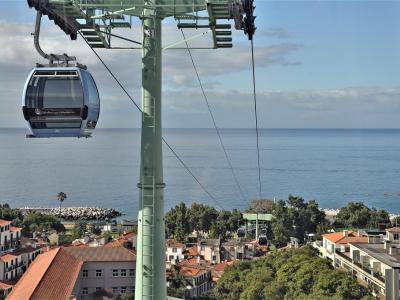
1) Teleférico Funchal-Monte (Funchal-Monte Cable Car) (must see)
The Funchal–Monte Cable Car offers one of Madeira’s most memorable experiences, gliding from the edge of Funchal’s old town up to the hillside village of Monte. Inaugurated in 2000, this modern gondola lift travels along a 3,200-meter cable line with a vertical rise of around 560 meters. The ride takes about fifteen minutes each way, carrying up to six passengers per cabin. The views unfold dramatically—the harbor, the city’s red rooftops, and the blue Atlantic opening out beneath you.
The cabins are comfortable and fitted with large, clear windows that offer panoramas over gardens, ravines, homes, and terraced hillsides. The ascent feels smooth rather than frightening, making it appealing even to those unsure about heights. Midway along the route, the landscape becomes greener and more rural until the line reaches its upper station, positioned between Babosas Village and the Mount Garden.
Stepping out at the top, visitors find themselves in Monte, a quieter, cooler village first established in 1565 as the parish of Our Lady of the Mount. Its leafy gardens, narrow lanes, small cafes, and scenic viewpoints offer a gentler pace compared to downtown Funchal. From here, travelers can explore nearby gardens, enjoy refreshments in Babosas Village or continue their visit to the Church of Our Lady of the Monte.
When it is time to return, there are two options. One is simply to board the cable car for a glide back down to the city. The other is the island’s famous traditional wicker-basket toboggan ride: a hand-guided descent on wooden runners, steered by two drivers who expertly guide passengers down the winding streets toward Funchal. Safe, lively, and entirely unique to Madeira, it provides a playful contrast to the calm, scenic ascent by cable car.
The cabins are comfortable and fitted with large, clear windows that offer panoramas over gardens, ravines, homes, and terraced hillsides. The ascent feels smooth rather than frightening, making it appealing even to those unsure about heights. Midway along the route, the landscape becomes greener and more rural until the line reaches its upper station, positioned between Babosas Village and the Mount Garden.
Stepping out at the top, visitors find themselves in Monte, a quieter, cooler village first established in 1565 as the parish of Our Lady of the Mount. Its leafy gardens, narrow lanes, small cafes, and scenic viewpoints offer a gentler pace compared to downtown Funchal. From here, travelers can explore nearby gardens, enjoy refreshments in Babosas Village or continue their visit to the Church of Our Lady of the Monte.
When it is time to return, there are two options. One is simply to board the cable car for a glide back down to the city. The other is the island’s famous traditional wicker-basket toboggan ride: a hand-guided descent on wooden runners, steered by two drivers who expertly guide passengers down the winding streets toward Funchal. Safe, lively, and entirely unique to Madeira, it provides a playful contrast to the calm, scenic ascent by cable car.
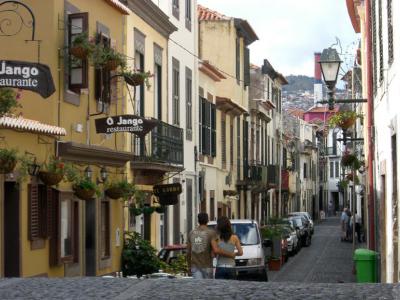
2) Rua de Santa Maria (Santa Maria Street)
Santa Maria street lies in the parish of Santa Maria Maior, the very first district on the island of Madeira. The street itself dates back to the early settlement of Funchal and was originally little more than a stone path about 1,970 feet long running parallel to the shore. When the area was first settled, a small church known as Saint Mary of the Pebble stood nearby, and a rough square extended to the beach; from that the street gradually grew.
Today the street presents a lively mix of residential houses and commercial establishments. One of its most celebrated features is the series of painted doors on private houses: thanks to the “Art of Open Doors” initiative, more than 200 doors have been transformed into works of art by local and international artists. The result is that ordinary frontages become mini-canvases of color, making the street itself feel like an open-air gallery.
Along the street you’ll find the popular Mariazinha Bakery, offering cream cakes, fruit cakes, croissants, espresso and other tempting baked goods in a five-star cafe atmosphere. The street is also jammed with restaurants and cafe terraces, offering both traditional Madeiran menus and international dishes; there are bars serving poncha, a traditional Madeiran alcoholic drink, and venues where you might hear traditional music.
Today the street presents a lively mix of residential houses and commercial establishments. One of its most celebrated features is the series of painted doors on private houses: thanks to the “Art of Open Doors” initiative, more than 200 doors have been transformed into works of art by local and international artists. The result is that ordinary frontages become mini-canvases of color, making the street itself feel like an open-air gallery.
Along the street you’ll find the popular Mariazinha Bakery, offering cream cakes, fruit cakes, croissants, espresso and other tempting baked goods in a five-star cafe atmosphere. The street is also jammed with restaurants and cafe terraces, offering both traditional Madeiran menus and international dishes; there are bars serving poncha, a traditional Madeiran alcoholic drink, and venues where you might hear traditional music.
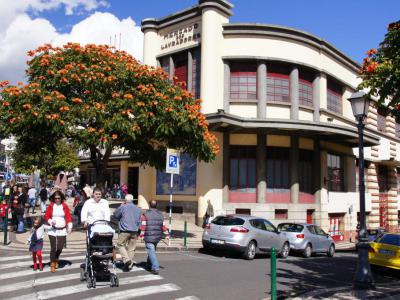
3) Mercado dos Lavradores (The Workers Market) (must see)
At the far end of Fernão Ornelas Street stands the Workers’ Market of Funchal, created in the late 1930s as part of a citywide modernization plan aimed at organizing food commerce and improving sanitary conditions. Designed by architect Edmundo Tavares and opened in 1940, the building reflects the Estado Novo political regime’s preference for strong geometric forms and practical public architecture. Its facade is lined with blue-and-white azulejo panels, illustrating scenes of Madeiran life and celebrating the island’s agricultural and fishing traditions.
As soon as you enter through the main Art Deco doorway, the flower hall is immediately on your left. This is where you’ll see rows of flower vendors, along with stalls selling seeds and bulbs—some in operation for more than fifty years. To continue into the market, walk straight ahead from the entrance and you will step into the central patio, where fruit and vegetable stands fill the open space. Small cafes, wine shops, and souvenir stalls line the perimeter on your right-hand side.
From the central patio, head straight across to the far end of the square. The Fish Hall is through the large doorway directly opposite the entrance. As you walk in, fishmongers line both the left and right sides, with long marble counters displaying black scabbardfish, tuna, octopus, and other local catches. The walls around you are decorated with tile illustrations of regional sea life.
To reach the upper level, turn right as you exit the Fish Hall and you’ll find the staircase leading to the second floor. Once upstairs, vendors selling exotic fruits, dried berries, spices, teas, and cork goods stretch out to your left and right along the balcony walkway. Keep walking to the far corner and you’ll reach the terrace, where two large cafes overlook the market. From here, you can look down into the central patio and even catch views of the surrounding rooftops.
The market neighborhood is always busy, but nothing compares to the night before Christmas Eve. This is when Market Night transforms the Workers’ Market into one of Funchal’s biggest street celebrations. Stalls spill into the streets, live music fills the air, people sing carols, and food and drink flow freely. It is one of Madeira’s most beloved traditions and a festive way to experience the island’s community spirit.
As soon as you enter through the main Art Deco doorway, the flower hall is immediately on your left. This is where you’ll see rows of flower vendors, along with stalls selling seeds and bulbs—some in operation for more than fifty years. To continue into the market, walk straight ahead from the entrance and you will step into the central patio, where fruit and vegetable stands fill the open space. Small cafes, wine shops, and souvenir stalls line the perimeter on your right-hand side.
From the central patio, head straight across to the far end of the square. The Fish Hall is through the large doorway directly opposite the entrance. As you walk in, fishmongers line both the left and right sides, with long marble counters displaying black scabbardfish, tuna, octopus, and other local catches. The walls around you are decorated with tile illustrations of regional sea life.
To reach the upper level, turn right as you exit the Fish Hall and you’ll find the staircase leading to the second floor. Once upstairs, vendors selling exotic fruits, dried berries, spices, teas, and cork goods stretch out to your left and right along the balcony walkway. Keep walking to the far corner and you’ll reach the terrace, where two large cafes overlook the market. From here, you can look down into the central patio and even catch views of the surrounding rooftops.
The market neighborhood is always busy, but nothing compares to the night before Christmas Eve. This is when Market Night transforms the Workers’ Market into one of Funchal’s biggest street celebrations. Stalls spill into the streets, live music fills the air, people sing carols, and food and drink flow freely. It is one of Madeira’s most beloved traditions and a festive way to experience the island’s community spirit.

4) Praça do Povo (People's Square)
The bay area of Funchal boasts the People's Square (Praça do Povo), a remarkable gateway to Madeira and a significant attraction for the island. This leisure zone, which opened in 2014, offers breathtaking views of the Atlantic on one side and the city of Funchal on the other, stretching up to the mountains.
People's Square is an expansive and delightful recreational area, ideal for walking, jogging, cycling, rollerblading, or just unwinding. Visitors can find benches scattered throughout the area, providing a tranquil spot to appreciate the stunning scenery.
The hiking trail that passes through the center of Funchal and across People's Square is adorned with lush green carpets of plants and flowers, further enhancing the beauty of the surroundings. Due to its central location and ample space, People's Square is a remarkable venue for cultural events such as concerts, exhibitions, shows, and fairs, especially during the summer.
To the north of the square, several notable buildings stand, including the Legislative Assembly of Madeira, the National Republican Guard, the Captaincy of the Port of Funchal, and the Funchal Customs (Alfândega do Funchal).
People's Square is an expansive and delightful recreational area, ideal for walking, jogging, cycling, rollerblading, or just unwinding. Visitors can find benches scattered throughout the area, providing a tranquil spot to appreciate the stunning scenery.
The hiking trail that passes through the center of Funchal and across People's Square is adorned with lush green carpets of plants and flowers, further enhancing the beauty of the surroundings. Due to its central location and ample space, People's Square is a remarkable venue for cultural events such as concerts, exhibitions, shows, and fairs, especially during the summer.
To the north of the square, several notable buildings stand, including the Legislative Assembly of Madeira, the National Republican Guard, the Captaincy of the Port of Funchal, and the Funchal Customs (Alfândega do Funchal).
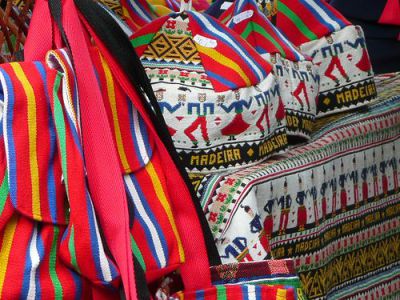
5) Rua do Castanheiro (Castanheiro Street)
Castanheiro Street (Rua do Castanheiro) is a charming street located in the heart of Funchal. This historic street is known for its distinctive architecture and traditional Madeiran buildings featuring a fascinating mix of styles and influences that reflects the city's rich cultural heritage.
The Castanheiro Street is also famous in Funchal for its souvenir shopping. You can find a bargain here on the country’s more famous souvenirs, such as Madeiran wine, embroidery, handmade shoes, wickerwork, and tapestries. There is always something on sale in one of the shops.
The Castanheiro Street is also famous in Funchal for its souvenir shopping. You can find a bargain here on the country’s more famous souvenirs, such as Madeiran wine, embroidery, handmade shoes, wickerwork, and tapestries. There is always something on sale in one of the shops.
6) Câmara Municipal (City Hall)
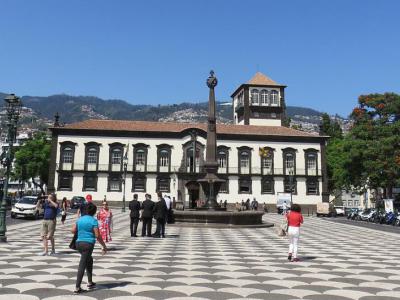
The first Funchal town hall was built in 1486 on Duque Square. The town council moved several times afterward, finally settling in Cathedral Square in 1802. Still dissatisfied with the facilities, the council eventually purchased the Carvalhal Esmeraldo Palace in 1883, adjoining the present-day Municipal Square.
Francisco António Camara Leme built his home, the Carvalhal Esmeraldo Palace in 1758. Although the original structure dates from the mid-18th century, it was later remodeled by the renowned Portuguese architects Raul Lino and Carlos Ramos during intensive restoration works around 1940. Construction materials included masonry, stone, wood, cast iron, and decorative tiles.
As you approach the City Hall, pay attention to the impressive entrance doorway carved in gray stone. On the second floor, the reception area is lined with eleven windows, each with its own small balcony. The ground-floor windows retain 17th-century wrought-iron security gratings. From the entrance, an extravagant interior staircase leads to the central courtyard. Here visitors encounter the sculpture “Leda and the Swan”, created by Madeiran sculptor Germano José Salles. The sculpture depicts the myth in which Zeus, disguised as a swan, approaches Leda—an ancient legend long admired for its symbolism and dramatic narrative.
Francisco António Camara Leme built his home, the Carvalhal Esmeraldo Palace in 1758. Although the original structure dates from the mid-18th century, it was later remodeled by the renowned Portuguese architects Raul Lino and Carlos Ramos during intensive restoration works around 1940. Construction materials included masonry, stone, wood, cast iron, and decorative tiles.
As you approach the City Hall, pay attention to the impressive entrance doorway carved in gray stone. On the second floor, the reception area is lined with eleven windows, each with its own small balcony. The ground-floor windows retain 17th-century wrought-iron security gratings. From the entrance, an extravagant interior staircase leads to the central courtyard. Here visitors encounter the sculpture “Leda and the Swan”, created by Madeiran sculptor Germano José Salles. The sculpture depicts the myth in which Zeus, disguised as a swan, approaches Leda—an ancient legend long admired for its symbolism and dramatic narrative.
7) Instituto do Vinho, do Bordado e do Artesanato da Madeira
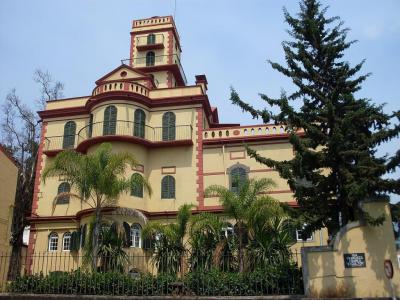
The Madeira Wine, Embroidery, and Handicraft Institute (Instituto do Vinho, do Bordado e do Artesanato da Madeira), IVBAM, was created in 2006 by merging the Madeira Wine Institute and the Madeira Embroidery, Tapestry, and Handicraft Institute. IVBAM is responsible for supervising wine-growing activities, certifying and controlling the quality of Madeira wine, and promoting regional handicrafts.
The Madeira Wine Institute was established in 1979 to ensure proper discipline in the production and sale of Madeira wine and coordinate wine-growing activities in the Autonomous Region of Madeira. The Institute proposed legal and administrative measures to adapt viticulture and wine production to the standards of the then-European Economic Community.
The Madeira Wine, Embroidery, and Handicraft Institute aims to continue supporting the Wine, Embroidery, and Regional Handicrafts sectors, promote their products, and preserve the credibility gained by the predecessor institutes.
The Madeira Wine Institute was established in 1979 to ensure proper discipline in the production and sale of Madeira wine and coordinate wine-growing activities in the Autonomous Region of Madeira. The Institute proposed legal and administrative measures to adapt viticulture and wine production to the standards of the then-European Economic Community.
The Madeira Wine, Embroidery, and Handicraft Institute aims to continue supporting the Wine, Embroidery, and Regional Handicrafts sectors, promote their products, and preserve the credibility gained by the predecessor institutes.
8) Forte de São João Baptista (Fortress of São João Baptista)
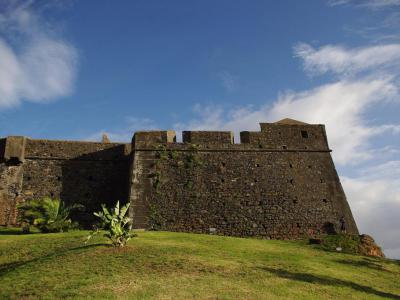
Situated at an altitude of 111 meters above sea level, one can discover the imposing Fortress of São João Baptista do Pico, also known as Fortaleza do Pico. With a breathtaking view of the Atlantic landscape, this monument is an absolute must-see among the many fascinating points of interest waiting to be explored in Funchal.
Originally constructed in the 17th century, this fortification was designed to reinforce the city's defensive system against frequent attacks by privateers. In its first phase, it served not only as a strategic lookout but also as a powder magazine for all of the forts and towers on the island.
In the mid-20th century, the Fortress of São João Baptista do Pico was handed over to the Navy and became home to the Navy's Communications Center. Today, it is occupied by the Funchal Naval Radio Telegraph Station, and as a result, the city's residents have affectionately nicknamed it 'Pico Rádio'.
In recent years, the Fortress of São João Baptista do Pico has undergone various renovation projects. It now includes a versatile space for hosting concerts and conferences, as well as a cafeteria where visitors can comfortably admire the spectacular views over Funchal.
Originally constructed in the 17th century, this fortification was designed to reinforce the city's defensive system against frequent attacks by privateers. In its first phase, it served not only as a strategic lookout but also as a powder magazine for all of the forts and towers on the island.
In the mid-20th century, the Fortress of São João Baptista do Pico was handed over to the Navy and became home to the Navy's Communications Center. Today, it is occupied by the Funchal Naval Radio Telegraph Station, and as a result, the city's residents have affectionately nicknamed it 'Pico Rádio'.
In recent years, the Fortress of São João Baptista do Pico has undergone various renovation projects. It now includes a versatile space for hosting concerts and conferences, as well as a cafeteria where visitors can comfortably admire the spectacular views over Funchal.
9) Blandy's Wine Lodge (must see)
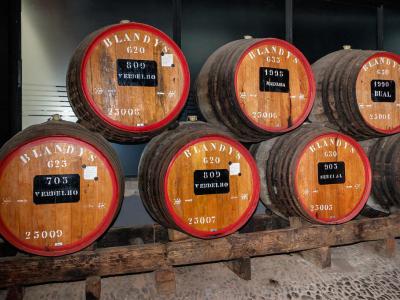
Blandy's Wine Lodge should not be missed when visiting Funchal. This old winery is situated right in the heart of the city. It offers a large spectrum of services, including wine tours, tasting rooms, winemaking techniques and of course a specialty shop where you can purchase the truly original Madeiran wine.
10) Jardim Municipal (Municipal Garden)
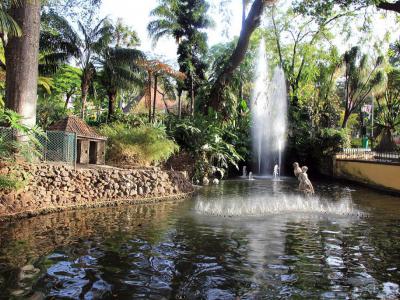
The Funchal Municipal Garden, also known as Dona Amélia Garden, is situated in a prime location, enhancing the beauty of this distinguished area with its lush and vibrant flora. This natural haven in the heart of the city attracts both locals and tourists, providing a serene escape.
Spanning across 8,300 square meters, the garden is located on the north side of Arriaga Avenue (Avenida Arriaga), opposite the Municipal Theatre, on the site where the Convent of São Francisco once stood. The Coat of Arms of the convent can still be admired on one of the lawns.
The garden boasts a vast collection of botanical species, including plants indigenous to Madeira and other regions of the world, making it a fascinating destination for nature enthusiasts. Visitors can explore a variety of captivating species during their visit.
Established in 1880, the Funchal Municipal Garden offers ample space for relaxation and entertainment. Its leisure area features shaded trees, a lake, and a stream inhabited by fish, ducks, and swans. The garden also houses an amphitheater, hosting numerous cultural events, and an esplanade.
Spanning across 8,300 square meters, the garden is located on the north side of Arriaga Avenue (Avenida Arriaga), opposite the Municipal Theatre, on the site where the Convent of São Francisco once stood. The Coat of Arms of the convent can still be admired on one of the lawns.
The garden boasts a vast collection of botanical species, including plants indigenous to Madeira and other regions of the world, making it a fascinating destination for nature enthusiasts. Visitors can explore a variety of captivating species during their visit.
Established in 1880, the Funchal Municipal Garden offers ample space for relaxation and entertainment. Its leisure area features shaded trees, a lake, and a stream inhabited by fish, ducks, and swans. The garden also houses an amphitheater, hosting numerous cultural events, and an esplanade.
11) Estátua de Cristóvão Colombo (Statue of Christopher Columbus)
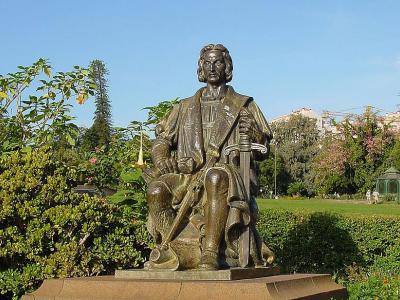
Located in the center of Funchal, Santa Catarina Park is a serene oasis with shady trees and lawns. Overlooking the harbor, within this park, stands the statue of Christopher Columbus, created by Portuguese sculptor Henrique Moreira. The City Hall acquired the statue, which was inaugurated in 1968. The bronze statue rests on a stone base, placed near the viewpoint from where one can see the city. The statue serves as a reminder of Columbus's voyages to the Americas and his stopovers in Madeira in 1475, 1480, and 1492.
In addition to the statue, several other things on the island commemorate Columbus's presence, such as the Columbus library, Columbus House, and Columbus's ship, the Santa Maria.
In addition to the statue, several other things on the island commemorate Columbus's presence, such as the Columbus library, Columbus House, and Columbus's ship, the Santa Maria.
12) Forte de São José (São José Fort)
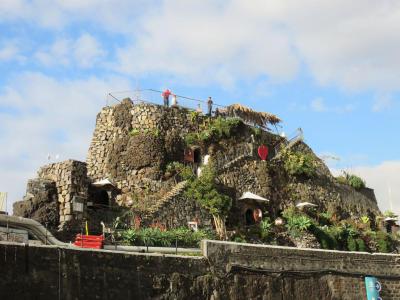
São José Fort, located at the maritime entrance to Funchal, is a noteworthy historical site that offers visitors a remarkable panoramic view of the Atlantic. It was constructed in the mid-18th century as part of Funchal's defensive infrastructure, which was vital to protect the city's port and commercial trade. The fort is situated on a rock formation known as Isle of San José (Ilhéu de São José), where the discoverers of Madeira, João Gonçalves Zarco, and Tristão Vaz Teixeira, sought refuge upon their arrival to the island, which was then heavily forested.
Despite its importance, the fort was later used as headquarters for British troops during the occupation of Madeira between 1801 and 1807 and was subsequently transformed into a prison. The monument fell into disrepair for many years until a private individual acquired it and undertook a significant effort to restore and revitalize the site.
Today, Forte de São José is a special place of interest for tourists visiting Madeira, not only for its historical significance but also for its architectural and cultural value. A visit to this site is highly recommended for anyone exploring the capital city of Madeira.
Despite its importance, the fort was later used as headquarters for British troops during the occupation of Madeira between 1801 and 1807 and was subsequently transformed into a prison. The monument fell into disrepair for many years until a private individual acquired it and undertook a significant effort to restore and revitalize the site.
Today, Forte de São José is a special place of interest for tourists visiting Madeira, not only for its historical significance but also for its architectural and cultural value. A visit to this site is highly recommended for anyone exploring the capital city of Madeira.
