Custom Walk in Trier, Germany by adw5013_765a35 created on 2026-02-27
Guide Location: Germany » Trier
Guide Type: Custom Walk
# of Sights: 9
Tour Duration: 3 Hour(s)
Travel Distance: 5.6 Km or 3.5 Miles
Share Key: 8BKJP
Guide Type: Custom Walk
# of Sights: 9
Tour Duration: 3 Hour(s)
Travel Distance: 5.6 Km or 3.5 Miles
Share Key: 8BKJP
How It Works
Please retrieve this walk in the GPSmyCity app. Once done, the app will guide you from one tour stop to the next as if you had a personal tour guide. If you created the walk on this website or come to the page via a link, please follow the instructions below to retrieve the walk in the app.
Retrieve This Walk in App
Step 1. Download the app "GPSmyCity: Walks in 1K+ Cities" on Apple App Store or Google Play Store.



Step 2. In the GPSmyCity app, download(or launch) the guide "Trier Map and Walking Tours".
Step 3. Tap the menu button located at upper right corner of the "Walks" screen and select "Retrieve custom walk". Enter the share key: 8BKJP
1) Hauptmarkt (Main Market Square) (must see)
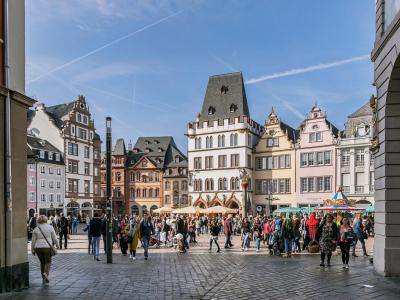
Main Market Square is the Trier's central square and one of its largest squares. Main Market Square has been a marketplace since the 10th century. Trier's main shopping streets meet here, and the square features many historic and landmark buildings.
Archbishop Heinrich I installed a cross in Main Market Square in 958. This ancient cross is one of Europe's oldest market crosses. It stands on an ancient Roman pillar, which served as a pillory. Visitors can see four holes where chains would have been attached to punish and humiliate law-breaking citizens publicly.
The cross features a Latin inscription, an image of the Lamb of God, and a victory banner. The sides of the cross have a sundial and a depiction of Saint Peter. The market cross is a replica, and the original cross is on display at the Simeonstift Municipal Museum.
The Petrusbrunnen fountain was created in 1594 by sculptor Hans Ruprecht Hoffman. A statue of Saint Peter stands at the top of the fountain, and representations of virtues stand around the fountain's base. The statues represent Fortitude, Temperance, Justice, and Wisdom. At the beginning of the Old Town Festival, residents add decorative lighting and a flower bouquet to the Saint Peter statue to ensure good holiday weather.
Main Market Square features historic houses from Renaissance, Baroque, and Classical periods, including the Steipe and Red Houses.
Visitors can access the Church of Saint Gangolf through the square. In addition, the square is an entrance point to the city's former Jewish quarter.
Main Market Square hosts several events and festivals throughout the year. For example, visitors might catch the Street Festival, the Old Town Festival, the Christmas Market, a New Year's Run, or the Corpus Christi Procession.
Archbishop Heinrich I installed a cross in Main Market Square in 958. This ancient cross is one of Europe's oldest market crosses. It stands on an ancient Roman pillar, which served as a pillory. Visitors can see four holes where chains would have been attached to punish and humiliate law-breaking citizens publicly.
The cross features a Latin inscription, an image of the Lamb of God, and a victory banner. The sides of the cross have a sundial and a depiction of Saint Peter. The market cross is a replica, and the original cross is on display at the Simeonstift Municipal Museum.
The Petrusbrunnen fountain was created in 1594 by sculptor Hans Ruprecht Hoffman. A statue of Saint Peter stands at the top of the fountain, and representations of virtues stand around the fountain's base. The statues represent Fortitude, Temperance, Justice, and Wisdom. At the beginning of the Old Town Festival, residents add decorative lighting and a flower bouquet to the Saint Peter statue to ensure good holiday weather.
Main Market Square features historic houses from Renaissance, Baroque, and Classical periods, including the Steipe and Red Houses.
Visitors can access the Church of Saint Gangolf through the square. In addition, the square is an entrance point to the city's former Jewish quarter.
Main Market Square hosts several events and festivals throughout the year. For example, visitors might catch the Street Festival, the Old Town Festival, the Christmas Market, a New Year's Run, or the Corpus Christi Procession.
2) Thermen am Viehmarkt (Forum Baths)
The Forum Baths in Trier offer a fascinating glimpse into Roman life through a blend of ancient ruins and modern design. Discovered in 1987 during the construction of an underground car park, this thermal bath complex, dating from around 80 CE, marks Trier's first thermal baths, even predating the city’s other famous baths, the Barbarathermen and Kaiserthermen. Named after the cattle market (Viehmarkt) under which they were found, the baths were strategically designed, with warm and cold baths placed to align with sun and shade, reflecting the Romans’ architectural expertise.
Covering 8,364 square meters, the baths reached peak usage in the 3rd and 4th centuries. Following the decline of the Roman Empire, the baths fell into disrepair and were gradually forgotten, even serving as a quarry in the 13th century. Later, in the 17th and 18th centuries, the Capuchin Order built monastery buildings over parts of the ruins, and the area evolved into a cattle market by 1811.
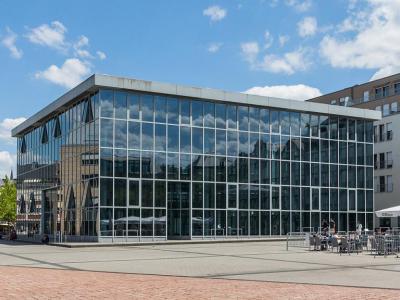
To protect the ruins, architect Oswald Mathias Ungers designed a distinctive glass enclosure, known locally as the "Ungers showcase." The cuboid structure combines glass facades and metal stairwells, giving the impression of an elevated platform, with stone patterns tracing the Roman road network. Though Ungers’ design has sparked controversy for its impact on the ancient structures, it preserves the baths while offering a visually compelling, immersive experience.
Today, the Forum Baths are open to visitors and regularly host events, including the popular annual wine tasting organized by the Rhineland-Palatinate Chamber of Agriculture. Not included in the UNESCO World Heritage listing of Trier’s Roman monuments, the baths remain a lively historical site that invites debate on whether heritage status should be sought-an addition that could potentially limit the modern events now held here.
Covering 8,364 square meters, the baths reached peak usage in the 3rd and 4th centuries. Following the decline of the Roman Empire, the baths fell into disrepair and were gradually forgotten, even serving as a quarry in the 13th century. Later, in the 17th and 18th centuries, the Capuchin Order built monastery buildings over parts of the ruins, and the area evolved into a cattle market by 1811.
To protect the ruins, architect Oswald Mathias Ungers designed a distinctive glass enclosure, known locally as the "Ungers showcase." The cuboid structure combines glass facades and metal stairwells, giving the impression of an elevated platform, with stone patterns tracing the Roman road network. Though Ungers’ design has sparked controversy for its impact on the ancient structures, it preserves the baths while offering a visually compelling, immersive experience.
Today, the Forum Baths are open to visitors and regularly host events, including the popular annual wine tasting organized by the Rhineland-Palatinate Chamber of Agriculture. Not included in the UNESCO World Heritage listing of Trier’s Roman monuments, the baths remain a lively historical site that invites debate on whether heritage status should be sought-an addition that could potentially limit the modern events now held here.
3) Römerbrücke (Roman Bridge)
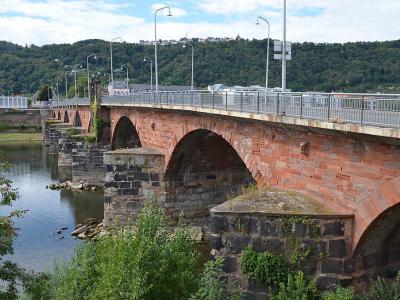
The Roman Bridge in Trier is a marvel of ancient engineering that has stood the test of time as the oldest standing bridge in the country and the oldest Roman bridge north of the Alps. Spanning the Moselle River, this bridge dates back to the 2nd century AD, with nine massive pillars constructed between 142 and 150 AD, using durable black basalt from the Eifel mountains. These pillars were designed with pointed fronts to resist the forces of ice and floods, showcasing the ingenuity of Roman engineering. The bridge's original wooden truss allowed it to support heavy traffic with a 14-meter clearance, so ships could pass without lowering their masts.
The bridge dates back to a wooden structure built around 17 BC, intended for wartime sacrifice by fire. Replaced by a stone bridge in 45 AD, it was later rebuilt in stone in its current form. Substantial repairs occurred over centuries, with stone vaults added between 1190 and 1490, likely under Elector Baldwin. Two bridge gates, resembling Trier's Porta Nigra, stood at each end until their 19th-century removal.
In 1689, the bridge suffered significant damage when French troops blew it up, leading to a reconstruction in 1716–1718 under Johann Georg Judas, the court carpenter of Electoral Trier, who added a crucifix and a statue of St. Nicholas on the western end. Remarkably, during WWII, despite severe bombardment and nearby destruction, the bridge remained intact, allowing American forces to cross it on March 2, 1945.
In 1986, UNESCO recognized the Roman Bridge as a World Heritage Site for its architectural and historical importance, aligning it with Trier’s many Roman and Early Gothic landmarks. Though restoration plans to enhance the bridge’s surroundings have been suggested, financial constraints have limited their realization. Today, this iconic structure connects Karl Marx Street with Eurener Street, symbolizing Trier's enduring legacy and the resilience of Roman craftsmanship.
The bridge dates back to a wooden structure built around 17 BC, intended for wartime sacrifice by fire. Replaced by a stone bridge in 45 AD, it was later rebuilt in stone in its current form. Substantial repairs occurred over centuries, with stone vaults added between 1190 and 1490, likely under Elector Baldwin. Two bridge gates, resembling Trier's Porta Nigra, stood at each end until their 19th-century removal.
In 1689, the bridge suffered significant damage when French troops blew it up, leading to a reconstruction in 1716–1718 under Johann Georg Judas, the court carpenter of Electoral Trier, who added a crucifix and a statue of St. Nicholas on the western end. Remarkably, during WWII, despite severe bombardment and nearby destruction, the bridge remained intact, allowing American forces to cross it on March 2, 1945.
In 1986, UNESCO recognized the Roman Bridge as a World Heritage Site for its architectural and historical importance, aligning it with Trier’s many Roman and Early Gothic landmarks. Though restoration plans to enhance the bridge’s surroundings have been suggested, financial constraints have limited their realization. Today, this iconic structure connects Karl Marx Street with Eurener Street, symbolizing Trier's enduring legacy and the resilience of Roman craftsmanship.
4) Amphitheater (must see)
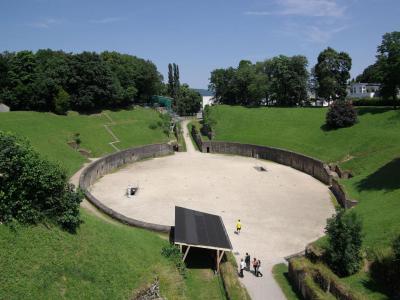
The Trier Amphitheater was erected around the 2nd century AD during the rule of Antoninus Pius. Dug into the side of a hill, the amphitheater is thought to have held up to 20,000 spectators at a time, which makes it the 10th largest Roman arena preserved intact to this day.
The amphitheater was incorporated into the city's fortification system, the defensive wall, serving partially as a gate. Preceding the entrance were two narrow passages, called vomitoria, which led through the embankments to the spectator stands. Contrary to what one may think, a vomitorium wasn’t a place for vomiting but an anteroom in which the crowds gathered prior to being “vomited” into the stands or back out to go home.
In times of crisis, hot oil and wild animals were unleashed from the amphitheater upon those who dared to attack the city.
The primary purpose of the venue, however, was entertainment: animal shows and gladiatorial fights. Both animals and fighters were kept in the cellar beneath the arena. The amphitheater was renovated in 293 AD, when Constantius Chlorus moved to Trier, which is thought to be the timeframe in which the cellar was added. A small burial ground, containing the graves of 46 people, was discovered in 1996.
Today, the amphitheater is used as a performance venue, hosting antiquity festivals and staged gladiator shows. It was designated as a UNESCO World Heritage Site in 1986.
The amphitheater was incorporated into the city's fortification system, the defensive wall, serving partially as a gate. Preceding the entrance were two narrow passages, called vomitoria, which led through the embankments to the spectator stands. Contrary to what one may think, a vomitorium wasn’t a place for vomiting but an anteroom in which the crowds gathered prior to being “vomited” into the stands or back out to go home.
In times of crisis, hot oil and wild animals were unleashed from the amphitheater upon those who dared to attack the city.
The primary purpose of the venue, however, was entertainment: animal shows and gladiatorial fights. Both animals and fighters were kept in the cellar beneath the arena. The amphitheater was renovated in 293 AD, when Constantius Chlorus moved to Trier, which is thought to be the timeframe in which the cellar was added. A small burial ground, containing the graves of 46 people, was discovered in 1996.
Today, the amphitheater is used as a performance venue, hosting antiquity festivals and staged gladiator shows. It was designated as a UNESCO World Heritage Site in 1986.
5) Kaiserthermen (Imperial Roman Baths) (must see)
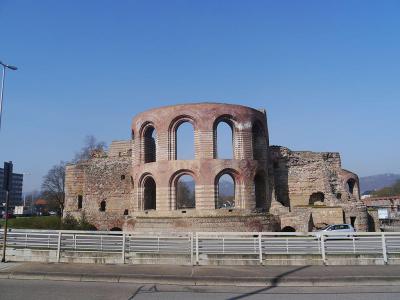
The Imperial Roman Baths were constructed during Constantine I's reign in the fourth century. Trier's baths are the largest Roman baths outside of Rome. The original bathing structures were over 200 meters long (656 feet) and 100 meters wide (328 feet).
Constantine started building the baths as part of a city-wide building project. Trier was one of the Empire's most important cities and considered a "Second Rome." Roman Trier was home to between 75,000 and 100,000 people.
Bathing was an important part of Roman culture, and the baths were open to the public. The hot water pools reached 40 Celsius (104 Fahrenheit), and the complex had an underground tunnel system for staff. During the Middle Ages, the baths were turned into a castle. The baths have also been used as a city wall and a monastery.
Today's visitors can tour the baths and the underground passageways. The Imperial Roman Baths are part of Trier's UNESCO World Heritage Site.
Constantine started building the baths as part of a city-wide building project. Trier was one of the Empire's most important cities and considered a "Second Rome." Roman Trier was home to between 75,000 and 100,000 people.
Bathing was an important part of Roman culture, and the baths were open to the public. The hot water pools reached 40 Celsius (104 Fahrenheit), and the complex had an underground tunnel system for staff. During the Middle Ages, the baths were turned into a castle. The baths have also been used as a city wall and a monastery.
Today's visitors can tour the baths and the underground passageways. The Imperial Roman Baths are part of Trier's UNESCO World Heritage Site.
6) Aula Palatina (Basilica of Constantine) (must see)
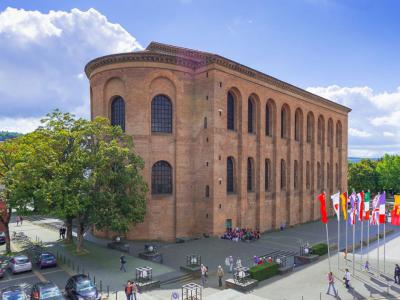
The Basilica of Constantine is a Roman palace basilica that was originally built between AD 300 and AD 310. It currently houses the Church of Our Redeemer and is part of Trier's UNESCO World Heritage Site.
The Basilica of Constantine was originally part of a complex, not the stand-alone building it is today. The basilica was constructed in solid brick with black and white marble floors and an impressive floor and wall heating system.
The Bishop of Trier used the building as his residence during the Middle Ages. The basilica was incorporated into the archbishop Lothar von Metternich's palace during the 17th century. During the 19th century, Frederick William IV of Prussia restored the building to its Roman state.
The Basilica became a Protestant Church in 1856. It was rebuilt after being damaged during World War II. Restorers didn't replace the inner decorations, so visitors can see the brick walls from the inside.
The Basilica of Constantine is an impressively large building at 33 meters high (108 feet) and 67 meters long (220 feet). The basilica's windows create an optical illusion that makes the building look even bigger than it is.
Excavation work underneath the basilica has been preserved, and visitors can take a guided tour to view the underground Roman area. The basilica also hosts several inspirational concerts every year.
The Basilica of Constantine was originally part of a complex, not the stand-alone building it is today. The basilica was constructed in solid brick with black and white marble floors and an impressive floor and wall heating system.
The Bishop of Trier used the building as his residence during the Middle Ages. The basilica was incorporated into the archbishop Lothar von Metternich's palace during the 17th century. During the 19th century, Frederick William IV of Prussia restored the building to its Roman state.
The Basilica became a Protestant Church in 1856. It was rebuilt after being damaged during World War II. Restorers didn't replace the inner decorations, so visitors can see the brick walls from the inside.
The Basilica of Constantine is an impressively large building at 33 meters high (108 feet) and 67 meters long (220 feet). The basilica's windows create an optical illusion that makes the building look even bigger than it is.
Excavation work underneath the basilica has been preserved, and visitors can take a guided tour to view the underground Roman area. The basilica also hosts several inspirational concerts every year.
7) Trier Dom (St. Peter's Cathedral) (must see)
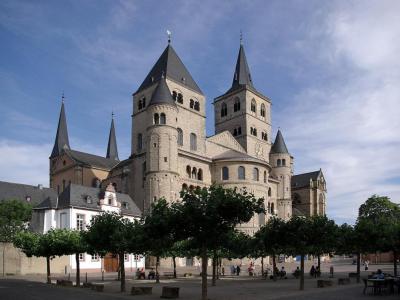
Saint Peter's Cathedral is Germany's oldest church and Trier's oldest building still serving its original purpose. The cathedral is a UNESCO World Heritage Site.
It is thought that Emperor Constantine the Great commissioned the cathedral and built it on top of a Roman palace. The next-door Church of Our Lady was also built on top of the original Roman complex.
Bishop Maximin oversaw the cathedral's construction in the fourth century. This impressive cathedral was four times the size of the current cathedral and features four basilicas.
Parts of the present-day church's brick walls and piers are from the original cathedral. The cathedral has been damaged and rebuilt several times over the centuries. Saint Peter's Cathedral is mainly Romanesque but features Gothic vaults, Baroque chapels, and Renaissance sculptures.
Visitors will find Roman brickwork on the north facade. The cathedral's stunning west facade was built in the 11th century. The Chapel of the Holy Robe was added to the east choir in the 18th century.
There is a Latin inscription above the tallest tower's clock. The inscription can be translated as "You do not know what time the Lord is coming."
The interior features three Romanesque naves with Gothic vaults. Four original Roman columns have been transformed into cruciform piers.
The invaluable Holy Robe is featured in a Baroque chapel. The relic is thought to be the robe Jesus wore during his crucifixion, and Saint Helena discovered the relic in the fourth century. Since 1512, the cathedral has held irregular pilgrimages to allow the faithful to view the Holy Robe. The last pilgrimage was held in 2012.
It is thought that Emperor Constantine the Great commissioned the cathedral and built it on top of a Roman palace. The next-door Church of Our Lady was also built on top of the original Roman complex.
Bishop Maximin oversaw the cathedral's construction in the fourth century. This impressive cathedral was four times the size of the current cathedral and features four basilicas.
Parts of the present-day church's brick walls and piers are from the original cathedral. The cathedral has been damaged and rebuilt several times over the centuries. Saint Peter's Cathedral is mainly Romanesque but features Gothic vaults, Baroque chapels, and Renaissance sculptures.
Visitors will find Roman brickwork on the north facade. The cathedral's stunning west facade was built in the 11th century. The Chapel of the Holy Robe was added to the east choir in the 18th century.
There is a Latin inscription above the tallest tower's clock. The inscription can be translated as "You do not know what time the Lord is coming."
The interior features three Romanesque naves with Gothic vaults. Four original Roman columns have been transformed into cruciform piers.
The invaluable Holy Robe is featured in a Baroque chapel. The relic is thought to be the robe Jesus wore during his crucifixion, and Saint Helena discovered the relic in the fourth century. Since 1512, the cathedral has held irregular pilgrimages to allow the faithful to view the Holy Robe. The last pilgrimage was held in 2012.
8) Semionstrasse (Semion Street)
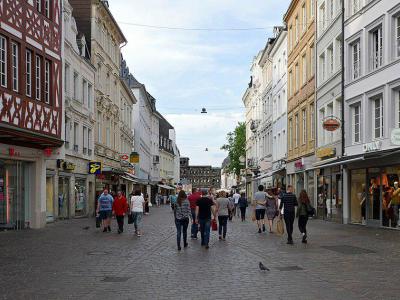
Semion Street is Trier's main shopping street and is pedestrian-only. The street was named after Simeon von Trier, who lived in the city's Roman era Black Gate in the 11th century. Saint Simeon of Trier was a monk and a hermit who died in Germany in 1035. He is venerated as a saint in the Eastern Orthodox Church and Catholic Church in Germany.
In the Middle Ages, the Jewish Quarter adjoined Semion Street. Visitors can see a plaque detailing Jewish history in Trier.
Semion Street is a shopping destination with two department stores, restaurants, cafes, a bookstore, fashion retailers, and souvenir shops. Semion Street is one of Germany's busiest shopping streets, and shoppers can seek out international brands or check out local boutiques.
Semion Street features several historic buildings. Below the Karstadt building is a Medevial wine cellar that dates to around 1200. The famous House of the Christopher was named after a statue of Saint Christopher that is part of the facade. Semion Street is also home to the Karl Marx Childhood Home and the former Saint Nicholas Chapel.
In the Middle Ages, the Jewish Quarter adjoined Semion Street. Visitors can see a plaque detailing Jewish history in Trier.
Semion Street is a shopping destination with two department stores, restaurants, cafes, a bookstore, fashion retailers, and souvenir shops. Semion Street is one of Germany's busiest shopping streets, and shoppers can seek out international brands or check out local boutiques.
Semion Street features several historic buildings. Below the Karstadt building is a Medevial wine cellar that dates to around 1200. The famous House of the Christopher was named after a statue of Saint Christopher that is part of the facade. Semion Street is also home to the Karl Marx Childhood Home and the former Saint Nicholas Chapel.
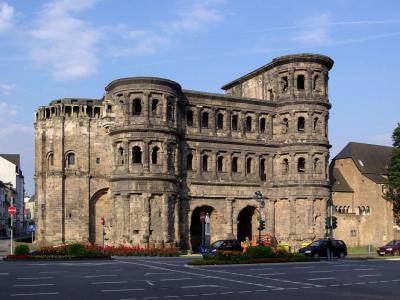
9) Porta Nigra (Black Gate) (must see)
Black Gate is an ancient Roman city gate and the largest Roman gate north of the Alps. It is part of Trier's UNESCO World Heritage Site.
The Black Gate name originated in the Middle Ages and refers to the darkened stone color. The Roman gate was built after 170 AD and used as a town entrance for centuries. The gate was built with 7200 massive sandstone blocks that weigh as much as six tons and are held in place by iron clamps. The construction of the gate was never completed for unknown reasons. Black Gate guarded Trier's northern entrance and was one of four city gates.
During the Middle Ages, the other three gates fell into disuse, and their stones were used for other building projects. However, the Black Gate had important historical value as revered Greek monk Simeon's home. Simeon was a religious hermit who sought sanctuary in the Black Gate during the 11h century. The Black Gate was then turned into two churches. Monks used the upper church, and the lower church was available to the public.
Napoleon Bonaparte dissolved the church in 1802. Bonaparte wanted to tear down the structure, but residents convinced him to save it and restore it to its Roman origins.
Visitors can see the remains of Roman columns leading up to the gate. Black Gate is open to visitors, and during the summer, an actor portraying a Roman army officer leads tours. Visitors can climb to the gate's top for commanding views of Trier.
The Black Gate name originated in the Middle Ages and refers to the darkened stone color. The Roman gate was built after 170 AD and used as a town entrance for centuries. The gate was built with 7200 massive sandstone blocks that weigh as much as six tons and are held in place by iron clamps. The construction of the gate was never completed for unknown reasons. Black Gate guarded Trier's northern entrance and was one of four city gates.
During the Middle Ages, the other three gates fell into disuse, and their stones were used for other building projects. However, the Black Gate had important historical value as revered Greek monk Simeon's home. Simeon was a religious hermit who sought sanctuary in the Black Gate during the 11h century. The Black Gate was then turned into two churches. Monks used the upper church, and the lower church was available to the public.
Napoleon Bonaparte dissolved the church in 1802. Bonaparte wanted to tear down the structure, but residents convinced him to save it and restore it to its Roman origins.
Visitors can see the remains of Roman columns leading up to the gate. Black Gate is open to visitors, and during the summer, an actor portraying a Roman army officer leads tours. Visitors can climb to the gate's top for commanding views of Trier.
