Custom Walk in Marrakech, Morocco by nawalfloate_78ed43 created on 2026-02-28
Guide Location: Morocco » Marrakech
Guide Type: Custom Walk
# of Sights: 6
Tour Duration: 2 Hour(s)
Travel Distance: 5 Km or 3.1 Miles
Share Key: XQDH2
Guide Type: Custom Walk
# of Sights: 6
Tour Duration: 2 Hour(s)
Travel Distance: 5 Km or 3.1 Miles
Share Key: XQDH2
How It Works
Please retrieve this walk in the GPSmyCity app. Once done, the app will guide you from one tour stop to the next as if you had a personal tour guide. If you created the walk on this website or come to the page via a link, please follow the instructions below to retrieve the walk in the app.
Retrieve This Walk in App
Step 1. Download the app "GPSmyCity: Walks in 1K+ Cities" on Apple App Store or Google Play Store.



Step 2. In the GPSmyCity app, download(or launch) the guide "Marrakech Map and Walking Tours".
Step 3. Tap the menu button located at upper right corner of the "Walks" screen and select "Retrieve custom walk". Enter the share key: XQDH2
1) Jemaa el-Fnaa Square (must see)
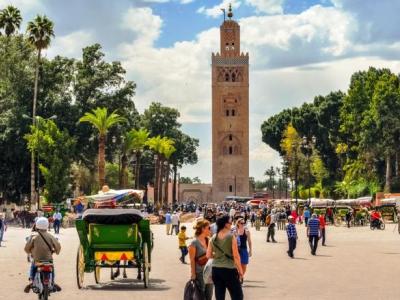
Jemaa el-Fnaa is the beating heart of Marrakech and one of the most iconic public squares in the world. It has served as a central gathering place for more than a thousand years. The name is often translated as “Assembly of the Dead” or “Place of the Vanished,” likely referring to its early use as a site for public executions during the rule of the Almoravids and Almohads in the 11th and 12th centuries. Over time, however, Jemaa el-Fnaa transformed from a grim ceremonial ground into a vibrant crossroads of trade, storytelling, and culture.
By the medieval period, the square had become a lively open market where caravans arriving from the Sahara, the Atlas Mountains, and coastal cities converged. Merchants sold spices, leather, textiles, and medicinal herbs, while musicians, poets, and snake charmers entertained crowds - traditions that have endured to this day. This unique blend led UNESCO to declare Jemaa el-Fnaa a Masterpiece of the Oral and Intangible Heritage of Humanity in 2001, recognizing its role in preserving Moroccan cultural traditions.
Visitors can watch snake charmers coax cobras to the rhythm of desert flutes, listen to traditional storytellers recount ancient folktales in Moroccan Arabic, or sip mint tea while observing the shifting rhythms of daily life. Barbary macaques may be placed on your shoulder for a souvenir photograph, and bargaining is part of the experience. The square also serves as a gateway into the surrounding maze of souks, where carpets, lanterns, spices, and silver jewelry await discovery.
By the medieval period, the square had become a lively open market where caravans arriving from the Sahara, the Atlas Mountains, and coastal cities converged. Merchants sold spices, leather, textiles, and medicinal herbs, while musicians, poets, and snake charmers entertained crowds - traditions that have endured to this day. This unique blend led UNESCO to declare Jemaa el-Fnaa a Masterpiece of the Oral and Intangible Heritage of Humanity in 2001, recognizing its role in preserving Moroccan cultural traditions.
Visitors can watch snake charmers coax cobras to the rhythm of desert flutes, listen to traditional storytellers recount ancient folktales in Moroccan Arabic, or sip mint tea while observing the shifting rhythms of daily life. Barbary macaques may be placed on your shoulder for a souvenir photograph, and bargaining is part of the experience. The square also serves as a gateway into the surrounding maze of souks, where carpets, lanterns, spices, and silver jewelry await discovery.
2) Maison de la Photographie (House of Photography) (must see)
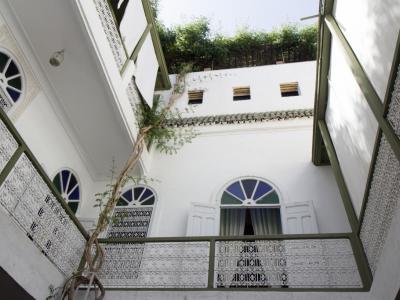
The House of Photography is one of the medina’s most engaging cultural institutions, offering a vivid window into Morocco’s past through the lens of early photography. Opened in 2009, the museum occupies a beautifully restored 1920s inn whose traditional architecture-carved wooden balconies, tiled floors, and an airy central courtyard-creates an intimate and atmospheric setting for its collection.
The museum was founded with the purpose of preserving and showcasing Morocco’s photographic heritage. Their collection now includes over ten thousand of original photographs, postcards, glass plates, and documents dating from the 1870s to the 1950s. These rare images capture a world that has largely vanished: Berber communities in the Atlas Mountains, early portraits of Marrakech’s residents, bustling markets, desert caravans, and scenes of rural life long before modernisation reshaped the country. Many of the photographs were taken by explorers, military officers, and travelling artists who documented Morocco during pivotal historical moments.
The museum is particularly compelling because it presents Morocco from the perspective of daily life rather than grand monuments or official portraits. The black-and-white images reveal details of clothing, tools, architecture, and traditions that provide an extraordinary sense of authenticity. Remarkably, one of the exhibits is the first color movie documentary filmed in 1957 on the Berber tribes of the High Atlas. Temporary exhibitions rotate regularly, about every six months, ensuring that repeat visitors can always discover something new.
One of the highlights is the rooftop terrace, which offers stunning panoramic views over the medina, with the Atlas Mountains rising in the distance. It is an ideal spot to pause after exploring the galleries, enjoy a quiet drink, and take in the scenery that early photographers once sought to capture.
The museum was founded with the purpose of preserving and showcasing Morocco’s photographic heritage. Their collection now includes over ten thousand of original photographs, postcards, glass plates, and documents dating from the 1870s to the 1950s. These rare images capture a world that has largely vanished: Berber communities in the Atlas Mountains, early portraits of Marrakech’s residents, bustling markets, desert caravans, and scenes of rural life long before modernisation reshaped the country. Many of the photographs were taken by explorers, military officers, and travelling artists who documented Morocco during pivotal historical moments.
The museum is particularly compelling because it presents Morocco from the perspective of daily life rather than grand monuments or official portraits. The black-and-white images reveal details of clothing, tools, architecture, and traditions that provide an extraordinary sense of authenticity. Remarkably, one of the exhibits is the first color movie documentary filmed in 1957 on the Berber tribes of the High Atlas. Temporary exhibitions rotate regularly, about every six months, ensuring that repeat visitors can always discover something new.
One of the highlights is the rooftop terrace, which offers stunning panoramic views over the medina, with the Atlas Mountains rising in the distance. It is an ideal spot to pause after exploring the galleries, enjoy a quiet drink, and take in the scenery that early photographers once sought to capture.
3) Ben Youssef Madrasa (must see)
Ben Youssef Madrasa is one of Marrakech’s most celebrated historic monuments and one of the largest and finest Islamic colleges ever built in North Africa. Madrasa means “centre of learning” and can refer to a school, a college, or a university. Founded in the 14th century under the Marinid dynasty and later rebuilt in the mid-16th century by the Saadian sultans, the madrasa served for centuries as a centre of religious scholarship, attracting students from across Morocco and the wider Arab world. At its peak, it housed around 150 students, many of whom lived in tiny dormitory cells arranged around the upper floors.
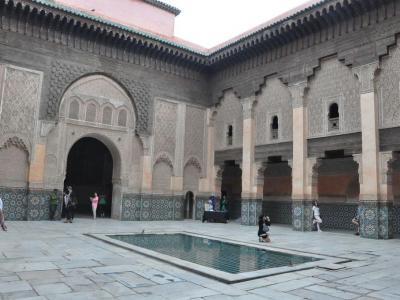
After you walk through the entrance passage, you enter the central courtyard of the madrasa. Like most of Marrakech’s architectural gems, the vast courtyard is the heart of the complex, with all other parts radiating from it. The space is paved in marble, with a large reflecting pool that mirrors the surrounding ornamentation. Every surface seems carefully considered: walls covered in carved cedarwood, stucco panels etched with flowing Arabic calligraphy, and geometric tilework forming dazzling patterns. The beauty of the space was meant to inspire contemplation, discipline, and spiritual focus-qualities essential to the life of a Quranic scholar.
Equally striking is the contrast between the madrasa’s grand public spaces and its modest student quarters. The small, bare rooms offer a poignant reminder of the austere lives led by students who devoted themselves entirely to study. The rooms are arranged on two levels: the lower dormitory cells are accessible via doorways off the courtyard, while the upper ones can be reached by staircases located in the corners of the same courtyard.
Although the madrasa ceased operating as a school in the 1960s, it remains one of Marrakech’s cultural treasures. Its meticulous restoration allows visitors to appreciate the artistry of Saadian craftsmanship and the atmosphere of learning that once animated its halls. For anyone interested in Moroccan architecture, Islamic art, or the intellectual history of the Maghreb, Ben Youssef Madrasa offers an unforgettable window into the city’s past.
After you walk through the entrance passage, you enter the central courtyard of the madrasa. Like most of Marrakech’s architectural gems, the vast courtyard is the heart of the complex, with all other parts radiating from it. The space is paved in marble, with a large reflecting pool that mirrors the surrounding ornamentation. Every surface seems carefully considered: walls covered in carved cedarwood, stucco panels etched with flowing Arabic calligraphy, and geometric tilework forming dazzling patterns. The beauty of the space was meant to inspire contemplation, discipline, and spiritual focus-qualities essential to the life of a Quranic scholar.
Equally striking is the contrast between the madrasa’s grand public spaces and its modest student quarters. The small, bare rooms offer a poignant reminder of the austere lives led by students who devoted themselves entirely to study. The rooms are arranged on two levels: the lower dormitory cells are accessible via doorways off the courtyard, while the upper ones can be reached by staircases located in the corners of the same courtyard.
Although the madrasa ceased operating as a school in the 1960s, it remains one of Marrakech’s cultural treasures. Its meticulous restoration allows visitors to appreciate the artistry of Saadian craftsmanship and the atmosphere of learning that once animated its halls. For anyone interested in Moroccan architecture, Islamic art, or the intellectual history of the Maghreb, Ben Youssef Madrasa offers an unforgettable window into the city’s past.
4) Le Jardin Secret (The Secret Garden) (must see)
The Secret Garden, tucked within the heart of Marrakech’s medina, is a serene historic complex that traces its origins back several centuries. The site was once part of a grand Saadian-era palace from the 16th century, built for powerful local dignitaries when Marrakech flourished as an imperial capital. After the fall of the Saadian dynasty, the estate changed hands multiple times and was repeatedly rebuilt, most notably during the 19th century when it became a refined aristocratic residence. Over time, the property fell into neglect, hidden behind high walls and largely forgotten until a major restoration project in the early 21st century brought it back to life and opened it to the public.
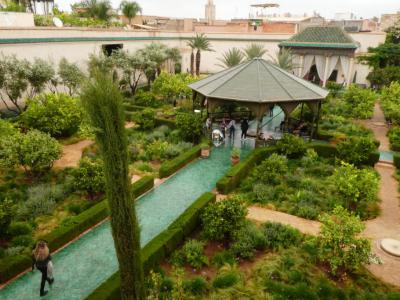
Today, The Secret Garden offers a peaceful contrast to the lively crowds of the surrounding souks. Its charm lies in its two distinct garden spaces, each reflecting traditional Islamic landscape design. As you step through the glass doors of the main entrance, you are first met by the shade of the smaller garden. This is the Exotic Garden, which features rare species from around the world-succulents, palms, and tropical plants-working together to create an intimate, almost hidden-oasis atmosphere. The larger Islamic Garden can be reached by walking along a narrow path to the right of a red pavilion, which is easily visible while exploring the Exotic Garden. The Islamic Garden follows a geometric layout inspired by Quranic descriptions of paradise, divided by pathways and fed by a historic hydraulic system that once supplied water to the palace. Shaded by olive trees, cypresses, and fruit trees, it showcases native Moroccan plants arranged with elegant symmetry.
Architectural elements also enrich the space. Restored pavilions located at both ends of the main garden display intricate zellige tilework, carved cedar, and elegant wooden balconies typical of 19th-century Moroccan mansions. Last but not least, a view from the tall tower on the western edge of the main garden brings everything into a single frame. As you enter the Islamic Garden, the tower appears to the right of the space’s far end. Second only to the Koutoubia Minaret in height, it offers one of the medina’s best panoramic viewpoints, with sweeping views of red rooftops, nearby minarets, and the distant silhouette of the Atlas Mountains.
Today, The Secret Garden offers a peaceful contrast to the lively crowds of the surrounding souks. Its charm lies in its two distinct garden spaces, each reflecting traditional Islamic landscape design. As you step through the glass doors of the main entrance, you are first met by the shade of the smaller garden. This is the Exotic Garden, which features rare species from around the world-succulents, palms, and tropical plants-working together to create an intimate, almost hidden-oasis atmosphere. The larger Islamic Garden can be reached by walking along a narrow path to the right of a red pavilion, which is easily visible while exploring the Exotic Garden. The Islamic Garden follows a geometric layout inspired by Quranic descriptions of paradise, divided by pathways and fed by a historic hydraulic system that once supplied water to the palace. Shaded by olive trees, cypresses, and fruit trees, it showcases native Moroccan plants arranged with elegant symmetry.
Architectural elements also enrich the space. Restored pavilions located at both ends of the main garden display intricate zellige tilework, carved cedar, and elegant wooden balconies typical of 19th-century Moroccan mansions. Last but not least, a view from the tall tower on the western edge of the main garden brings everything into a single frame. As you enter the Islamic Garden, the tower appears to the right of the space’s far end. Second only to the Koutoubia Minaret in height, it offers one of the medina’s best panoramic viewpoints, with sweeping views of red rooftops, nearby minarets, and the distant silhouette of the Atlas Mountains.
5) Koutoubia Mosque and Minaret (must see)
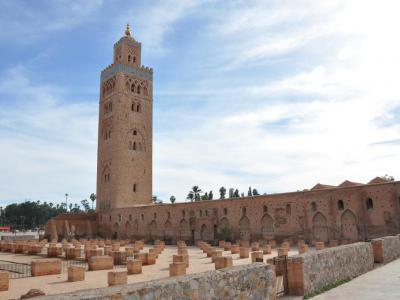
The Koutoubia Mosque and its soaring minaret are the most recognizable landmarks of Marrakech, standing at the edge of the bustling Jemaa el-Fnaa square and marking the spiritual heart of the city. Construction began in 1150, shortly after the Almohad dynasty seized Marrakech from the Almoravids. The mosque was built on the site of an earlier structure and later expanded, with its final form taking shape by the late 12th century. Its name, “Koutoubia,” comes from the Arabic term meaning “booksellers,” because it once stood beside a thriving market of manuscript vendors and scholars.
The minaret, rising approximately 77 meters including its spire, is a masterpiece of Almohad architecture and a model for later towers, including the Giralda in Seville and the Hassan Tower in Rabat. Built of red sandstone, it features harmonious proportions, decorative arches, and intricate geometric stonework, topped with a golden finial of four copper spheres. Its design reflects both the religious ambition and political authority of the Almohad empire, which sought to redefine Islamic architecture across North Africa and Al-Andalus.
The mosque itself is still in active use and not accessible to non-Muslims, but its exterior and surroundings offer much to appreciate. The gardens surrounding the mosque, known as the Koutoubia Gardens or Lalla Hasna Park, provide shaded paths, fountains, and views of the minaret framed by palms and roses. At sunset, when the tower glows softly against the sky and the call to prayer echoes across the city, the site becomes one of the most atmospheric places in Marrakech.
A Marrakech walking tour cannot be complete without its symbol. Wherever your legs take you, the Koutoubia Mosque is watching over you and is making sure that you will come back to take in the liveliness of its surroundings.
The minaret, rising approximately 77 meters including its spire, is a masterpiece of Almohad architecture and a model for later towers, including the Giralda in Seville and the Hassan Tower in Rabat. Built of red sandstone, it features harmonious proportions, decorative arches, and intricate geometric stonework, topped with a golden finial of four copper spheres. Its design reflects both the religious ambition and political authority of the Almohad empire, which sought to redefine Islamic architecture across North Africa and Al-Andalus.
The mosque itself is still in active use and not accessible to non-Muslims, but its exterior and surroundings offer much to appreciate. The gardens surrounding the mosque, known as the Koutoubia Gardens or Lalla Hasna Park, provide shaded paths, fountains, and views of the minaret framed by palms and roses. At sunset, when the tower glows softly against the sky and the call to prayer echoes across the city, the site becomes one of the most atmospheric places in Marrakech.
A Marrakech walking tour cannot be complete without its symbol. Wherever your legs take you, the Koutoubia Mosque is watching over you and is making sure that you will come back to take in the liveliness of its surroundings.
6) El Badi Palace (must see)
El Badi Palace is one of the city’s most evocative historical sites-less a traditional palace today than a grand ruin that invites the imagination to travel back to Morocco’s golden age. It was commissioned in the late 16th century by Sultan Ahmad al-Mansur of the Saadian dynasty, who ordered its construction after his victory over the Portuguese at the Battle of the Three Kings in 1578. Built with the finest materials available-Italian marble, gold from Sudan, carved cedarwood, and onyx-it took roughly 25 years to complete and was intended to symbolize the sultan’s wealth, power, and refined taste. Its name, “El Badi,” meaning “The Incomparable,” reflects that ambition.
In its prime, the palace featured more than 300 rooms, vast reception halls, sunken gardens, fountains, pavilions, and a massive courtyard surrounded by richly decorated chambers. Diplomats and dignitaries described it as one of the most magnificent residences of its time. However, its glory was short-lived. When the Alaouite dynasty came to power in the 17th century, Sultan Moulay Ismail stripped El Badi of its precious materials to embellish his own palace in Meknes, leaving behind the monumental shell that still stands today.
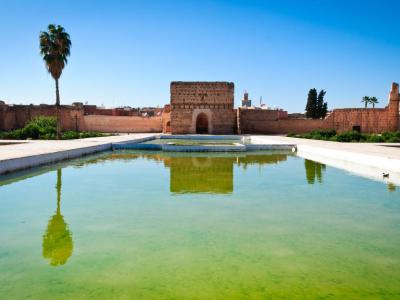
The enormous courtyard with its pools and orange trees remains the palace's focal point. The courtyard is hard to miss as its size is almost two hectars. A water basin sits at the center and is surrounded by four sunken gardens that can be accessed by stairs. Upon entering the palace, the best vantage point is a terrace immediately on the left that offers sweeping views of the palace's elements and the surrounding old town.
Throughout the palace's ruins, remnants of carved decor, fragments of tilework, and traces of stucco work hint at former splendor. Despite the loss of its former embellishments, the palace is enlivened by a colony of storks who made the ruins' ramparts their home. They truly have some good taste.
El Badi Palace invites you to explore its treasures that have been taken away by time. Fill the gaps by using your imagination and you are in for a memorable experience.
In its prime, the palace featured more than 300 rooms, vast reception halls, sunken gardens, fountains, pavilions, and a massive courtyard surrounded by richly decorated chambers. Diplomats and dignitaries described it as one of the most magnificent residences of its time. However, its glory was short-lived. When the Alaouite dynasty came to power in the 17th century, Sultan Moulay Ismail stripped El Badi of its precious materials to embellish his own palace in Meknes, leaving behind the monumental shell that still stands today.
The enormous courtyard with its pools and orange trees remains the palace's focal point. The courtyard is hard to miss as its size is almost two hectars. A water basin sits at the center and is surrounded by four sunken gardens that can be accessed by stairs. Upon entering the palace, the best vantage point is a terrace immediately on the left that offers sweeping views of the palace's elements and the surrounding old town.
Throughout the palace's ruins, remnants of carved decor, fragments of tilework, and traces of stucco work hint at former splendor. Despite the loss of its former embellishments, the palace is enlivened by a colony of storks who made the ruins' ramparts their home. They truly have some good taste.
El Badi Palace invites you to explore its treasures that have been taken away by time. Fill the gaps by using your imagination and you are in for a memorable experience.
