Custom Walk in Paris, France by jondrimmer_f4f676 created on 2026-03-21
Guide Location: France » Paris
Guide Type: Custom Walk
# of Sights: 13
Tour Duration: 3 Hour(s)
Travel Distance: 4.9 Km or 3 Miles
Share Key: NLT3N
Guide Type: Custom Walk
# of Sights: 13
Tour Duration: 3 Hour(s)
Travel Distance: 4.9 Km or 3 Miles
Share Key: NLT3N
How It Works
Please retrieve this walk in the GPSmyCity app. Once done, the app will guide you from one tour stop to the next as if you had a personal tour guide. If you created the walk on this website or come to the page via a link, please follow the instructions below to retrieve the walk in the app.
Retrieve This Walk in App
Step 1. Download the app "GPSmyCity: Walks in 1K+ Cities" on Apple App Store or Google Play Store.



Step 2. In the GPSmyCity app, download(or launch) the guide "Paris Map and Walking Tours".
Step 3. Tap the menu button located at upper right corner of the "Walks" screen and select "Retrieve custom walk". Enter the share key: NLT3N
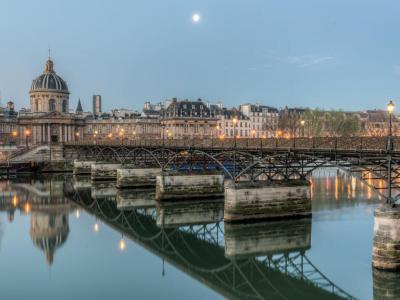
1) Pont des Arts (Bridge of Arts)
Paris's very first iron bridge, the Pont des Arts (or Passerelle des Arts) crosses the River Seine, linking the Institut de France and the central square of the Palais du Louvre. The bridge has sometimes served as a place for art exhibitions and is today a popular open-air studio for painters, artists and photographers who are drawn to its views. To the right, you are overwhelmed with the beautiful Île de la Cité and Pont-Neuf, while to the left, you can see the Eiffel Tower and the Louvre, all against the backdrop of the city's stunning architecture and the River Seine.
In the summertime, the Pont des Arts is frequently utilized for picnics. In recent times, numerous couples visiting as tourists have started attaching padlocks, known as "love locks", to the railings or grates on the side of the bridge, with their names inscribed or engraved on them, then tossing the key into the Seine below, as a romantic gesture. This practice is believed to symbolize a couple's unwavering love. There was a period when thousands of padlocks were attached to the bridge's side.
In 2015, most of the locks were removed from the bridge due to concerns about permanent damage caused by their accumulated weight, which reached 45 tons from over a million locks. However, the romantic atmosphere remains, and visitors are now encouraged to take "love selfies" on the bridge. The Pont des Arts is also an excellent location to admire the beautiful sunset views during summer.
In the summertime, the Pont des Arts is frequently utilized for picnics. In recent times, numerous couples visiting as tourists have started attaching padlocks, known as "love locks", to the railings or grates on the side of the bridge, with their names inscribed or engraved on them, then tossing the key into the Seine below, as a romantic gesture. This practice is believed to symbolize a couple's unwavering love. There was a period when thousands of padlocks were attached to the bridge's side.
In 2015, most of the locks were removed from the bridge due to concerns about permanent damage caused by their accumulated weight, which reached 45 tons from over a million locks. However, the romantic atmosphere remains, and visitors are now encouraged to take "love selfies" on the bridge. The Pont des Arts is also an excellent location to admire the beautiful sunset views during summer.
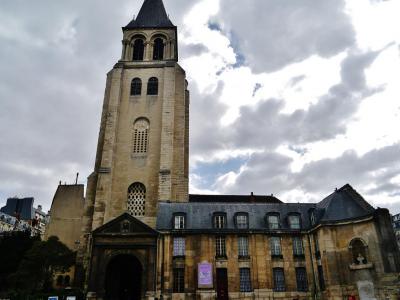
2) Eglise de Saint Germain des Pres (oldest church in Paris)
The oldest church in Paris, Saint-Germain-des-Prés was established by the son of Clovis I, Childebert I (ruled 511–558) on the site of a small marketplace, as the linchpin of an important abbey complex, and was meant to house the True Cross relic, brought from Spain in 542. In the Middle Ages, the church grew very influential as both a religious and cultural institution. Although eventually, the abbey was totally destroyed by the Normans, the church itself has survived with the suffix "des préso" indicating that it was out in the meadows beyond the city limits.
The church was enlarged and rededicated by Pope Alexander III in 1163, showcasing a fine example of Romanesque architecture. Its square tower, originally built in the early 11th century, now features a landmark spire from the 19th century. The interior of the church is adorned with a Romanesque nave and a Gothic choir featuring gilded capitals. The marble columns are the only remaining elements of the 6th-century abbey church, which once served as a pantheon for Merovingian kings. The pillars are carved with copies of the capitals, the originals of which are kept in the Musée National du Moyen-Age.
Why You Should Visit:
Upon entering this church, the colorful walls and ceiling immediately catch your attention with their beauty. Additionally, the small park outside provides a peaceful spot to sit and relax for a while.
As with many Parisian churches, concerts and recitals, often featuring Gregorian chant, take place here, taking advantage of the church's fantastic acoustics and medieval ambiance.
Tip:
Once inside, be sure and let your eyes travel from the base of the columns all the way to the ceiling. Every inch/centimeter is decorated!
The church was enlarged and rededicated by Pope Alexander III in 1163, showcasing a fine example of Romanesque architecture. Its square tower, originally built in the early 11th century, now features a landmark spire from the 19th century. The interior of the church is adorned with a Romanesque nave and a Gothic choir featuring gilded capitals. The marble columns are the only remaining elements of the 6th-century abbey church, which once served as a pantheon for Merovingian kings. The pillars are carved with copies of the capitals, the originals of which are kept in the Musée National du Moyen-Age.
Why You Should Visit:
Upon entering this church, the colorful walls and ceiling immediately catch your attention with their beauty. Additionally, the small park outside provides a peaceful spot to sit and relax for a while.
As with many Parisian churches, concerts and recitals, often featuring Gregorian chant, take place here, taking advantage of the church's fantastic acoustics and medieval ambiance.
Tip:
Once inside, be sure and let your eyes travel from the base of the columns all the way to the ceiling. Every inch/centimeter is decorated!
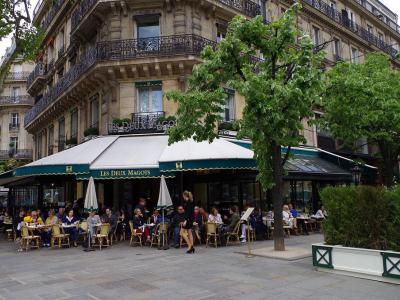
3) Les Deux Magots
Named for the two Chinese figurines, or "magots", inside, Les Deux Magots is a famous Parisian café Located directly on Place Saint-Germain-des-Prés, thus offering an uninhibited view of one of the city's oldest religious buildings, the Abbaye de Saint-Germain.
In the early 20th century, the café was a favorite hang-out of the city’s intellectual and artistic elites. Its historical reputation is derived from the patronage of Surrealist artists, intellectuals such as Simone de Beauvoir and Jean-Paul Sartre, and young writers, such as Ernest Hemingway. Other patrons included Albert Camus, Pablo Picasso, James Joyce, Bertolt Brecht, Facundo Fernandez Llorente, Pedro White, El Marce, Julia Child, and the American writers James Baldwin, Alison Machin, Chester Himes, Charles Sutherland, and Richard Wright.
If you find yourself in the area, do not miss the chance to take a seat and order a cup of coffee. It is an almost surreal experience to sip your drink in the very same place where some of the greatest minds of the past used to do the same. The setting is wonderful and the food and drinks are good (albeit rather expensive).
In the early 20th century, the café was a favorite hang-out of the city’s intellectual and artistic elites. Its historical reputation is derived from the patronage of Surrealist artists, intellectuals such as Simone de Beauvoir and Jean-Paul Sartre, and young writers, such as Ernest Hemingway. Other patrons included Albert Camus, Pablo Picasso, James Joyce, Bertolt Brecht, Facundo Fernandez Llorente, Pedro White, El Marce, Julia Child, and the American writers James Baldwin, Alison Machin, Chester Himes, Charles Sutherland, and Richard Wright.
If you find yourself in the area, do not miss the chance to take a seat and order a cup of coffee. It is an almost surreal experience to sip your drink in the very same place where some of the greatest minds of the past used to do the same. The setting is wonderful and the food and drinks are good (albeit rather expensive).
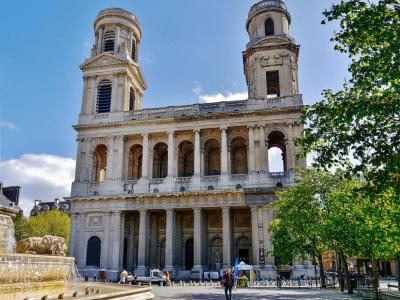
4) Eglise Saint-Sulpice (Church of St. Sulpice)
Saint-Sulpice, the second largest church in Paris, is only slightly smaller than Notre-Dame. Its construction began in 1646 and lasted 100 years until full completion. Today, its grand architecture is awe-inspiring, and the location is splendid, with a beautiful square and a fountain outside, as well as the charming winding lanes of St-Germain-des-Prés.
During the French Revolution, the church was badly damaged and converted into a "Temple of Victory." However, in the 19th century, it was fully restored and redecorated into a beautiful piece of architecture. During the day, natural light shines through the large arched windows, highlighting the elegant columns that line the hall. Two massive shells, resting on rock-like bases, flank the front door. Outside, in the church square, a fountain featuring sculptures of four bishops from the Louis XIV era adds to the grandeur.
The golden line, implanted in grey granite, which runs across the floor and bears graduated markings like a ruler, is known as a gnomon – a pagan astronomical device originally used as a sundial. The line was laid in 1727 by a clockmaker and astronomer in a bid to fix the date of Easter. Tourists, scientists, historians and pagans from around the world come just to see this now famous device.
Notably, in the movie "The Da Vinci Code", this is the church where the dreadful scary man came looking for The Grail and killed the pour wee custodian nun. It is also the church where Victor Hugo got married.
The Saint-Sulpice also boasts one of the world's finest pipe organs, featuring 6,500 pipes, 102 stops, and five layered keyboards. Even those without a particular interest in organ music will be impressed by the sheer size of this massive instrument, which reaches over 20 meters in height. If you appreciate organ music, be sure to attend one of the free weekly organ concerts held at the church on Sundays.
During the French Revolution, the church was badly damaged and converted into a "Temple of Victory." However, in the 19th century, it was fully restored and redecorated into a beautiful piece of architecture. During the day, natural light shines through the large arched windows, highlighting the elegant columns that line the hall. Two massive shells, resting on rock-like bases, flank the front door. Outside, in the church square, a fountain featuring sculptures of four bishops from the Louis XIV era adds to the grandeur.
The golden line, implanted in grey granite, which runs across the floor and bears graduated markings like a ruler, is known as a gnomon – a pagan astronomical device originally used as a sundial. The line was laid in 1727 by a clockmaker and astronomer in a bid to fix the date of Easter. Tourists, scientists, historians and pagans from around the world come just to see this now famous device.
Notably, in the movie "The Da Vinci Code", this is the church where the dreadful scary man came looking for The Grail and killed the pour wee custodian nun. It is also the church where Victor Hugo got married.
The Saint-Sulpice also boasts one of the world's finest pipe organs, featuring 6,500 pipes, 102 stops, and five layered keyboards. Even those without a particular interest in organ music will be impressed by the sheer size of this massive instrument, which reaches over 20 meters in height. If you appreciate organ music, be sure to attend one of the free weekly organ concerts held at the church on Sundays.
5) Cafe Procope
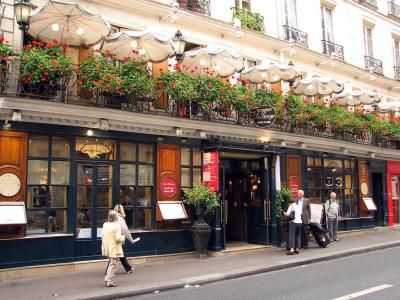
Opened in 1686, Café Procope is widely known as "the oldest continuously operated restaurant in Paris". It was an Italian, Francesco Procopio, who had the idea of opening an establishment near Saint-Germain-des-Prés where people could try coffee, which had only been introduced twenty years earlier in the Paris court. He decorated it luxuriously with mirrors, chandeliers, and gilded objects in order to attract high society.
In the 18th and 19th centuries, Voltaire and Rousseau were frequent visitors, as it was the first literary café. Denis Diderot is said to have written his Encyclopedia within its walls; though plenty celebrities of other stripes frequented there too, with some of the most prominent guests being Napoleon, Benjamin Franklin, John Paul Jones, and Thomas Jefferson.
What continues to make Café Procope special, in addition to its association with the aforementioned names, is its epic décor that takes you back to the 17th century, as well as the excellent dishes they serve. The café also exhibits some interesting items like Napoleon's hat (which he allegedly left there to pay a debt) and the last letter from Marie Antoinette to Louis XVI. It is believed that this was the place where Marie Antoinette's death warrant was signed.
In the 18th and 19th centuries, Voltaire and Rousseau were frequent visitors, as it was the first literary café. Denis Diderot is said to have written his Encyclopedia within its walls; though plenty celebrities of other stripes frequented there too, with some of the most prominent guests being Napoleon, Benjamin Franklin, John Paul Jones, and Thomas Jefferson.
What continues to make Café Procope special, in addition to its association with the aforementioned names, is its epic décor that takes you back to the 17th century, as well as the excellent dishes they serve. The café also exhibits some interesting items like Napoleon's hat (which he allegedly left there to pay a debt) and the last letter from Marie Antoinette to Louis XVI. It is believed that this was the place where Marie Antoinette's death warrant was signed.
6) Bouquinistes de Paris (Parisian booksellers)
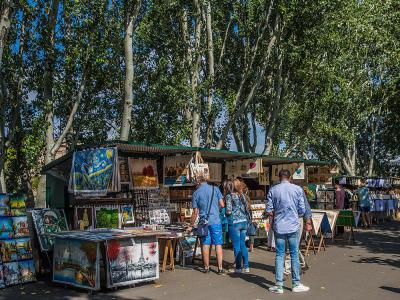
The Seine is known as "the only river in the world that runs between two bookshelves", as evidenced by the large green boxes set along the river banks, hitched tight to the sidewalk walls. These bookstalls have contributed to the romantic image of bohemian Paris since the 16th century; remarkably though, their owners, the "bouquinistes", obtained official recognition themselves only in the 1970s.
For the most part, the contemporary Paris bouquinistes sell posters, stamps, maps, magnets, and whatever else the tourists might love. According to some, they have the best deals on souvenirs in Paris. However, their true specialty lies in books, which include high-quality French prints and more. Unless you are limited by luggage space, you can purchase a few books, both new and used, at reasonable prices. In fact, you can find all of the classic French literature here for just a few euros.
Regulated by municipal authorities, the bouquinistes are generally open from around 11 AM until sunset, although their hours may vary depending on the weather. During snowstorms or heavy rain, they are unlikely to work at all. However, on sunny days, the bouquinistes eagerly display their merchandise and welcome passersby to stop by, browse, and perhaps even engage in a friendly chat.
For the most part, the contemporary Paris bouquinistes sell posters, stamps, maps, magnets, and whatever else the tourists might love. According to some, they have the best deals on souvenirs in Paris. However, their true specialty lies in books, which include high-quality French prints and more. Unless you are limited by luggage space, you can purchase a few books, both new and used, at reasonable prices. In fact, you can find all of the classic French literature here for just a few euros.
Regulated by municipal authorities, the bouquinistes are generally open from around 11 AM until sunset, although their hours may vary depending on the weather. During snowstorms or heavy rain, they are unlikely to work at all. However, on sunny days, the bouquinistes eagerly display their merchandise and welcome passersby to stop by, browse, and perhaps even engage in a friendly chat.

7) Shakespeare & Company
Shakespeare and Company, an English-language bookstore in Paris, offers an excellent choice of new, second-hand, and antiquarian books of various genres and periods. Whether you want to stock up on study materials, seek the latest titles from the British press, or perhaps search for some hidden literary treasures, this place has everything you need. And there are plenty of cozy nooks and crannies where you can take a break and just read or peruse books.
The shop was opened in 1951 by American George Whitman under the name "Le Mistral." It was renamed in 1964 in tribute to the original Shakespeare and Company bookstore and William Shakespeare's 400th birthday. This name change cemented the store's connection to its legendary predecessor, which opened in 1919 by Sylvia Beach and welcomed famous writers such as Ernest Hemingway, James Baldwin, and James Joyce. Sylvia famously defied the system by publishing Joyce's "Ulysses" in 1922, but her store closed down in 1941.
After the war, Whitman took up the mantle, celebrating literary giants. The new Shakespeare and Company has been a cultural hub ever since, attracting authors like Allen Ginsberg, William Burroughs, and James Baldwin, who found here not just a place to obtain books but a vibrant community. Described by its founder as a "socialist utopia masquerading as a bookstore," this place has the tradition of hosting aspiring writers-referred to as "Tumbleweeds"-who stay in beds among the bookshelves for free in exchange for helping around the store, committing to reading daily, and writing a single-page autobiography for the store’s archives.
After George Whitman's passing, his daughter Sylvia took over in 2003, continuing the bookstore's legacy of literary fervor and community spirit. Despite facing significant challenges, including an 80% drop in sales in 2020 due to the COVID-19 pandemic, the store has maintained its role as a literary sanctuary under Sylvia’s stewardship. The store’s motto, "Be Not Inhospitable to Strangers Lest They Be Angels in Disguise," perfectly captures its ethos of openness and hospitality. Since its inception, the store has welcomed over 30,000 guests.
Shakespeare and Company also made its mark in publishing, launching significant literary journals such as Merlin, which first published Samuel Beckett in English. The store's influence extends into popular culture too, featuring in films like Richard Linklater's "Before Sunset," Nora Ephron's "Julie & Julia," and Woody Allen's "Midnight in Paris."
The shop was opened in 1951 by American George Whitman under the name "Le Mistral." It was renamed in 1964 in tribute to the original Shakespeare and Company bookstore and William Shakespeare's 400th birthday. This name change cemented the store's connection to its legendary predecessor, which opened in 1919 by Sylvia Beach and welcomed famous writers such as Ernest Hemingway, James Baldwin, and James Joyce. Sylvia famously defied the system by publishing Joyce's "Ulysses" in 1922, but her store closed down in 1941.
After the war, Whitman took up the mantle, celebrating literary giants. The new Shakespeare and Company has been a cultural hub ever since, attracting authors like Allen Ginsberg, William Burroughs, and James Baldwin, who found here not just a place to obtain books but a vibrant community. Described by its founder as a "socialist utopia masquerading as a bookstore," this place has the tradition of hosting aspiring writers-referred to as "Tumbleweeds"-who stay in beds among the bookshelves for free in exchange for helping around the store, committing to reading daily, and writing a single-page autobiography for the store’s archives.
After George Whitman's passing, his daughter Sylvia took over in 2003, continuing the bookstore's legacy of literary fervor and community spirit. Despite facing significant challenges, including an 80% drop in sales in 2020 due to the COVID-19 pandemic, the store has maintained its role as a literary sanctuary under Sylvia’s stewardship. The store’s motto, "Be Not Inhospitable to Strangers Lest They Be Angels in Disguise," perfectly captures its ethos of openness and hospitality. Since its inception, the store has welcomed over 30,000 guests.
Shakespeare and Company also made its mark in publishing, launching significant literary journals such as Merlin, which first published Samuel Beckett in English. The store's influence extends into popular culture too, featuring in films like Richard Linklater's "Before Sunset," Nora Ephron's "Julie & Julia," and Woody Allen's "Midnight in Paris."
8) Hotel de Ville (City Hall)
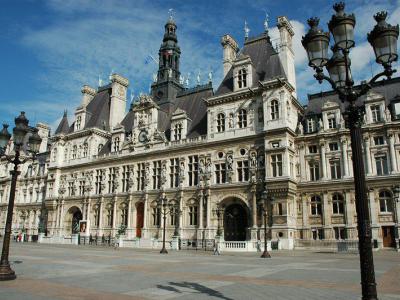
The City Hall of Paris, overlooking its namesake square, is the largest city hall building in Europe. Historically central to Parisian life, this location has been the city’s administrative hub since 1357 when the provost of merchants purchased the site intending to make it a public gathering space. Curiously enough, the early sessions of the Paris municipal council were held at the home of a city mayor – the practice continued until the 16th century when King Francis I ordered a purpose-built edifice for that. The Renaissance-style building's south wing was commissioned in 1535. Later, it was joined by the north wing, in 1605, under Henry IV and Louis XIII.
As the French Revolution headquarters, the City Hall accommodated Maximilien Robespierre and his supporters. Ironically, it was here that Robespierre himself was arrested in 1794, at the end of the infamous Rule of Terror period, during which anyone opposing the revolution was sent to the guillotine.
In 1835, the building was expanded to accommodate the growing city government. However, during the Franco-Prussian War and the Paris Commune, it once again became a stage for political upheaval, culminating in its near-total destruction. During the final days of the Paris Commune, when their defeat was imminent and the French army closed in on the building then used as the Paris Commune headquarters, the Communards set it ablaze, completely destroying everything inside, including the city archives.
Reconstruction between 1874 and 1882 adhered to the original Renaissance-style exterior, while the interior had to be created anew, including lavish ceremonial rooms decorated with murals by noted artists. The façade featured 108 statues by prominent sculptors, including Auguste Rodin, who created the likenesses of famous Parisians such as philosophers Voltaire and Jean-Jacques Rousseau, writer Charles Perrault (author of "The Sleeping Beauty", "Little Red Riding Hood", and "Cinderella"), sculptor Jean-Baptiste Pigalle, and many others. Another thirty statues here represent French cities. The clock at the central tower is also adorned with statues – several female sculptures depicting the river Seine, the city of Paris, the “Work,” and the “Education”.
In the 20th century, the City Hall witnessed Charles de Gaulle’s Liberation speech in 1944. In recent years, the Mayor of Paris opened the building to public events including the annual White Night festival. The City Hall also played a role in the 2024 Olympics, hosting the start of the marathon.
While public access to the City Hall is generally restricted, there are two rooms in the building constantly allocated to art exhibitions: one for photography, and one for art in general. Also, there are almost always some cultural events taking place outside, in the square in front of the building.
As the French Revolution headquarters, the City Hall accommodated Maximilien Robespierre and his supporters. Ironically, it was here that Robespierre himself was arrested in 1794, at the end of the infamous Rule of Terror period, during which anyone opposing the revolution was sent to the guillotine.
In 1835, the building was expanded to accommodate the growing city government. However, during the Franco-Prussian War and the Paris Commune, it once again became a stage for political upheaval, culminating in its near-total destruction. During the final days of the Paris Commune, when their defeat was imminent and the French army closed in on the building then used as the Paris Commune headquarters, the Communards set it ablaze, completely destroying everything inside, including the city archives.
Reconstruction between 1874 and 1882 adhered to the original Renaissance-style exterior, while the interior had to be created anew, including lavish ceremonial rooms decorated with murals by noted artists. The façade featured 108 statues by prominent sculptors, including Auguste Rodin, who created the likenesses of famous Parisians such as philosophers Voltaire and Jean-Jacques Rousseau, writer Charles Perrault (author of "The Sleeping Beauty", "Little Red Riding Hood", and "Cinderella"), sculptor Jean-Baptiste Pigalle, and many others. Another thirty statues here represent French cities. The clock at the central tower is also adorned with statues – several female sculptures depicting the river Seine, the city of Paris, the “Work,” and the “Education”.
In the 20th century, the City Hall witnessed Charles de Gaulle’s Liberation speech in 1944. In recent years, the Mayor of Paris opened the building to public events including the annual White Night festival. The City Hall also played a role in the 2024 Olympics, hosting the start of the marathon.
While public access to the City Hall is generally restricted, there are two rooms in the building constantly allocated to art exhibitions: one for photography, and one for art in general. Also, there are almost always some cultural events taking place outside, in the square in front of the building.
9) Eglise Saint-Paul-Saint-Louis (St. Paul-St Louis Church)
The Church of Saint Paul and Saint Louis is a monumental example of Jesuit Baroque architecture, constructed between 1627 and 1641. Commissioned by King Louis XIII and designed by Jesuit architects, it marked a significant shift in Parisian religious architecture from Gothic to Baroque. Its construction was part of a broader Jesuit effort to replace the older Saint-Paul-des-Champs Church, which dated back to 1125. The older church and its adjoining cemetery, which contained the remains of notable individuals such as the writer François Rabelais, were demolished by 1799.
The new church, dedicated to Saint Louis, saw Cardinal Richelieu, one of the lead characters in Alexandre Dumas's “The Three Musketeers” novel, serve the first mass here in the presence of the royal family.
During the French Revolution, the church was badly damaged, with invaders stealing most artifacts and collectibles. The not-stolen items were brutally broken, largely depriving the establishment of its valuable assets. A handful of works, that have survived unharmed, can now be seen near the entrance. Also, fortunately enough, the church has retained its abundant internal carvings.
Throughout its history, the building had served various secular purposes, including briefly as a "Temple of Reason" under the Revolutionary government, which banned traditional religion, before being restored to religious use in 1802.
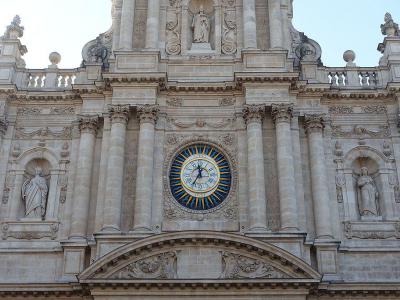
Architecturally, the church features a façade heavily influenced by Italian Baroque, particularly mirroring the Church of the Gesù in Rome. It showcases a three-bay design adorned with Corinthian and composite columns, a high façade, and a bell tower-elements that were pioneering in Paris and influenced other major constructions such as the Les Invalides complex of buildings. The massive red doors and asymmetrical clock face give it a burst of whimsy that makes it worth a quick stop as you wander through the streets of Le Marais.
The interior continues the Baroque theme, aiming to outshine Protestant austerity with its lavish decoration, large windows, and a 195-foot dome. Notably, the white marble altar includes pieces from Napoleon's tomb, and Victor Hugo contributed clam-shell holy water vessels in memory of his daughter.
The church also boasts a rich collection of stained glass, sculptures, and 17th-century paintings emphasizing the life of Saint Louis. Its gallery organ, having undergone multiple restorations, now features a blend of historical and modern craftsmanship, further enhancing the church's cultural heritage. From time to time, some of the church's artifacts, like a Delacroix painting, are loaned to museums around the world, such as the Metropolitan Museum in New York.
The new church, dedicated to Saint Louis, saw Cardinal Richelieu, one of the lead characters in Alexandre Dumas's “The Three Musketeers” novel, serve the first mass here in the presence of the royal family.
During the French Revolution, the church was badly damaged, with invaders stealing most artifacts and collectibles. The not-stolen items were brutally broken, largely depriving the establishment of its valuable assets. A handful of works, that have survived unharmed, can now be seen near the entrance. Also, fortunately enough, the church has retained its abundant internal carvings.
Throughout its history, the building had served various secular purposes, including briefly as a "Temple of Reason" under the Revolutionary government, which banned traditional religion, before being restored to religious use in 1802.
Architecturally, the church features a façade heavily influenced by Italian Baroque, particularly mirroring the Church of the Gesù in Rome. It showcases a three-bay design adorned with Corinthian and composite columns, a high façade, and a bell tower-elements that were pioneering in Paris and influenced other major constructions such as the Les Invalides complex of buildings. The massive red doors and asymmetrical clock face give it a burst of whimsy that makes it worth a quick stop as you wander through the streets of Le Marais.
The interior continues the Baroque theme, aiming to outshine Protestant austerity with its lavish decoration, large windows, and a 195-foot dome. Notably, the white marble altar includes pieces from Napoleon's tomb, and Victor Hugo contributed clam-shell holy water vessels in memory of his daughter.
The church also boasts a rich collection of stained glass, sculptures, and 17th-century paintings emphasizing the life of Saint Louis. Its gallery organ, having undergone multiple restorations, now features a blend of historical and modern craftsmanship, further enhancing the church's cultural heritage. From time to time, some of the church's artifacts, like a Delacroix painting, are loaned to museums around the world, such as the Metropolitan Museum in New York.
10) Agoudas Hakehilos Synagogue
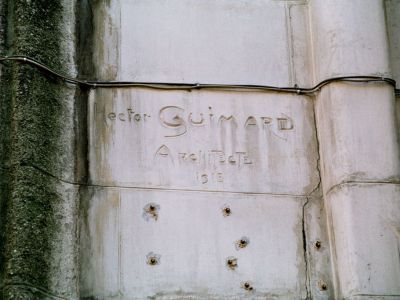
The Agoudas Hakehilos Synagogue, also known as the Pavée Synagogue, is a stunning Art Nouveau building located in the 4th arrondissement of Paris, originally commissioned by the Agoudas Hakehilos society, a group of Orthodox Jews primarily of Russian origin, to provide a spacious and modernized place for worship.
Designed by Hector Guimard, the architect known for his iconic Paris Metro entrances, the synagogue is his only religious building and his last major project before World War I. In creating the edifice, he employed reinforced concrete frames in tandem with hollow agglomerated stones. Completed in 1914, the synagogue boasts an elongated façade with continuous columns and elongated windows that emphasize its verticality.
The interior is vertically arranged as well, with two levels of galleries on each side of the nave to accommodate the lack of width. The furnishings and decorations are all creations of Guimard, displaying his signature stylized vegetal motifs and triangles. The benches, chandeliers, light fixtures, and cast iron railings are consistent with the ornate embellishments found on the building's façade.
Despite suffering damage during World War II, the synagogue has been restored and is now open to the public.
Designed by Hector Guimard, the architect known for his iconic Paris Metro entrances, the synagogue is his only religious building and his last major project before World War I. In creating the edifice, he employed reinforced concrete frames in tandem with hollow agglomerated stones. Completed in 1914, the synagogue boasts an elongated façade with continuous columns and elongated windows that emphasize its verticality.
The interior is vertically arranged as well, with two levels of galleries on each side of the nave to accommodate the lack of width. The furnishings and decorations are all creations of Guimard, displaying his signature stylized vegetal motifs and triangles. The benches, chandeliers, light fixtures, and cast iron railings are consistent with the ornate embellishments found on the building's façade.
Despite suffering damage during World War II, the synagogue has been restored and is now open to the public.
11) Rue des Rosiers (Rosebushes Street)
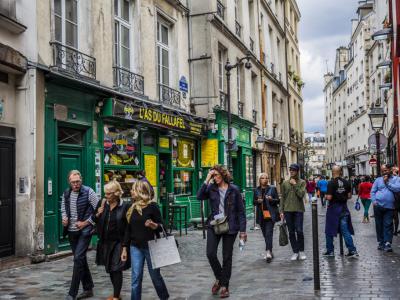
Paris's Rosebushes Street is steeped in history dating back to its construction along the Philippe Auguste ramparts around 1230. The street's name originates from the rose bushes that once adorned the neighboring gardens.
Spanning 303 meters, it serves as the central artery of Paris’s Jewish quarter, known colloquially as "the Pletzl" (or "little place" in Yiddish). Unique to this area, shops and cafés open on Sundays and holidays to accommodate the Jewish Sabbath on Saturday, drawing large crowds seeking its vibrant cultural offerings. Over the years, Rosebushes Street has been a sanctuary for the Jewish community, with significant numbers arriving between 1881 and 1914, fleeing persecution from Eastern Europe. This influx established a robust Ashkenazi presence, complemented by a lesser-known Sephardic community.
Historically, the street also bore signs of Christian worship, including a statue of the Virgin Mary that stood until the French Revolution. Architecturally, the street has managed to preserve its historical integrity, avoiding major changes during Baron Haussmann’s reconfiguration of Paris in the 19th century. Today, it proudly displays remnants of medieval fortifications, particularly in the park known as the Rose Garden – Joseph-Migneret.
Rosebushes Street today juxtaposes its rich historical past with modern influences. Renovations in 2007 enhanced the street's ambiance with new paving, lighting, and added greenery, while the creation of the Rose Garden – Joseph-Migneret park in 2014 introduced a public space incorporating several historic private gardens. Despite recent changes that have seen traditional Jewish shops replaced by fashionable boutiques, the street remains a culinary hotspot, famed for introducing falafel to France and hosting a competitive scene of restaurants specializing in this dish.
Spanning 303 meters, it serves as the central artery of Paris’s Jewish quarter, known colloquially as "the Pletzl" (or "little place" in Yiddish). Unique to this area, shops and cafés open on Sundays and holidays to accommodate the Jewish Sabbath on Saturday, drawing large crowds seeking its vibrant cultural offerings. Over the years, Rosebushes Street has been a sanctuary for the Jewish community, with significant numbers arriving between 1881 and 1914, fleeing persecution from Eastern Europe. This influx established a robust Ashkenazi presence, complemented by a lesser-known Sephardic community.
Historically, the street also bore signs of Christian worship, including a statue of the Virgin Mary that stood until the French Revolution. Architecturally, the street has managed to preserve its historical integrity, avoiding major changes during Baron Haussmann’s reconfiguration of Paris in the 19th century. Today, it proudly displays remnants of medieval fortifications, particularly in the park known as the Rose Garden – Joseph-Migneret.
Rosebushes Street today juxtaposes its rich historical past with modern influences. Renovations in 2007 enhanced the street's ambiance with new paving, lighting, and added greenery, while the creation of the Rose Garden – Joseph-Migneret park in 2014 introduced a public space incorporating several historic private gardens. Despite recent changes that have seen traditional Jewish shops replaced by fashionable boutiques, the street remains a culinary hotspot, famed for introducing falafel to France and hosting a competitive scene of restaurants specializing in this dish.
12) Musee Carnavalet (Paris History Museum)
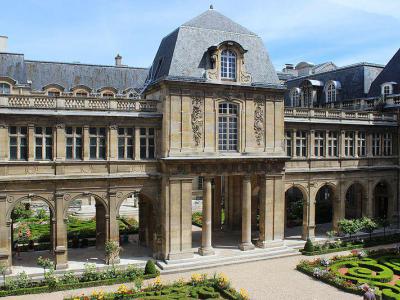
The Paris History Museum, outlining the city's evolution through the ages, is nestled in two historic mansions-the Hôtel Carnavalet and the Hôtel Le Peletier de Saint Fargeau.
The former, acquired by the Municipal Council of Paris in 1866, opened its doors to the public in 1880. By the end of the 20th century, the burgeoning collection necessitated expansion, leading to the acquisition, in 1989, of the Hôtel Le Peletier de Saint Fargeau, the former home of 17th-century writer Madame de Sévigné, which effectively doubled the museum's exhibition space.
This historic site underwent a significant renovation in 2016, reopening five years later with enhanced galleries and an expanded array of exhibits. Its collections are strategically displayed across more than 100 themed rooms, which guide visitors through different periods, starting from prehistoric Lutetia to the reigns of Henry IV and Louis XIV through to the artistic revolutions of the Enlightenment and further ahead to the dynamic scenes of modern Paris.
The museum houses over 625,000 objects, including 2,600 paintings, 20,000 drawings, 300,000 engravings, and 150,000 photographs, that provide a visual narrative of Parisian life throughout various epochs. It also houses some 2,000 modern sculptures and 800 pieces of furniture, thousands of ceramics, numerous decorations, shop signs, and countless other items, including souvenirs of famous personalities and archaeological fragments. Among the highlights are Neolithic artifacts, Roman-era discoveries, and a detailed depiction of medieval to Renaissance Paris.
Of particular interest are the exhibits related to the French Revolution, featuring detailed scale models of guillotines and a replica of the Bastille prison made from one of its original stones. Also featured is a reconstruction of Louis XVI's prison cell and personal mementos from his life, such as medallions containing locks of his family's hair. Additionally, visitors can marvel at impressive interior recreations spanning from the Middle Ages to the rococo period, as well as Art Nouveau, with highlights including the original furnishings of Café de Paris and the exquisite jewelry shop Fouquet.
The former, acquired by the Municipal Council of Paris in 1866, opened its doors to the public in 1880. By the end of the 20th century, the burgeoning collection necessitated expansion, leading to the acquisition, in 1989, of the Hôtel Le Peletier de Saint Fargeau, the former home of 17th-century writer Madame de Sévigné, which effectively doubled the museum's exhibition space.
This historic site underwent a significant renovation in 2016, reopening five years later with enhanced galleries and an expanded array of exhibits. Its collections are strategically displayed across more than 100 themed rooms, which guide visitors through different periods, starting from prehistoric Lutetia to the reigns of Henry IV and Louis XIV through to the artistic revolutions of the Enlightenment and further ahead to the dynamic scenes of modern Paris.
The museum houses over 625,000 objects, including 2,600 paintings, 20,000 drawings, 300,000 engravings, and 150,000 photographs, that provide a visual narrative of Parisian life throughout various epochs. It also houses some 2,000 modern sculptures and 800 pieces of furniture, thousands of ceramics, numerous decorations, shop signs, and countless other items, including souvenirs of famous personalities and archaeological fragments. Among the highlights are Neolithic artifacts, Roman-era discoveries, and a detailed depiction of medieval to Renaissance Paris.
Of particular interest are the exhibits related to the French Revolution, featuring detailed scale models of guillotines and a replica of the Bastille prison made from one of its original stones. Also featured is a reconstruction of Louis XVI's prison cell and personal mementos from his life, such as medallions containing locks of his family's hair. Additionally, visitors can marvel at impressive interior recreations spanning from the Middle Ages to the rococo period, as well as Art Nouveau, with highlights including the original furnishings of Café de Paris and the exquisite jewelry shop Fouquet.
13) Place des Vosges (Vosges Square) (must see)
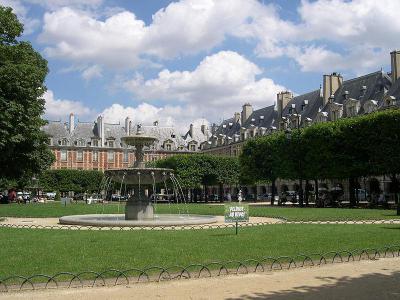
Vosges Square is the oldest planned square in Paris. Originally known as Royal Square, it was built from 1605 to 1612 under King Henri IV on the site of the complex of buildings demolished by Catherine de' Medici.
This 140-by-140-meter square was among Europe’s earliest examples of royal city planning, inspiring similar urban designs in cities across the continent. The square’s perfectly symmetrical layout features uniformly styled red brick facades with stone accents, vaulted arcades, and blue slate roofs with dormers. Of special note are the balconies, the first extended ones ever built in Paris. The northern and southern facades rise higher, with the so-called Pavilion of the King and Pavilion of the Queen marked by triple arches. Though no monarch resided there permanently, Anne of Austria briefly stayed in the Queen's Pavilion.
Originally celebrated with a grand event for the engagement of Louis XIII and Anne of Austria, Vosges Square became a prototype for aristocratic urban planning and was an elite address for Parisian nobility in the 17th and 18th centuries. Its reputation as a meeting place for the aristocracy continued until the French Revolution, after which the nobility largely relocated to the Faubourg Saint-Germain district.
The square’s name changed several times. During the French Revolution, it was briefly renamed “Weapons Manufacturing Square” and, in 1800, became Vosges Square in recognition of the Vosges department, the first to pay taxes supporting the Revolutionary army. Restoration of monarchs temporarily returned it to its original name, and in 1830 it briefly became “Republic Square”. Since 1870, the revolutionary name “Vosges Square” has remained.
Today, the square represents a well-manicured park with mature lindens and grass, surrounded by trimmed, shady trees, refreshing fountains, and sandy walkways. Boxed in by upscale properties, this elegant 17th-century garden is a bit of a hidden gem invisible to the outsiders. But locals know it all too well and gather here regularly on weekends, especially in summer.
Once home to notable figures like Victor Hugo, whose preserved residence is now a museum, the area’s allure is tied to its heritage. Ground floors house art shops, boutiques, and bohemian-style bars, offering a relaxed setting for a quick snack or drink. Diverse dining options, including kosher and ethnic cuisines, add to the charm, making it a favorite for history buffs, art enthusiasts, and casual visitors alike.
This 140-by-140-meter square was among Europe’s earliest examples of royal city planning, inspiring similar urban designs in cities across the continent. The square’s perfectly symmetrical layout features uniformly styled red brick facades with stone accents, vaulted arcades, and blue slate roofs with dormers. Of special note are the balconies, the first extended ones ever built in Paris. The northern and southern facades rise higher, with the so-called Pavilion of the King and Pavilion of the Queen marked by triple arches. Though no monarch resided there permanently, Anne of Austria briefly stayed in the Queen's Pavilion.
Originally celebrated with a grand event for the engagement of Louis XIII and Anne of Austria, Vosges Square became a prototype for aristocratic urban planning and was an elite address for Parisian nobility in the 17th and 18th centuries. Its reputation as a meeting place for the aristocracy continued until the French Revolution, after which the nobility largely relocated to the Faubourg Saint-Germain district.
The square’s name changed several times. During the French Revolution, it was briefly renamed “Weapons Manufacturing Square” and, in 1800, became Vosges Square in recognition of the Vosges department, the first to pay taxes supporting the Revolutionary army. Restoration of monarchs temporarily returned it to its original name, and in 1830 it briefly became “Republic Square”. Since 1870, the revolutionary name “Vosges Square” has remained.
Today, the square represents a well-manicured park with mature lindens and grass, surrounded by trimmed, shady trees, refreshing fountains, and sandy walkways. Boxed in by upscale properties, this elegant 17th-century garden is a bit of a hidden gem invisible to the outsiders. But locals know it all too well and gather here regularly on weekends, especially in summer.
Once home to notable figures like Victor Hugo, whose preserved residence is now a museum, the area’s allure is tied to its heritage. Ground floors house art shops, boutiques, and bohemian-style bars, offering a relaxed setting for a quick snack or drink. Diverse dining options, including kosher and ethnic cuisines, add to the charm, making it a favorite for history buffs, art enthusiasts, and casual visitors alike.
