Custom Walk in Malaga, Spain by denhumphrey_22f54c created on 2026-04-07
Guide Location: Spain » Malaga
Guide Type: Custom Walk
# of Sights: 6
Tour Duration: 1 Hour(s)
Travel Distance: 2.2 Km or 1.4 Miles
Share Key: YJCUZ
Guide Type: Custom Walk
# of Sights: 6
Tour Duration: 1 Hour(s)
Travel Distance: 2.2 Km or 1.4 Miles
Share Key: YJCUZ
How It Works
Please retrieve this walk in the GPSmyCity app. Once done, the app will guide you from one tour stop to the next as if you had a personal tour guide. If you created the walk on this website or come to the page via a link, please follow the instructions below to retrieve the walk in the app.
Retrieve This Walk in App
Step 1. Download the app "GPSmyCity: Walks in 1K+ Cities" on Apple App Store or Google Play Store.



Step 2. In the GPSmyCity app, download(or launch) the guide "Malaga Map and Walking Tours".
Step 3. Tap the menu button located at upper right corner of the "Walks" screen and select "Retrieve custom walk". Enter the share key: YJCUZ

1) Plaza y Acera de La Marina (Marina Square and Sidewalk)
Spanish sculptor Jaime Fernández Pimentel wanted to memorialize “Diego,” a cenachero-a traditional fish seller who carried baskets-who worked in front of Jaime’s childhood home on Carretería Street. Although cenacheros no longer exist, Jaime’s statue of Diego stands today as a lasting symbol of Málaga, located in Marina Square.
Marina Square and the adjoining waterfront promenade form part of Málaga’s long effort to reconnect the historic city with the sea. For much of the 19th and 20th centuries, this stretch of coastline functioned primarily as a working port, separated from the urban centre by busy roads and port infrastructure. This changed in the early 21st century, when Málaga undertook a major redevelopment of its port front, transforming former docklands into open civic space.
Today, Marina Square acts as a natural transition point between the old city streets and the modern promenade. From here, wide pedestrian paths lead toward the sea, passing landscaped areas and shaded walkways. The promenade offers clear views back toward the city skyline, with the Alcazaba and Gibralfaro fortresses rising above the harbour, and outward toward the open bay.
The flat, spacious sidewalks make the square ideal for walking at a relaxed pace, while benches and palm-lined sections invite short pauses to watch the yachts, cruise ships, and the changing light over the bay. Public art installations and seasonal events occasionally animate the space.
Marina Square and the adjoining waterfront promenade form part of Málaga’s long effort to reconnect the historic city with the sea. For much of the 19th and 20th centuries, this stretch of coastline functioned primarily as a working port, separated from the urban centre by busy roads and port infrastructure. This changed in the early 21st century, when Málaga undertook a major redevelopment of its port front, transforming former docklands into open civic space.
Today, Marina Square acts as a natural transition point between the old city streets and the modern promenade. From here, wide pedestrian paths lead toward the sea, passing landscaped areas and shaded walkways. The promenade offers clear views back toward the city skyline, with the Alcazaba and Gibralfaro fortresses rising above the harbour, and outward toward the open bay.
The flat, spacious sidewalks make the square ideal for walking at a relaxed pace, while benches and palm-lined sections invite short pauses to watch the yachts, cruise ships, and the changing light over the bay. Public art installations and seasonal events occasionally animate the space.
2) Plaza del Obispo de Malaga (Bishop's Square)
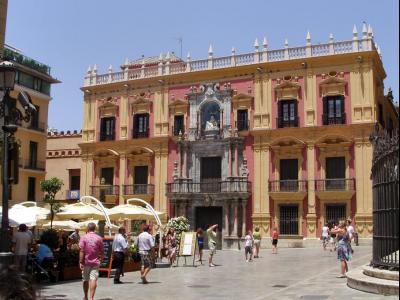
The Bishop's Square (Plaza del Obispo) is a historic and architectural gem in the heart of Malaga. Situated in front of the main façade of the Cathedral of Malaga, famously known as La Manquita, and adjacent to the Episcopal Palace, this square forms a striking ensemble of Baroque artistry.
The origins of the square may date back to Malaga's Muslim period, but its current appearance was shaped during the 18th century, with the completion of the cathedral's main façade and the episcopal palace. In the late 20th century, significant renovations were undertaken, including the restoration of some of its surrounding buildings. These works also unearthed remnants of late Roman and Byzantine walls, highlighting the square's deep historical layers.
At the center of the square is a fountain dating to 1785, a masterpiece of grey marble that complements the façade of the Episcopal Palace. The fountain features two elegant basins and a pineapple-shaped top from which water flows. Originally designed to provide water to residents via the San Telmo aqueduct, it remains an iconic feature. A 1998 restoration removed the planter surrounding the fountain, replacing it with a stone base for improved accessibility and aesthetics.
The Episcopal Palace, initiated in 1762, dominates the square with its striking Baroque design. Across the square, the Cathedral of Malaga rises with its majestic marble façade and staircase leading down to the square, separated by an ornate gate. The harmonious interplay between these structures makes Bishop's Square one of Málaga's most visually compelling spaces.
Renowned as Malaga’s Baroque centerpiece, the Bishop's Square has also served as a cinematic setting. It notably appeared in the 2004 feature film The Bridge of San Luis Rey (El Puente de San Luis Rey), which portrayed an 18th-century city in colonial Peru.
With its historical charm, architectural grandeur, and cultural significance, the Bishop's Square remains a must-visit site, offering a glimpse into Malaga's rich history and artistic heritage.
The origins of the square may date back to Malaga's Muslim period, but its current appearance was shaped during the 18th century, with the completion of the cathedral's main façade and the episcopal palace. In the late 20th century, significant renovations were undertaken, including the restoration of some of its surrounding buildings. These works also unearthed remnants of late Roman and Byzantine walls, highlighting the square's deep historical layers.
At the center of the square is a fountain dating to 1785, a masterpiece of grey marble that complements the façade of the Episcopal Palace. The fountain features two elegant basins and a pineapple-shaped top from which water flows. Originally designed to provide water to residents via the San Telmo aqueduct, it remains an iconic feature. A 1998 restoration removed the planter surrounding the fountain, replacing it with a stone base for improved accessibility and aesthetics.
The Episcopal Palace, initiated in 1762, dominates the square with its striking Baroque design. Across the square, the Cathedral of Malaga rises with its majestic marble façade and staircase leading down to the square, separated by an ornate gate. The harmonious interplay between these structures makes Bishop's Square one of Málaga's most visually compelling spaces.
Renowned as Malaga’s Baroque centerpiece, the Bishop's Square has also served as a cinematic setting. It notably appeared in the 2004 feature film The Bridge of San Luis Rey (El Puente de San Luis Rey), which portrayed an 18th-century city in colonial Peru.
With its historical charm, architectural grandeur, and cultural significance, the Bishop's Square remains a must-visit site, offering a glimpse into Malaga's rich history and artistic heritage.
3) Museo Picasso Málaga (Picasso Museum) (must see)
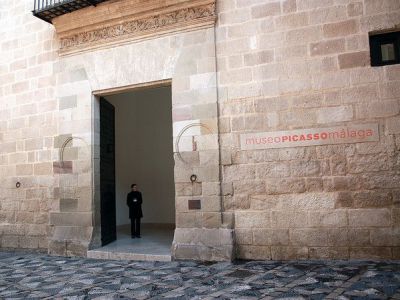
The Picasso Museum is rooted directly in the city where Pablo Picasso was born in 1881 and occupies the Buenavista Palace, a 16th-century aristocratic residence in Málaga’s historic centre.
Picasso’s father, José Ruiz, served as curator of Málaga’s city museum, which operated under tight budgets and was rarely open to the public. As part of his compensation, Ruiz was granted exclusive use of a room as an art studio, where the young Pablo made his earliest sketches under his father’s guidance. Although Picasso would later be represented by major museums in Paris and Barcelona, the Málaga museum holds particular significance: it stands only a short walk from Merced Square, where he was born.
The idea of establishing a Picasso museum in Málaga circulated for decades before becoming a reality in the early 21st century, driven by the artist’s family. The museum opened in 2003, following a substantial donation of works from Christine and Bernard Ruiz-Picasso, with the official inauguration attended by the King and Queen of Spain.
Rather than concentrating on a single period, the collection traces Picasso’s artistic evolution across his entire career. Typically organised chronologically across 11 galleries, it begins with Picasso’s early academic works, led by the 1895 painting Portrait of a Bearded Man. The rooms dedicated to his Neoclassical period contain one of the museum’s crown jewels-the 1923 painting The Three Graces. Toward the end of the circuit, visitors encounter Picasso’s works from the 1970s, which are noticeably more colourful and expressive. Temporary exhibitions regularly place the artist’s work in dialogue with other creators and themes.
Beneath the palace lie archaeological remains, including partially preserved structures from a Nasrid palace alongside earlier Roman traces. Visitors can walk on glass walkways over 2,500-year-old city walls and the remains of a Roman fish-salting factory. One of the main highlights of the basement level is the Phoenician wall dating from the 7th and 8th centuries BC. The archaeological site is accessible via staircases or an elevator.
The institution also houses an archive of documents and photographs, as well as a specialised library containing more than 14,000 titles devoted to Picasso.
Picasso’s father, José Ruiz, served as curator of Málaga’s city museum, which operated under tight budgets and was rarely open to the public. As part of his compensation, Ruiz was granted exclusive use of a room as an art studio, where the young Pablo made his earliest sketches under his father’s guidance. Although Picasso would later be represented by major museums in Paris and Barcelona, the Málaga museum holds particular significance: it stands only a short walk from Merced Square, where he was born.
The idea of establishing a Picasso museum in Málaga circulated for decades before becoming a reality in the early 21st century, driven by the artist’s family. The museum opened in 2003, following a substantial donation of works from Christine and Bernard Ruiz-Picasso, with the official inauguration attended by the King and Queen of Spain.
Rather than concentrating on a single period, the collection traces Picasso’s artistic evolution across his entire career. Typically organised chronologically across 11 galleries, it begins with Picasso’s early academic works, led by the 1895 painting Portrait of a Bearded Man. The rooms dedicated to his Neoclassical period contain one of the museum’s crown jewels-the 1923 painting The Three Graces. Toward the end of the circuit, visitors encounter Picasso’s works from the 1970s, which are noticeably more colourful and expressive. Temporary exhibitions regularly place the artist’s work in dialogue with other creators and themes.
Beneath the palace lie archaeological remains, including partially preserved structures from a Nasrid palace alongside earlier Roman traces. Visitors can walk on glass walkways over 2,500-year-old city walls and the remains of a Roman fish-salting factory. One of the main highlights of the basement level is the Phoenician wall dating from the 7th and 8th centuries BC. The archaeological site is accessible via staircases or an elevator.
The institution also houses an archive of documents and photographs, as well as a specialised library containing more than 14,000 titles devoted to Picasso.
4) Teatro Romano (Roman Theatre)
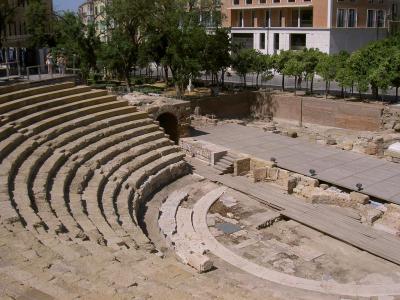
The Roman Theatre of Málaga is one of the city’s most important archaeological remains and a clear reminder of its Roman past. It was built in the early 1st century AD, during the reign of Emperor Augustus, when Málaga was a prosperous Roman municipium within the province of Hispania Baetica. Set at the foot of the Alcazaba hill, close to the ancient harbour, the theatre hosted dramatic performances and public gatherings. The seating area was carefully integrated into the slope of the hillside: the semicircular enclosure has a radius of about 31 metres, reaches a height of roughly 16 metres, and is divided by aisles to organise spectators. In front of it lies the orchestra, a semicircular space about 15 metres wide where performances were staged.
After the decline of Roman rule, the theatre gradually fell out of use and was buried beneath later structures. During the Islamic period, some of its stone was reused in the construction of the Alcazaba above, and in the 20th century the site was covered by a cultural centre. The theatre came back to light only in 1951, during redevelopment works, prompting systematic excavations that revealed its overall form, including seating tiers, sections of the stage, and surviving fragments of original walls. Much of what visitors see today is a careful reconstruction that outlines the ancient structure. Excavation is still ongoing, and signs of a larger Roman complex around the theatre continue to emerge.
A modern interpretation centre, inaugurated in 2010, offers audiovisual presentations explaining Roman Málaga and displaying objects uncovered during excavations.
After the decline of Roman rule, the theatre gradually fell out of use and was buried beneath later structures. During the Islamic period, some of its stone was reused in the construction of the Alcazaba above, and in the 20th century the site was covered by a cultural centre. The theatre came back to light only in 1951, during redevelopment works, prompting systematic excavations that revealed its overall form, including seating tiers, sections of the stage, and surviving fragments of original walls. Much of what visitors see today is a careful reconstruction that outlines the ancient structure. Excavation is still ongoing, and signs of a larger Roman complex around the theatre continue to emerge.
A modern interpretation centre, inaugurated in 2010, offers audiovisual presentations explaining Roman Málaga and displaying objects uncovered during excavations.
5) Alcazaba of Malaga (Malaga Fortress) (must see)
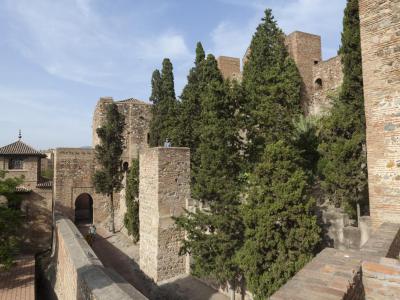
The Málaga Fortress, commonly known as the Alcazaba, is a defining reminder of the city’s Islamic past. Built in the 11th century during Muslim rule in al-Andalus, it functioned both as a military stronghold and as a residence for governors. Its commanding position above the old city and port allowed control over maritime traffic and inland routes. The complex was expanded and reinforced over time, particularly under the Nasrid dynasty, before being taken by the Catholic Monarchs in 1487 after one of the longest sieges of the Reconquest. King Ferdinand II and Queen Isabella I entered the fortress and raised their royal standard on the Tower of Tribute, a moment often cited as a turning point in the formation of unified Spain.
The fortress is organised as a carefully layered defensive system. Access to the outer enclosure is gained through the Vault Gate, designed with a sharp double-back turn intended to slow and expose intruders-though today visitors can bypass this ascent using an elevator located on Guillén Sotelo Street, behind the City Hall. From the Vault Gate, a rising path leads past gardens and ornate fountains to the Gate of Columns. After passing through the Gate of Columns, the path opens to the left toward the Christ Gate. Once through this gate, you enter the Parade Ground. Here, on the opposite side of the Christ Gate, the Gate of the Granada Quarters leads toward the palatial heart of the Alcazaba.
Beyond the Gate of the Granada Quarters lies the Courtyard of the Jets. On the western side of the courtyard, the 11th-century Taifa Palace comes into view. Its defining feature is the Southern Pavilion, which displays Caliphal-style horseshoe arches of particular elegance.
Moving to the northwestern side of the Courtyard of the Jets brings you into the Orange Tree Courtyard-a quiet space that once served as the entrance hall to the palaces. Continuing north, you encounter the more delicate architecture of the 13th-century Nasrid period. This section is centred around the Pool Palace, where a long reflecting pool and finely carved plaster arches define the space. The rooms surrounding this courtyard now house a small Archaeological Museum, displaying Moorish ceramics and artefacts uncovered during excavations.
The fortress is organised as a carefully layered defensive system. Access to the outer enclosure is gained through the Vault Gate, designed with a sharp double-back turn intended to slow and expose intruders-though today visitors can bypass this ascent using an elevator located on Guillén Sotelo Street, behind the City Hall. From the Vault Gate, a rising path leads past gardens and ornate fountains to the Gate of Columns. After passing through the Gate of Columns, the path opens to the left toward the Christ Gate. Once through this gate, you enter the Parade Ground. Here, on the opposite side of the Christ Gate, the Gate of the Granada Quarters leads toward the palatial heart of the Alcazaba.
Beyond the Gate of the Granada Quarters lies the Courtyard of the Jets. On the western side of the courtyard, the 11th-century Taifa Palace comes into view. Its defining feature is the Southern Pavilion, which displays Caliphal-style horseshoe arches of particular elegance.
Moving to the northwestern side of the Courtyard of the Jets brings you into the Orange Tree Courtyard-a quiet space that once served as the entrance hall to the palaces. Continuing north, you encounter the more delicate architecture of the 13th-century Nasrid period. This section is centred around the Pool Palace, where a long reflecting pool and finely carved plaster arches define the space. The rooms surrounding this courtyard now house a small Archaeological Museum, displaying Moorish ceramics and artefacts uncovered during excavations.
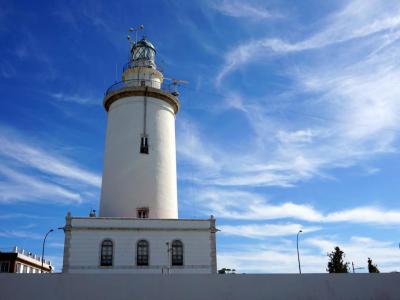
6) La Farola
The La Farola is a 21.64 meter high lighthouse in Malaga that towers above the harbor. The name is unique because lighthouses are generally called El Faro in Spain using the masculine gender rather than La Farola, the feminine gender as used in the name of the Malaga lighthouse.
The La Farola was designed by army engineer, Joaquin. M Pery y Guzman and built in 1817. It replaced an earlier lighthouse built at the location in 1724. A four meter extension was added at the top of the lighthouse in 1885 and a new lighting device was installed. The structure was damaged during the earthquake of 1898. It was repaired again between 1909 and 1913 with the help of engineer, Mauro Serret and an additional structure to accommodate the family of the lighthouse keeper was added. The lighthouse was damaged during the Spanish Civil War and restored again in 1939. Today, it is being remodeled to accommodate a museum dedicated to the port of Malaga.
Today, La Farola serves the port and air traffic. The light gives 3+1 flashes every 20 seconds. Visitors can reach the lighthouse by bus and by taxi and enjoy spectacular views of the Mediterranean Sea and the port of Malaga from the building.
The La Farola was designed by army engineer, Joaquin. M Pery y Guzman and built in 1817. It replaced an earlier lighthouse built at the location in 1724. A four meter extension was added at the top of the lighthouse in 1885 and a new lighting device was installed. The structure was damaged during the earthquake of 1898. It was repaired again between 1909 and 1913 with the help of engineer, Mauro Serret and an additional structure to accommodate the family of the lighthouse keeper was added. The lighthouse was damaged during the Spanish Civil War and restored again in 1939. Today, it is being remodeled to accommodate a museum dedicated to the port of Malaga.
Today, La Farola serves the port and air traffic. The light gives 3+1 flashes every 20 seconds. Visitors can reach the lighthouse by bus and by taxi and enjoy spectacular views of the Mediterranean Sea and the port of Malaga from the building.
