Custom Walk in Lecce, Italy by stsh001_43e643 created on 2026-04-25
Guide Location: Italy » Lecce
Guide Type: Custom Walk
# of Sights: 14
Tour Duration: 3 Hour(s)
Travel Distance: 4.6 Km or 2.9 Miles
Share Key: 2FQ2V
Guide Type: Custom Walk
# of Sights: 14
Tour Duration: 3 Hour(s)
Travel Distance: 4.6 Km or 2.9 Miles
Share Key: 2FQ2V
How It Works
Please retrieve this walk in the GPSmyCity app. Once done, the app will guide you from one tour stop to the next as if you had a personal tour guide. If you created the walk on this website or come to the page via a link, please follow the instructions below to retrieve the walk in the app.
Retrieve This Walk in App
Step 1. Download the app "GPSmyCity: Walks in 1K+ Cities" on Apple App Store or Google Play Store.



Step 2. In the GPSmyCity app, download(or launch) the guide "Lecce Map and Walking Tours".
Step 3. Tap the menu button located at upper right corner of the "Walks" screen and select "Retrieve custom walk". Enter the share key: 2FQ2V
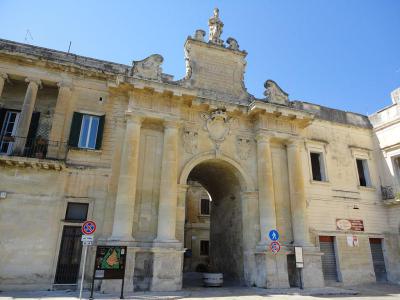
1) Porta San Biagio (St. Biagio Gate)
San Biagio Gate is one of the three historic gates providing access to the ancient heart of the city. It is named after Saint Biagio, the 4th-century bishop of Sebaste in Armenia who was originally born in Lecce. It was rebuilt in 1774 on the site of an earlier medieval gate commissioned by Charles V. The gate’s reconstruction is noted by a Latin inscription crowning the structure.
Designed in the distinctive Barocco Leccese style, San Biagio Gate features pairs of smooth columns resting on tall bases and is adorned with the coats of arms of King Ferdinand IV of Naples and the city of Lecce. A statue of Saint Biagio, dressed as a bishop, adds a spiritual touch to the gate’s decoration.
Standing approximately 17.3 meters high, the gate historically regulated access to the city, protecting it from potential invasions by barbarians and pirates. Both its exterior and interior facades display artistic details that invite careful observation, reflecting Lecce’s rich architectural heritage.
Designed in the distinctive Barocco Leccese style, San Biagio Gate features pairs of smooth columns resting on tall bases and is adorned with the coats of arms of King Ferdinand IV of Naples and the city of Lecce. A statue of Saint Biagio, dressed as a bishop, adds a spiritual touch to the gate’s decoration.
Standing approximately 17.3 meters high, the gate historically regulated access to the city, protecting it from potential invasions by barbarians and pirates. Both its exterior and interior facades display artistic details that invite careful observation, reflecting Lecce’s rich architectural heritage.
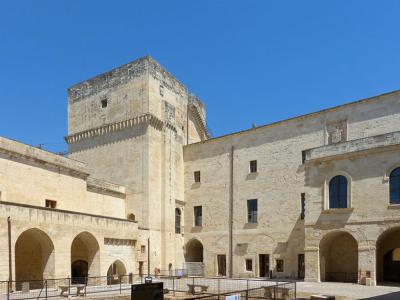
2) Castello Carlo V (Castle of Charles V)
Digging around the courtyard, archaeologists discovered that Lecce’s Castle of Charles V began life as a humble 12th-century Norman stronghold. Next, 1537, and Emperor Charles V himself (when he wasn’t busy running half of Europe) ordered a fortress face-lift. By 1553, architect Gian Giacomo dell’Acaya had woven the old keep into a new curtain wall linking four stout bastions. Today, the Master Tower and the Show Tower still stand guard-silent sentinels of ramparts long vanished.
In the transformation, the medieval chapel of the Trinity got modified to make way for cannon openings, and one cozy room even moonlighted as an 18th-century theater. From 1870 to 1979, the castle put on its uniform and oversaw the surroundings as a military post. Now it’s shed its martial past to become Lecce’s cultural nerve center. The grand Palace Hall dazzles with stained-glass windows, while upper chambers lean on stone columns like proud athletes.
Legend has it the 14th-century Orsini del Balzo clan kept a white bear in the moat-probably more myth than beast, but hey, “Orsini” does mean “little bear,” so maybe someone just had a very ambitious pet. Either way, today’s Castle of Charles V invites you to a concert, exhibition, or lecture. It’s proof that even the mightiest fortress can soften into the town’s favorite gathering spot.
In the transformation, the medieval chapel of the Trinity got modified to make way for cannon openings, and one cozy room even moonlighted as an 18th-century theater. From 1870 to 1979, the castle put on its uniform and oversaw the surroundings as a military post. Now it’s shed its martial past to become Lecce’s cultural nerve center. The grand Palace Hall dazzles with stained-glass windows, while upper chambers lean on stone columns like proud athletes.
Legend has it the 14th-century Orsini del Balzo clan kept a white bear in the moat-probably more myth than beast, but hey, “Orsini” does mean “little bear,” so maybe someone just had a very ambitious pet. Either way, today’s Castle of Charles V invites you to a concert, exhibition, or lecture. It’s proof that even the mightiest fortress can soften into the town’s favorite gathering spot.
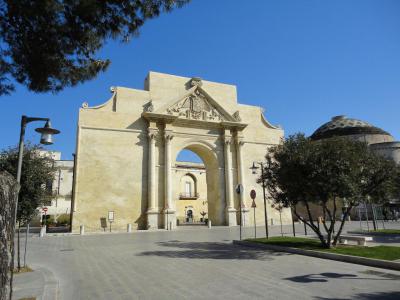
3) Porta Napoli (Naples Gate)
They call it the Naples Gate, but locals consider it the Arch of Triumph-the ultimate starting line for your Baroque adventure through Lecce’s maze of alleys and plazas. Built in 1548 by the celebrated Gian Giacomo-a military engineer and architect best known for fortifying southern Italy against Ottoman attacks. This 66-foot-tall triumphal gateway was Charles V’s way of high-fiving his own greatness after booting the Turks back east. With two Corinthian pillars flexing support under a giant triangular pediment, it’s decked out in carvings of armor, weapons, and the Habsburg-Spanish coat of arms-because what’s a victory arch without a little coat-of-arms flex?
Stroll to the far end of Arch of Triumph Square and you’ll meet its long-lost cousin: the Obelisk of Ferdinand I, planted in 1922 to honor the King of the Two Sicilies. Its sides sport bas-reliefs of mythic beasts-think a moon-munching dolphin-that prove Lecce has been mixing history and a dash of whimsy for centuries.
So, if you're in the neighborhood, don't be shy – let the arch embrace you, strike your best Imperial pose, and may Lecce’s golden stones escort you on a journey where every corner holds a story.
Stroll to the far end of Arch of Triumph Square and you’ll meet its long-lost cousin: the Obelisk of Ferdinand I, planted in 1922 to honor the King of the Two Sicilies. Its sides sport bas-reliefs of mythic beasts-think a moon-munching dolphin-that prove Lecce has been mixing history and a dash of whimsy for centuries.
So, if you're in the neighborhood, don't be shy – let the arch embrace you, strike your best Imperial pose, and may Lecce’s golden stones escort you on a journey where every corner holds a story.
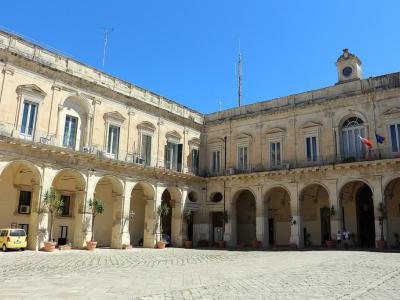
4) Palazzo dei Celestini (Palace of the Celestines)
Once home to the cloistered Celestine fathers-an ascetic branch of the Benedictines known for their strict devotion and love of solitude-for three whole centuries, this grand edifice is now Lecce’s Government Palace-a title that sounds far less poetic than its origins as the Palace of the Celestines.
Back in 1352, Gualtieri VI of Brienne, Count of Lecce and Duke of Athens, laid the monastery’s first stones. A bit later, in 1549, Holy Roman Emperor Charles V decided the old convent needed to make way for beefed-up city walls. Architect Gabriele Riccardi stepped in with a bold new design, but the building we see today didn’t reach its full Baroque glory until much later-finished in 1695 by Giuseppe Zimbalo, the same artist who had just wrapped up work on the stunning Basilica of the Holy Cross.
Zimbalo’s vision was a façade sculpted from golden Lecce limestone, trimmed with lance-tipped window crowns and swirling cornice friezes, perfectly echoing the basilica next door. Today, the former Celestine retreat presides over Lecce’s civic life, its lavish stonework reminding us that even government buildings deserve a little divine inspiration.
Back in 1352, Gualtieri VI of Brienne, Count of Lecce and Duke of Athens, laid the monastery’s first stones. A bit later, in 1549, Holy Roman Emperor Charles V decided the old convent needed to make way for beefed-up city walls. Architect Gabriele Riccardi stepped in with a bold new design, but the building we see today didn’t reach its full Baroque glory until much later-finished in 1695 by Giuseppe Zimbalo, the same artist who had just wrapped up work on the stunning Basilica of the Holy Cross.
Zimbalo’s vision was a façade sculpted from golden Lecce limestone, trimmed with lance-tipped window crowns and swirling cornice friezes, perfectly echoing the basilica next door. Today, the former Celestine retreat presides over Lecce’s civic life, its lavish stonework reminding us that even government buildings deserve a little divine inspiration.
5) Basilica di Santa Croce (Basilica of the Holy Cross) (must see)
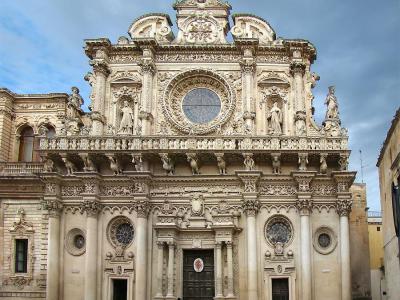
By the 16th century, Lecce’s blueprint for holy real estate was simple: clear out the Jewish neighborhood, lay the stones for a grand church, and call it progress. Back in 1510, the city’s Jews were unceremoniously shown the door-and by 1549, architects and stone masons were on the job, creating a new basilica for the venerable Celestine monastery next door.
The architects in charge took their sweet time, tacking on Baroque flourishes for well over a century. Finally, in 1699, the Basilica of the Holy Cross unveiled its riotously ornate façade: six sleek columns flanking the portal, topped by a frieze bristling with fantastical beasts and exotic foliage. Keep an eye out for the heraldic cameos-Philip III of Spain, Mary of Enghien, Walter VI of Brienne (all kings and queens)-and even the hefty visages of captured Turks propping up the decorative band.
Step inside, and you’ll find a Latin-cross layout with three central aisles (two side lanes now chapels) and a 1590 dome that’s stubbornly resisted every earthquake. Sixteen Baroque altars gleam in the glow-none more show-stopping than the 1615 masterpiece to Saint Francis of Paola, tucked into the left transept like the city’s most precious keepsake. Paintings of shepherds adoring, Mary annunciating, and the flight into Egypt line the walls, while the wooden ceiling-rebuilt in 1800-arches overhead.
In Lecce, even a church tells a century-long story of ambition, artistry, and a dash of architectural one-upmanship.
The architects in charge took their sweet time, tacking on Baroque flourishes for well over a century. Finally, in 1699, the Basilica of the Holy Cross unveiled its riotously ornate façade: six sleek columns flanking the portal, topped by a frieze bristling with fantastical beasts and exotic foliage. Keep an eye out for the heraldic cameos-Philip III of Spain, Mary of Enghien, Walter VI of Brienne (all kings and queens)-and even the hefty visages of captured Turks propping up the decorative band.
Step inside, and you’ll find a Latin-cross layout with three central aisles (two side lanes now chapels) and a 1590 dome that’s stubbornly resisted every earthquake. Sixteen Baroque altars gleam in the glow-none more show-stopping than the 1615 masterpiece to Saint Francis of Paola, tucked into the left transept like the city’s most precious keepsake. Paintings of shepherds adoring, Mary annunciating, and the flight into Egypt line the walls, while the wooden ceiling-rebuilt in 1800-arches overhead.
In Lecce, even a church tells a century-long story of ambition, artistry, and a dash of architectural one-upmanship.
6) Museo Ebraico di Lecce (Lecce Jewish Museum)
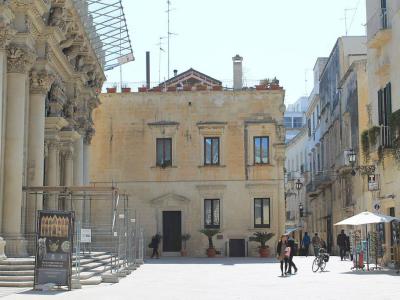
Long before Lecce was showing off its Baroque brilliance, it was home to a vibrant medieval Jewish community. You can still trace that story at the Jewish Museum of Lecce, located on the ground floor of what’s now called Palazzo Taurino. The building’s history is a bit like a historical layer cake: in 1589, Bergamo merchant Marco Trono expanded his home over the ruins of the Church of the Annunciation, which itself had been built on top of a medieval synagogue. Real estate doesn’t get much more layered than that.
The museum came to life after a careful restoration by Bruno Taurino, who uncovered archaeological remains from the old Jewish quarter while renovating the property. Inside, you’ll find mikveh pools once used for ritual bathing, a stone doorframe that held a mezuzah, and a clever 3D model that maps out the vanished Jewish neighborhood beneath today’s Baroque streets. It’s a before-and-after like no other.
But this place isn’t just about silent artifacts behind glass. Since opening, the museum has become an active hub, offering guided tours, workshops, and themed walks that revive centuries of Jewish life in Lecce-from the early presence in the 9th century all the way to the tragic expulsion and pogrom of 1496. If you’re curious about the city’s lesser-known layers, the Jewish Museum offers a rare and moving glimpse into a chapter Baroque Lecce nearly paved over.
The museum came to life after a careful restoration by Bruno Taurino, who uncovered archaeological remains from the old Jewish quarter while renovating the property. Inside, you’ll find mikveh pools once used for ritual bathing, a stone doorframe that held a mezuzah, and a clever 3D model that maps out the vanished Jewish neighborhood beneath today’s Baroque streets. It’s a before-and-after like no other.
But this place isn’t just about silent artifacts behind glass. Since opening, the museum has become an active hub, offering guided tours, workshops, and themed walks that revive centuries of Jewish life in Lecce-from the early presence in the 9th century all the way to the tragic expulsion and pogrom of 1496. If you’re curious about the city’s lesser-known layers, the Jewish Museum offers a rare and moving glimpse into a chapter Baroque Lecce nearly paved over.
7) Piazza Sant'Oronzo (St. Orontius Square) (must see)
Welcome to St. Orontius Square, Lecce’s very own “all-you-can-feast” buffet of food, wine, music, and people-watching-truly the city’s beating heart. You can arrive here via practically any road or, if you’re feeling dramatic, pass under one of the ancient gates-Napoli, Rudiae, or San Biagio-and step straight into the action.
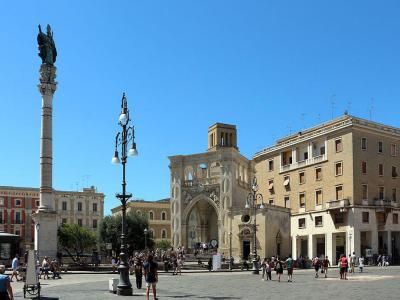
Look around: beneath your feet lies the mosaic “Oval,” laid in 1930 by Giuseppe Nicolardi (artisan at heart), flaunting Lecce’s coat of arms-a she-wolf under a holm oak. Locals treat it like sacred ground, hopping over it rather than risk the she-wolf’s anger. Half-buried under the elegant Church of Holy Mary of Grace, peek the arches of the Roman Amphitheater-a stage that’s been hiding in plain sight since the days of Emperors Hadrian and Augustus in the 2nd century AD. Flanking the square are contrasting palaces-one a monument to Fascist Rationalism, another the graceful “Seat of Venice”-and at its center, the bronze Saint Oronzo, Lecce’s patron saint, stranded atop a 95-foot Roman column since 1739, still blessing the Carafa Palace and the entire city he once saved from the plague of 1656.
Saint Orontius Square is the perfect launchpad to discover the wonders of Lecce. Just remember: don’t step on the oval, do raise your glass to Saint Oronzo, and savor every golden-hued moment in Lecce’s grandest gathering place.
Look around: beneath your feet lies the mosaic “Oval,” laid in 1930 by Giuseppe Nicolardi (artisan at heart), flaunting Lecce’s coat of arms-a she-wolf under a holm oak. Locals treat it like sacred ground, hopping over it rather than risk the she-wolf’s anger. Half-buried under the elegant Church of Holy Mary of Grace, peek the arches of the Roman Amphitheater-a stage that’s been hiding in plain sight since the days of Emperors Hadrian and Augustus in the 2nd century AD. Flanking the square are contrasting palaces-one a monument to Fascist Rationalism, another the graceful “Seat of Venice”-and at its center, the bronze Saint Oronzo, Lecce’s patron saint, stranded atop a 95-foot Roman column since 1739, still blessing the Carafa Palace and the entire city he once saved from the plague of 1656.
Saint Orontius Square is the perfect launchpad to discover the wonders of Lecce. Just remember: don’t step on the oval, do raise your glass to Saint Oronzo, and savor every golden-hued moment in Lecce’s grandest gathering place.
8) Anfiteatro Romano di Lecce (Roman Amphitheater of Lecce) (must see)
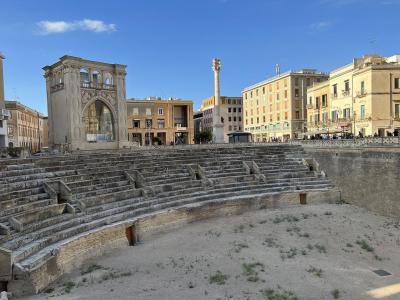
Right in the beating heart of Lecce’s Saint Orontius Square, you’ll stumble upon what looks like a half-hidden time capsule: the Roman Amphitheater of Lupiae. Imagine dusting off your morning espresso only to find you’re standing atop the ancient stage for gladiator brawls and lion-versus-man spectacles. Unearthed quite by accident in 1906-when builders digging for a bank vault hit marble instead of cashier’s drawers-this arena most likely dates from Emperor Augustus’s golden era, with Hadrian later tossing in a stately portico for good measure.
By the 11th century, the amphitheater’s glory days had faded, and locals liberally repurposed its stones for city walls-and rumor has it, even parts of Lecce stone ended up in the Cathedral of Otranto. By the 15th century, its remaining above-ground bits were folded into the foundations of the Island of the Governor complex. Yet when stripped back to its original oval-335 feet by 269 feet-you can still picture 15,000 cheering fans packed into tiered seating, peering down through 24 of the original 68 arches.
Today, the Amphitheater of Lupiae enjoys a peaceful second act. Its sun-baked limestone steps and radial tunnels now host concerts, theater, and festivals rather than chariot races. Ever since its designation as an Italian “National Monument” on February 1, 1906, this slice of antiquity has proven that sometimes the best way to experience Rome is not in Rome at all-but right here in Lecce, where ancient stones and modern stage lights share the spotlight.
By the 11th century, the amphitheater’s glory days had faded, and locals liberally repurposed its stones for city walls-and rumor has it, even parts of Lecce stone ended up in the Cathedral of Otranto. By the 15th century, its remaining above-ground bits were folded into the foundations of the Island of the Governor complex. Yet when stripped back to its original oval-335 feet by 269 feet-you can still picture 15,000 cheering fans packed into tiered seating, peering down through 24 of the original 68 arches.
Today, the Amphitheater of Lupiae enjoys a peaceful second act. Its sun-baked limestone steps and radial tunnels now host concerts, theater, and festivals rather than chariot races. Ever since its designation as an Italian “National Monument” on February 1, 1906, this slice of antiquity has proven that sometimes the best way to experience Rome is not in Rome at all-but right here in Lecce, where ancient stones and modern stage lights share the spotlight.
9) Chiesa di Sant'Irene (Saint Irene Church)
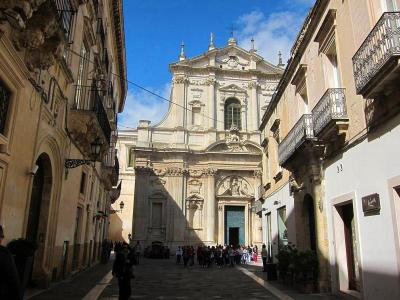
The Church of Saint Irene stands proudly in Lecce’s historic center, dedicated to the city’s onetime protector, Saint Irene of Lecce. She held the title until 1656, when Pope Alexander VII handed the patron saint role over to Saint Oronzo-basically a celestial reshuffle at the top.
Construction started in 1591 under architect Francesco Grimaldi, who had sharpened his skills in Rome, and by 1639 the church was ready to open its doors. The bishop of Brindisi presided over the consecration, sealing its place in Lecce’s spiritual map.
Over the centuries, the church saw its share of drama. In 1797, King Ferdinand IV of Naples stopped by-always a good sign you’ve made it onto the “hot ones” list. Later, in October 1860, Saint Irene’s turned into a civic hotspot when it hosted the plebiscite deciding whether Lecce would join the Kingdom of Italy. Even after the adjoining convent was closed in 1866, the church kept its doors open for worship, showing its staying power.
The architecture is pure Baroque confidence, modeled on Rome’s Saint Andrea della Valle. The façade is a double-decker spectacle: below, columns and decorative flourishes, including niches that once begged for statues; above, a grand window framed by molded wreaths and pilasters. It’s a textbook example of how Lecce used stone like other artists use paint-layered, ornate, and designed to impress.
Saint Irene may have passed the baton as patroness, but her church remains one of Lecce’s great Baroque landmarks, mixing local devotion with architectural talent.
Construction started in 1591 under architect Francesco Grimaldi, who had sharpened his skills in Rome, and by 1639 the church was ready to open its doors. The bishop of Brindisi presided over the consecration, sealing its place in Lecce’s spiritual map.
Over the centuries, the church saw its share of drama. In 1797, King Ferdinand IV of Naples stopped by-always a good sign you’ve made it onto the “hot ones” list. Later, in October 1860, Saint Irene’s turned into a civic hotspot when it hosted the plebiscite deciding whether Lecce would join the Kingdom of Italy. Even after the adjoining convent was closed in 1866, the church kept its doors open for worship, showing its staying power.
The architecture is pure Baroque confidence, modeled on Rome’s Saint Andrea della Valle. The façade is a double-decker spectacle: below, columns and decorative flourishes, including niches that once begged for statues; above, a grand window framed by molded wreaths and pilasters. It’s a textbook example of how Lecce used stone like other artists use paint-layered, ornate, and designed to impress.
Saint Irene may have passed the baton as patroness, but her church remains one of Lecce’s great Baroque landmarks, mixing local devotion with architectural talent.
10) Lecce Cathedral and Square (must see)
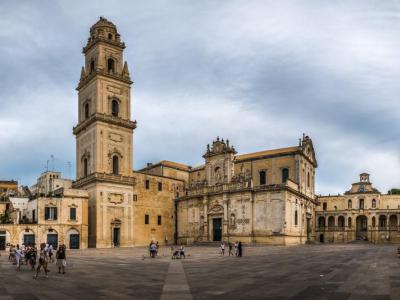
A step into Cathedral Square reveals Lecce’s secret garden of carved stone and Baroque bravado-hidden behind a slim passage off Libertini Street. Here, the Cathedral of the Assumption presides like a diva atop a set of cascading stairs, flanked by stout columns that guard niches boasting statues of Saints Giusto and Fortunato. Legend says Saint Orontius himself watches from his ornate arch above, forever grateful for slaying the plague rather than dragons.
This isn’t your average medieval church: since its inauguration in 1144, Lecce’s Cathedral has had two makeovers-first in 1230, then in 1659 when Giuseppe Zimbalo supercharged it with baroque exuberance. The majesty of the edifice invites anyone to cross the threshold into a world of three naves divided by sculpted pilasters and columns, under a 1685 wooden ceiling painted by Giuseppe da Brindisi. Twelve side chapels brim with altars honoring everyone from sacrament superstars to the lives of Jesus and Mary.
Guarding the square’s flanks are three other grand players: the Bishop’s Palace, which got its stately clock and facade facelift in 1758; the soaring 230-foot bell tower, another Zimbalo marvel from 1682; and the Seminary, Giuseppe Cino’s 1729 masterpiece that wraps the west side in Rococo ruffles. Together, they form Lecce’s ultimate architectural girl band-each with its own star turn, yet perfectly in sync.
So pause beneath those sculpted ledges, let your eyes follow the soaring bell tower skyward, and picture the endless parades that once wove through this secret square. In Lecce, even the quietest corner is a stage-and everyone gets front-row seats.
This isn’t your average medieval church: since its inauguration in 1144, Lecce’s Cathedral has had two makeovers-first in 1230, then in 1659 when Giuseppe Zimbalo supercharged it with baroque exuberance. The majesty of the edifice invites anyone to cross the threshold into a world of three naves divided by sculpted pilasters and columns, under a 1685 wooden ceiling painted by Giuseppe da Brindisi. Twelve side chapels brim with altars honoring everyone from sacrament superstars to the lives of Jesus and Mary.
Guarding the square’s flanks are three other grand players: the Bishop’s Palace, which got its stately clock and facade facelift in 1758; the soaring 230-foot bell tower, another Zimbalo marvel from 1682; and the Seminary, Giuseppe Cino’s 1729 masterpiece that wraps the west side in Rococo ruffles. Together, they form Lecce’s ultimate architectural girl band-each with its own star turn, yet perfectly in sync.
So pause beneath those sculpted ledges, let your eyes follow the soaring bell tower skyward, and picture the endless parades that once wove through this secret square. In Lecce, even the quietest corner is a stage-and everyone gets front-row seats.
11) Chiesa di Santa Chiara (Saint Chiara Church)
The Church of Santa Chiara sits right in Lecce’s historic center and it’s been drawing eyes since 1429, when Bishop Tommaso Ammirato decided the city needed something special for the Poor Clares (an enclosed Order of nuns). Rolling into the late 1600s, and architect Giuseppe Cino gave it a dramatic Baroque makeover-because in Lecce, stone never stays plain for long.
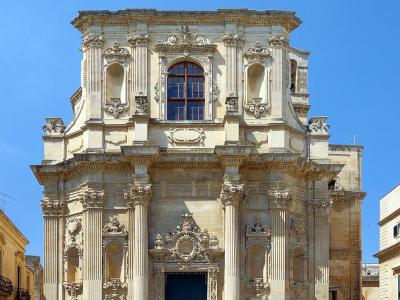
The façade leans into theater. Its curving shape immediately stands out, and the lower section frames a decorated portal bursting with leafy carvings. Above, a niche held aloft by smiling angels proudly displays the Poor Clares’ coat of arms. The upper level repeats the rhythm with pilasters and niches but ups the drama with a big central window and a scrolling top, like the curtain call of a play.
Step inside and the stage gets bigger. The church’s elongated octagonal plan leads your eyes to a deep presbytery under a starry vaulted ceiling. Along the walls, chapels break up the space, each decorated to impress. The altars go all-in on Baroque flair: twisted columns wrapped with angels, birds, garlands, and scrolls. Wooden statues from the late 1600s stand guard, while niches host saints, creating a full house of heavenly residents.
The true star is the high altar, anchored by twisted columns and crowned with a statue of Saint Clare of Assisi in pride of place. Adding to the richness, you’ll also find a canvas of Saint Agnese by Francesco Solimena, one of the most important painters of the Baroque era, tucked near the altar of Saint Francis of Assisi.
Santa Chiara proves that Baroque wasn’t just about grandeur-it was about joy, energy, and detail so rich it feels alive.
The façade leans into theater. Its curving shape immediately stands out, and the lower section frames a decorated portal bursting with leafy carvings. Above, a niche held aloft by smiling angels proudly displays the Poor Clares’ coat of arms. The upper level repeats the rhythm with pilasters and niches but ups the drama with a big central window and a scrolling top, like the curtain call of a play.
Step inside and the stage gets bigger. The church’s elongated octagonal plan leads your eyes to a deep presbytery under a starry vaulted ceiling. Along the walls, chapels break up the space, each decorated to impress. The altars go all-in on Baroque flair: twisted columns wrapped with angels, birds, garlands, and scrolls. Wooden statues from the late 1600s stand guard, while niches host saints, creating a full house of heavenly residents.
The true star is the high altar, anchored by twisted columns and crowned with a statue of Saint Clare of Assisi in pride of place. Adding to the richness, you’ll also find a canvas of Saint Agnese by Francesco Solimena, one of the most important painters of the Baroque era, tucked near the altar of Saint Francis of Assisi.
Santa Chiara proves that Baroque wasn’t just about grandeur-it was about joy, energy, and detail so rich it feels alive.
12) Porta Rudiae (Rudiae Gate)
Rudiae Gate, is the oldest and most historically significant of the three city gates. It originally faced the ancient city of Rudiae, the birthplace of the poets Ennio and Virgilio. The current structure dates back to 1703 when it was rebuilt by the nobleman Prospero Lubelli after the earlier Gothic gate collapsed in the late 17th century.
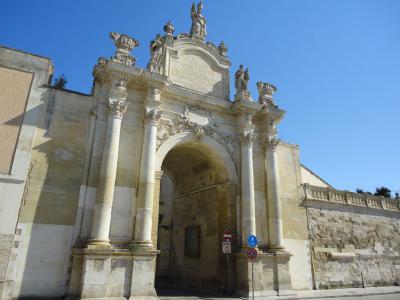
The gate features a single arch flanked by pairs of columns resting on a podium, supporting a decorative frieze adorned with busts of Lecce’s mythical founders: Malennio, Dauno, Euippa, and Idomeneo.
Above the arch stand statues of Saint Oronzo, Lecce’s patron saint, along with other protectors Irene and San Domenico. A Latin inscription commemorates the gate’s reconstruction under Lubelli’s patronage.
Historically, Porta Rudiae served both defensive and commercial purposes, guarding the city and regulating trade from surrounding areas.
Today, it remains a symbolic entrance to Lecce’s baroque old town, hosting cultural and religious events that celebrate the city’s rich heritage and maintain its connection to longstanding traditions.
The gate features a single arch flanked by pairs of columns resting on a podium, supporting a decorative frieze adorned with busts of Lecce’s mythical founders: Malennio, Dauno, Euippa, and Idomeneo.
Above the arch stand statues of Saint Oronzo, Lecce’s patron saint, along with other protectors Irene and San Domenico. A Latin inscription commemorates the gate’s reconstruction under Lubelli’s patronage.
Historically, Porta Rudiae served both defensive and commercial purposes, guarding the city and regulating trade from surrounding areas.
Today, it remains a symbolic entrance to Lecce’s baroque old town, hosting cultural and religious events that celebrate the city’s rich heritage and maintain its connection to longstanding traditions.
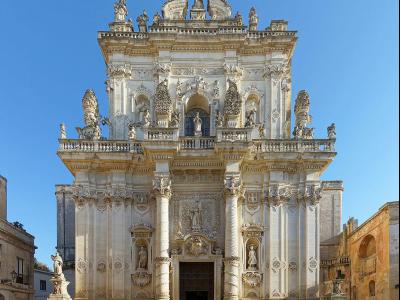
13) Basilica di San Giovanni Battista al Rosario (Church of Saint John Battista of Rosario)
The Church of Saint John the Baptist of the Rosary isn’t shy about showing off its Baroque credentials. This church has anchored its parish since 1914, but its story stretches back much further. The Dominicans first landed here in 1388, and by the late 1600s, they decided the old building just wasn’t cutting it. Cue master architect Giuseppe Zimbalo, the man behind much of Lecce’s Baroque look. At seventy years old, he launched the project in 1691, even helping to fund it himself. By the time of his death in 1710, the walls were up, but finishing touches fell to other local talents, who wrapped it up in 1728.
From the outside, the façade is pure Baroque theater. The lower part of the church greets you with two tall, decorated columns framing an entrance dramatic enough to deserve its own soundtrack. Above the doorway sits the Dominican crest, crowned by a statue of Saint Domenico di Guzmán, the order’s founder. Get a bit closer and you’ll notice two more stone figures-Saint John the Baptist and Blessed Francis-like a carved lineup of the church’s VIPs.
Inside, the layout trades the drama for harmony. The church follows a Greek cross plan, its spacious octagonal chamber capped with wooden trusses. Along the edges, twelve side chapels hold richly carved Baroque altars-miniature showcases of Lecce stonework, each competing to outshine the next.
This basilica may not be Lecce’s loudest Baroque statement, but it’s a masterclass in elegance and devotion-a place where Zimbalo’s vision and his successors’ craft come together in perfect balance.
From the outside, the façade is pure Baroque theater. The lower part of the church greets you with two tall, decorated columns framing an entrance dramatic enough to deserve its own soundtrack. Above the doorway sits the Dominican crest, crowned by a statue of Saint Domenico di Guzmán, the order’s founder. Get a bit closer and you’ll notice two more stone figures-Saint John the Baptist and Blessed Francis-like a carved lineup of the church’s VIPs.
Inside, the layout trades the drama for harmony. The church follows a Greek cross plan, its spacious octagonal chamber capped with wooden trusses. Along the edges, twelve side chapels hold richly carved Baroque altars-miniature showcases of Lecce stonework, each competing to outshine the next.
This basilica may not be Lecce’s loudest Baroque statement, but it’s a masterclass in elegance and devotion-a place where Zimbalo’s vision and his successors’ craft come together in perfect balance.
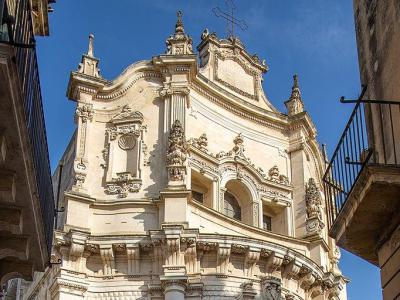
14) Chiesa di San Matteo (Church of Saint Mathew)
Imagine stepping into a Baroque time machine and landing in Lecce circa 1700-welcome to the Church of Saint Matthew, brainchild of Achille Larducci di Salo, nephew to Rome’s own star architect Borromini. In 1667, Bishop Luigi Pappacoda ceremoniously plopped down the first stone, replacing a humble 15th-century chapel. By 1700, Larducci’s vision had sprung into glorious reality.
Outside, the façade plays “concave above, convex below” in stunning limestone choreography. The lower register flaunts three sections framed by beefy columns and an ornate main portal crowned with the Franciscan coat of arms. Above, a grand three-part doorway stretches between sculpted columns and niches, all finished with a curving overhang and a tall triangular top that seems to nod hello as you walk by.
Slip inside, and you’ll find a single, sweeping nave traced in an elegant ellipse. Pilasters, each based on a plinth, salute the Twelve Apostles while the left side parades five jeweled altars honoring Saints Agatha, Francis, Rita, the Virgin, and the Pietà. Opposite them stand four more shrines-Madonna of the Light, Saint Anne, the Holy Family, and Saint Orontius-beneath a star-studded vault that feels straight out of a celestial blueprint. In Lecce, even a church floor plan is fit for Baroque stardom-this is Saint Matthew’s grand stage.
Outside, the façade plays “concave above, convex below” in stunning limestone choreography. The lower register flaunts three sections framed by beefy columns and an ornate main portal crowned with the Franciscan coat of arms. Above, a grand three-part doorway stretches between sculpted columns and niches, all finished with a curving overhang and a tall triangular top that seems to nod hello as you walk by.
Slip inside, and you’ll find a single, sweeping nave traced in an elegant ellipse. Pilasters, each based on a plinth, salute the Twelve Apostles while the left side parades five jeweled altars honoring Saints Agatha, Francis, Rita, the Virgin, and the Pietà. Opposite them stand four more shrines-Madonna of the Light, Saint Anne, the Holy Family, and Saint Orontius-beneath a star-studded vault that feels straight out of a celestial blueprint. In Lecce, even a church floor plan is fit for Baroque stardom-this is Saint Matthew’s grand stage.
