Custom Walk in Aix-en-Provence, France by tonicassrels_de5c5c created on 2026-05-01
Guide Location: France » Aix-en-Provence
Guide Type: Custom Walk
# of Sights: 12
Tour Duration: 3 Hour(s)
Travel Distance: 5.3 Km or 3.3 Miles
Share Key: 8LWHL
Guide Type: Custom Walk
# of Sights: 12
Tour Duration: 3 Hour(s)
Travel Distance: 5.3 Km or 3.3 Miles
Share Key: 8LWHL
How It Works
Please retrieve this walk in the GPSmyCity app. Once done, the app will guide you from one tour stop to the next as if you had a personal tour guide. If you created the walk on this website or come to the page via a link, please follow the instructions below to retrieve the walk in the app.
Retrieve This Walk in App
Step 1. Download the app "GPSmyCity: Walks in 1K+ Cities" on Apple App Store or Google Play Store.



Step 2. In the GPSmyCity app, download(or launch) the guide "Aix-en-Provence Map and Walking Tours".
Step 3. Tap the menu button located at upper right corner of the "Walks" screen and select "Retrieve custom walk". Enter the share key: 8LWHL
1) Fontaine de la Rotonde (Fountain of the Rotunda)
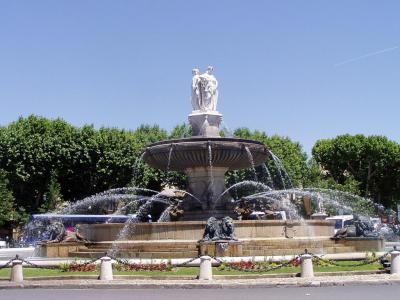
The Count of Valbelle checked out in 1779, but not before leaving the city of Aix a generous parting gift: 30,000 livres, which was the currency at the time. By November, the city decided to put that money to work-out went the crumbling ramparts, and in came plans for something more civic-minded. Ideas floated around for a while (as they tend to do), but it wasn’t until 1860 that the most iconic splash zone in town got born: the Fountain of the Rotunda.
Long known for its love affair with water-from Roman baths to bubbling neighborhood spouts-Aix needed a proper fountain to fortify its reputation. The Rotunda Fountain delivered. Towering nearly 40 feet, it was the first in the city to feature a cast-iron basin. Lions lounge around its edge like they own the place, while bronze children cling to swans mid-ride, adding just the right touch of misdemeanor.
Further up, a second bowl rests above the pool, this one guarded by snarling cheetah heads that look like they’ve seen things. Crowning the whole affair is a trio of ladies-each facing a different destiny. “Justice,” by Joseph Marius Ramus, stares down Mirabeau Boulevard toward the courthouse. “Commerce and Agriculture,” by Louis Chabaud, keep watch toward Marseille’s factories. And “Fine Arts,” by Hippolyte Ferrat, gazes toward Avignon. Together, they’re known as the Three Graces-a rather dignified nickname for a fountain that never stops showing off.
Long known for its love affair with water-from Roman baths to bubbling neighborhood spouts-Aix needed a proper fountain to fortify its reputation. The Rotunda Fountain delivered. Towering nearly 40 feet, it was the first in the city to feature a cast-iron basin. Lions lounge around its edge like they own the place, while bronze children cling to swans mid-ride, adding just the right touch of misdemeanor.
Further up, a second bowl rests above the pool, this one guarded by snarling cheetah heads that look like they’ve seen things. Crowning the whole affair is a trio of ladies-each facing a different destiny. “Justice,” by Joseph Marius Ramus, stares down Mirabeau Boulevard toward the courthouse. “Commerce and Agriculture,” by Louis Chabaud, keep watch toward Marseille’s factories. And “Fine Arts,” by Hippolyte Ferrat, gazes toward Avignon. Together, they’re known as the Three Graces-a rather dignified nickname for a fountain that never stops showing off.
2) Cours Mirabeau (Mirabeau Boulevard) (must see)
Gabriel Riqueti, Count of Mirabeau, was a man of big gestures and even bigger contradictions. He spoke for liberty, flirted with monarchy, and somehow managed to represent Aix at the General Assembly in 1789 without burning any bridges-at least not immediately. When he died in 1791, France collectively put down its quills and mourned.
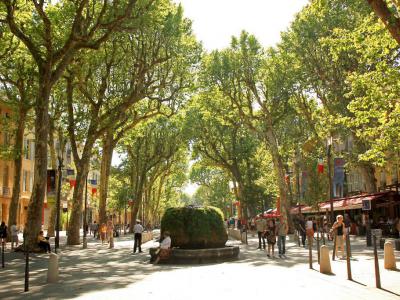
A few decades and revolutions later, Aix named its most iconic street after him: Mirabeau Boulevard. Back in 1649, however, this grand promenade was just a gleam in Archbishop Michel Mazarin’s eye. With the city bursting at the seams, Mazarin tore down the southern ramparts to build a tree-lined thoroughfare fit for gilded carriages, powdered wigs, and Sunday strolls. Architect Jean Lombard helped draft the blueprint for this upscale expansion, turning what was once a defense wall into something much more stylish.
It took fifteen years of rubble removal to make way for the noble set, but the result still impresses: a leafy tunnel of plane trees lined with elegant mansions, wrought-iron balconies, and enough cafés to caffeinate all of Provence. The name “Mirabeau” wasn’t slapped on until 1876, but the spirit of grandeur had been there from the beginning.
Fountains punctuate the boulevard like commas in a particularly well-watered sentence. There’s the showy Fountain of the Rotunda at one end, the Fountain of the Nine Canons mid-way, and the Mossy Fountain, which looks exactly like it sounds. As for the Fountain of the Seahorses, it vanished in 1777; today, only a stony lump remains to tell the tale.
A statue of King René marks the east end of the boulevard, looking pleased with the view-shopfronts now outnumber mansions, but the Boulevard still holds its swagger. Like its namesake, it doesn’t quite pick a side-bourgeois polish, revolutionary echoes, and a strong preference for table service.
A few decades and revolutions later, Aix named its most iconic street after him: Mirabeau Boulevard. Back in 1649, however, this grand promenade was just a gleam in Archbishop Michel Mazarin’s eye. With the city bursting at the seams, Mazarin tore down the southern ramparts to build a tree-lined thoroughfare fit for gilded carriages, powdered wigs, and Sunday strolls. Architect Jean Lombard helped draft the blueprint for this upscale expansion, turning what was once a defense wall into something much more stylish.
It took fifteen years of rubble removal to make way for the noble set, but the result still impresses: a leafy tunnel of plane trees lined with elegant mansions, wrought-iron balconies, and enough cafés to caffeinate all of Provence. The name “Mirabeau” wasn’t slapped on until 1876, but the spirit of grandeur had been there from the beginning.
Fountains punctuate the boulevard like commas in a particularly well-watered sentence. There’s the showy Fountain of the Rotunda at one end, the Fountain of the Nine Canons mid-way, and the Mossy Fountain, which looks exactly like it sounds. As for the Fountain of the Seahorses, it vanished in 1777; today, only a stony lump remains to tell the tale.
A statue of King René marks the east end of the boulevard, looking pleased with the view-shopfronts now outnumber mansions, but the Boulevard still holds its swagger. Like its namesake, it doesn’t quite pick a side-bourgeois polish, revolutionary echoes, and a strong preference for table service.

3) Fontaine des Neuf-Canons (Fountain of the Nine Cannons)
The Fountain of the Nine Cannons (Fontaine des Neuf-Canons) is a fountain and historical monument located on Mirabeau Boulevard, at the intersection of Nazareth Street and Joseph Cabassol Street in Aix-en-Provence.
The fountain, designed by architect Laurent Vallon and constructed in 1691, was named for the nine cannons that shoot water into the basin.
The Fountain of the Nine Cannons was built to provide water to sheep as they passed through the area. At that time, an easement authorized herds of sheep on transhumance between the commune La Crau and the Alps to come and drink there. The lower coping of the basin, as well as the length of its perimeter, was designed in the 17th century.
The fountain was partially destroyed in 1944 during the liberation of Aix-en-Provence. An American tank has taken away one of the four lobes of the basin, this arm was not rebuilt, and its opposite lobe was, on the occasion of this incident, suppressed.
The Fountain of the Nine Cannons was listed as a historical monument in 1929.
The fountain, designed by architect Laurent Vallon and constructed in 1691, was named for the nine cannons that shoot water into the basin.
The Fountain of the Nine Cannons was built to provide water to sheep as they passed through the area. At that time, an easement authorized herds of sheep on transhumance between the commune La Crau and the Alps to come and drink there. The lower coping of the basin, as well as the length of its perimeter, was designed in the 17th century.
The fountain was partially destroyed in 1944 during the liberation of Aix-en-Provence. An American tank has taken away one of the four lobes of the basin, this arm was not rebuilt, and its opposite lobe was, on the occasion of this incident, suppressed.
The Fountain of the Nine Cannons was listed as a historical monument in 1929.
4) Hotel de Caumont (Caumont Hotel) (must see)
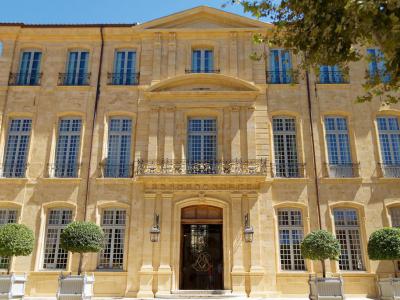
The Caumont Hotel may sound like a boutique stay with extra fluff pillows, but it's actually one of Aix’s finest 18th-century mansions-now operating as an art centre. Designed in 1715 by Robert de Cotte and Georges Vallon for the Marquess of Cabannes, the residence comes complete with an imposing entrance flanked by an Atlas sculpture courtesy of Rambot and Toro-yes, real sculptors, not a circus duo.
Over the centuries, the place rotated through various hands, eventually landing with the city of Aix in 1964. It moonlighted as a post office until 1970, and then hosted the Darius Milhaud Conservatory-proof that this house has always had good acoustics and a social calendar. The original owners of this Mazarin Quarter gem weren’t shy about entertaining either; they even had rooms dedicated just to music and mingling.
Inside, it’s all aristocratic finesse -curvy decorations, playful ceiling angels, and the frame of a harpsichord by Jean-Henri Naderman, because no proper 18th-century evening skipped the string section. The bedrooms feature cozy nooks, private corners, and wall monkeys that look like they wandered in from someone’s exotic daydream.
Outside, there’s an impressive courtyard, over 1,000 square meters of sculpted gardens, and an indoor fountain doing its best impression of refined understatement. Temporary exhibitions fill the elegant halls, along with a gift shop and a pocket-sized theatre-because this mansion really does have it all.
Over the centuries, the place rotated through various hands, eventually landing with the city of Aix in 1964. It moonlighted as a post office until 1970, and then hosted the Darius Milhaud Conservatory-proof that this house has always had good acoustics and a social calendar. The original owners of this Mazarin Quarter gem weren’t shy about entertaining either; they even had rooms dedicated just to music and mingling.
Inside, it’s all aristocratic finesse -curvy decorations, playful ceiling angels, and the frame of a harpsichord by Jean-Henri Naderman, because no proper 18th-century evening skipped the string section. The bedrooms feature cozy nooks, private corners, and wall monkeys that look like they wandered in from someone’s exotic daydream.
Outside, there’s an impressive courtyard, over 1,000 square meters of sculpted gardens, and an indoor fountain doing its best impression of refined understatement. Temporary exhibitions fill the elegant halls, along with a gift shop and a pocket-sized theatre-because this mansion really does have it all.

5) Fontaine Moussue (Mossy Fountain)
Mossy Fountain (Fontaine Moussue) is a classic fountain designed by the architect Jean-Claude Rambot. It is known locally as the Mossy Fountain, the Big Green Sponge, or the Hot Water Fountain.
The thermal fountain was built in 1667. It was the first fountain built on the landmark Mirabeau Boulevard. It underwent a major reconstruction in 1687 and 1734.
The moss that grows on the fountain is due to the heated water. As the Mossy Fountain is the only fountain fed from the Thermal Baths, its temperature remains 64 degrees throughout the year.
The fountain's water is not drinkable, still, it can be used for other purposes. Through the beginning of the 20th century, locals used heated water to wash clothing. Water was also regularly taken from the fountain in buckets for washing walkways and steps. Some used the water from the Mossy Fountain to feed their plants.
The Mossy Fountain has suffered from calcification, which makes the design difficult to see. It is believed that the shapes under the limestone deposits are four children holding a basin for the water.
The thermal fountain was built in 1667. It was the first fountain built on the landmark Mirabeau Boulevard. It underwent a major reconstruction in 1687 and 1734.
The moss that grows on the fountain is due to the heated water. As the Mossy Fountain is the only fountain fed from the Thermal Baths, its temperature remains 64 degrees throughout the year.
The fountain's water is not drinkable, still, it can be used for other purposes. Through the beginning of the 20th century, locals used heated water to wash clothing. Water was also regularly taken from the fountain in buckets for washing walkways and steps. Some used the water from the Mossy Fountain to feed their plants.
The Mossy Fountain has suffered from calcification, which makes the design difficult to see. It is believed that the shapes under the limestone deposits are four children holding a basin for the water.
6) Mazarin District and Fountain of the Four Dolphins
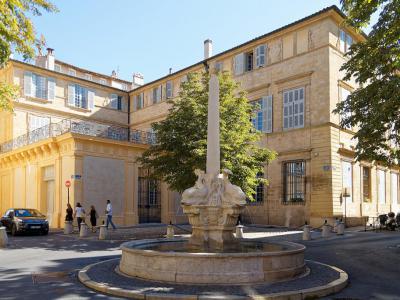
Right in the heart of Aix’s Mazarin district, you’ll stumble upon the Square of the Four Dolphins-a quiet intersection dressed in 17th-century elegance. It’s flanked by grand mansions, including the Boisgelin Hotel, dreamed up by Pierre Pavillon in 1655. But the real centerpiece is, naturally, the fountain-a quartet of dolphins doing synchronized spray work since the 17th century.
This whole corner of Aix exists thanks to Michel Mazarin, the city’s archbishop with a flair for demolition. Back in 1645, he got the green light from Louis XIV to knock down Aix’s southern ramparts and replace them with something far more fashionable. Inspired by Italian Renaissance planning (and perhaps a few ego trips), architect Jean Lombard laid out a crisp grid of streets and dropped in a proper square right in the middle.
Originally dubbed Saint-Michel Square, the space eventually took its cue from the sculpture at its core. The fountain stars four dolphins coiling around a pedestal, still making a splash. A pine cone is adorned at the top-unexpected, but somehow it works. The dolphins spit water into a wide basin, watched over by four chestnut trees that offer shade with a sense of seniority. It’s a stylish pause in a neighborhood built to impress-and it still does.
This whole corner of Aix exists thanks to Michel Mazarin, the city’s archbishop with a flair for demolition. Back in 1645, he got the green light from Louis XIV to knock down Aix’s southern ramparts and replace them with something far more fashionable. Inspired by Italian Renaissance planning (and perhaps a few ego trips), architect Jean Lombard laid out a crisp grid of streets and dropped in a proper square right in the middle.
Originally dubbed Saint-Michel Square, the space eventually took its cue from the sculpture at its core. The fountain stars four dolphins coiling around a pedestal, still making a splash. A pine cone is adorned at the top-unexpected, but somehow it works. The dolphins spit water into a wide basin, watched over by four chestnut trees that offer shade with a sense of seniority. It’s a stylish pause in a neighborhood built to impress-and it still does.
7) Musee Granet (Granet Museum) (must see)
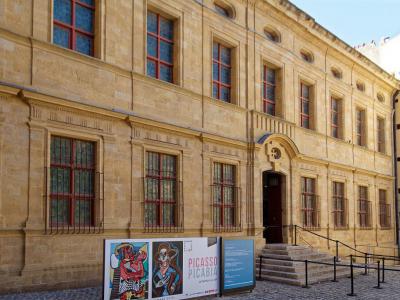
Henri Pointier, curator of the Aix museum from 1892 to 1925, was no fan of Cézanne. In fact, he reportedly swore the painter’s work would only hang there “over my dead body.” Wish granted: Pointier died in 1949, and within months, the museum started collecting Cézannes like overdue apologies. That same year, it also rebranded as Granet Museum, in honor of local artist and major benefactor François-Marius Granet.
The museum itself occupies the former priory of Saint John's Church and still shares a peaceful garden with the neighboring church-a rare case of art and religion staying civil. In 2009, it mounted a centenary exhibition of Cézanne’s death, turning the whole affair into poetic payback.
Among the collection: works by Ingres (his thunderous Jupiter and Thetis included), a self-portrait by Rembrandt, pieces by Van Dyck, Giacometti, and yes, Cézanne-front and center at last.
In 2011, the Jean and Suzanne Planque Foundation kicked off a long-term show at the museum with over 180 works from the late Swiss collector’s archive. Eventually topping 300 pieces, the collection includes heavy-hitters like Degas, Renoir, Monet, Van Gogh, Picasso and Dubuffet. The ensemble now lives in a dedicated annex: the beautifully repurposed Chapel of the White Penitents-where penance meets prestige.
The museum itself occupies the former priory of Saint John's Church and still shares a peaceful garden with the neighboring church-a rare case of art and religion staying civil. In 2009, it mounted a centenary exhibition of Cézanne’s death, turning the whole affair into poetic payback.
Among the collection: works by Ingres (his thunderous Jupiter and Thetis included), a self-portrait by Rembrandt, pieces by Van Dyck, Giacometti, and yes, Cézanne-front and center at last.
In 2011, the Jean and Suzanne Planque Foundation kicked off a long-term show at the museum with over 180 works from the late Swiss collector’s archive. Eventually topping 300 pieces, the collection includes heavy-hitters like Degas, Renoir, Monet, Van Gogh, Picasso and Dubuffet. The ensemble now lives in a dedicated annex: the beautifully repurposed Chapel of the White Penitents-where penance meets prestige.
8) Maison Natale de Cezanne (Cezanne's Birth House)
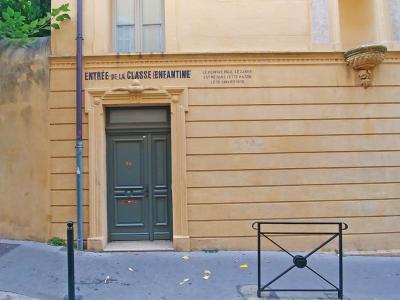
Paul Cézanne was born on January 19th, 1839, in Aix-en-Provence-back when opera wasn’t just a street name but a sign you might be doing well. His father, Louis-Auguste Cézanne, started out as a hatter and worked his way up to banker. His mother, Elisabeth-Honorine Aubert, rounded out the household at 28 Opera street, where young Paul spent his early years sketching.
By 1844, the family had moved to 14 Icehouse Road. That’s where the paperwork for his parents’ marriage turned up, listing Louis-Auguste as a former milliner who had moved on to property ownership-swapping hats for houses. The Church of the Madeleine saw a lot of Cézanne family milestones: Paul’s parents were married there, his sister Marie was baptized in 1841, and his other sister, Rose, tied the knot there four decades later.
From 1850 to 1870, the Cézannes lived at 14 Matheron street, just a few minutes’ walk from Paul’s first address. Although Cézanne traveled often-especially to Paris-Aix always pulled him back like a canvas waiting for its next layer.
He studied at the local municipal school on Thorn street, then at the Bourbon College-now known as Mignet College-on Cardinal street. His art training came from the school housed inside the Granet Museum, conveniently parked on Saint John Square.
Cézanne married Hortense Fiquet at the Town Hall in Aix-en-Provence. For company and conversation, he often chose a table at Les Deux Garçons on Mirabeau Boulevard-a place where painters, poets, and politics all shared the bill.
Today, you’ll find brass markers scattered around town-on walls, streets, and squares-quietly guiding you through the places where Cézanne lived, loved, painted, and occasionally dodged his father’s advice to get a “real job.”
By 1844, the family had moved to 14 Icehouse Road. That’s where the paperwork for his parents’ marriage turned up, listing Louis-Auguste as a former milliner who had moved on to property ownership-swapping hats for houses. The Church of the Madeleine saw a lot of Cézanne family milestones: Paul’s parents were married there, his sister Marie was baptized in 1841, and his other sister, Rose, tied the knot there four decades later.
From 1850 to 1870, the Cézannes lived at 14 Matheron street, just a few minutes’ walk from Paul’s first address. Although Cézanne traveled often-especially to Paris-Aix always pulled him back like a canvas waiting for its next layer.
He studied at the local municipal school on Thorn street, then at the Bourbon College-now known as Mignet College-on Cardinal street. His art training came from the school housed inside the Granet Museum, conveniently parked on Saint John Square.
Cézanne married Hortense Fiquet at the Town Hall in Aix-en-Provence. For company and conversation, he often chose a table at Les Deux Garçons on Mirabeau Boulevard-a place where painters, poets, and politics all shared the bill.
Today, you’ll find brass markers scattered around town-on walls, streets, and squares-quietly guiding you through the places where Cézanne lived, loved, painted, and occasionally dodged his father’s advice to get a “real job.”

9) Place des Trois Ormeaux (Three Elms Square)
The Three Elms Square (Place des Trois Ormeaux) is a small town square near the center of Aix-en-Provence. It was named after its fountain, the Three Elms Fountain, which, in turn, was named for three elms planted in a triangle at each corner of the plaza.
There is a legend that the elms magically grew in an area where local soldiers took up arms against the ruler of Aix. Though the square remains named The Square of the Three Elms, the elm trees were removed and replaced with plane trees. Three Elms Square was previously named for the Consul of Aix-en-Provence, Bertrand Berici, who lived here at the beginning of the 15th century.
The fountain, made from Calissane and Bibemus stone, stands in the center of the square. The 17th-century fountain has a polygonal base with a central pedestal from which the water flows out of six cannons. The pedestal is carved with a floral motif, and vine leaves with a sublime bunch of grapes at the top. The fountain has stood the test of time with modesty and simple beauty.
The Three Elms Square is surrounded by houses, shops, and restaurants. Tourists should pay close attention to the door of the Saphallin Hotel, which dates to 1672.
There is a legend that the elms magically grew in an area where local soldiers took up arms against the ruler of Aix. Though the square remains named The Square of the Three Elms, the elm trees were removed and replaced with plane trees. Three Elms Square was previously named for the Consul of Aix-en-Provence, Bertrand Berici, who lived here at the beginning of the 15th century.
The fountain, made from Calissane and Bibemus stone, stands in the center of the square. The 17th-century fountain has a polygonal base with a central pedestal from which the water flows out of six cannons. The pedestal is carved with a floral motif, and vine leaves with a sublime bunch of grapes at the top. The fountain has stood the test of time with modesty and simple beauty.
The Three Elms Square is surrounded by houses, shops, and restaurants. Tourists should pay close attention to the door of the Saphallin Hotel, which dates to 1672.
10) Tour de l'Horloge (Clock Tower)
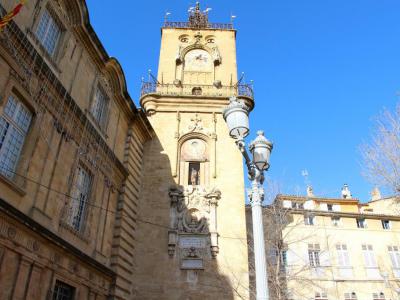
The Clock Tower (Tour de l'Horloge) is a notable monument on the Town Hall Square (Place de l'Hôtel-de-Ville). The tower, which dates to 1510, was built on the site of a military checkpoint in Roman times.
The Clock Tower is distinctive for its decorative ogees, braces, and pinnacles. Its Gothic architectural style is accented with commemorative plaques and sculptures added over the years. Perhaps most notable is the white limestone foundation of the tower, which was part of the original military checkpoint of Sextius.
The Clock Tower has an astronomical clock installed in 1661. There are four wooden statues under the clock that represent the four seasons. These statues are manually rotated as the seasons change. Among the statues is a blindfolded cherub that serves as a reminder that love is blind.
The tower's interior has a wrought-iron cage with a bell that rings the hours of the day. The bell was installed to notify the town of any dangers approaching the borders.
The Clock Tower is distinctive for its decorative ogees, braces, and pinnacles. Its Gothic architectural style is accented with commemorative plaques and sculptures added over the years. Perhaps most notable is the white limestone foundation of the tower, which was part of the original military checkpoint of Sextius.
The Clock Tower has an astronomical clock installed in 1661. There are four wooden statues under the clock that represent the four seasons. These statues are manually rotated as the seasons change. Among the statues is a blindfolded cherub that serves as a reminder that love is blind.
The tower's interior has a wrought-iron cage with a bell that rings the hours of the day. The bell was installed to notify the town of any dangers approaching the borders.
11) Atelier de Cezanne (Cezanne's Studio) (must see)
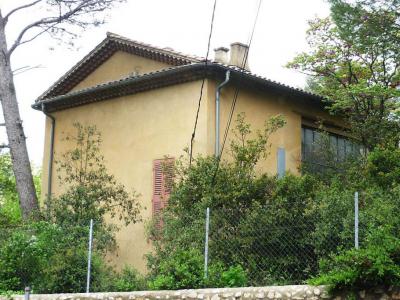
Head uphill from the city, and you'll find what might be the quietest place in Aix with the loudest artistic legacy-Cézanne’s Studio. Perched on Lauves Hill, this was Paul Cézanne’s creative headquarters from 1902 until his death in 1906. No gallery glitz here-just the real deal, exactly where he stood, mixed his paints, and glared at fruit until it revealed its geometric truth.
After his mother passed away and the family estate was sold, Cézanne bought an old farmhouse with a generous patch of land and a postcard view of his muse-Mountain Saint-Victoire. He added a studio upstairs with big south-facing windows and a glass roof to let in that famously moody Provence light. Downstairs was for living, upstairs was for working. The layout proved worthwhile as the result was paintings like The Bathers, still studied and swooned over.
When Cézanne died, the studio passed to his son, who eventually sold it to writer Marcel Provence. Luckily, Provence was the sentimental type-he left the studio just as Cézanne had, and artists and historians made quiet pilgrimages to soak in the genius vibes. After Provence’s death, art historian John Rewald and writer James Lord rallied to buy and preserve the site. By 1952, the Cézanne Memorial Committee had turned the place into a museum.
Today, it’s owned by the Aix-en-Provence Tourist Office and recognized as a House of the Illustrious-which is France’s fancy way of saying “Yes, this place really matters.” Inside, you’ll find Cézanne’s brushes, easel, still-life props, and a sense of paused time. Temporary exhibits rotate through, but the real magic is standing in the room where modern art found its backbone.
After his mother passed away and the family estate was sold, Cézanne bought an old farmhouse with a generous patch of land and a postcard view of his muse-Mountain Saint-Victoire. He added a studio upstairs with big south-facing windows and a glass roof to let in that famously moody Provence light. Downstairs was for living, upstairs was for working. The layout proved worthwhile as the result was paintings like The Bathers, still studied and swooned over.
When Cézanne died, the studio passed to his son, who eventually sold it to writer Marcel Provence. Luckily, Provence was the sentimental type-he left the studio just as Cézanne had, and artists and historians made quiet pilgrimages to soak in the genius vibes. After Provence’s death, art historian John Rewald and writer James Lord rallied to buy and preserve the site. By 1952, the Cézanne Memorial Committee had turned the place into a museum.
Today, it’s owned by the Aix-en-Provence Tourist Office and recognized as a House of the Illustrious-which is France’s fancy way of saying “Yes, this place really matters.” Inside, you’ll find Cézanne’s brushes, easel, still-life props, and a sense of paused time. Temporary exhibits rotate through, but the real magic is standing in the room where modern art found its backbone.
12) Oppidum d'Entremont
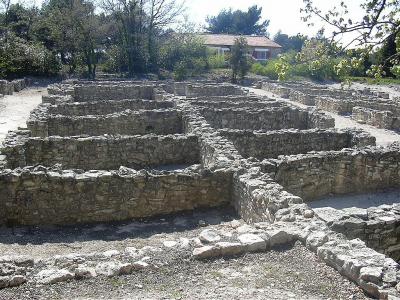
The Oppidum d’Entremont is an ancient settlement from the 2nd century BCE, built by the Salyes, a Celtic-Ligurian tribe that lived in the region before the arrival of the Romans. It stands on a plateau, a position that provided natural protection and clear views over the surrounding area. Visitors can walk through the remains of this fortified site and understand how a pre-Roman community was organized.
The structure of the oppidum is still visible, with remains of streets, houses, and defensive walls. The settlement was arranged in blocks, showing a planned layout rather than a random grouping of buildings. Stone was widely used, and parts of the walls are still standing. Excavations have revealed objects such as pottery, tools, and storage spaces, giving insight into daily life, trade, and local activities.
The site is known for its carved stone sculptures, including human heads and figures linked to ritual or social display. Many were moved to museums for preservation. The oppidum was destroyed by Roman forces around 123 BCE and later abandoned.
The structure of the oppidum is still visible, with remains of streets, houses, and defensive walls. The settlement was arranged in blocks, showing a planned layout rather than a random grouping of buildings. Stone was widely used, and parts of the walls are still standing. Excavations have revealed objects such as pottery, tools, and storage spaces, giving insight into daily life, trade, and local activities.
The site is known for its carved stone sculptures, including human heads and figures linked to ritual or social display. Many were moved to museums for preservation. The oppidum was destroyed by Roman forces around 123 BCE and later abandoned.
