Custom Walk in Philadelphia, Pennsylvania by d8801030_436363 created on 2026-05-07
Guide Location: USA » Philadelphia
Guide Type: Custom Walk
# of Sights: 10
Tour Duration: 2 Hour(s)
Travel Distance: 3.2 Km or 2 Miles
Share Key: J4QW9
Guide Type: Custom Walk
# of Sights: 10
Tour Duration: 2 Hour(s)
Travel Distance: 3.2 Km or 2 Miles
Share Key: J4QW9
How It Works
Please retrieve this walk in the GPSmyCity app. Once done, the app will guide you from one tour stop to the next as if you had a personal tour guide. If you created the walk on this website or come to the page via a link, please follow the instructions below to retrieve the walk in the app.
Retrieve This Walk in App
Step 1. Download the app "GPSmyCity: Walks in 1K+ Cities" on Apple App Store or Google Play Store.



Step 2. In the GPSmyCity app, download(or launch) the guide "Philadelphia Map and Walking Tours".
Step 3. Tap the menu button located at upper right corner of the "Walks" screen and select "Retrieve custom walk". Enter the share key: J4QW9
1) Perelman Quadrangle
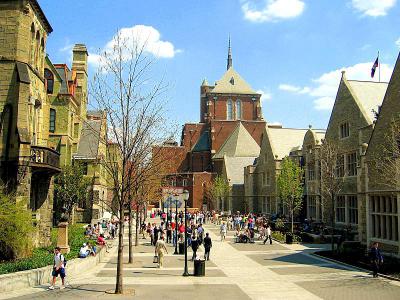
The Perelman Quadrangle comprises a set of event venues situated on the campus of the University of Pennsylvania, located in the University City area of Philadelphia. The Perelman Quadrangle primarily revolves around a central plaza located between Houston and College halls, with additional event spaces spread out across the wider Penn campus.
Houston Hall, constructed in 1895, serves as Penn's student union building and is considered by some as the first of its kind in the United States. In 1978, it was listed as a contributing property in the National Register of Historic Places within the University of Pennsylvania Campus Historic District. Today, Houston Hall houses a cafeteria, various dining options, study rooms, auditoriums, and numerous meeting rooms and offices.
College Hall, Penn's inaugural building on its West Philadelphia campus, dating back to 1871, stands just across the plaza and accommodates most of the university's classrooms and administrative spaces.
Additionally, facing the plaza are Claudia Cohen Hall, initially constructed in 1874, and Irvine Auditorium, completed in 1932. Originally known as Logan Hall, Cohen Hall currently houses administrative offices, meeting rooms, and several academic departments. It was originally built for the university's medical school, later serving as the home of the dental school and subsequently the Wharton School. The Irvine building boasts a grand auditorium featuring a significant pipe organ gifted by Cyrus Curtis, and it also includes various smaller performance and rehearsal spaces. Williams Hall, built in 1972, overlooks the plaza and contains offices and classrooms for humanities and language departments.
Houston Hall, constructed in 1895, serves as Penn's student union building and is considered by some as the first of its kind in the United States. In 1978, it was listed as a contributing property in the National Register of Historic Places within the University of Pennsylvania Campus Historic District. Today, Houston Hall houses a cafeteria, various dining options, study rooms, auditoriums, and numerous meeting rooms and offices.
College Hall, Penn's inaugural building on its West Philadelphia campus, dating back to 1871, stands just across the plaza and accommodates most of the university's classrooms and administrative spaces.
Additionally, facing the plaza are Claudia Cohen Hall, initially constructed in 1874, and Irvine Auditorium, completed in 1932. Originally known as Logan Hall, Cohen Hall currently houses administrative offices, meeting rooms, and several academic departments. It was originally built for the university's medical school, later serving as the home of the dental school and subsequently the Wharton School. The Irvine building boasts a grand auditorium featuring a significant pipe organ gifted by Cyrus Curtis, and it also includes various smaller performance and rehearsal spaces. Williams Hall, built in 1972, overlooks the plaza and contains offices and classrooms for humanities and language departments.
2) College Hall
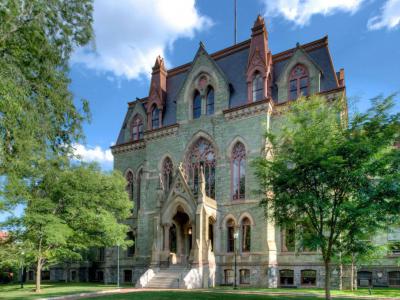
College Hall stands as the oldest structure on the campus of the University of Pennsylvania in West Philadelphia. Before its construction, the university's location was at Ninth Street in Center City, Philadelphia. This architectural marvel was designed by Thomas Webb Richards and completed in 1873. The distinct green hue of the building is attributed to its use of green serpentine stone in its construction.
On February 14, 1978, College Hall was designated as a historic site and added to the National Register of Historic Places. It also contributes to the overall historical significance of the University of Pennsylvania Campus Historic District.
Today, College Hall serves various purposes, including housing the undergraduate admissions office, the offices of the university president, the Department of History, and classrooms. The top floor of the building was specifically designed to accommodate the Zelosophic and Philomathean Societies and now serves as the home for the Philomathean Society, a literary organization established in 1813.
While there have been speculations that College Hall, along with the now-demolished Blanchard Hall, served as the inspiration for the Victorian Gothic mansion in The Addams Family cartoons, the cartoonist Charles Addams consistently refuted these claims.
On February 14, 1978, College Hall was designated as a historic site and added to the National Register of Historic Places. It also contributes to the overall historical significance of the University of Pennsylvania Campus Historic District.
Today, College Hall serves various purposes, including housing the undergraduate admissions office, the offices of the university president, the Department of History, and classrooms. The top floor of the building was specifically designed to accommodate the Zelosophic and Philomathean Societies and now serves as the home for the Philomathean Society, a literary organization established in 1813.
While there have been speculations that College Hall, along with the now-demolished Blanchard Hall, served as the inspiration for the Victorian Gothic mansion in The Addams Family cartoons, the cartoonist Charles Addams consistently refuted these claims.
3) Fisher Fine Arts Library
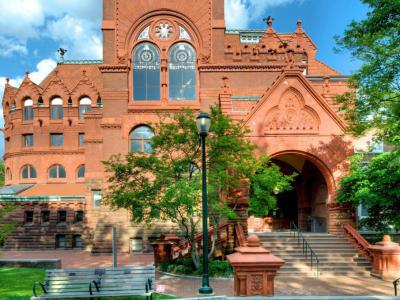
The Fisher Fine Arts Library served as the main library for the University of Pennsylvania from 1891 to 1962. It was an impressive architectural creation designed by the renowned Philadelphia architect Frank Furness (1839–1912). This imposing structure, constructed from red sandstone, brick, and terra-cotta in the Venetian Gothic style, combined elements of a fortress and a cathedral. Construction began with the laying of the cornerstone in October 1888, and it was finished in late 1890, with the official dedication taking place in February 1891.
The library's uniqueness stemmed from its innovative layout, featuring a central tower staircase as the main access to its five stories. The Main Reading Room, a spacious four-story area enclosed by brick and terra-cotta, was separated from the two-story Rotunda Reading Room by an arcade. Above the Rotunda Reading Room was a two-story lecture hall, currently used as an architecture studio. The Main Reading Room stood out for its large skylight and south-facing wall of windows, providing natural light to the adjacent inner rooms through leaded glass windows.
Throughout the building, one could find windows adorned with Shakespearean quotations, carefully selected by Horace Howard Furness, Frank's older brother, who was a lecturer at the University and a prominent American Shakespearean scholar in the 19th century. Frank Furness collaborated with Melvil Dewey, the creator of the Dewey Decimal System, and others to ensure that this library was at the forefront of modern American library design during its time.
Upon the completion of the Van Pelt Library in 1962, the library was renamed the Furness Building in honor of its architect. It was repurposed to house the university's art and architecture collections. In 1985, it received recognition as a National Historic Landmark.
In 1991, after a six-year, $16.5-million restoration project, the building was renamed the Anne and Jerome Fisher Fine Arts Library. It is situated on the eastern side of College Green. Additionally, a two-story extension to the building's east side, known as the Henry Charles Lea Library, was designed by Furness, Evans & Company and was completed in 1905.
The library's uniqueness stemmed from its innovative layout, featuring a central tower staircase as the main access to its five stories. The Main Reading Room, a spacious four-story area enclosed by brick and terra-cotta, was separated from the two-story Rotunda Reading Room by an arcade. Above the Rotunda Reading Room was a two-story lecture hall, currently used as an architecture studio. The Main Reading Room stood out for its large skylight and south-facing wall of windows, providing natural light to the adjacent inner rooms through leaded glass windows.
Throughout the building, one could find windows adorned with Shakespearean quotations, carefully selected by Horace Howard Furness, Frank's older brother, who was a lecturer at the University and a prominent American Shakespearean scholar in the 19th century. Frank Furness collaborated with Melvil Dewey, the creator of the Dewey Decimal System, and others to ensure that this library was at the forefront of modern American library design during its time.
Upon the completion of the Van Pelt Library in 1962, the library was renamed the Furness Building in honor of its architect. It was repurposed to house the university's art and architecture collections. In 1985, it received recognition as a National Historic Landmark.
In 1991, after a six-year, $16.5-million restoration project, the building was renamed the Anne and Jerome Fisher Fine Arts Library. It is situated on the eastern side of College Green. Additionally, a two-story extension to the building's east side, known as the Henry Charles Lea Library, was designed by Furness, Evans & Company and was completed in 1905.
4) Fisher-Bennett Hall
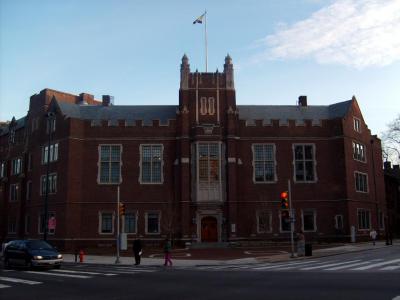
Situated at a somewhat unusual site – the juncture of three streets (Walnut, 34th, and the diagonal of the former Woodland Avenue), Bennett Hall has just as unusual plan, determined by the location, with its main façade being on the beveled corner. Because of the slope of the site, the actual height of the building varies from four to six stories.
The symmetrical principal façade is dominated by a central tower over the main entrance, with articulated decorative buttresses crowned by corner spires. The tower is flanked by two-story windows below a battlement at the roof line.
Still, it is not so much the architecture that distinguishes this building, but the fact that it was the first facility at the University built specifically for women. Originally known as Bennett College, the edifice was erected in 1925, designed by architects Stewardson & Page. Inside, other than classrooms, it had a library, a gymnasium and a student union. An important landmark for the campus, the building was generously renovated and upgraded in 2005. Upon re-opening in 2006, it was renamed Fisher-Bennett Hall. Presently, the facility houses the English Department, English Language Programs, Music Department and Cinema Studies among other occupants.
The symmetrical principal façade is dominated by a central tower over the main entrance, with articulated decorative buttresses crowned by corner spires. The tower is flanked by two-story windows below a battlement at the roof line.
Still, it is not so much the architecture that distinguishes this building, but the fact that it was the first facility at the University built specifically for women. Originally known as Bennett College, the edifice was erected in 1925, designed by architects Stewardson & Page. Inside, other than classrooms, it had a library, a gymnasium and a student union. An important landmark for the campus, the building was generously renovated and upgraded in 2005. Upon re-opening in 2006, it was renamed Fisher-Bennett Hall. Presently, the facility houses the English Department, English Language Programs, Music Department and Cinema Studies among other occupants.
5) The Button (sculpture)
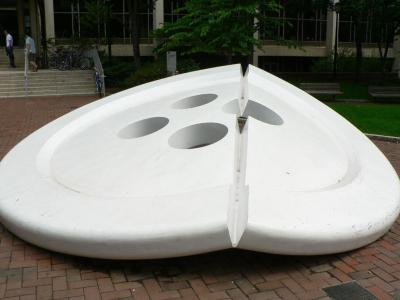
The Button, also known as the Split Button, is a contemporary art sculpture situated at the heart of the University of Pennsylvania campus. It was created by Claes Oldenburg, a Swedish artist renowned for crafting oversized sculptures inspired by ordinary objects.
When The Button was installed in front of the Van Pelt Library on June 18, 1981, it sparked significant controversy. Some students regarded the structure as intrusive and believed it did not enhance the appearance of College Green. Although the controversy surrounding the artwork has diminished over the years since 1981, it has nonetheless become a prominent landmark and focal point of the campus.
A popular legend, primarily circulated by University of Pennsylvania students, attributes the creation of The Button to the university's founder, Benjamin Franklin. According to the tale, a monument of Franklin seated nearby depicts a moment when the corpulent figure sat down, causing his vest button to pop off and roll across Locust Walk on the university grounds. Eventually, the button came to a halt and split into two pieces, giving rise to the sculpture we see today.
Oldenburg, however, offers an alternative interpretation. He once explained that "The Split represents the Schuylkill River, dividing the button into four sections, symbolizing William Penn's original Philadelphia squares."
The name of The Button has even lent itself to a satirical blog at Penn, known as Under the Button.
When The Button was installed in front of the Van Pelt Library on June 18, 1981, it sparked significant controversy. Some students regarded the structure as intrusive and believed it did not enhance the appearance of College Green. Although the controversy surrounding the artwork has diminished over the years since 1981, it has nonetheless become a prominent landmark and focal point of the campus.
A popular legend, primarily circulated by University of Pennsylvania students, attributes the creation of The Button to the university's founder, Benjamin Franklin. According to the tale, a monument of Franklin seated nearby depicts a moment when the corpulent figure sat down, causing his vest button to pop off and roll across Locust Walk on the university grounds. Eventually, the button came to a halt and split into two pieces, giving rise to the sculpture we see today.
Oldenburg, however, offers an alternative interpretation. He once explained that "The Split represents the Schuylkill River, dividing the button into four sections, symbolizing William Penn's original Philadelphia squares."
The name of The Button has even lent itself to a satirical blog at Penn, known as Under the Button.
6) Van Pelt Library
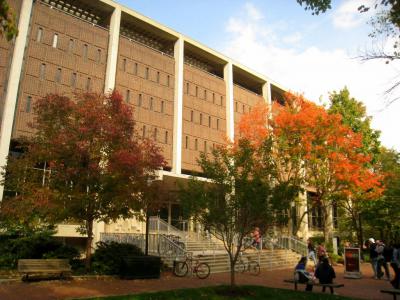
The Charles Patterson Van Pelt Library, commonly referred to as the Van Pelt-Dietrich Library Center or simply Van Pelt, stands as the centerpiece of the University of Pennsylvania's library system. Designed by the architectural firm Harbeson, Hough, Livingston & Larson, this significant building was constructed in 1962 and boasts an impressive gross area of 201,215 square feet (18,693 square meters).
Van Pelt is not just a hub for social sciences and humanities research but also accommodates several specialized libraries and collections. It is home to the Lippincott Library of The Wharton School, renowned for its business resources, and the Ormandy Music Library, catering to music-related studies. Moreover, the Kislak Center for Special Collections, Rare Books, and Manuscripts is housed here, offering a wealth of rare and unique materials.
The library's Area Studies collections are particularly notable, with extensive resources in African, Japanese, Latin American, Chinese, Middle East, South Asia, and Judaica & Ancient Near East Studies. Adding to its academic richness is the Henry Charles Lea Library, located on the 6th floor, known for its historical collections.
Architecturally, Van Pelt Library presents a blend of styles. Its vaguely Grecian appearance, marked by a significant colonnade, is juxtaposed with brick panels and small windows, reminiscent of an old French library, creating a distinctive aesthetic on the campus. Additionally, a modern art sculpture titled "The Button" is prominently placed at the library's southern entrance, further accentuating its modern and eclectic character.
The library also features the Weigle Information Commons, situated on the west side of the first floor. This space is designed to facilitate information access and collaborative learning, underscoring the library's role as a dynamic and integral part of the university's academic landscape.
Van Pelt is not just a hub for social sciences and humanities research but also accommodates several specialized libraries and collections. It is home to the Lippincott Library of The Wharton School, renowned for its business resources, and the Ormandy Music Library, catering to music-related studies. Moreover, the Kislak Center for Special Collections, Rare Books, and Manuscripts is housed here, offering a wealth of rare and unique materials.
The library's Area Studies collections are particularly notable, with extensive resources in African, Japanese, Latin American, Chinese, Middle East, South Asia, and Judaica & Ancient Near East Studies. Adding to its academic richness is the Henry Charles Lea Library, located on the 6th floor, known for its historical collections.
Architecturally, Van Pelt Library presents a blend of styles. Its vaguely Grecian appearance, marked by a significant colonnade, is juxtaposed with brick panels and small windows, reminiscent of an old French library, creating a distinctive aesthetic on the campus. Additionally, a modern art sculpture titled "The Button" is prominently placed at the library's southern entrance, further accentuating its modern and eclectic character.
The library also features the Weigle Information Commons, situated on the west side of the first floor. This space is designed to facilitate information access and collaborative learning, underscoring the library's role as a dynamic and integral part of the university's academic landscape.
7) Quadrangle Dormitories
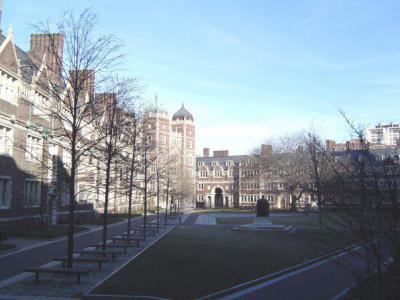
The Quadrangle Dormitories, commonly referred to as "The Quad," consist of 39 interconnected residential buildings located within the University of Pennsylvania. These structures were designed by the architectural firm Cope and Stewardson in a vibrant Neo-Jacobean interpretation of the Collegiate Gothic architectural style.
The majority of the dormitories were constructed between 1894 and 1912. They span from 36th to 38th Streets and from Spruce Street to Hamilton Walk, which used to be Pine Street. To the west of the Memorial Tower on 37th Street, the buildings on the north side align with the diagonal path of Woodland Avenue, now known as Woodland Walk, forming an elongated triangle when juxtaposed with the structures on the south side.
Historically, from 1895 to 1971, Quadrangle Dormitories exclusively accommodated male students. In 1978, they were recognized as a contributing property within the University of Pennsylvania Campus Historic District.
Presently, "The Quad" has been organized into three distinct college houses: Fisher Hassenfeld College House on the west, Ware College House in the center, and Riepe College House on the east. These college houses primarily serve as "first-year communities" and currently house around 1,445 students.
Fisher Hassenfeld College House, located on the western part of the Quad, honors Jerome and Anne Fisher, along with Alan G. Hassenfeld, all alumni and trustees who funded its establishment. Ware College House, in the central Quad area, is named after Congressman John H. Ware III and includes the Memorial Tower and buildings east of 37th Street. Riepe College House, on the eastern Quad section, was created with a $10 million pledge from James and Gail Petty Riepe in 2004.
The majority of the dormitories were constructed between 1894 and 1912. They span from 36th to 38th Streets and from Spruce Street to Hamilton Walk, which used to be Pine Street. To the west of the Memorial Tower on 37th Street, the buildings on the north side align with the diagonal path of Woodland Avenue, now known as Woodland Walk, forming an elongated triangle when juxtaposed with the structures on the south side.
Historically, from 1895 to 1971, Quadrangle Dormitories exclusively accommodated male students. In 1978, they were recognized as a contributing property within the University of Pennsylvania Campus Historic District.
Presently, "The Quad" has been organized into three distinct college houses: Fisher Hassenfeld College House on the west, Ware College House in the center, and Riepe College House on the east. These college houses primarily serve as "first-year communities" and currently house around 1,445 students.
Fisher Hassenfeld College House, located on the western part of the Quad, honors Jerome and Anne Fisher, along with Alan G. Hassenfeld, all alumni and trustees who funded its establishment. Ware College House, in the central Quad area, is named after Congressman John H. Ware III and includes the Memorial Tower and buildings east of 37th Street. Riepe College House, on the eastern Quad section, was created with a $10 million pledge from James and Gail Petty Riepe in 2004.
8) Provosts Tower
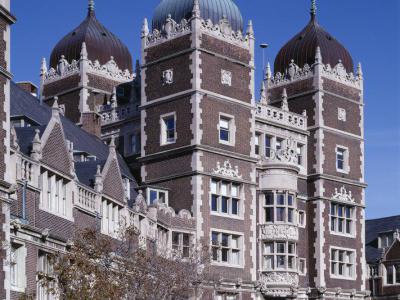
Located in the heart of Philadelphia, Provost Tower stands as a historic and architecturally significant structure on 36th Street, just south of Spruce Street. Constructed in 1912, this seven-story building functions as the grand entrance to the Lower Quad and holds immense historical value for the University of Pennsylvania.
The tower was named in honor of William Smith, the university's first provost, who served from 1755 to 1779 and again from 1789 to 1791. Smith's contributions were pivotal in shaping the early development of the college, which evolved into the prestigious University of Pennsylvania.
Interestingly, the construction of Provosts Tower was funded as a generous gift from the family and friends of Provost Charles Custis Harrison, to commemorate his retirement in 1910. This gesture symbolizes the deep respect and admiration for Harrison’s contributions to the university.
Adding to the tower's grandeur is a seated statue of Provost Harrison, positioned outside the building, overlooking the property with a sense of pride. This statue is not only a tribute to Harrison but also serves as a reminder of the enduring legacy of the university's leadership.
The building itself is a marvel of architectural design, featuring intricately carved limestone decorations by the sculptor Edward Maene. These decorations include plaques dedicated to each of the first 12 provosts of the university, signifying the tower’s role as a tribute to all the provosts who have served at the institution. Additionally, twin "headboards" embellished with the Coat of Arms of Pennsylvania adorn the parapet, adding to the building's aesthetic and historical significance.
One of the key features of Provosts Tower is its fifth floor, which houses a two-story library and lounge. This space not only serves as a functional area for study and relaxation but also as a physical embodiment of the university's commitment to academic excellence and the pursuit of knowledge.
The tower was named in honor of William Smith, the university's first provost, who served from 1755 to 1779 and again from 1789 to 1791. Smith's contributions were pivotal in shaping the early development of the college, which evolved into the prestigious University of Pennsylvania.
Interestingly, the construction of Provosts Tower was funded as a generous gift from the family and friends of Provost Charles Custis Harrison, to commemorate his retirement in 1910. This gesture symbolizes the deep respect and admiration for Harrison’s contributions to the university.
Adding to the tower's grandeur is a seated statue of Provost Harrison, positioned outside the building, overlooking the property with a sense of pride. This statue is not only a tribute to Harrison but also serves as a reminder of the enduring legacy of the university's leadership.
The building itself is a marvel of architectural design, featuring intricately carved limestone decorations by the sculptor Edward Maene. These decorations include plaques dedicated to each of the first 12 provosts of the university, signifying the tower’s role as a tribute to all the provosts who have served at the institution. Additionally, twin "headboards" embellished with the Coat of Arms of Pennsylvania adorn the parapet, adding to the building's aesthetic and historical significance.
One of the key features of Provosts Tower is its fifth floor, which houses a two-story library and lounge. This space not only serves as a functional area for study and relaxation but also as a physical embodiment of the university's commitment to academic excellence and the pursuit of knowledge.
9) Irvine Auditorium
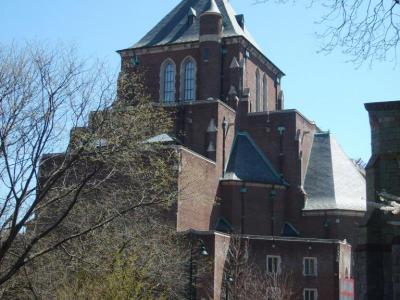
Irvine Auditorium, located on Spruce Street within the University of Pennsylvania's campus in Philadelphia, is a performance venue with a rich history. Designed by the renowned Philadelphia architect Horace Trumbauer, the auditorium was constructed between 1926 and 1932. One of its standout features is the Curtis Organ, boasting nearly 11,000 pipes, making it the world's 22nd-largest pipe organ in terms of ranks. Originally built for the Sesquicentennial Exposition in 1926, it was generously donated to the university in 1928. The auditorium officially opened its doors in May 1929.
There's an enduring but inaccurate campus legend surrounding Irvine Auditorium. According to this story, the building was the brainchild of a Penn architecture student whose design project received a failing grade. He subsequently abandoned his architectural aspirations and ventured into business, eventually amassing a fortune. Many years later, he made a substantial bequest to the university in his will, but with the condition that his original project be brought to life.
The seating capacity of Irvine Auditorium currently stands at 1,260, though it used to accommodate 1,976 people prior to a renovation. The auditorium's design is octagonal, featuring side balconies that once faced each other at right angles to the stage. In a significant restoration and renovation effort spanning from 1997 to 2000, Venturi, Scott Brown & Associates, Inc. removed these side balconies. This not only enhanced the acoustic quality of the venue but also created more intimate performance spaces within the building.
There's an enduring but inaccurate campus legend surrounding Irvine Auditorium. According to this story, the building was the brainchild of a Penn architecture student whose design project received a failing grade. He subsequently abandoned his architectural aspirations and ventured into business, eventually amassing a fortune. Many years later, he made a substantial bequest to the university in his will, but with the condition that his original project be brought to life.
The seating capacity of Irvine Auditorium currently stands at 1,260, though it used to accommodate 1,976 people prior to a renovation. The auditorium's design is octagonal, featuring side balconies that once faced each other at right angles to the stage. In a significant restoration and renovation effort spanning from 1997 to 2000, Venturi, Scott Brown & Associates, Inc. removed these side balconies. This not only enhanced the acoustic quality of the venue but also created more intimate performance spaces within the building.

10) Mutter Museum (must see)
The Mütter Museum, situated in the Center City area of Philadelphia, is a renowned institution dedicated to medical history and science. It's an integral part of The College of Physicians of Philadelphia and houses an extensive collection of medical artifacts. The museum's inception dates back to December 11, 1858, when it was founded with a generous contribution from Dr. Thomas Dent Mütter. Initially, its primary purpose was to serve as an educational resource for medical professionals, students and guests of the College Fellows. It wasn't until the mid-1970s that the museum opened its doors to the general public.
The Mütter Museum boasts a staggering collection of over 37,000 specimens, though only about 10% of these are on display. This collection does not include the vast array of literature contained in the Historical Medical Library, also located within the College. The museum's collection features a variety of anatomical and pathological specimens, wax models, and antique medical equipment, providing a unique and comprehensive view of the history of medicine.
The items, artifacts, and specimens in the museum's collection have been sourced from all over the world. Many were acquired by College Fellows during their travels, with the College reimbursing them for these purchases and any related expenses. Additionally, numerous pieces have been donated from the private collections of physicians, further enriching the museum's diversity and scope.
One of the Mütter Museum's most notable holdings is its collection of over 3,000 osteological specimens, which includes several complete skeletons. Among these is the famous skeleton of Harry Raymond Eastlack, a patient who suffered from Fibrodysplasia Ossificans Progressiva (FOP), making it a particularly fascinating and educational exhibit. The Mütter Museum stands out not only for its unique collections but also for its role in preserving and presenting the history of medicine to a wide audience.
The Mütter Museum boasts a staggering collection of over 37,000 specimens, though only about 10% of these are on display. This collection does not include the vast array of literature contained in the Historical Medical Library, also located within the College. The museum's collection features a variety of anatomical and pathological specimens, wax models, and antique medical equipment, providing a unique and comprehensive view of the history of medicine.
The items, artifacts, and specimens in the museum's collection have been sourced from all over the world. Many were acquired by College Fellows during their travels, with the College reimbursing them for these purchases and any related expenses. Additionally, numerous pieces have been donated from the private collections of physicians, further enriching the museum's diversity and scope.
One of the Mütter Museum's most notable holdings is its collection of over 3,000 osteological specimens, which includes several complete skeletons. Among these is the famous skeleton of Harry Raymond Eastlack, a patient who suffered from Fibrodysplasia Ossificans Progressiva (FOP), making it a particularly fascinating and educational exhibit. The Mütter Museum stands out not only for its unique collections but also for its role in preserving and presenting the history of medicine to a wide audience.
