Custom Walk in Berlin, Germany by bgsb78_4473af created on 2026-05-21
Guide Location: Germany » Berlin
Guide Type: Custom Walk
# of Sights: 5
Tour Duration: 3 Hour(s)
Travel Distance: 8.8 Km or 5.5 Miles
Share Key: MGBQK
Guide Type: Custom Walk
# of Sights: 5
Tour Duration: 3 Hour(s)
Travel Distance: 8.8 Km or 5.5 Miles
Share Key: MGBQK
How It Works
Please retrieve this walk in the GPSmyCity app. Once done, the app will guide you from one tour stop to the next as if you had a personal tour guide. If you created the walk on this website or come to the page via a link, please follow the instructions below to retrieve the walk in the app.
Retrieve This Walk in App
Step 1. Download the app "GPSmyCity: Walks in 1K+ Cities" on Apple App Store or Google Play Store.



Step 2. In the GPSmyCity app, download(or launch) the guide "Berlin Map and Walking Tours".
Step 3. Tap the menu button located at upper right corner of the "Walks" screen and select "Retrieve custom walk". Enter the share key: MGBQK
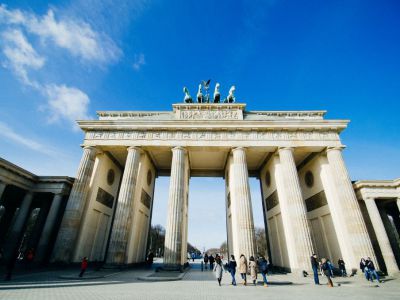
1) Brandenburger Tor (Brandenburg Gate) (must see)
The Brandenburg Gate is the last standing part of the western side of the Customs Wall that surrounded Berlin in the 18th century. It marks a monumental entry to Unter den Linden, the famed boulevard lined with lime trees that once led to the palace of the Prussian monarchs.
This neoclassical landmark was built between 1788 and 1791 during the reign of King Frederick William II of Prussia. Inspired by Roman triumphal arches and the classical Greek gateway to the Acropolis of Athens, the gate has twelve fluted Doric columns flanked by two pavilions originally occupied by guards, as well as five passageways, and reliefs depicting the Labors of Hercules. Its crowning glory is the bronze Quadriga sculpture – the goddess of victory atop a four-horsed chariot, originally regarded as a symbol of peace.
Throughout its history, the gate has played a crucial role in Germany's political narrative. In 1806, during the French occupation, Napoleon ordered its dismantling and transportation to Paris. However, upon its return in 1814, after Napolean's defeat, the gate was declared a symbol of victory, and the goddess was adorned with the Prussian eagle and iron cross, symbolizing triumph. The structure has stood witness to many pivotal events in Berlin's history, from military parades to the rise of the Third Reich and Hitler's ascent to power, upon which it was used as a Nazi propaganda symbol.
The Brandenburg Gate also holds memories of the Fall of Berlin and the Russian flag's raising in May 1945. After World War II, it stood damaged but intact and became part of the Soviet occupation zone. During the Cold War era, the gate – blocked by the Berlin Wall from 1961 until the fall of the Berlin Wall in 1989 – remained in no-man's land between East and West Germany. Back then, it served as a defining symbol of Berlin's and Germany’s division and their eventual reunification.
Today, the Brandenburg Gate is a venue for commemorations and public events. Apart from being a photo-op, its historical importance is just as good a reason to visit.
Tip:
Consider visiting at night when the gate is beautifully illuminated and less crowded, allowing for contemplation of its storied past and symbolic value.
This neoclassical landmark was built between 1788 and 1791 during the reign of King Frederick William II of Prussia. Inspired by Roman triumphal arches and the classical Greek gateway to the Acropolis of Athens, the gate has twelve fluted Doric columns flanked by two pavilions originally occupied by guards, as well as five passageways, and reliefs depicting the Labors of Hercules. Its crowning glory is the bronze Quadriga sculpture – the goddess of victory atop a four-horsed chariot, originally regarded as a symbol of peace.
Throughout its history, the gate has played a crucial role in Germany's political narrative. In 1806, during the French occupation, Napoleon ordered its dismantling and transportation to Paris. However, upon its return in 1814, after Napolean's defeat, the gate was declared a symbol of victory, and the goddess was adorned with the Prussian eagle and iron cross, symbolizing triumph. The structure has stood witness to many pivotal events in Berlin's history, from military parades to the rise of the Third Reich and Hitler's ascent to power, upon which it was used as a Nazi propaganda symbol.
The Brandenburg Gate also holds memories of the Fall of Berlin and the Russian flag's raising in May 1945. After World War II, it stood damaged but intact and became part of the Soviet occupation zone. During the Cold War era, the gate – blocked by the Berlin Wall from 1961 until the fall of the Berlin Wall in 1989 – remained in no-man's land between East and West Germany. Back then, it served as a defining symbol of Berlin's and Germany’s division and their eventual reunification.
Today, the Brandenburg Gate is a venue for commemorations and public events. Apart from being a photo-op, its historical importance is just as good a reason to visit.
Tip:
Consider visiting at night when the gate is beautifully illuminated and less crowded, allowing for contemplation of its storied past and symbolic value.
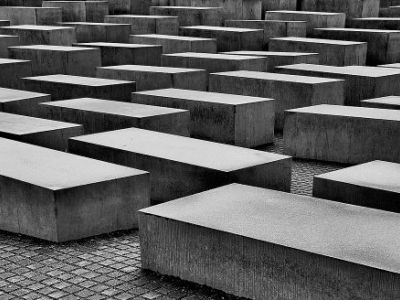
2) Holocaust Denkmal (Holocaust Memorial) (must see)
Officially named The Memorial to the Murdered Jews of Europe, this solemn expanse of concrete, situated near Berlin’s Brandenburg Gate, stands as a stark and enduring tribute to the millions of Jewish lives extinguished under the Nazi regime between the years 1933 and 1945.
Unveiled in 2005, the memorial was conceived by American architect Peter Eisenman. It spans nearly 19,000 square meters and consists of more than 2,700 concrete stelae-each of varying height and dimension-arranged in a strict grid across a subtly sloping field. The result is a landscape that is simultaneously orderly and disorienting.
Though the design is intentionally abstract and, according to its creator, devoid of explicit symbolism, its resemblance to a graveyard is unmistakable. Some interpret the sea of grey pillars as evoking unmarked graves or the cold efficiency of a bureaucratic system that facilitated mass murder. Others see in its rigid structure a metaphor for a state that lost its humanity behind walls of administration and ideology.
As one moves deeper into the memorial, the concrete blocks grow taller, eclipsing the cityscape and swallowing sound. The sensation is deliberate. It conveys isolation, loss of identity, and the disorienting fear that accompanied the systematic persecution of Jews under the Third Reich. The path dips downward, suggesting the slow descent into darkness that defined those years.
The unfinished quality of some surfaces serves as a quiet reminder: remembrance is not complete, and history’s wounds do not fully heal. The fragmentation of space may reflect the fragmented memories of survivors-and of those lost, whose stories were never told.
This memorial does not offer resolution or unity. It does not attempt to console. Instead, it confronts. It calls forth reflection-on individual memory, on collective guilt, and on the enduring responsibility to remember, in a world where forgetting is all too easy...
Unveiled in 2005, the memorial was conceived by American architect Peter Eisenman. It spans nearly 19,000 square meters and consists of more than 2,700 concrete stelae-each of varying height and dimension-arranged in a strict grid across a subtly sloping field. The result is a landscape that is simultaneously orderly and disorienting.
Though the design is intentionally abstract and, according to its creator, devoid of explicit symbolism, its resemblance to a graveyard is unmistakable. Some interpret the sea of grey pillars as evoking unmarked graves or the cold efficiency of a bureaucratic system that facilitated mass murder. Others see in its rigid structure a metaphor for a state that lost its humanity behind walls of administration and ideology.
As one moves deeper into the memorial, the concrete blocks grow taller, eclipsing the cityscape and swallowing sound. The sensation is deliberate. It conveys isolation, loss of identity, and the disorienting fear that accompanied the systematic persecution of Jews under the Third Reich. The path dips downward, suggesting the slow descent into darkness that defined those years.
The unfinished quality of some surfaces serves as a quiet reminder: remembrance is not complete, and history’s wounds do not fully heal. The fragmentation of space may reflect the fragmented memories of survivors-and of those lost, whose stories were never told.
This memorial does not offer resolution or unity. It does not attempt to console. Instead, it confronts. It calls forth reflection-on individual memory, on collective guilt, and on the enduring responsibility to remember, in a world where forgetting is all too easy...
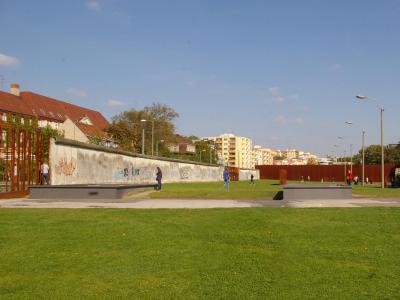
3) Gedenkstatte Berliner Mauer (Berlin Wall Memorial) (must see)
Located a bit away from the tourist hubbub, allowing you to avoid the crowds at Checkpoint Charlie, the Berlin Wall Memorial offers a more scholarly perspective on Germany's division. More precisely, it focuses on a section of the former border strip, with an outdoor exhibition tracing the history of Bernauer Strasse and the Wall. This outdoor exhibit extends for 1.4 kilometers, reaching up to the Mauerpark, and includes remnants of border obstacles that preserve the appearance of the Wall as it stood in the past.
Across from the memorial, the museum expanded in 2014 and now houses a permanent exhibition titled "1961–1989: the Berlin Wall", which delves into the lives of those who tried to escape the dictatorship (notably, some of the most successful escape tunnels were dug nearby) and the resistance efforts, often deadly, organized by those living in the vicinity. Additionally, there is a separate exhibition within the adjacent Nordbahnhof station, detailing the division of the U-Bahn and S-Bahn lines (open during station hours). On weekdays at noon, the chapel hosts prayer services in memory of the Berlin Wall's victims.
Across from the memorial, the museum expanded in 2014 and now houses a permanent exhibition titled "1961–1989: the Berlin Wall", which delves into the lives of those who tried to escape the dictatorship (notably, some of the most successful escape tunnels were dug nearby) and the resistance efforts, often deadly, organized by those living in the vicinity. Additionally, there is a separate exhibition within the adjacent Nordbahnhof station, detailing the division of the U-Bahn and S-Bahn lines (open during station hours). On weekdays at noon, the chapel hosts prayer services in memory of the Berlin Wall's victims.
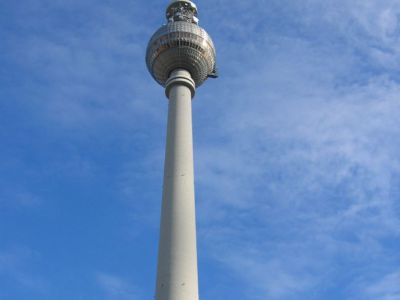
4) Fernsehturm (TV Tower) (must see)
The Berlin Television Tower was built by East Germany in the late 1960s. Inaugurated on October 3, 1969, it is the tallest structure in Germany and the third-tallest in the European Union.
Designated as a monument in 1979, the tower attracts around 1.2 million visitors annually and is one of Germany’s top tourist attractions. It has an observation deck at 203 meters and the rotating restaurant “Sphere” at 207 meters, offering panoramic views of the city, extending up to 40 kilometers (or 25 miles) on a clear day.
The tower’s height increased from 365 to 368 meters in 1997 after a new antenna was added, making it the fourth tallest free-standing structure in Europe, surpassed only by Moscow's Ostankino Tower and TV towers in Kiev and Riga. If you have a mild fear of heights, fear not-the elevator whisks you to the top in a mere 40 seconds. You can also opt for a more adventurous ascent via 985 steps.
Inside, enjoy the authentic Sputnik-era ambiance complete with period-appropriate decor and finishes. If you have specific dietary preferences, particularly as a vegetarian, it's advisable to peruse the restaurant menu on their website before making a reservation. The dining experience itself is quite lovely otherwise, comprising a starter, main course, and dessert, plus a glass of sparkling wine and two glasses of red or white wine, along with unlimited water. Moreover, the restaurant rotates slowly, affording you a comprehensive view of Berlin, making it an ideal setting for photography. A full rotation takes about half an hour, offering ample opportunity to capture the city from a bird's-eye perspective while sipping a coffee.
Presently dubbed "the toothpick" by locals, the tower previously earned the nickname “Pope’s Revenge” because sunlight reflecting off its dome forms a Greek cross, which some saw as a rebuke to East Germany’s anti-religious stance, and was mentioned by the former US president Ronald Reagan in his 1987 “Tear down this wall” speech. For the same reasons, it was also jokingly called "Saint Walter" after Walter Ulbricht, leader of the Socialist Unity Party which governed East Germany.
Originally a symbol of Communist power, the TV tower is now a unified Berlin landmark and a cultural and tourist icon, hosting events like the Festival of Lights.
Designated as a monument in 1979, the tower attracts around 1.2 million visitors annually and is one of Germany’s top tourist attractions. It has an observation deck at 203 meters and the rotating restaurant “Sphere” at 207 meters, offering panoramic views of the city, extending up to 40 kilometers (or 25 miles) on a clear day.
The tower’s height increased from 365 to 368 meters in 1997 after a new antenna was added, making it the fourth tallest free-standing structure in Europe, surpassed only by Moscow's Ostankino Tower and TV towers in Kiev and Riga. If you have a mild fear of heights, fear not-the elevator whisks you to the top in a mere 40 seconds. You can also opt for a more adventurous ascent via 985 steps.
Inside, enjoy the authentic Sputnik-era ambiance complete with period-appropriate decor and finishes. If you have specific dietary preferences, particularly as a vegetarian, it's advisable to peruse the restaurant menu on their website before making a reservation. The dining experience itself is quite lovely otherwise, comprising a starter, main course, and dessert, plus a glass of sparkling wine and two glasses of red or white wine, along with unlimited water. Moreover, the restaurant rotates slowly, affording you a comprehensive view of Berlin, making it an ideal setting for photography. A full rotation takes about half an hour, offering ample opportunity to capture the city from a bird's-eye perspective while sipping a coffee.
Presently dubbed "the toothpick" by locals, the tower previously earned the nickname “Pope’s Revenge” because sunlight reflecting off its dome forms a Greek cross, which some saw as a rebuke to East Germany’s anti-religious stance, and was mentioned by the former US president Ronald Reagan in his 1987 “Tear down this wall” speech. For the same reasons, it was also jokingly called "Saint Walter" after Walter Ulbricht, leader of the Socialist Unity Party which governed East Germany.
Originally a symbol of Communist power, the TV tower is now a unified Berlin landmark and a cultural and tourist icon, hosting events like the Festival of Lights.
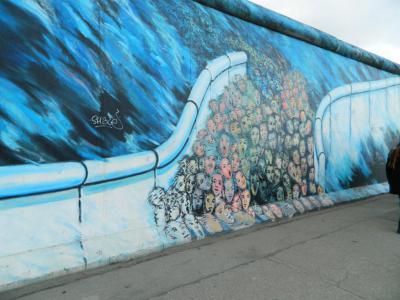
5) East Side Gallery (must see)
In just three months, this one-kilometer (approximately half-mile) expanse of concrete transformed from a heavily guarded border to an open-air art gallery. The momentous breach of the Berlin Wall by East Berliners on November 9, 1989, paved the way for a remarkable change. Between February and June of 1990, 118 artists from various corners of the world converged here to craft distinctive works of art along its longest remaining section.
Among the most iconic pieces is the creation by Russian artist Dmitri Vrubel, portraying the embrace of Brezhnev and Honecker, the former leader of East Germany, accompanied by the poignant caption, "My God. Help me survive this deadly love."
This extraordinary stretch of art lines the banks of the Spree Canal, spanning from the Warschauer Strasse S- and U-bahn station to Ostbahnhof. Adding to its charm, the scene is graced by the redbrick Oberbaumbrücke, a bridge dating back to 1896, located at Warschauer Street.
Among the most iconic pieces is the creation by Russian artist Dmitri Vrubel, portraying the embrace of Brezhnev and Honecker, the former leader of East Germany, accompanied by the poignant caption, "My God. Help me survive this deadly love."
This extraordinary stretch of art lines the banks of the Spree Canal, spanning from the Warschauer Strasse S- and U-bahn station to Ostbahnhof. Adding to its charm, the scene is graced by the redbrick Oberbaumbrücke, a bridge dating back to 1896, located at Warschauer Street.
