Custom Walk in Ohrid, North Macedonia by julietpande_7689b created on 2026-05-31
Guide Location: North Macedonia » Ohrid
Guide Type: Custom Walk
# of Sights: 5
Tour Duration: 2 Hour(s)
Travel Distance: 3.1 Km or 1.9 Miles
Share Key: PLPA3
Guide Type: Custom Walk
# of Sights: 5
Tour Duration: 2 Hour(s)
Travel Distance: 3.1 Km or 1.9 Miles
Share Key: PLPA3
How It Works
Please retrieve this walk in the GPSmyCity app. Once done, the app will guide you from one tour stop to the next as if you had a personal tour guide. If you created the walk on this website or come to the page via a link, please follow the instructions below to retrieve the walk in the app.
Retrieve This Walk in App
Step 1. Download the app "GPSmyCity: Walks in 1K+ Cities" on Apple App Store or Google Play Store.



Step 2. In the GPSmyCity app, download(or launch) the guide "Ohrid Map and Walking Tours".
Step 3. Tap the menu button located at upper right corner of the "Walks" screen and select "Retrieve custom walk". Enter the share key: PLPA3
1) Ohrid Main Square
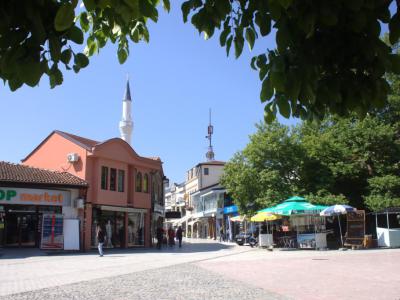
Ohrid Main Square is known as Krusevska Republika Square. It is not named for Nikita Kruschev, former leader of the Soviet Union. It is named instead in memory of the short-lived uprising against Ottoman rule in the town of Krusevo, Macedonia in 1903. There are several such squares in Macedonia. The Ohrid Main Square is one of them.
The Main Square opens up at the northern end of the Old Bazaar that reaches up from the waterfront. This is the touchstone of Ohrid. There are well tailored flower gardens, and walking spaces paved with marble.
Here is the home of the fabled Chinar tree, said to be 1,000 years old. Minarets and church steeples loom nearby.
The vibes in the square are friendly. Inviting shops and cafes line the edges. There are many comfortable vantage points from which to observe fascinating Ohrid.
The Main Square opens up at the northern end of the Old Bazaar that reaches up from the waterfront. This is the touchstone of Ohrid. There are well tailored flower gardens, and walking spaces paved with marble.
Here is the home of the fabled Chinar tree, said to be 1,000 years old. Minarets and church steeples loom nearby.
The vibes in the square are friendly. Inviting shops and cafes line the edges. There are many comfortable vantage points from which to observe fascinating Ohrid.
2) Church of St. John at Kaneo (must see)
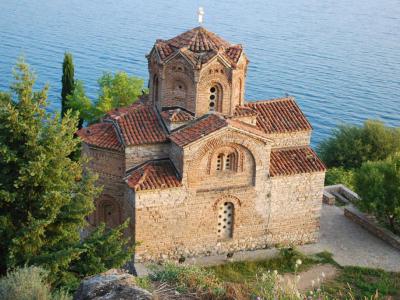
The Church of Saint John the Theologian sits on a cliff overlooking Kaneo Beach and Lake Ohrid. It is really next door to the Plaosnik Archeological Site and Saint Clement's Church. The John referred to is John of Patmos, credited to be the writer of Revelations. According to some historians, he may also have been John the Apostle.
It is not known precisely when the church was built. Certain documents indicate construction was perhaps in the 13th century, well before the rise of the Ottoman Empire which eventually engulfed Macedonia.
The church is laid out in a cruciform plan on a rectangular base. Unfortunately, the architect is not yet known. The church has a single dome. The roof cornice is unusual. It is neither flat nor undulating in the normal manner. It forms angled tympanums between a doorway lintel and the arch above. This is customary in the central Balkans.
Frescoes dating from the 1200s are intact in the dome apse. The naos niche contains bits from the Passion of Christ. The altar space holds scenes of the liturgy and the Worship of the Lamb. There are portraits of Saints Clement of Ohrid, Erasmus of Lychnidos and Constantine Cabasilas, Ohrid Archbishop in the 1260s.
Christ Pancrator is featured in a fresco in the church dome. The Church of Saint John is a pleasant walk from the fortress of Tsar Samoil downhill through the pine forest. The views of Lake Ohrid and the old town are sweeping and dramatic. For weary, hungry hikers there is no dearth of friendly restaurants at the water's edge.
It is not known precisely when the church was built. Certain documents indicate construction was perhaps in the 13th century, well before the rise of the Ottoman Empire which eventually engulfed Macedonia.
The church is laid out in a cruciform plan on a rectangular base. Unfortunately, the architect is not yet known. The church has a single dome. The roof cornice is unusual. It is neither flat nor undulating in the normal manner. It forms angled tympanums between a doorway lintel and the arch above. This is customary in the central Balkans.
Frescoes dating from the 1200s are intact in the dome apse. The naos niche contains bits from the Passion of Christ. The altar space holds scenes of the liturgy and the Worship of the Lamb. There are portraits of Saints Clement of Ohrid, Erasmus of Lychnidos and Constantine Cabasilas, Ohrid Archbishop in the 1260s.
Christ Pancrator is featured in a fresco in the church dome. The Church of Saint John is a pleasant walk from the fortress of Tsar Samoil downhill through the pine forest. The views of Lake Ohrid and the old town are sweeping and dramatic. For weary, hungry hikers there is no dearth of friendly restaurants at the water's edge.
3) Church of Saints Clement and Panteleimon
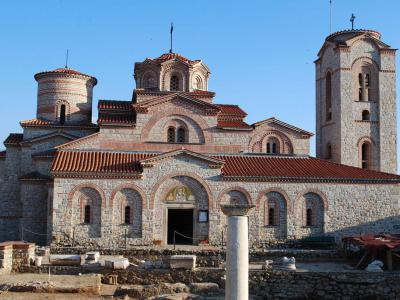
The Church of Saints Clement and Panteleimon, located in Ohrid, is a significant Byzantine architectural monument and an important historical and religious site. Attributed to Saint Clement of Ohrid, a disciple of Saint Cyril and Saint Methodius, this church stands on the grounds believed to be where the first students of the Glagolitic alphabet were educated. These teachings facilitated the translation of the Bible into Old Church Slavonic during the First Bulgarian Empire.
Saint Clement arrived in Ohrid under the commission of Boris I of Bulgaria. Upon his arrival, Clement restored an existing old church. However, dissatisfied with its size, he decided to construct a new church over the old structure, dedicating it to Saint Panteleimon. This new establishment not only served as a church but also as a monastery, which Clement possibly designed himself. Alongside Naum of Preslav, another disciple of Cyril and Methodius, Clement used this monastery as a hub for teaching the Glagolitic and Cyrillic alphabets to the newly Christianized Slavs. This educational activity effectively turned the monastery into what is considered the first and oldest discontinued university in Europe.
Architecturally, the church reflects its intended purpose as a literary school, with its design emphasizing educational and monastic functions. The exterior of the monastery is noted for its intricate mosaics and features a stone baptismal font, likely used by Clement to baptize his disciples. This combination of religious and educational elements underscores the church's historical significance as a center for religious teaching and Slavic literacy during the Byzantine period.
Saint Clement arrived in Ohrid under the commission of Boris I of Bulgaria. Upon his arrival, Clement restored an existing old church. However, dissatisfied with its size, he decided to construct a new church over the old structure, dedicating it to Saint Panteleimon. This new establishment not only served as a church but also as a monastery, which Clement possibly designed himself. Alongside Naum of Preslav, another disciple of Cyril and Methodius, Clement used this monastery as a hub for teaching the Glagolitic and Cyrillic alphabets to the newly Christianized Slavs. This educational activity effectively turned the monastery into what is considered the first and oldest discontinued university in Europe.
Architecturally, the church reflects its intended purpose as a literary school, with its design emphasizing educational and monastic functions. The exterior of the monastery is noted for its intricate mosaics and features a stone baptismal font, likely used by Clement to baptize his disciples. This combination of religious and educational elements underscores the church's historical significance as a center for religious teaching and Slavic literacy during the Byzantine period.
4) Ancient Theatre of Ohrid (must see)
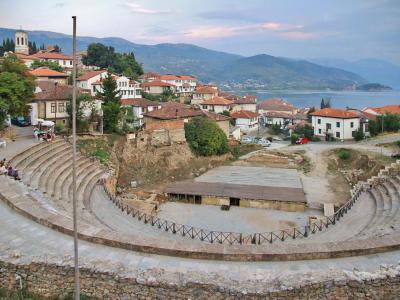
The Ancient Theatre of Ohrid is a remarkable Hellenistic-period relic, dating back to 200 BC. It holds the distinction of being the only theater of its type in the country, contrasting with the Roman-era theaters found in Scupi, Stobi, and Heraklea Lynkestis. Originally designed to host a considerable audience, only the lower section of the theater survives today, making it difficult to ascertain its full capacity.
Strategically nestled between two hills, the theater's location is ideal, providing natural wind protection which enhances its acoustics, a feature crucial for the live performances it was built to host. During the Roman era, the theater’s purpose expanded to include gladiator fights and it also served as a venue for executing Christians, which led to its growing unpopularity among the local populace. This disfavor ultimately resulted in the theater being buried by the locals following the fall of the Roman Empire, an act which inadvertently preserved much of its structure.
The theater remained hidden until the 1980s when it was accidentally uncovered during construction activities in the area. Discoveries of large stone blocks engraved with depictions of the Greek god Dionysus and the muses suggested the presence of a significant Greek cultural site, leading to its excavation.
Revived in the late 1980s, the Ancient Theatre of Ohrid has been reintegrated into cultural life, hosting a variety of public performances including plays, concerts, operas, and ballet. It has also become a prestigious venue within the Ohrid Summer Festival, attracting international performances from renowned groups and artists like the Bolshoi and José Carreras. This historical site not only serves as a testament to the architectural and cultural achievements of ancient times but also as a vibrant center of contemporary cultural expression.
Strategically nestled between two hills, the theater's location is ideal, providing natural wind protection which enhances its acoustics, a feature crucial for the live performances it was built to host. During the Roman era, the theater’s purpose expanded to include gladiator fights and it also served as a venue for executing Christians, which led to its growing unpopularity among the local populace. This disfavor ultimately resulted in the theater being buried by the locals following the fall of the Roman Empire, an act which inadvertently preserved much of its structure.
The theater remained hidden until the 1980s when it was accidentally uncovered during construction activities in the area. Discoveries of large stone blocks engraved with depictions of the Greek god Dionysus and the muses suggested the presence of a significant Greek cultural site, leading to its excavation.
Revived in the late 1980s, the Ancient Theatre of Ohrid has been reintegrated into cultural life, hosting a variety of public performances including plays, concerts, operas, and ballet. It has also become a prestigious venue within the Ohrid Summer Festival, attracting international performances from renowned groups and artists like the Bolshoi and José Carreras. This historical site not only serves as a testament to the architectural and cultural achievements of ancient times but also as a vibrant center of contemporary cultural expression.
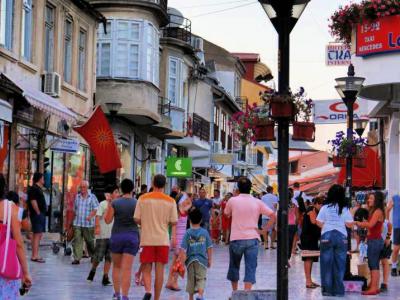
5) Old Bazaar Street
The Old Bazaar ain't what it used to be. Or perhaps it never was a world-class market place. Ohrid has always been a religious and cultural center more then anything else. It shines not as a center for trade. So the bazaar is simple. It is just one street extending up from the waterfront to the Main Square of town, not a great distance.
The bazaar extends from the Square downhill to the waterfront or it reaches the square from the shore of Lake Ohrid, whichever way one chooses. It is a walk, no cars. The street is variously paved with cobblestones in the narrow parts or with marble slates in the wider parts. In olden times, the street was covered with grape vines for shade.
Starting from the Main Square, one passes through the food market (formerly an animal market). The few original stores of the bazaar are made of stone. The Ohrid market provides a very different experience than that of Greek or Serbian markets. The open market is not noisy. The merchants sell their foods with a calm not found elsewhere.
After the food market is the Turkish bazaar. Here are kebabs, baklava, Turkish delights, and other foods in the Ottoman legacy. Shoemakers, barbers, leather shops, pearl makers and various other crafts may satisfy the pleasant needs of everyday.
The bazaar extends from the Square downhill to the waterfront or it reaches the square from the shore of Lake Ohrid, whichever way one chooses. It is a walk, no cars. The street is variously paved with cobblestones in the narrow parts or with marble slates in the wider parts. In olden times, the street was covered with grape vines for shade.
Starting from the Main Square, one passes through the food market (formerly an animal market). The few original stores of the bazaar are made of stone. The Ohrid market provides a very different experience than that of Greek or Serbian markets. The open market is not noisy. The merchants sell their foods with a calm not found elsewhere.
After the food market is the Turkish bazaar. Here are kebabs, baklava, Turkish delights, and other foods in the Ottoman legacy. Shoemakers, barbers, leather shops, pearl makers and various other crafts may satisfy the pleasant needs of everyday.
