Custom Walk in Verona, Italy by f_carter_au_22c276 created on 2026-06-04
Guide Location: Italy » Verona
Guide Type: Custom Walk
# of Sights: 7
Tour Duration: 1 Hour(s)
Travel Distance: 2 Km or 1.2 Miles
Share Key: HPNVA
Guide Type: Custom Walk
# of Sights: 7
Tour Duration: 1 Hour(s)
Travel Distance: 2 Km or 1.2 Miles
Share Key: HPNVA
How It Works
Please retrieve this walk in the GPSmyCity app. Once done, the app will guide you from one tour stop to the next as if you had a personal tour guide. If you created the walk on this website or come to the page via a link, please follow the instructions below to retrieve the walk in the app.
Retrieve This Walk in App
Step 1. Download the app "GPSmyCity: Walks in 1K+ Cities" on Apple App Store or Google Play Store.



Step 2. In the GPSmyCity app, download(or launch) the guide "Verona Map and Walking Tours".
Step 3. Tap the menu button located at upper right corner of the "Walks" screen and select "Retrieve custom walk". Enter the share key: HPNVA
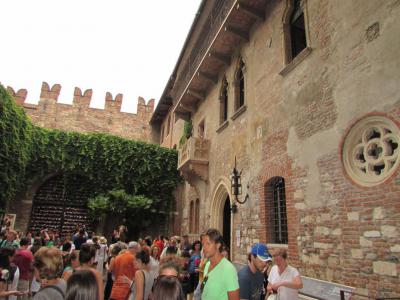
1) Casa de Giulietta (House of Juliet) (must see)
The House of Juliet is one of the most famous landmarks associated with William Shakespeare’s Romeo and Juliet, often visited by those seeking to experience the legendary romance between Juliet Capulet and Romeo Montague. Though the story is fictional, the house itself has become a symbol of love and tragedy, drawing countless visitors who are eager to connect with Verona’s most romantic tale.
The house dates back to the 13th century and is believed to have belonged to the Cappelletti family, traditionally linked to Juliet’s fictional lineage. The most famous feature of the house is its balcony, now an enduring emblem of Juliet’s longing in the play. Visitors often picture the moment when Romeo whispers his devotion from below. Although the balcony itself was added during restoration in the 20th century, it remains one of the city’s most photographed sights and a key highlight for fans of Shakespeare’s work.
The building is a fine example of medieval architecture, featuring Gothic elements, a brick façade, and intricately carved details. In the courtyard, a bronze statue of Juliet stands beneath the balcony, and the tradition of rubbing its right breast for good luck in love has made it a popular spot for photos. The walls nearby are covered with love messages, notes, and padlocks left by couples hoping for lasting affection.
Inside, the house has been transformed into a museum, displaying period furnishings, costumes used in film adaptations, and exhibits about the cultural impact of Shakespeare’s tragic story. From its romantic folklore to its historical roots, the House of Juliet continues to inspire visitors from around the world with the enduring power of love and imagination.
The house dates back to the 13th century and is believed to have belonged to the Cappelletti family, traditionally linked to Juliet’s fictional lineage. The most famous feature of the house is its balcony, now an enduring emblem of Juliet’s longing in the play. Visitors often picture the moment when Romeo whispers his devotion from below. Although the balcony itself was added during restoration in the 20th century, it remains one of the city’s most photographed sights and a key highlight for fans of Shakespeare’s work.
The building is a fine example of medieval architecture, featuring Gothic elements, a brick façade, and intricately carved details. In the courtyard, a bronze statue of Juliet stands beneath the balcony, and the tradition of rubbing its right breast for good luck in love has made it a popular spot for photos. The walls nearby are covered with love messages, notes, and padlocks left by couples hoping for lasting affection.
Inside, the house has been transformed into a museum, displaying period furnishings, costumes used in film adaptations, and exhibits about the cultural impact of Shakespeare’s tragic story. From its romantic folklore to its historical roots, the House of Juliet continues to inspire visitors from around the world with the enduring power of love and imagination.
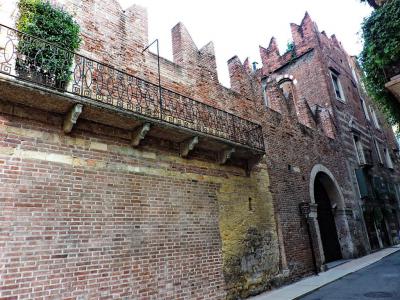
2) Casa di Romeo (House of Romeo)
The House of Romeo is a 13th-century brick residence often linked to the Montague family from Shakespeare’s Romeo and Juliet. In reality, the building historically belonged to the noble Nogarola family, but its medieval appearance and location near Juliet’s House have made it part of Verona’s romantic storytelling.
With its fortified walls and tower-like structure, the home reflects the architectural style of noble residences from a period marked by family rivalries and political tension. These defensive features recall the bitter factional conflicts that once divided Verona into two opposing political groups: the Guelphs and the Ghibellines - the very type of feud Shakespeare drew upon for his tragedy.
Unlike Juliet’s House, the House of Romeo is privately owned and cannot be visited inside. Visitors typically admire the exterior from the narrow street outside the entrance, where the building’s castle-like presence evokes the turbulent atmosphere that inspired Shakespeare’s drama. A small relief of a stylized coat of arms can be seen above the entrance, a reminder of the noble family that once lived within.
Next to the residence is La Taverna di Romeo restaurant, where visitors often stop for a meal or drink - not to enter the house itself, but to enjoy the surrounding ambience. Some regional dishes include traditional Veronese specialties such as horse or donkey meat.
By the 19th century, Romantic-era travelers were already seeking out places linked to the Shakespeare’s play, helping cement the building’s modern identity. Today, the House of Romeo remains a symbolic stop for those exploring the city of love - a modest yet atmospheric reminder of the enduring power of literature layered onto real medieval history.
With its fortified walls and tower-like structure, the home reflects the architectural style of noble residences from a period marked by family rivalries and political tension. These defensive features recall the bitter factional conflicts that once divided Verona into two opposing political groups: the Guelphs and the Ghibellines - the very type of feud Shakespeare drew upon for his tragedy.
Unlike Juliet’s House, the House of Romeo is privately owned and cannot be visited inside. Visitors typically admire the exterior from the narrow street outside the entrance, where the building’s castle-like presence evokes the turbulent atmosphere that inspired Shakespeare’s drama. A small relief of a stylized coat of arms can be seen above the entrance, a reminder of the noble family that once lived within.
Next to the residence is La Taverna di Romeo restaurant, where visitors often stop for a meal or drink - not to enter the house itself, but to enjoy the surrounding ambience. Some regional dishes include traditional Veronese specialties such as horse or donkey meat.
By the 19th century, Romantic-era travelers were already seeking out places linked to the Shakespeare’s play, helping cement the building’s modern identity. Today, the House of Romeo remains a symbolic stop for those exploring the city of love - a modest yet atmospheric reminder of the enduring power of literature layered onto real medieval history.
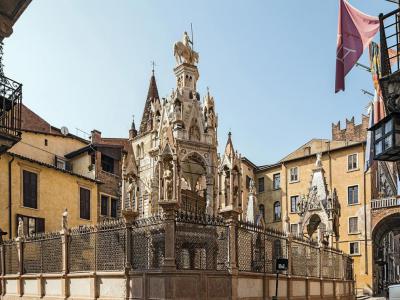
3) Arche Scaligere (Scaligeri Tombs)
The Scaliger Tombs form one of Verona’s most prominent Gothic ensembles. These five funerary monuments commemorate the Scaligeri family, who ruled Verona during the 13th and 14th centuries. While often associated with Shakespeare’s Romeo and Juliet, the idea that this was the location of Juliet’s staged death belongs to literary tradition rather than documented history.
The tombs stand in a small, gated courtyard beside the Church of Santa Maria Antica, the family’s private chapel. Their design resembles elaborate Gothic tabernacles: each features a highly carved sarcophagus and a canopy, with the deceased depicted on horseback in full armor symbolizing power and leadership.
The rise of these monuments reflects the political ascent of the Scaligeri. Mastino I della Scala secured control over Verona in 1259, earning his family hereditary authority. Yet, as in many medieval dynasties, internal rivalries eventually led to their downfall - an echo of the dramatic themes that later inspired Shakespeare’s storytelling.
Celebrated as some of the finest examples of Gothic funerary architecture in Italy, the Scaliger Tombs remain a powerful reminder of the family who shaped Verona’s medieval history and left a legacy visible in the city’s towers, fortifications, and political memory.
The tombs stand in a small, gated courtyard beside the Church of Santa Maria Antica, the family’s private chapel. Their design resembles elaborate Gothic tabernacles: each features a highly carved sarcophagus and a canopy, with the deceased depicted on horseback in full armor symbolizing power and leadership.
The rise of these monuments reflects the political ascent of the Scaligeri. Mastino I della Scala secured control over Verona in 1259, earning his family hereditary authority. Yet, as in many medieval dynasties, internal rivalries eventually led to their downfall - an echo of the dramatic themes that later inspired Shakespeare’s storytelling.
Celebrated as some of the finest examples of Gothic funerary architecture in Italy, the Scaliger Tombs remain a powerful reminder of the family who shaped Verona’s medieval history and left a legacy visible in the city’s towers, fortifications, and political memory.
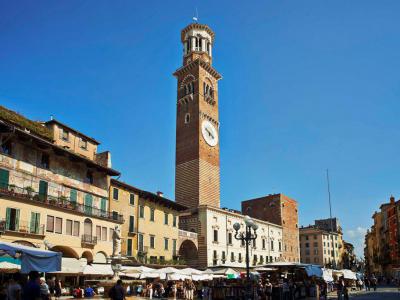
4) Torre dei Lamberti (Lamberti Tower) (must see)
Lamberti Tower is one of Verona’s most recognizable landmarks, built beginning in 1172 by the influential Lamberti family, at a time when prominent Veronese households constructed tall towers to express their wealth and political influence. Over the centuries, the tower has undergone several phases of modification, including a major restoration following a lightning strike in 1403. This reconstruction campaign, which lasted from 1448 to 1464, introduced visible changes in materials and extended the structure to its current height of 84 metres.
The tower features two bells, each with a distinct civic purpose. The Rengo bell once summoned citizens to arms or to public assemblies, while the Marangona signaled work hours, timekeeping, and fire warnings. These bells were central to the daily lives of medieval and Renaissance residents, long before the advent of printed notices or municipal clocks. Their sound was so important that strict laws governed when and how each bell could be rung.
Visitors today can take an elevator partway up and then climb the remaining stairs to reach the main viewing terrace. From the top, the view extends across the historic center - from Market Square directly below to the rooftops and bell towers that define Verona’s skyline - and outward to the Adige River and the surrounding hills. The tower’s clock, a late-18th-century addition, enhanced its civic importance and remains one of the most visible timekeepers in the city.
Today, Lamberti Tower is part of the vast Palace of the Reason complex and is included in Verona’s network of civic museums, hosting temporary exhibitions and occasional special events in its interior spaces. It continues to serve as a key point of orientation for locals and travellers alike.
The tower features two bells, each with a distinct civic purpose. The Rengo bell once summoned citizens to arms or to public assemblies, while the Marangona signaled work hours, timekeeping, and fire warnings. These bells were central to the daily lives of medieval and Renaissance residents, long before the advent of printed notices or municipal clocks. Their sound was so important that strict laws governed when and how each bell could be rung.
Visitors today can take an elevator partway up and then climb the remaining stairs to reach the main viewing terrace. From the top, the view extends across the historic center - from Market Square directly below to the rooftops and bell towers that define Verona’s skyline - and outward to the Adige River and the surrounding hills. The tower’s clock, a late-18th-century addition, enhanced its civic importance and remains one of the most visible timekeepers in the city.
Today, Lamberti Tower is part of the vast Palace of the Reason complex and is included in Verona’s network of civic museums, hosting temporary exhibitions and occasional special events in its interior spaces. It continues to serve as a key point of orientation for locals and travellers alike.
5) Arena di Verona (Verona Amphitheater) (must see)
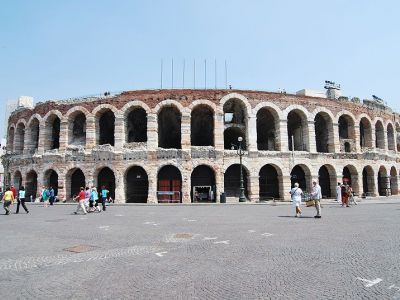
Verona Amphitheater stands as one of the most remarkable Roman amphitheatres still in existence. Built around 30 AD, it once formed the lively heart of entertainment in ancient Verona. Its elliptical shape, strong stone arches, and imposing tiers made it a masterpiece of Roman engineering, perfectly designed to host crowds who came to witness gladiatorial combat and public spectacles. Today, more than 500,000 visitors each year step into the Arena to reconnect with this extraordinary past.
Constructed from pink and white limestone quarried in nearby Valpolicella, the amphitheatre originally seated up to 30,000 spectators. A devastating earthquake in 1117 damaged the structure and destroyed most of its outer ring, leaving only a single surviving portion, known as the “Wing”. Even with a reduced capacity of around 22,000, the Arena still conveys the scale and innovation that made it one of the largest venues in the Roman world.
In the modern era, the Arena has earned international acclaim as the home of the Verona Opera Festival, held every summer beneath the open sky. Its acoustics are so exceptional that performers often sing without amplification, their voices carried naturally through the ancient stone. Legendary operatic stars such as Maria Callas, Plácido Domingo, and Luciano Pavarotti have graced this stage, along with world-renowned rock and pop artists.
Visiting the Arena offers a chance to explore its historic passageways, climb the stone seating tiers, and admire views across Bra Square. Yet the most unforgettable experience comes at night, when the amphitheatre glows beneath the lights and a performance begins.
Constructed from pink and white limestone quarried in nearby Valpolicella, the amphitheatre originally seated up to 30,000 spectators. A devastating earthquake in 1117 damaged the structure and destroyed most of its outer ring, leaving only a single surviving portion, known as the “Wing”. Even with a reduced capacity of around 22,000, the Arena still conveys the scale and innovation that made it one of the largest venues in the Roman world.
In the modern era, the Arena has earned international acclaim as the home of the Verona Opera Festival, held every summer beneath the open sky. Its acoustics are so exceptional that performers often sing without amplification, their voices carried naturally through the ancient stone. Legendary operatic stars such as Maria Callas, Plácido Domingo, and Luciano Pavarotti have graced this stage, along with world-renowned rock and pop artists.
Visiting the Arena offers a chance to explore its historic passageways, climb the stone seating tiers, and admire views across Bra Square. Yet the most unforgettable experience comes at night, when the amphitheatre glows beneath the lights and a performance begins.
6) William Shakespeare Bust and Plaque
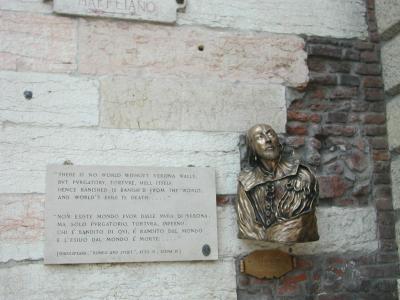
The bust of William Shakespeare, accompanied by a commemorative plaque, stands near the historic gates of Verona - a symbolic tribute to the playwright who immortalized the city through Romeo and Juliet. Set into the old stone walls leading toward Bra Square, this monument marks what was once the city’s primary entrance during medieval times. According to the story, when Romeo was punished for killing Tybalt, he would have been forced to leave Verona through these very gates, stepping into exile and away from Juliet forever.
The plaque features lines from Shakespeare’s tragedy, displayed in both English and Italian to honor Verona’s international audience. The quoted passage captures Romeo’s anguish at being banished from the city of his love: “There is no world without Verona walls. But purgatory, torture, hell itself. Hence banished is banished from the world. And world’s exile is death.”
The bronze bust, crafted in 2003 by local sculptor Sergio Pasetto, portrays Shakespeare with a thoughtful, upward gaze, as if contemplating the drama he set among Verona’s streets and palaces. Today, visitors often pause here to take photos, read the heartfelt inscription, and reflect on how a fictional love story helped shape Verona’s identity.
The plaque features lines from Shakespeare’s tragedy, displayed in both English and Italian to honor Verona’s international audience. The quoted passage captures Romeo’s anguish at being banished from the city of his love: “There is no world without Verona walls. But purgatory, torture, hell itself. Hence banished is banished from the world. And world’s exile is death.”
The bronze bust, crafted in 2003 by local sculptor Sergio Pasetto, portrays Shakespeare with a thoughtful, upward gaze, as if contemplating the drama he set among Verona’s streets and palaces. Today, visitors often pause here to take photos, read the heartfelt inscription, and reflect on how a fictional love story helped shape Verona’s identity.
7) Juliet's Tomb
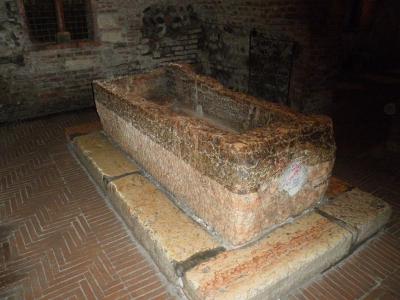
Located within the peaceful grounds of the Monastery of San Francesco al Corso lies Juliet’s Tomb, a site closely tied to the legend of Shakespeare’s Romeo and Juliet. This setting has become one of the most emotional stops for those drawn to Verona’s most famous lovers. Here, visitors can step into the dim, atmospheric crypt where Juliet is said to have lain in eternal slumber.
In the courtyard above, a bronze statue of Juliet stands as a gesture of everlasting love. Tradition says that touching the statue - especially placing a hand over her heart - brings good fortune in romance. Devoted couples often leave heartfelt notes or photos nearby.
The monastery complex offers far more than a legendary tomb. Its gardens, trellised paths, and historical halls form a graceful venue for weddings and commemorative events. Near the tomb, the beautiful Guarienti Hall displays artworks depicting scenes from the play, while the adjacent church is frequently imagined as the church where Romeo and Juliet were secretly married.
Adding cultural depth to the visit, the monastery is also home to the Museum of Frescoes, inaugurated in 1975. Inside, visitors can admire detached frescoes from Verona’s noble houses and churches dating from the Middle Ages to the 18th century, as well as Roman artifacts that connect this romantic site to the city’s ancient past. Seasonal theatrical performances, often reenacting scenes from Shakespeare’s masterpiece, animate the cloisters and terraces, making the story feel vividly alive.
Each February, Juliet’s Tomb becomes the heart of a special tradition: the “Dear Juliet” contest selects the most touching love letters sent from around the world, carried on the belief that Juliet’s spirit still listens to those in love.
Tip:
If you plan to visit Juliet’s House as well, consider a combined ticket - it offers convenient access to both of Verona’s romantic sites, and helps you follow the lovers’ story from balcony to tomb.
In the courtyard above, a bronze statue of Juliet stands as a gesture of everlasting love. Tradition says that touching the statue - especially placing a hand over her heart - brings good fortune in romance. Devoted couples often leave heartfelt notes or photos nearby.
The monastery complex offers far more than a legendary tomb. Its gardens, trellised paths, and historical halls form a graceful venue for weddings and commemorative events. Near the tomb, the beautiful Guarienti Hall displays artworks depicting scenes from the play, while the adjacent church is frequently imagined as the church where Romeo and Juliet were secretly married.
Adding cultural depth to the visit, the monastery is also home to the Museum of Frescoes, inaugurated in 1975. Inside, visitors can admire detached frescoes from Verona’s noble houses and churches dating from the Middle Ages to the 18th century, as well as Roman artifacts that connect this romantic site to the city’s ancient past. Seasonal theatrical performances, often reenacting scenes from Shakespeare’s masterpiece, animate the cloisters and terraces, making the story feel vividly alive.
Each February, Juliet’s Tomb becomes the heart of a special tradition: the “Dear Juliet” contest selects the most touching love letters sent from around the world, carried on the belief that Juliet’s spirit still listens to those in love.
Tip:
If you plan to visit Juliet’s House as well, consider a combined ticket - it offers convenient access to both of Verona’s romantic sites, and helps you follow the lovers’ story from balcony to tomb.
