Custom Walk in Geneva, Switzerland by nyy87543_9bef9 created on 2026-06-11
Guide Location: Switzerland » Geneva
Guide Type: Custom Walk
# of Sights: 7
Tour Duration: 3 Hour(s)
Travel Distance: 6.9 Km or 4.3 Miles
Share Key: H4WVD
Guide Type: Custom Walk
# of Sights: 7
Tour Duration: 3 Hour(s)
Travel Distance: 6.9 Km or 4.3 Miles
Share Key: H4WVD
How It Works
Please retrieve this walk in the GPSmyCity app. Once done, the app will guide you from one tour stop to the next as if you had a personal tour guide. If you created the walk on this website or come to the page via a link, please follow the instructions below to retrieve the walk in the app.
Retrieve This Walk in App
Step 1. Download the app "GPSmyCity: Walks in 1K+ Cities" on Apple App Store or Google Play Store.



Step 2. In the GPSmyCity app, download(or launch) the guide "Geneva Map and Walking Tours".
Step 3. Tap the menu button located at upper right corner of the "Walks" screen and select "Retrieve custom walk". Enter the share key: H4WVD
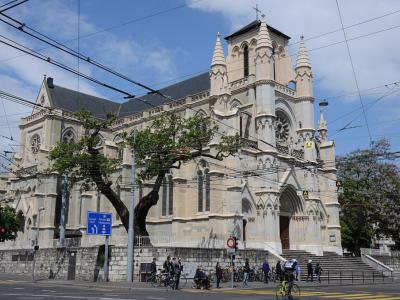
1) Basilique Notre-Dame
The Basilique de Notre-Dame serves as the primary Catholic church in Geneva. It was constructed between 1852 and 1857 based on the architectural plans of Alexandre Grigny. The basilica stands on the former site of defensive fortifications. This Neo-Gothic structure draws some of its design inspiration from the Beauvais Cathedral. Its establishment was made possible through a combination of factors, including the city of Geneva granting land to religious communities for the construction of places of worship, along with donations and manual labor contributed by the Catholic community in Geneva.
Inside the basilica, there is a statue of Our Lady of Geneva, a gift from Pope Pius IX, which is highly revered. However, the basilica is particularly renowned for its stained glass windows. While some of these windows are produced in a semi-industrial Neo-Gothic style, most of them showcase the evolution of stained glass art during the 20th century. These windows come in various styles, following the era of Claudius Lavergne, who installed them between 1857 and 1875. Starting in 1912, several artists have contributed to the decoration of the basilica, including Charles Brunner, Alexandre Cingria, Maurice Denis, Gherri Moro, Paul Monnier, Jean-Claude Morend, and Théodore Strawinsky.
The basilica has been recognized as a culturally significant National Heritage Site.
Inside the basilica, there is a statue of Our Lady of Geneva, a gift from Pope Pius IX, which is highly revered. However, the basilica is particularly renowned for its stained glass windows. While some of these windows are produced in a semi-industrial Neo-Gothic style, most of them showcase the evolution of stained glass art during the 20th century. These windows come in various styles, following the era of Claudius Lavergne, who installed them between 1857 and 1875. Starting in 1912, several artists have contributed to the decoration of the basilica, including Charles Brunner, Alexandre Cingria, Maurice Denis, Gherri Moro, Paul Monnier, Jean-Claude Morend, and Théodore Strawinsky.
The basilica has been recognized as a culturally significant National Heritage Site.
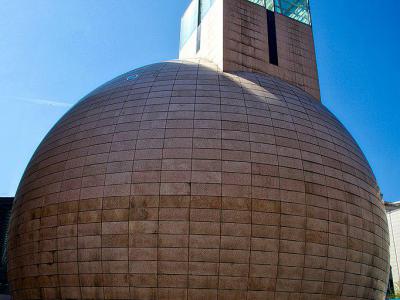
2) Église Sainte-Trinité (Church of the Holy Trinity)
The Church of the Holy Trinity in Geneva is a remarkable example of modern religious architecture. Dressed in pink granite, its spherical shape is unique and eye-catching, making it stand out in the city. Completed in 1994, this church is more than just a building; it's a significant addition to the region's Roman Catholic buildings, marking an important chapter in the local history of architecture and religion.
The church's design, conceived by Ugo Brunoni, reflects contemporary architectural thinking. The sphere, 20 meters across, isn't just a shape but carries deep theological meaning, representing the Holy Trinity - the Father, the Son, and the Holy Spirit. The sphere's placement over water, a symbol of life and fertility, adds even more depth to its meaning.
Inside, the church comes alive with 12 round windows, each a different color of the rainbow. These windows light up the interior and add a vibrant, dynamic quality to the space. The combination of modern design, meaningful symbolism, and colorful elements offers a place that can be interpreted in many ways, mirroring the diverse views and ideas of its visitors.
Overall, the Église Sainte-Trinité is a unique and modern architectural wonder, rich in symbolism and artistic flair. Its distinct shape and thoughtful design make it a prominent feature in Geneva's urban landscape.
The church's design, conceived by Ugo Brunoni, reflects contemporary architectural thinking. The sphere, 20 meters across, isn't just a shape but carries deep theological meaning, representing the Holy Trinity - the Father, the Son, and the Holy Spirit. The sphere's placement over water, a symbol of life and fertility, adds even more depth to its meaning.
Inside, the church comes alive with 12 round windows, each a different color of the rainbow. These windows light up the interior and add a vibrant, dynamic quality to the space. The combination of modern design, meaningful symbolism, and colorful elements offers a place that can be interpreted in many ways, mirroring the diverse views and ideas of its visitors.
Overall, the Église Sainte-Trinité is a unique and modern architectural wonder, rich in symbolism and artistic flair. Its distinct shape and thoughtful design make it a prominent feature in Geneva's urban landscape.
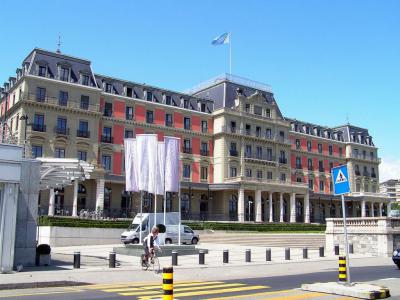
3) Palais Wilson (Wilson Palace)
The Wilson Palace is an iconic building that has historical and international importance. It has served as the headquarters of the Office of the United Nations High Commissioner for Human Rights (OHCHR) since 1993.
The palace is a beautiful example of neoclassical architecture, characterized by its elegant design, grand columns, and intricate detailing. The building's façade is particularly noteworthy, featuring Ionic columns and decorative elements that reflect the architectural style of the early 20th century.
The palace was constructed between 1873 and 1878 as a luxury hotel called the Hotel National. It was designed by the Swiss architect Jules-Louis and John Camoletti. In 1924, it was acquired by the League of Nations, an intergovernmental organization that preceded the United Nations. It was then renamed the Wilson Palace in honor of U.S. President Woodrow Wilson, who played a crucial role in the establishment of the League of Nations.
Today, the Wilson Palace is best known for its role in promoting human rights and global diplomacy. It houses the offices of the United Nations High Commissioner for Human Rights and serves as a center for discussions and activities related to human rights on an international scale.
While the Wilson Palace is primarily a working government building and not typically open to the public for tours, its grand architecture and historical significance make it a notable landmark to admire from the outside. Visitors to Geneva can appreciate its beauty as they explore the city's vibrant streets.
The palace is a beautiful example of neoclassical architecture, characterized by its elegant design, grand columns, and intricate detailing. The building's façade is particularly noteworthy, featuring Ionic columns and decorative elements that reflect the architectural style of the early 20th century.
The palace was constructed between 1873 and 1878 as a luxury hotel called the Hotel National. It was designed by the Swiss architect Jules-Louis and John Camoletti. In 1924, it was acquired by the League of Nations, an intergovernmental organization that preceded the United Nations. It was then renamed the Wilson Palace in honor of U.S. President Woodrow Wilson, who played a crucial role in the establishment of the League of Nations.
Today, the Wilson Palace is best known for its role in promoting human rights and global diplomacy. It houses the offices of the United Nations High Commissioner for Human Rights and serves as a center for discussions and activities related to human rights on an international scale.
While the Wilson Palace is primarily a working government building and not typically open to the public for tours, its grand architecture and historical significance make it a notable landmark to admire from the outside. Visitors to Geneva can appreciate its beauty as they explore the city's vibrant streets.
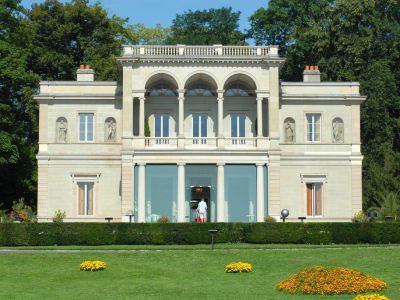
4) Musée D'Histoire Des Sciences (Museum of the History of Science)
The Museum of the History of Science of the City of Geneva is a small museum located in Switzerland. This museum is dedicated to showcasing the historical developments and achievements in the field of science.
Situated in the Villa Bartholoni, a remarkable architectural gem constructed in 1830 and extensively restored from 1985 to 1992 within the La Perle du Lac park, the museum enjoys a stunning setting. The Villa is a prime example of Palladian architecture, characterized by its geometric simplicity. Its interior is adorned with mythological scenes and an extravagant selection of materials. Originally a summer residence for the aristocracy, it has been the History of Science Museum's home since 1964 and is recognized as culturally significant in the Swiss Inventory.
The museum was established in 1964 due to the enthusiasm of the Museum and Review of the History of Science Association, which was inspired by an exhibition on the history of science at the Musée Rath. Upon its inception, the Swiss Institute of Physics and Observatory generously contributed their historic scientific instruments to the museum's collection.
The museum's collections primarily consist of scientific measurement apparatus dating from the 17th to the 19th centuries. These collections include items such as microscopes, telescopes, thermometers, and other scientific instruments, particularly those formerly used by renowned Genevan scientists like Saussure, Pictet, de la Rive, and Colladon. The exhibits not only feature these historic instruments but also offer practical experiments within the museum building and some displays in the surrounding park.
Situated in the Villa Bartholoni, a remarkable architectural gem constructed in 1830 and extensively restored from 1985 to 1992 within the La Perle du Lac park, the museum enjoys a stunning setting. The Villa is a prime example of Palladian architecture, characterized by its geometric simplicity. Its interior is adorned with mythological scenes and an extravagant selection of materials. Originally a summer residence for the aristocracy, it has been the History of Science Museum's home since 1964 and is recognized as culturally significant in the Swiss Inventory.
The museum was established in 1964 due to the enthusiasm of the Museum and Review of the History of Science Association, which was inspired by an exhibition on the history of science at the Musée Rath. Upon its inception, the Swiss Institute of Physics and Observatory generously contributed their historic scientific instruments to the museum's collection.
The museum's collections primarily consist of scientific measurement apparatus dating from the 17th to the 19th centuries. These collections include items such as microscopes, telescopes, thermometers, and other scientific instruments, particularly those formerly used by renowned Genevan scientists like Saussure, Pictet, de la Rive, and Colladon. The exhibits not only feature these historic instruments but also offer practical experiments within the museum building and some displays in the surrounding park.
5) Palace of Nations (must see)
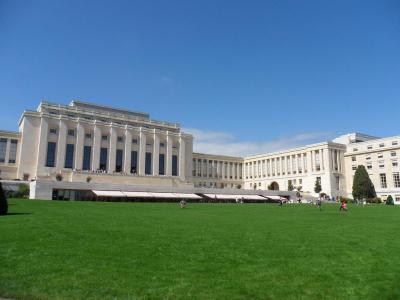
The League of Nations, predecessor of the United Nations, first established itself in the old Hotel National building (later called Wilson Palace) on the shores of Lake Geneva in the early 1920s. In 1926 a competition was held for the construction designs of the Palace of Nations, future home of the League.
Five architects were chosen: Julien Flegenheimer of Switzerland, Camile Lefevre and Henri-Paul Nenot of France, Carlo Broggi of Italy and Jozsef Vago of Hungary. The library, in a separate wing, was funded later by John D. Rockefeller, Jr. A place for the Palace of Nations was found in the 114-acre Ariana Park.
The palace is a Modernist stone combination of Art Deco and Rationalism, with a soupçon of Bauhaus. The foundation stone was laid in 1929. Underneath the stone, a time capsule contains a list of members, a copy of the League Covenant, and coins.
On the south side of the Palace of Nations, four rows of the flags of 190 nations extend from the gate to the building. The 40-foot high Broken Chair sculpture in front of the palace, makes visitors mindful of the dangers of land mines scattered throughout the world.
The massive "Celestial Sphere" of steel and bronze before the palace mirrors the heavens, as seen from the earth. Created by American sculptor Paul Howard Manship in 1938, the sphere has witnessed the fall of the League of Nations and the birth of the United Nations. Hope lives on.
Five architects were chosen: Julien Flegenheimer of Switzerland, Camile Lefevre and Henri-Paul Nenot of France, Carlo Broggi of Italy and Jozsef Vago of Hungary. The library, in a separate wing, was funded later by John D. Rockefeller, Jr. A place for the Palace of Nations was found in the 114-acre Ariana Park.
The palace is a Modernist stone combination of Art Deco and Rationalism, with a soupçon of Bauhaus. The foundation stone was laid in 1929. Underneath the stone, a time capsule contains a list of members, a copy of the League Covenant, and coins.
On the south side of the Palace of Nations, four rows of the flags of 190 nations extend from the gate to the building. The 40-foot high Broken Chair sculpture in front of the palace, makes visitors mindful of the dangers of land mines scattered throughout the world.
The massive "Celestial Sphere" of steel and bronze before the palace mirrors the heavens, as seen from the earth. Created by American sculptor Paul Howard Manship in 1938, the sphere has witnessed the fall of the League of Nations and the birth of the United Nations. Hope lives on.
6) Musée Ariana (Ariana Museum)
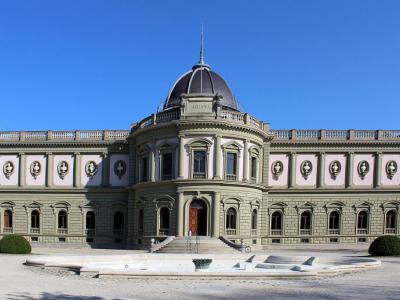
The Ariana Museum (Musée Ariana), also referred to as the Swiss Museum of Ceramics and Glass, is a cultural institution located in Geneva. Its primary focus is the exhibition of ceramic and glass artworks, boasting a remarkable collection of approximately 20,000 items spanning a historical period of 1,200 years. This collection effectively captures the diverse aspects of glass and ceramic production in terms of historical evolution, geographical origins, artistic expressions, and technological advancements. It is noteworthy that this museum stands as the sole institution of its kind in Switzerland.
Constructed between 1877 and 1884, the architectural design of the museum seamlessly incorporates elements of Neo-Classical and Neo-Baroque styles. It is prominently positioned on Avenue de la Paix, in close proximity to the Palace of Nations. The museum was originally established to house the private art collection of the Swiss art enthusiast and patron, Gustave Revilliod. He named the museum in honor of his mother, Ariane de la Rive, and eventually bequeathed it to the city of Geneva.
In 1934, the museum became a member of the association of art and history museums in Geneva, known as Les Musées d'Art et d'Histoire Geneve. Subsequently, certain portions of the collection were relocated to other museums, while the Ariana Museum expanded its holdings by acquiring new exhibits, with a specific emphasis on glass and ceramics. After a period of extensive renovations lasting 12 years, the museum was reopened to the public in 1993.
Constructed between 1877 and 1884, the architectural design of the museum seamlessly incorporates elements of Neo-Classical and Neo-Baroque styles. It is prominently positioned on Avenue de la Paix, in close proximity to the Palace of Nations. The museum was originally established to house the private art collection of the Swiss art enthusiast and patron, Gustave Revilliod. He named the museum in honor of his mother, Ariane de la Rive, and eventually bequeathed it to the city of Geneva.
In 1934, the museum became a member of the association of art and history museums in Geneva, known as Les Musées d'Art et d'Histoire Geneve. Subsequently, certain portions of the collection were relocated to other museums, while the Ariana Museum expanded its holdings by acquiring new exhibits, with a specific emphasis on glass and ceramics. After a period of extensive renovations lasting 12 years, the museum was reopened to the public in 1993.
7) Les Schtroumpfs (Smurf Buildings)
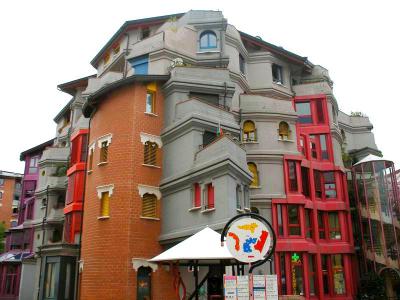
Built between 1982 and 1984 by Swiss architects Christian Hunziger, Robert Frei, and Georges Berthoud, this housing complex looks as though someone gave geometry a day off. Inspired by the playful imagination of Catalan architect Antoni Gaudí, the buildings twist and bend with irregular angles, rounded walls, colorful details, and wrought-iron balconies that seem determined to avoid a straight line at all costs. It feels less like a standard apartment block, and more like architecture decided to loosen its tie and have some fun...
Locals quickly gave the complex a nickname: the “Schtroumpf” buildings. “Schtroumpf” is the French word for Smurf, borrowed from the Belgian comic world of tiny blue creatures living in whimsical mushroom-shaped homes. One glance at these playful façades and the comparison suddenly makes perfect sense. The buildings appear almost hand-sculpted, as if they grew naturally rather than being carefully planned on an architect’s drafting table.
The complex itself includes around 170 subsidized apartments, along with offices, a small theatre, medical practices, a café, and even a pole dance studio—because apparently ordinary amenities would not quite match the spirit of the place... It is a lively little micro-neighbourhood tucked into the city rather than simply a row of residences.
While the interiors are not open to visitors, the exterior alone makes the detour worthwhile. Wander around slowly, notice the uneven windows and curved corners, and enjoy one of Geneva’s most unexpected architectural surprises. Also, if you happen to visit on a Thursday, nearby Grottes (or Caves) Square hosts a local market with an equally relaxed and eclectic atmosphere.
Locals quickly gave the complex a nickname: the “Schtroumpf” buildings. “Schtroumpf” is the French word for Smurf, borrowed from the Belgian comic world of tiny blue creatures living in whimsical mushroom-shaped homes. One glance at these playful façades and the comparison suddenly makes perfect sense. The buildings appear almost hand-sculpted, as if they grew naturally rather than being carefully planned on an architect’s drafting table.
The complex itself includes around 170 subsidized apartments, along with offices, a small theatre, medical practices, a café, and even a pole dance studio—because apparently ordinary amenities would not quite match the spirit of the place... It is a lively little micro-neighbourhood tucked into the city rather than simply a row of residences.
While the interiors are not open to visitors, the exterior alone makes the detour worthwhile. Wander around slowly, notice the uneven windows and curved corners, and enjoy one of Geneva’s most unexpected architectural surprises. Also, if you happen to visit on a Thursday, nearby Grottes (or Caves) Square hosts a local market with an equally relaxed and eclectic atmosphere.
