Custom Walk in Montreal, Canada by ems_cart99_dc6f84 created on 2026-07-15
Guide Location: Canada » Montreal
Guide Type: Custom Walk
# of Sights: 5
Tour Duration: 1 Hour(s)
Travel Distance: 2.9 Km or 1.8 Miles
Share Key: N5D9W
Guide Type: Custom Walk
# of Sights: 5
Tour Duration: 1 Hour(s)
Travel Distance: 2.9 Km or 1.8 Miles
Share Key: N5D9W
How It Works
Please retrieve this walk in the GPSmyCity app. Once done, the app will guide you from one tour stop to the next as if you had a personal tour guide. If you created the walk on this website or come to the page via a link, please follow the instructions below to retrieve the walk in the app.
Retrieve This Walk in App
Step 1. Download the app "GPSmyCity: Walks in 1K+ Cities" on Apple App Store or Google Play Store.



Step 2. In the GPSmyCity app, download(or launch) the guide "Montreal Map and Walking Tours".
Step 3. Tap the menu button located at upper right corner of the "Walks" screen and select "Retrieve custom walk". Enter the share key: N5D9W
1) Cathedrale Marie-Reine-du-Monde (Mary, Queen of the World Cathedral) (must see)
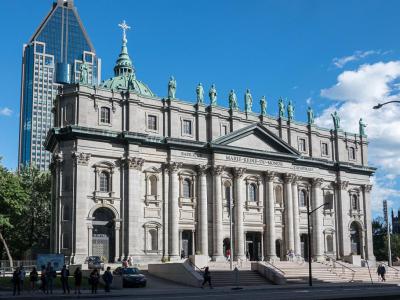
If you think skyscrapers have the last word in downtown Montreal, look up. Rising confidently among the glass and steel is a dome that feels suspiciously Roman.
This is Mary, Queen of the World Cathedral, and yes, that dome is modeled on Saint Peter's Basilica. Think of it as Rome’s greatest architectural hit—re-recorded in Québec. Slightly scaled down, perhaps, but impressively faithful, right down to the red copper baldachin above the altar, hand-carved in Rome itself. No shortcuts here...
Completed in the 1890s, the cathedral somehow manages to look older than it is, while also feeling more streamlined than many of its European cousins. Compared to Notre-Dame Basilica of Montreal, its interior feels lighter, calmer, and almost minimalist.
The design is clean, the lines are clear, and the colours lean toward soft pastels rather than dramatic flourishes. On a sunny day, the stained glass comes alive, casting shifting light across the ceiling, the altar, and the organ pipes at the rear. It's the kind of place where you instinctively lower your voice.
Take a moment near the baptismal font and look up: a striking stucco crucifix crowns it—one of Québec’s most significant religious sculptures. Around you, Italian marble stretches across floors and walls, adding a quiet sense of grandeur. The artwork pays tribute not just to biblical figures but to Montreal’s own spiritual history, including Marguerite Bourgeoys and Marguerite d’Youville, founder of the Grey Nuns. This cathedral tells the city’s story as much as it echoes Rome’s.
Step outside and glance at the façade. You’ll notice 13 statues—just like at Saint Peter’s—but with a local twist. Instead of Jesus and the 12 apostles, these figures represent patron saints from parishes that supported the diocese, including Saint Hyacinthe, Saint Francis of Assisi, and Saint John the Baptist. A European silhouette, a distinctly Canadian cast...
The overall effect is peaceful, dignified, and unexpectedly transportive. For a moment, downtown Montreal fades away, and you could almost believe you’ve wandered into an old basilica somewhere in Europe—just with better maple syrup nearby...
And before you leave, have a look at the gift shop. It carries distinctive jewellery and religious keepsakes—small reminders that Rome may be far away, but its architectural spirit has clearly made itself at home here.
This is Mary, Queen of the World Cathedral, and yes, that dome is modeled on Saint Peter's Basilica. Think of it as Rome’s greatest architectural hit—re-recorded in Québec. Slightly scaled down, perhaps, but impressively faithful, right down to the red copper baldachin above the altar, hand-carved in Rome itself. No shortcuts here...
Completed in the 1890s, the cathedral somehow manages to look older than it is, while also feeling more streamlined than many of its European cousins. Compared to Notre-Dame Basilica of Montreal, its interior feels lighter, calmer, and almost minimalist.
The design is clean, the lines are clear, and the colours lean toward soft pastels rather than dramatic flourishes. On a sunny day, the stained glass comes alive, casting shifting light across the ceiling, the altar, and the organ pipes at the rear. It's the kind of place where you instinctively lower your voice.
Take a moment near the baptismal font and look up: a striking stucco crucifix crowns it—one of Québec’s most significant religious sculptures. Around you, Italian marble stretches across floors and walls, adding a quiet sense of grandeur. The artwork pays tribute not just to biblical figures but to Montreal’s own spiritual history, including Marguerite Bourgeoys and Marguerite d’Youville, founder of the Grey Nuns. This cathedral tells the city’s story as much as it echoes Rome’s.
Step outside and glance at the façade. You’ll notice 13 statues—just like at Saint Peter’s—but with a local twist. Instead of Jesus and the 12 apostles, these figures represent patron saints from parishes that supported the diocese, including Saint Hyacinthe, Saint Francis of Assisi, and Saint John the Baptist. A European silhouette, a distinctly Canadian cast...
The overall effect is peaceful, dignified, and unexpectedly transportive. For a moment, downtown Montreal fades away, and you could almost believe you’ve wandered into an old basilica somewhere in Europe—just with better maple syrup nearby...
And before you leave, have a look at the gift shop. It carries distinctive jewellery and religious keepsakes—small reminders that Rome may be far away, but its architectural spirit has clearly made itself at home here.
2) St. George's Anglican Church
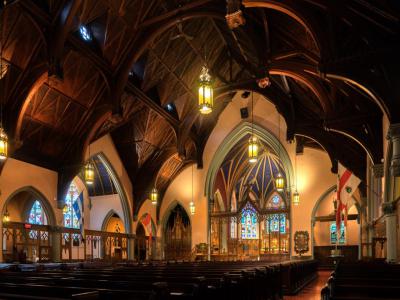
Named after England’s dragon-slaying patron saint, St. George's Anglican Church brings a slice of 13th-century English Gothic straight into downtown Montreal. Complete with pointed arches, sharp pinnacles, glowing stained glass, and intricate wooden carvings, it is basically the architectural equivalent of a very well-tailored medieval cloak.
The church opened in 1843 to handle the overflow crowd from Christ Church Cathedral—proof that even in the 19th century, Montreal Sundays were well attended.
Inside, you’ll find a tapestry with roots in Westminster Abbey, one that was used during the coronation of Queen Elizabeth II in 1953.
Look up, and you’ll see a dramatic double hammer-beam ceiling stretching overhead, grand enough to make you instinctively lower your voice. Even better, no interior columns are blocking your view, so the space feels open, lofty, and quietly theatrical. On the east side of the main altar, the Lady Chapel adds another layer of intimacy and detail, completing the picture with understated elegance.
So, while traffic hums outside and Centre Bell sits just across the street like a modern shrine to slap shots and Stanley Cup dreams, step through these doors, and you enter a very different kind of arena—one of vaulted timber, colored light, and centuries of tradition.
The church opened in 1843 to handle the overflow crowd from Christ Church Cathedral—proof that even in the 19th century, Montreal Sundays were well attended.
Inside, you’ll find a tapestry with roots in Westminster Abbey, one that was used during the coronation of Queen Elizabeth II in 1953.
Look up, and you’ll see a dramatic double hammer-beam ceiling stretching overhead, grand enough to make you instinctively lower your voice. Even better, no interior columns are blocking your view, so the space feels open, lofty, and quietly theatrical. On the east side of the main altar, the Lady Chapel adds another layer of intimacy and detail, completing the picture with understated elegance.
So, while traffic hums outside and Centre Bell sits just across the street like a modern shrine to slap shots and Stanley Cup dreams, step through these doors, and you enter a very different kind of arena—one of vaulted timber, colored light, and centuries of tradition.
3) St. Patrick's Basilica (must see)
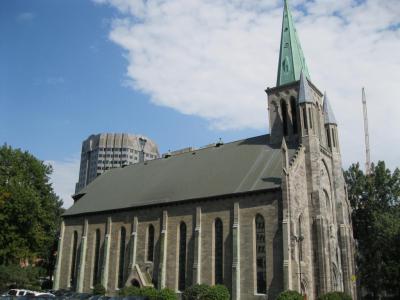
Completed in 1847, in the thick of the Irish Famine migration, Saint Patrick’s rose as a spiritual anchor for Montreal’s English-speaking Catholics — much as Notre-Dame Basilica serves the city’s French-speaking faithful. It stands as one of Canada’s purest expressions of the Gothic Revival style, later recognized as both a historic monument and a National Historic Site. In other words, this isn’t just another church. It’s a statement in stone.
Now, if you’re expecting the gilded drama of Notre-Dame, adjust your expectations. Saint Patrick’s is lighter, brighter, and more restrained. The woodwork is rich without being overwhelming, the Gothic lines clean and confident.
On a clear afternoon, the interior doesn’t merely glow — it performs. Golden light filters through stained-glass windows that line the walls like pages in an illuminated manuscript. Colour spills across the floor, climbs the columns, and settles into every carved detail. And those tall, slender columns — they may look like marble, but are actually pine logs bound together and carefully finished to create the illusion of stone. A little architectural theatre, executed beautifully...
Then there’s the showstopper overhead: a hanging sanctuary lamp weighing in at 1,800 pounds. Suspended high above, ringed by six angels, it’s less a fixture and more a floating sculpture. It commands attention without saying a word — which, in a church, feels appropriate.
Drop by after lunch, and you might hear the organist rehearsing, the notes rolling through the nave long before a service begins. And if the main doors are closed, try a side entrance — one is often left open, as if the building itself prefers to keep things welcoming rather than grand.
There’s also a quiet benefit: it’s free to enter, and chances are you won’t be elbowing through crowds either. You may even find yourself alone, with time to sit, breathe, and let the colours settle.
Now, if you’re expecting the gilded drama of Notre-Dame, adjust your expectations. Saint Patrick’s is lighter, brighter, and more restrained. The woodwork is rich without being overwhelming, the Gothic lines clean and confident.
On a clear afternoon, the interior doesn’t merely glow — it performs. Golden light filters through stained-glass windows that line the walls like pages in an illuminated manuscript. Colour spills across the floor, climbs the columns, and settles into every carved detail. And those tall, slender columns — they may look like marble, but are actually pine logs bound together and carefully finished to create the illusion of stone. A little architectural theatre, executed beautifully...
Then there’s the showstopper overhead: a hanging sanctuary lamp weighing in at 1,800 pounds. Suspended high above, ringed by six angels, it’s less a fixture and more a floating sculpture. It commands attention without saying a word — which, in a church, feels appropriate.
Drop by after lunch, and you might hear the organist rehearsing, the notes rolling through the nave long before a service begins. And if the main doors are closed, try a side entrance — one is often left open, as if the building itself prefers to keep things welcoming rather than grand.
There’s also a quiet benefit: it’s free to enter, and chances are you won’t be elbowing through crowds either. You may even find yourself alone, with time to sit, breathe, and let the colours settle.
4) Christ Church Cathedral
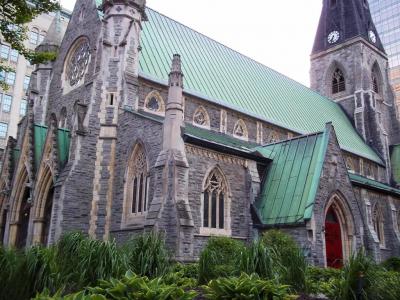
Sitting right in the middle of downtown Montreal, the Christ Church Cathedral looks every bit like it misplaced its passport somewhere between Oxford and Quebec. Built between 1857 and 1860 to the designs of architect Frank Wills, this Gothic Revival landmark was created to reflect a very specific Anglican dream: bring back the spirit—and the look—of the medieval English church.
Sharply pointed arches stand at attention, sturdy buttresses brace the walls, and crenellated turrets complete the medieval silhouette with quiet confidence. From the outside, it’s all drama and detail. But step inside, and the mood shifts to something calmer: polished wood, cool marble, and a dignified simplicity that makes its point gently, without a grand declaration.
Now, here’s where things get interesting. The ground beneath the cathedral was sold off to developers, which resulted in this 19th-century church now floating—quite literally—above a vast underground shopping mall known as Promenades Cathedrale. Yes, you can admire Gothic arches upstairs and browse retail racks downstairs without ever stepping outdoors. Only in Montreal...
Also, if you raise your head, you may notice something unexpected. The timber roof structure resembles the interior of a Scandinavian stave church—the kind of which you might stumble upon near Bergen, Norway. And then there’s the artwork: flat, gold-accented depictions of the Holy Family that feel as though they’ve taken a slight detour from the Eastern Orthodox world before settling here. Medieval England meets Norway meets Byzantium—under one Canadian roof...
Unlike several major churches in the city, this cathedral is generally open throughout the day, and there’s no admission fee. Visitors are welcomed warmly, and if you’re lucky enough to catch the organ in full voice, the acoustics alone are worth the pause.
And then there’s its quieter connection to history. In the Chapel of Saint John of Jerusalem, just left of the main altar, a memorial tablet honours Vivian Arthur Ponsonby Payne, who perished aboard the RMS Titanic. The 23-year-old was a secretary of Charles Hays, president of the Grand Trunk Pacific Railroad, whom he accompanied on a trip to Europe, his first trip abroad, from which he never returned. The cathedral was also the place of worship for another Titanic victim, Harry Markland Molson.
So, beneath the soaring spire and above the hum of the Underground City, this cathedral holds not only architectural ambition—but human stories that still echo...
Sharply pointed arches stand at attention, sturdy buttresses brace the walls, and crenellated turrets complete the medieval silhouette with quiet confidence. From the outside, it’s all drama and detail. But step inside, and the mood shifts to something calmer: polished wood, cool marble, and a dignified simplicity that makes its point gently, without a grand declaration.
Now, here’s where things get interesting. The ground beneath the cathedral was sold off to developers, which resulted in this 19th-century church now floating—quite literally—above a vast underground shopping mall known as Promenades Cathedrale. Yes, you can admire Gothic arches upstairs and browse retail racks downstairs without ever stepping outdoors. Only in Montreal...
Also, if you raise your head, you may notice something unexpected. The timber roof structure resembles the interior of a Scandinavian stave church—the kind of which you might stumble upon near Bergen, Norway. And then there’s the artwork: flat, gold-accented depictions of the Holy Family that feel as though they’ve taken a slight detour from the Eastern Orthodox world before settling here. Medieval England meets Norway meets Byzantium—under one Canadian roof...
Unlike several major churches in the city, this cathedral is generally open throughout the day, and there’s no admission fee. Visitors are welcomed warmly, and if you’re lucky enough to catch the organ in full voice, the acoustics alone are worth the pause.
And then there’s its quieter connection to history. In the Chapel of Saint John of Jerusalem, just left of the main altar, a memorial tablet honours Vivian Arthur Ponsonby Payne, who perished aboard the RMS Titanic. The 23-year-old was a secretary of Charles Hays, president of the Grand Trunk Pacific Railroad, whom he accompanied on a trip to Europe, his first trip abroad, from which he never returned. The cathedral was also the place of worship for another Titanic victim, Harry Markland Molson.
So, beneath the soaring spire and above the hum of the Underground City, this cathedral holds not only architectural ambition—but human stories that still echo...
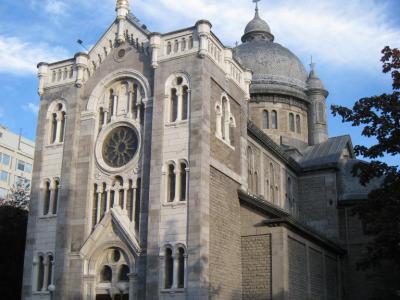
5) Notre-Dame-de-Lourdes (Our Lady of Lourdes Chapel)
Amid all the traffic lights and office towers of downtown Montreal, the moment you enter the Our Lady of Lourdes Chapel, suddenly everything slows down.
This chapel was the life project of Napoleon Bourassa, the painter, architect, and thinker, who designed this building as his own statement of faith. You can almost feel how personal it was to him. Every arch, every color choice, every brushstroke carries that sense of devotion, as if he signed his name not with ink, but with symbolism.
The chapel opened for worship on April 30, 1881, and it hasn’t stopped welcoming pilgrims ever since. Built in the Romano-Byzantine style—which means rounded arches, domes, and a strong sense of symmetry—it stands apart from the Gothic drama you might expect elsewhere in the city. Instead of sharp vertical lines pulling you upward, here the architecture gathers you in, gently guiding your eyes toward the centre of the dome.
And that dome itself is the true visual crescendo. The entire interior leads you there. The decoration culminates in a painted proclamation of the dogma of the Immaculate Conception, announced in 1854, which means the belief that Mary was conceived without original sin. Four pendentives—those curved triangular supports beneath the dome—each hold a painted angel, seemingly pausing in contemplation. Above them, against a deep celestial backdrop dotted with stars and cherubim, stands Mary herself, calm and radiant at the apex.
The single nave is covered by a barrel vault, supported by grey marble pilasters with engaged columns. Transverse arches add rhythm and structure, while trefoil windows filter in soft natural light that animates the Mariological—or Mary-focused—imagery throughout. The colours don’t compete; they converse. Blues, golds, and warm tones blend into one harmonious composition.
So, step inside, look up, and let the city fall away. In this small but powerful sanctuary, art and faith meet—and for a moment, Montreal feels entirely contemplative...
This chapel was the life project of Napoleon Bourassa, the painter, architect, and thinker, who designed this building as his own statement of faith. You can almost feel how personal it was to him. Every arch, every color choice, every brushstroke carries that sense of devotion, as if he signed his name not with ink, but with symbolism.
The chapel opened for worship on April 30, 1881, and it hasn’t stopped welcoming pilgrims ever since. Built in the Romano-Byzantine style—which means rounded arches, domes, and a strong sense of symmetry—it stands apart from the Gothic drama you might expect elsewhere in the city. Instead of sharp vertical lines pulling you upward, here the architecture gathers you in, gently guiding your eyes toward the centre of the dome.
And that dome itself is the true visual crescendo. The entire interior leads you there. The decoration culminates in a painted proclamation of the dogma of the Immaculate Conception, announced in 1854, which means the belief that Mary was conceived without original sin. Four pendentives—those curved triangular supports beneath the dome—each hold a painted angel, seemingly pausing in contemplation. Above them, against a deep celestial backdrop dotted with stars and cherubim, stands Mary herself, calm and radiant at the apex.
The single nave is covered by a barrel vault, supported by grey marble pilasters with engaged columns. Transverse arches add rhythm and structure, while trefoil windows filter in soft natural light that animates the Mariological—or Mary-focused—imagery throughout. The colours don’t compete; they converse. Blues, golds, and warm tones blend into one harmonious composition.
So, step inside, look up, and let the city fall away. In this small but powerful sanctuary, art and faith meet—and for a moment, Montreal feels entirely contemplative...
