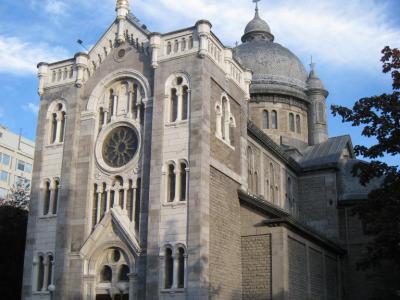


Notre-Dame-de-Lourdes (Our Lady of Lourdes Chapel), Montreal
Amid all the traffic lights and office towers of downtown Montreal, the moment you enter the Our Lady of Lourdes Chapel, suddenly everything slows down.
This chapel was the life project of Napoleon Bourassa, the painter, architect, and thinker, who designed this building as his own statement of faith. You can almost feel how personal it was to him. Every arch, every color choice, every brushstroke carries that sense of devotion, as if he signed his name not with ink, but with symbolism.
The chapel opened for worship on April 30, 1881, and it hasn’t stopped welcoming pilgrims ever since. Built in the Romano-Byzantine style-which means rounded arches, domes, and a strong sense of symmetry-it stands apart from the Gothic drama you might expect elsewhere in the city. Instead of sharp vertical lines pulling you upward, here the architecture gathers you in, gently guiding your eyes toward the centre of the dome.
And that dome itself is the true visual crescendo. The entire interior leads you there. The decoration culminates in a painted proclamation of the dogma of the Immaculate Conception, announced in 1854, which means the belief that Mary was conceived without original sin. Four pendentives-those curved triangular supports beneath the dome-each hold a painted angel, seemingly pausing in contemplation. Above them, against a deep celestial backdrop dotted with stars and cherubim, stands Mary herself, calm and radiant at the apex.
The single nave is covered by a barrel vault, supported by grey marble pilasters with engaged columns. Transverse arches add rhythm and structure, while trefoil windows filter in soft natural light that animates the Mariological-or Mary-focused-imagery throughout. The colours don’t compete; they converse. Blues, golds, and warm tones blend into one harmonious composition.
So, step inside, look up, and let the city fall away. In this small but powerful sanctuary, art and faith meet-and for a moment, Montreal feels entirely contemplative...
This chapel was the life project of Napoleon Bourassa, the painter, architect, and thinker, who designed this building as his own statement of faith. You can almost feel how personal it was to him. Every arch, every color choice, every brushstroke carries that sense of devotion, as if he signed his name not with ink, but with symbolism.
The chapel opened for worship on April 30, 1881, and it hasn’t stopped welcoming pilgrims ever since. Built in the Romano-Byzantine style-which means rounded arches, domes, and a strong sense of symmetry-it stands apart from the Gothic drama you might expect elsewhere in the city. Instead of sharp vertical lines pulling you upward, here the architecture gathers you in, gently guiding your eyes toward the centre of the dome.
And that dome itself is the true visual crescendo. The entire interior leads you there. The decoration culminates in a painted proclamation of the dogma of the Immaculate Conception, announced in 1854, which means the belief that Mary was conceived without original sin. Four pendentives-those curved triangular supports beneath the dome-each hold a painted angel, seemingly pausing in contemplation. Above them, against a deep celestial backdrop dotted with stars and cherubim, stands Mary herself, calm and radiant at the apex.
The single nave is covered by a barrel vault, supported by grey marble pilasters with engaged columns. Transverse arches add rhythm and structure, while trefoil windows filter in soft natural light that animates the Mariological-or Mary-focused-imagery throughout. The colours don’t compete; they converse. Blues, golds, and warm tones blend into one harmonious composition.
So, step inside, look up, and let the city fall away. In this small but powerful sanctuary, art and faith meet-and for a moment, Montreal feels entirely contemplative...
Want to visit this sight? Check out these Self-Guided Walking Tours in Montreal. Alternatively, you can download the mobile app "GPSmyCity: Walks in 1K+ Cities" from Apple App Store or Google Play Store. The app turns your mobile device to a personal tour guide and it works offline, so no data plan is needed when traveling abroad.
Download The GPSmyCity App



Notre-Dame-de-Lourdes (Our Lady of Lourdes Chapel) on Map
Sight Name: Notre-Dame-de-Lourdes (Our Lady of Lourdes Chapel)
Sight Location: Montreal, Canada (See walking tours in Montreal)
Sight Type: Religious
Guide(s) Containing This Sight:
Sight Location: Montreal, Canada (See walking tours in Montreal)
Sight Type: Religious
Guide(s) Containing This Sight:
Nearby Sights

Walking Tours in Montreal, Canada

Create Your Own Walk in Montreal
Creating your own self-guided walk in Montreal is easy and fun. Choose the city attractions that you want to see and a walk route map will be created just for you. You can even set your hotel as the start point of the walk.
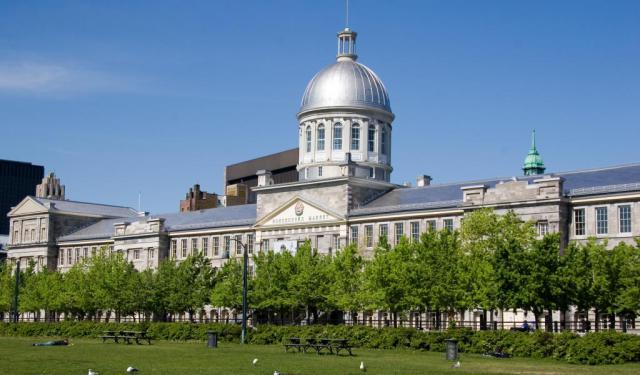
Historical Buildings Walking Tour
Whenever you gaze upon the historical buildings of Montreal, you are reminded that the true measure of a city's greatness lies in its ability to preserve its past while embracing its future. Old Montreal – home to four centuries of architecture shaped by French sophistication and English practicality – is a place all its own.
Here, modern buildings coexist with some of the oldest and... view more
Tour Duration: 2 Hour(s)
Travel Distance: 3.8 Km or 2.4 Miles
Here, modern buildings coexist with some of the oldest and... view more
Tour Duration: 2 Hour(s)
Travel Distance: 3.8 Km or 2.4 Miles
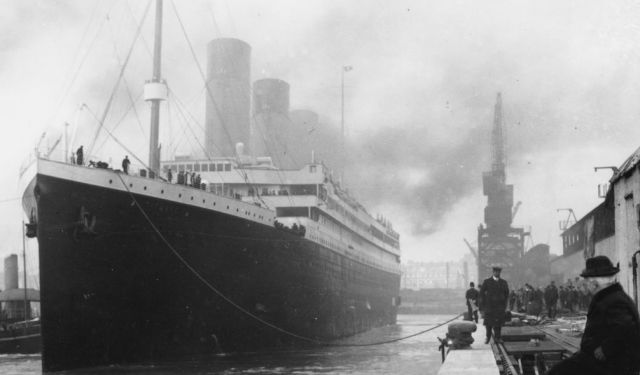
The RMS Titanic Walking Tour
Built as the ship of dreams, the RMS Titanic went down in history as the one that carried “both the hopes and the tragedies of a generation.” The luxury cruiser sank on her maiden voyage across the Atlantic in the early hours of April 15, 1912, and today is largely remembered throughout the world, in part, due to the blockbuster movie starring Leonardo DiCaprio.
Although Montreal's... view more
Tour Duration: 2 Hour(s)
Travel Distance: 3.5 Km or 2.2 Miles
Although Montreal's... view more
Tour Duration: 2 Hour(s)
Travel Distance: 3.5 Km or 2.2 Miles
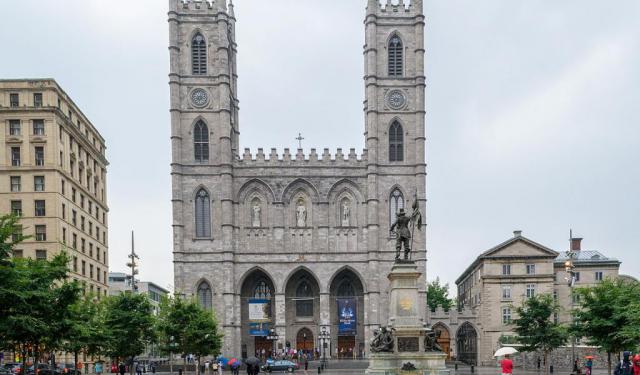
Historical Churches Walking Tour
Montreal’s skyline doubles as a history book - you just have to know how to read the spires. Before modern towers reshaped the city's skyline, church spires, domes, bell towers, and carved façades didn’t simply decorate neighbourhoods; they announced who lived there. French and British. Catholic and Protestant. Immigrants and long-established communities. If you wanted to understand... view more
Tour Duration: 2 Hour(s)
Travel Distance: 4.2 Km or 2.6 Miles
Tour Duration: 2 Hour(s)
Travel Distance: 4.2 Km or 2.6 Miles
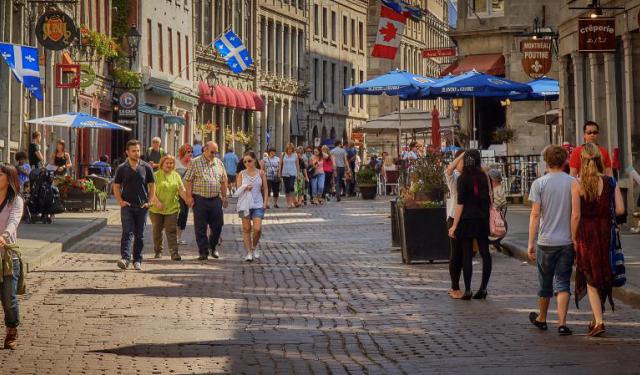
Old Montreal Walking Tour
Old Montreal (Vieux-Montréal) is a historic neighborhood southeast of the downtown area, home to many architectural monuments of the New France era. Founded by French settlers in 1642 as Fort Ville-Marie, the settlement gave its name to the city borough of which it is now part.
Most of Montreal's earliest architecture, characterized by uniquely French influence, including grey stone... view more
Tour Duration: 2 Hour(s)
Travel Distance: 3.3 Km or 2.1 Miles
Most of Montreal's earliest architecture, characterized by uniquely French influence, including grey stone... view more
Tour Duration: 2 Hour(s)
Travel Distance: 3.3 Km or 2.1 Miles
Montreal Downtown Walking Tour
Canada’s second-most populous city likes to keep things interesting. Montreal is old enough to have stories carved in stone, yet modern enough to reinvent itself every few decades. It sits comfortably on an island in the Saint Lawrence River, with Mount Royal rising at its centre-the triple-peaked hill that gave the city its name. In 16th-century French, “réal” and “royal” were... view more
Tour Duration: 2 Hour(s)
Travel Distance: 3.6 Km or 2.2 Miles
Tour Duration: 2 Hour(s)
Travel Distance: 3.6 Km or 2.2 Miles
Useful Travel Guides for Planning Your Trip

Montreal Souvenirs: 15 Trip Mementos to Bring Home
The outpost of Frenchness in North America (and the world's 2nd largest francophone city after Paris), Montreal is the meeting point of the New and Old World styles, the collision of the French, English and Aboriginal cultures. The historical and ethnic uniqueness of the city is seen throughout...