Custom Walk in New Haven, Connecticut by neidad66_d79d27 created on 2026-07-25
Guide Location: USA » New Haven
Guide Type: Custom Walk
# of Sights: 5
Tour Duration: 1 Hour(s)
Travel Distance: 2.6 Km or 1.6 Miles
Share Key: 5EFLF
Guide Type: Custom Walk
# of Sights: 5
Tour Duration: 1 Hour(s)
Travel Distance: 2.6 Km or 1.6 Miles
Share Key: 5EFLF
How It Works
Please retrieve this walk in the GPSmyCity app. Once done, the app will guide you from one tour stop to the next as if you had a personal tour guide. If you created the walk on this website or come to the page via a link, please follow the instructions below to retrieve the walk in the app.
Retrieve This Walk in App
Step 1. Download the app "GPSmyCity: Walks in 1K+ Cities" on Apple App Store or Google Play Store.



Step 2. In the GPSmyCity app, download(or launch) the guide "New Haven Map and Walking Tours".
Step 3. Tap the menu button located at upper right corner of the "Walks" screen and select "Retrieve custom walk". Enter the share key: 5EFLF
1) Battell Chapel
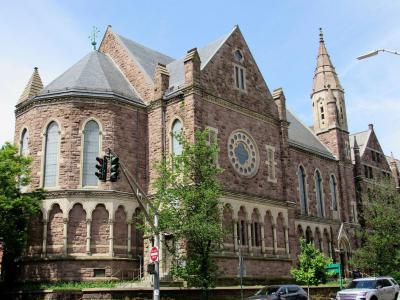
Battell Chapel is the largest chapel of Yale University, located on the historic Old Campus in New Haven. Constructed between 1874 and 1876, it was primarily funded by Joseph Battell and other members of his family. Designed in the High Victorian Gothic style, the chapel features a striking exterior of rough brown New Jersey sandstone with decorative elements made of blue Ohio sandstone.
This building succeeded two earlier Yale chapels and served as the space for daily worship services, which were mandatory for all (male and mostly Protestant) Yale College students until 1926. Alongside Durfee Hall and Farnam Hall, Battell Chapel was part of a 19th-century initiative to define the perimeter of the Old Campus and create a stronger visual and structural separation from the rest of the city.
Inside, the chapel features a flat coffered ceiling made of wooden beams, painted blue and adorned with gold leaf. Solid oak paneling and pews line the interior, while religious symbols such as the Greek Cross and the Shield of the Trinity are displayed on the upper pier walls, reflecting Yale’s Congregational and Trinitarian heritage.
One of the chapel’s distinctive features is its now-silent clock and bell chime system, once a timekeeping reference for the entire university. The organ, gifted by Irene Battell Larned (Joseph Battell’s sister), and the Apse Memorial Windows-designed by architect Russell Sturgis and installed in 1876-honor Yale benefactors and its early leadership, including Elihu Yale and the university’s first nine presidents.
Today, Battell Chapel hosts University Church services and concerts by local ensembles, including youth and civic orchestras. It is also a recognized site on the Connecticut Freedom Trail, reflecting its cultural and historical importance.
*** Amistad Freedom Trail ***
The Chapel symbolizes the role the Yale Divinity School faculty and students played in helping the Mende Africans of La Amistad and houses a themed exhibition maintained by Yale.
This building succeeded two earlier Yale chapels and served as the space for daily worship services, which were mandatory for all (male and mostly Protestant) Yale College students until 1926. Alongside Durfee Hall and Farnam Hall, Battell Chapel was part of a 19th-century initiative to define the perimeter of the Old Campus and create a stronger visual and structural separation from the rest of the city.
Inside, the chapel features a flat coffered ceiling made of wooden beams, painted blue and adorned with gold leaf. Solid oak paneling and pews line the interior, while religious symbols such as the Greek Cross and the Shield of the Trinity are displayed on the upper pier walls, reflecting Yale’s Congregational and Trinitarian heritage.
One of the chapel’s distinctive features is its now-silent clock and bell chime system, once a timekeeping reference for the entire university. The organ, gifted by Irene Battell Larned (Joseph Battell’s sister), and the Apse Memorial Windows-designed by architect Russell Sturgis and installed in 1876-honor Yale benefactors and its early leadership, including Elihu Yale and the university’s first nine presidents.
Today, Battell Chapel hosts University Church services and concerts by local ensembles, including youth and civic orchestras. It is also a recognized site on the Connecticut Freedom Trail, reflecting its cultural and historical importance.
*** Amistad Freedom Trail ***
The Chapel symbolizes the role the Yale Divinity School faculty and students played in helping the Mende Africans of La Amistad and houses a themed exhibition maintained by Yale.

2) Louis' Lunch (Oldest Hamburger Restaurant)
Louis' Lunch is not just any restaurant. It is the oldest hamburger restaurant in the United states. Established in 1892, Louis' Lunch claims to be the originator of the hamburger when a patron asked for a quick lunch that could be eaten by hand.
Though others also claim the invention of the hamburger, the Library of Congress recognizes Louis' Lunch as the originator.Louis' Lunch also claims to be one of the oldest family-run companies in the United States. It is currently owned and operated by the fourth generation of the Lassen family.
Tourists can enjoy a hamburger at Louis' Lunch Tuesdays through Saturdays. The menu also includes drinks, sides and homemade pie. Remember to bring some money as Louis' Lunch is a cash-only establishment.
Louis' Lunch is located on Crown Street near New Haven Green. It is within easy walking distance of the Yale University Art Gallery and the Yale Center for British Art.
Though others also claim the invention of the hamburger, the Library of Congress recognizes Louis' Lunch as the originator.Louis' Lunch also claims to be one of the oldest family-run companies in the United States. It is currently owned and operated by the fourth generation of the Lassen family.
Tourists can enjoy a hamburger at Louis' Lunch Tuesdays through Saturdays. The menu also includes drinks, sides and homemade pie. Remember to bring some money as Louis' Lunch is a cash-only establishment.
Louis' Lunch is located on Crown Street near New Haven Green. It is within easy walking distance of the Yale University Art Gallery and the Yale Center for British Art.
3) Beinecke Rare Book and Manuscript Library (must see)
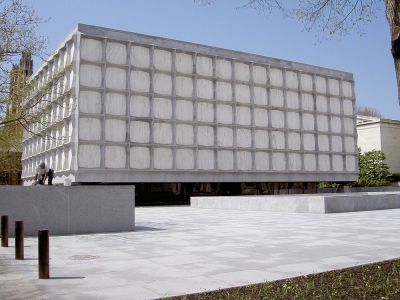
The Beinecke Rare Book and Manuscript Library is located on the Yale University campus in the Hewitt Quadrangle. The library, which was established in 1963, is one of the world's largest institutions devoted entirely to rare books and manuscripts.
The building has a unique appearance that is indicative of its Modern style. Architect Gordon Bunshaft famously designed the building with thin, marble panels that filter indirect sunlight into the library in order to protect the rare manuscripts and books. The outstanding architecture is enhanced by the surrounding buildings, like the Lillian Goldman Law Library and Woolsey Hall, that have a more typically collegiate Beaux-Arts style.
Tourists may marvel at the design of the building, but if possible should plan to stop inside to see the golden light that spills in from the outside and the modernist sculptures by Isamu Naguchi. Though the bulk of the library is only available to Yale University faculty and students as well as visiting researchers, members of the public are typically permitted in exhibition hall, the ground floor and the mezzanine.
Beinecke holds one of the few copies of the original Gutenberg Bible. This is on display in the exhibition hall. John James Audubon's "Birds of America" is also permanently on display. Visitors can find the 1742 Library of Yale College on the ground floor. They will also see some of the earliest books published in the West with dates that go back to 1472.
Special exhibitions are offered throughout the year as well. Previous exhibitions have included modern photography, a focus on poetry and the display of the Declaration of Independence.
Why You Should Visit:
- To see an original Gutenberg Bible
- To marvel at Modern architecture
Tips:
Anyone wanting to see more than the exhibition hall will have to contact Beinecke in advance. Only approved researchers can enter the reading room, which is open by appointment only.
The building has a unique appearance that is indicative of its Modern style. Architect Gordon Bunshaft famously designed the building with thin, marble panels that filter indirect sunlight into the library in order to protect the rare manuscripts and books. The outstanding architecture is enhanced by the surrounding buildings, like the Lillian Goldman Law Library and Woolsey Hall, that have a more typically collegiate Beaux-Arts style.
Tourists may marvel at the design of the building, but if possible should plan to stop inside to see the golden light that spills in from the outside and the modernist sculptures by Isamu Naguchi. Though the bulk of the library is only available to Yale University faculty and students as well as visiting researchers, members of the public are typically permitted in exhibition hall, the ground floor and the mezzanine.
Beinecke holds one of the few copies of the original Gutenberg Bible. This is on display in the exhibition hall. John James Audubon's "Birds of America" is also permanently on display. Visitors can find the 1742 Library of Yale College on the ground floor. They will also see some of the earliest books published in the West with dates that go back to 1472.
Special exhibitions are offered throughout the year as well. Previous exhibitions have included modern photography, a focus on poetry and the display of the Declaration of Independence.
Why You Should Visit:
- To see an original Gutenberg Bible
- To marvel at Modern architecture
Tips:
Anyone wanting to see more than the exhibition hall will have to contact Beinecke in advance. Only approved researchers can enter the reading room, which is open by appointment only.
4) Grove Street Cemetery
Grove Street Cemetery is a historic cemetery located in the heart of New Haven, nestled within the Yale University campus. Established in 1796 and officially incorporated a year later, it was created to replace the overcrowded burial ground on the New Haven Green. It holds the distinction of being the first private, nonprofit cemetery in the world.
This cemetery marked a shift in burial practices, pioneering a thoughtfully planned layout with individually owned family plots, paved and named avenues, and ornamental plantings-features that helped redefine how society viewed death and burial. Historian Peter Dobkin Hall described it as a “real turning point” in the cultural treatment of death.
The cemetery owes its origins to a devastating yellow fever epidemic in 1794–95, which overwhelmed existing burial spaces. In response, Senator James Hillhouse and local families purchased land just north of Grove Street. The original 6-acre plot eventually expanded to 18 acres to accommodate demand. In 1821, monuments from the original New Haven Green burial site were transferred here.
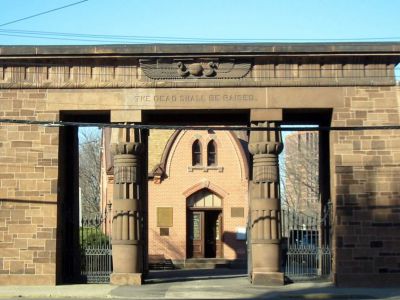
One of Grove Street Cemetery’s most notable features is its Egyptian Revival gateway, completed in 1845. Designed by local architect Henry Austin and sculptor Hezekiah Augur-both of whom are buried there-the brownstone entrance bears the inscription “The Dead Shall Be Raised.” An 8-foot stone wall, added in the late 1840s, encloses the cemetery on three sides.
The site is the final resting place for many prominent figures, including 14 Yale University presidents, yet it was never an exclusive space and remained open to all. It reflects both the democratic and historical spirit of New Haven.
Grove Street Cemetery was added to the National Register of Historic Places in 1997 and designated a National Historic Landmark in 2000 for its historical and architectural significance. Today, it is maintained by Camco Cemetery Management and continues to be an important site of remembrance and heritage.
*** Amistad Freedom Trail ***
Among those interred here are the active members of the abolition movement, as well as those associated with African American history. A stone marker was dedicated by the Amistad Committee in September 2001 in remembrance of the six Mende African captives of La Amistad buried here.
This cemetery marked a shift in burial practices, pioneering a thoughtfully planned layout with individually owned family plots, paved and named avenues, and ornamental plantings-features that helped redefine how society viewed death and burial. Historian Peter Dobkin Hall described it as a “real turning point” in the cultural treatment of death.
The cemetery owes its origins to a devastating yellow fever epidemic in 1794–95, which overwhelmed existing burial spaces. In response, Senator James Hillhouse and local families purchased land just north of Grove Street. The original 6-acre plot eventually expanded to 18 acres to accommodate demand. In 1821, monuments from the original New Haven Green burial site were transferred here.
One of Grove Street Cemetery’s most notable features is its Egyptian Revival gateway, completed in 1845. Designed by local architect Henry Austin and sculptor Hezekiah Augur-both of whom are buried there-the brownstone entrance bears the inscription “The Dead Shall Be Raised.” An 8-foot stone wall, added in the late 1840s, encloses the cemetery on three sides.
The site is the final resting place for many prominent figures, including 14 Yale University presidents, yet it was never an exclusive space and remained open to all. It reflects both the democratic and historical spirit of New Haven.
Grove Street Cemetery was added to the National Register of Historic Places in 1997 and designated a National Historic Landmark in 2000 for its historical and architectural significance. Today, it is maintained by Camco Cemetery Management and continues to be an important site of remembrance and heritage.
*** Amistad Freedom Trail ***
Among those interred here are the active members of the abolition movement, as well as those associated with African American history. A stone marker was dedicated by the Amistad Committee in September 2001 in remembrance of the six Mende African captives of La Amistad buried here.
5) Marsh Hall and Botanical Garden
Tucked into the Yale University campus in New Haven, Marsh Hall and the Marsh Botanical Garden form a historic and botanical gem with deep academic roots and leafy character. Originally the estate of Othniel Charles Marsh, a pioneering paleontologist and Yale alumnus (Class of 1860), the site was established as a botanical garden in 1899 when Marsh bequeathed his home and plant collections to the university.
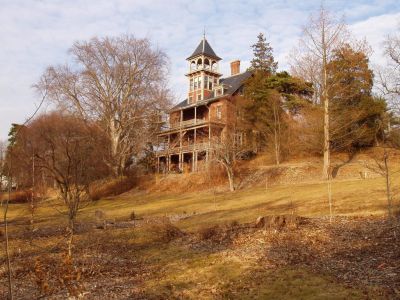
Marsh Hall, also known as the Othniel C. Marsh House, was completed in 1878 and designed by architect J. Cleaveland Cady. Its red sandstone, Jacobean Revival features, and decorative turrets made it one of the grandest private residences in the city at the time. Declared a National Historic Landmark in 1965, the house now serves as part of Yale’s School of the Environment and is home to The Forest School at YSE. The building sits on Prospect Hill, overlooking the lush grounds Marsh once called home.
Surrounding the house is the Marsh Botanical Garden, which stretches across eight acres and includes six greenhouses filled with an impressive variety of cacti, insectivorous plants, and orchids. Though the original landscape design by Beatrix Farrand-Yale’s former landscape architect during the 1920s–30s-survives only in fragments, restoration work is ongoing. Today, the garden offers a tranquil public green space and a robust hub for research and instruction.
The garden changes with the seasons throughout the year: wildflowers and naturalistic beds bloom in summer, bulb displays and flowering trees brighten the spring, and many woody plants offer brilliant fall colors through leaves and fruits. The collection includes rare and endangered plants from around the world, making it a delight for everyone-from casual visitors and school groups to faculty, researchers, and plant enthusiasts.
Open to the public 24/7, the Marsh Botanical Garden continues to serve as a living laboratory, a quiet retreat, and a place where New Haven's academic and natural heritage come together under the canopy of history and science.
Marsh Hall, also known as the Othniel C. Marsh House, was completed in 1878 and designed by architect J. Cleaveland Cady. Its red sandstone, Jacobean Revival features, and decorative turrets made it one of the grandest private residences in the city at the time. Declared a National Historic Landmark in 1965, the house now serves as part of Yale’s School of the Environment and is home to The Forest School at YSE. The building sits on Prospect Hill, overlooking the lush grounds Marsh once called home.
Surrounding the house is the Marsh Botanical Garden, which stretches across eight acres and includes six greenhouses filled with an impressive variety of cacti, insectivorous plants, and orchids. Though the original landscape design by Beatrix Farrand-Yale’s former landscape architect during the 1920s–30s-survives only in fragments, restoration work is ongoing. Today, the garden offers a tranquil public green space and a robust hub for research and instruction.
The garden changes with the seasons throughout the year: wildflowers and naturalistic beds bloom in summer, bulb displays and flowering trees brighten the spring, and many woody plants offer brilliant fall colors through leaves and fruits. The collection includes rare and endangered plants from around the world, making it a delight for everyone-from casual visitors and school groups to faculty, researchers, and plant enthusiasts.
Open to the public 24/7, the Marsh Botanical Garden continues to serve as a living laboratory, a quiet retreat, and a place where New Haven's academic and natural heritage come together under the canopy of history and science.
