

Archaeological Museum of Thera, Santorini
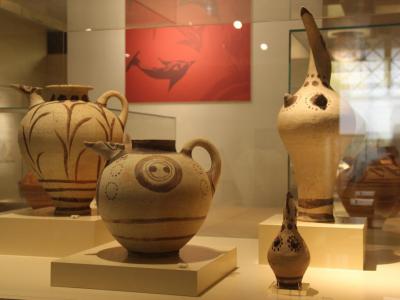
The Archaeological Museum of Thera offers an overview of the island’s history from antiquity through the Roman period, drawing entirely on material uncovered in local excavations. Its permanent exhibition includes sculpture, inscriptions, pottery, and small finds dating from the Archaic, Classical, Hellenistic, and Roman eras, illustrating how Santorini was integrated into wider Greek and Mediterranean cultural networks.
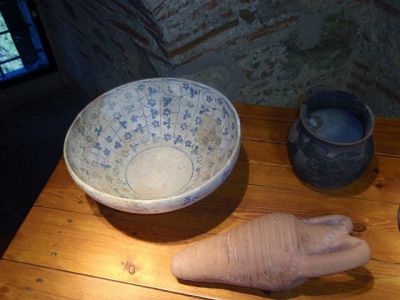
Among the highlights are stone sculptures, as well as vases and clay figurines spanning from the Geometric to the Hellenistic periods. These objects reflect everyday life, religious practices, and funerary customs on the island. A notable geological exhibit, a large volcanic boulder, underscores the close relationship between local history and Santorini’s volcanic environment.
The museum was founded in 1902, making it one of the earliest archaeological museums established in Greece outside Athens. The current building dates from the 1960s, constructed after the earlier structure was destroyed during the 1956 earthquake. While smaller in scale than national collections in Athens, the museum’s significance lies in the local origin of its exhibits. Every major piece comes from Santorini itself, offering visitors a concentrated view of the island’s archaeological record in one place.
Notable objects on display include the Theran amphora with Geometric decoration, fragments of Archaic funerary kouroi, a Daedalic-style clay figurine, and an Attic black-figure kylix. Another significant highlight is the Kore of Thera, a nearly intact Archaic female statue standing 2.48 meters tall, dated to around 640 BCE. Executed in the early Daedalic style, the kore offers rare insight into large-scale sculptural production on the island during the early Archaic period.
Among the highlights are stone sculptures, as well as vases and clay figurines spanning from the Geometric to the Hellenistic periods. These objects reflect everyday life, religious practices, and funerary customs on the island. A notable geological exhibit, a large volcanic boulder, underscores the close relationship between local history and Santorini’s volcanic environment.
The museum was founded in 1902, making it one of the earliest archaeological museums established in Greece outside Athens. The current building dates from the 1960s, constructed after the earlier structure was destroyed during the 1956 earthquake. While smaller in scale than national collections in Athens, the museum’s significance lies in the local origin of its exhibits. Every major piece comes from Santorini itself, offering visitors a concentrated view of the island’s archaeological record in one place.
Notable objects on display include the Theran amphora with Geometric decoration, fragments of Archaic funerary kouroi, a Daedalic-style clay figurine, and an Attic black-figure kylix. Another significant highlight is the Kore of Thera, a nearly intact Archaic female statue standing 2.48 meters tall, dated to around 640 BCE. Executed in the early Daedalic style, the kore offers rare insight into large-scale sculptural production on the island during the early Archaic period.
Want to visit this sight? Check out these Self-Guided Walking Tours in Santorini. Alternatively, you can download the mobile app "GPSmyCity: Walks in 1K+ Cities" from Apple App Store or Google Play Store. The app turns your mobile device to a personal tour guide and it works offline, so no data plan is needed when traveling abroad.
Download The GPSmyCity App



Archaeological Museum of Thera on Map
Sight Name: Archaeological Museum of Thera
Sight Location: Santorini, Greece (See walking tours in Santorini)
Sight Type: Museum/Gallery
Guide(s) Containing This Sight:
Sight Location: Santorini, Greece (See walking tours in Santorini)
Sight Type: Museum/Gallery
Guide(s) Containing This Sight:
Nearby Sights
Walking Tours in Santorini, Greece

Create Your Own Walk in Santorini
Creating your own self-guided walk in Santorini is easy and fun. Choose the city attractions that you want to see and a walk route map will be created just for you. You can even set your hotel as the start point of the walk.

Oia Walking Tour
Oia is one of the oldest settlements on Santorini, with a history shaped by geography, seafaring, and repeated cycles of destruction and rebuilding. The village occupies the northwestern edge of the island, set along the rim of the volcanic caldera. This elevated position offered both strategic advantages and exposure to natural forces, particularly earthquakes, which have repeatedly altered the... view more
Tour Duration: 1 Hour
Travel Distance: 1 Km or 0.6 Miles
Tour Duration: 1 Hour
Travel Distance: 1 Km or 0.6 Miles
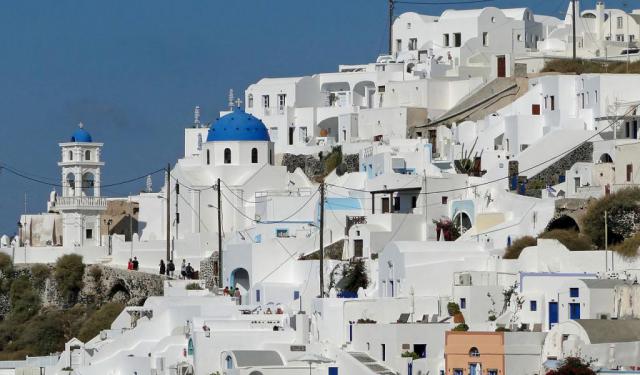
Firostefani and Imerovigli Walking Tour
Away from the crowded Fira yet close to the famous Santorini caldera, there are two small settlements: Firostefani and Imerovigli. Each of these gorgeous neighborhoods has something unique to offer, and thus represents an attraction in its own right.
The quaint village of Firostefani, whose name translates as "The Crown of Fira", is now considered a suburb of Santorini's capital,... view more
Tour Duration: 1 Hour
Travel Distance: 2.3 Km or 1.4 Miles
The quaint village of Firostefani, whose name translates as "The Crown of Fira", is now considered a suburb of Santorini's capital,... view more
Tour Duration: 1 Hour
Travel Distance: 2.3 Km or 1.4 Miles
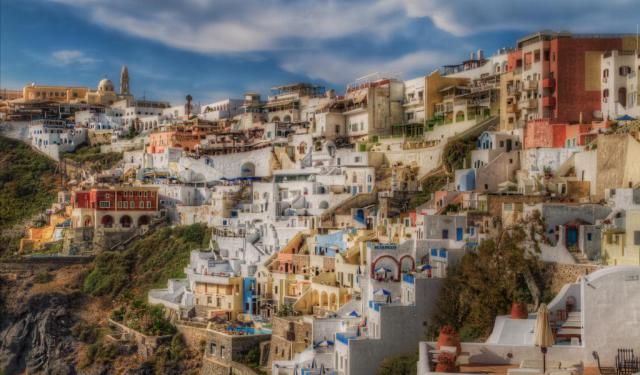
Fira Walking Tour
Known in antiquity as Thera, the island was originally a roughly circular landmass shaped by volcanic activity in the southern Aegean. Its earliest known settlement dates to the Neolithic period, but Santorini entered history more clearly during the Bronze Age, when it developed into an important center of Cycladic and later Minoan civilization.
Around the 17th century BCE, Santorini... view more
Tour Duration: 2 Hours
Travel Distance: 3.4 Km or 2.1 Miles
Around the 17th century BCE, Santorini... view more
Tour Duration: 2 Hours
Travel Distance: 3.4 Km or 2.1 Miles
City Walks Overview
