

Archiginnasio Palace, Bologna (must see)
Just past the Archaeological Museum lies the historic Archiginnasio Palace, constructed in the 1560s as the first permanent home of Europe's oldest university. Prior to its erection, the faculties of law and medicine were like lost socks, scattered across various sites within the city. The palace served as the university's central headquarters until 1803, when it relocated to its present campus on Zamboni Street.
Presently, it hosts the esteemed Archiginnasio Municipal Library, which preserves a monumental collection of over 1.3 million books, manuscripts, and historic documents. The complex also features the lavishly decorated Stabat Mater Hall-which hosted Gaetano Rossini's inaugural Italian performance of Stabat Mater in 1842 under the direction of Donizetti-and the captivating Anatomy Theatre.
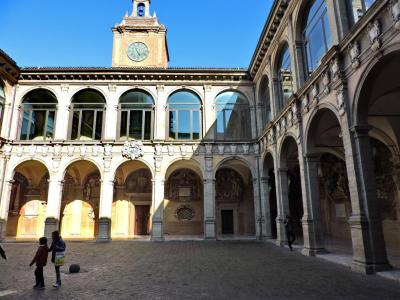
The moment you enter the palace's premises, make sure you get a good look all around the lower level. The elegant central courtyard, framed by an impressive two-story portico, along with the staircases and lecture halls, is covered in the world's largest mural heraldic complex, displaying roughly 6,000 student coats of arms alongside tributes to the university's legendary professors. This courtyard historically served as the public backdrop for university ceremonies, including the public Preparation of the Theriac. This highly sought-after medieval panacea and antidote for venomous bites was a complex concoction comprising over sixty ingredients, including viper flesh, opium, fermented herbs, and honey, publicly mixed by the medical faculty to verify its authenticity.
For the next highlight, leave the courtyard through its south-western corner where you'll be met by a staircase to the upper levels. Follow it up to the top floor and make your way down the hallway to your left. Behold the Anatomy Theatre, constructed entirely of spruce wood in 1637 in the shape of an amphitheater. It was designed to give the university’s long-standing medical school a grand, permanent arena for its annual winter public anatomy lectures.
The room is adorned with life-sized wooden sculptures depicting renowned university anatomists and celebrated ancient physicians. Flanking the professor's ornate podium are the famous Skinned Men-two anatomical statues depicting the human body stripped down to its muscle layers, structurally supporting a canopy overhead. While popular myths suggest the Church heavily restricted these sessions, dissections were actively permitted and heavily attended academic and public events.
Photographs at the entrance showcase the devastation suffered by this wing of the building during the 1944 bombardment, yet immediate post-war reconstruction efforts utilized salvaged original wooden sculptures retrieved from the rubble.
Presently, it hosts the esteemed Archiginnasio Municipal Library, which preserves a monumental collection of over 1.3 million books, manuscripts, and historic documents. The complex also features the lavishly decorated Stabat Mater Hall-which hosted Gaetano Rossini's inaugural Italian performance of Stabat Mater in 1842 under the direction of Donizetti-and the captivating Anatomy Theatre.
The moment you enter the palace's premises, make sure you get a good look all around the lower level. The elegant central courtyard, framed by an impressive two-story portico, along with the staircases and lecture halls, is covered in the world's largest mural heraldic complex, displaying roughly 6,000 student coats of arms alongside tributes to the university's legendary professors. This courtyard historically served as the public backdrop for university ceremonies, including the public Preparation of the Theriac. This highly sought-after medieval panacea and antidote for venomous bites was a complex concoction comprising over sixty ingredients, including viper flesh, opium, fermented herbs, and honey, publicly mixed by the medical faculty to verify its authenticity.
For the next highlight, leave the courtyard through its south-western corner where you'll be met by a staircase to the upper levels. Follow it up to the top floor and make your way down the hallway to your left. Behold the Anatomy Theatre, constructed entirely of spruce wood in 1637 in the shape of an amphitheater. It was designed to give the university’s long-standing medical school a grand, permanent arena for its annual winter public anatomy lectures.
The room is adorned with life-sized wooden sculptures depicting renowned university anatomists and celebrated ancient physicians. Flanking the professor's ornate podium are the famous Skinned Men-two anatomical statues depicting the human body stripped down to its muscle layers, structurally supporting a canopy overhead. While popular myths suggest the Church heavily restricted these sessions, dissections were actively permitted and heavily attended academic and public events.
Photographs at the entrance showcase the devastation suffered by this wing of the building during the 1944 bombardment, yet immediate post-war reconstruction efforts utilized salvaged original wooden sculptures retrieved from the rubble.
Want to visit this sight? Check out these Self-Guided Walking Tours in Bologna. Alternatively, you can download the mobile app "GPSmyCity: Walks in 1K+ Cities" from Apple App Store or Google Play Store. The app turns your mobile device to a personal tour guide and it works offline, so no data plan is needed when traveling abroad.
Download The GPSmyCity App



Archiginnasio Palace on Map
Sight Name: Archiginnasio Palace
Sight Location: Bologna, Italy (See walking tours in Bologna)
Sight Type: Attraction/Landmark
Guide(s) Containing This Sight:
Sight Location: Bologna, Italy (See walking tours in Bologna)
Sight Type: Attraction/Landmark
Guide(s) Containing This Sight:
Nearby Sights

Walking Tours in Bologna, Italy

Create Your Own Walk in Bologna
Creating your own self-guided walk in Bologna is easy and fun. Choose the city attractions that you want to see and a walk route map will be created just for you. You can even set your hotel as the start point of the walk.
Exploring Bologna Historic Center on Foot
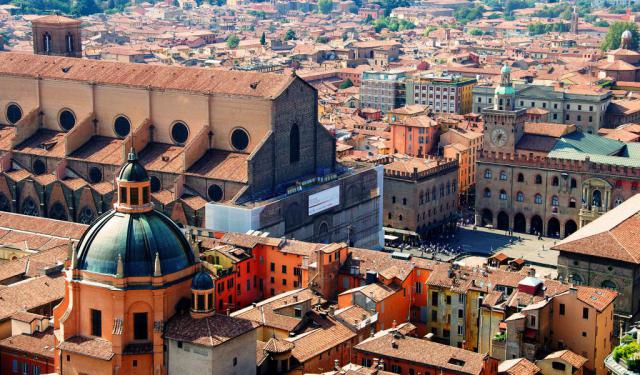
Bologna is one of Italy’s oldest and most historically significant cities, shaped by more than two thousand years of political, cultural, and intellectual development.
Around the 3rd century BC, the Romans conquered the Po valley area and established the colony of Bononia in 189 BC. The name is generally believed to derive from the Celtic root bon, meaning “settlement” or “fortified... view more
Tour Duration: 2 Hour(s)
Travel Distance: 2.3 Km or 1.4 Miles
Around the 3rd century BC, the Romans conquered the Po valley area and established the colony of Bononia in 189 BC. The name is generally believed to derive from the Celtic root bon, meaning “settlement” or “fortified... view more
Tour Duration: 2 Hour(s)
Travel Distance: 2.3 Km or 1.4 Miles
Historical Churches
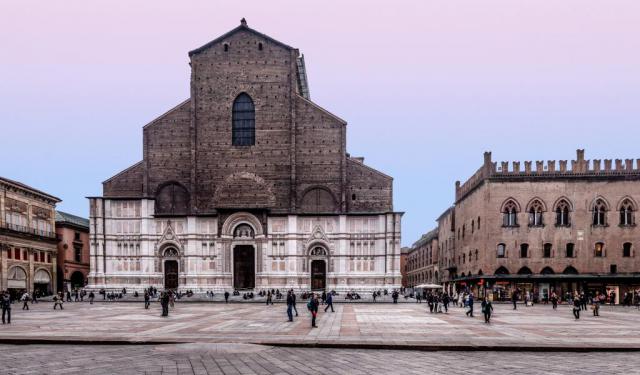
The historic city of Bologna is one of the most sumptuous medieval places in Italy, as well as one of the country's most visited destinations. There are churches everywhere in the city, many of which are well-preserved and well worth a visit. Magnificent and centuries-old, each of them has its own specialty and history carved into, replete with great historic artifacts associated with world... view more
Tour Duration: 1 Hour(s)
Travel Distance: 2.2 Km or 1.4 Miles
Tour Duration: 1 Hour(s)
Travel Distance: 2.2 Km or 1.4 Miles
Bologna Palaces
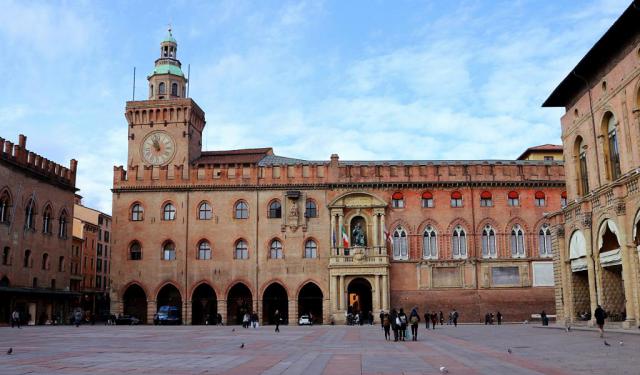
English writer Charles Dickens found “a grave and learned air” in Bologna-an impression that still lingers beneath the arches of its medieval palaces.
Bologna’s palaces are more than impressive historic buildings. Together, they form a record of how the city was governed, administered, and enriched over many centuries. Their walls reflect the changing ambitions of civic officials,... view more
Tour Duration: 1 Hour(s)
Travel Distance: 1.4 Km or 0.9 Miles
Bologna’s palaces are more than impressive historic buildings. Together, they form a record of how the city was governed, administered, and enriched over many centuries. Their walls reflect the changing ambitions of civic officials,... view more
Tour Duration: 1 Hour(s)
Travel Distance: 1.4 Km or 0.9 Miles
Bologna's Shopping Areas
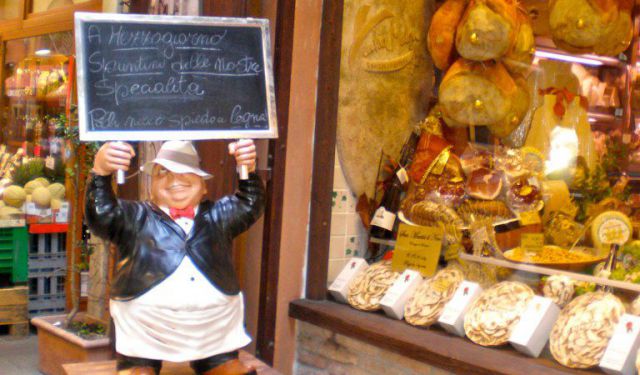
When it comes to shopping, Bologna walks tall amid grands like Milan or Rome, with a harmonious mix of international chains, exclusive boutiques, luxury stores and open-air markets lining the streets in the city center, offering a wealth of international fashion, designer brands and top quality local delicacies in rich supply.
Shopping here is particularly pleasant on weekends when Zone... view more
Tour Duration: 1 Hour(s)
Travel Distance: 0.8 Km or 0.5 Miles
Shopping here is particularly pleasant on weekends when Zone... view more
Tour Duration: 1 Hour(s)
Travel Distance: 0.8 Km or 0.5 Miles