


Castel Nuovo (New Castle), Naples (must see)
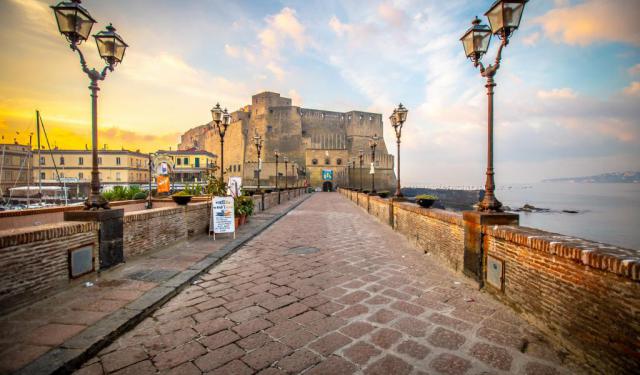
New Castle rises near the harbour as one of Naples’ most recognisable medieval landmarks. Its history begins in 1279, when Charles I of Anjou, King of Sicily, ordered the construction of a new royal fortress to serve as both a defensive stronghold and a symbol of power. At the time, Naples had recently become the capital of the Kingdom of Naples, and the castle’s location near the sea underlined its political and strategic importance.
Over the centuries, New Castle was repeatedly modified as control of the city passed from the Angevins to the Aragonese and later rulers. The most significant transformation occurred in the 15th century under Alfonso V of Aragon, who added the imposing cylindrical towers seen today and commissioned the white marble triumphal arch that marks the main entrance. This arch, celebrating Alfonso’s victorious entry into Naples in 1443, blends classical Roman imagery with Renaissance ideals and stands in deliberate contrast to the fortress’s dark volcanic stone.
Beyond its military role, New Castle also functioned as a royal residence and cultural centre. The castle hosted court ceremonies, diplomatic meetings, and intellectual gatherings. One of its most notable interior spaces is the Hall of the Barons, a vast hall once used for royal assemblies, whose ribbed vault combines Gothic tradition with early Renaissance experimentation. The imposing room can be reached via a long staircase on the northern wall of the inner courtyard. From the courtyard, the beige wall of the Hall of the Barons contrasts with the dark grey of the Palatine Chapel-the only surviving element of the 14th-century Angevin castle. The chapel can be recognised by its Renaissance portal and the rose window above it.
In addition, the castle houses interior museum spaces displaying sculptures, fresco fragments, and archaeological finds connected to Naples’ medieval and Renaissance history.
Despite later losing its status as a royal home, the castle remained central to Naples’ political life well into the modern era, serving as military and civic administrative offices until 1815.
Over the centuries, New Castle was repeatedly modified as control of the city passed from the Angevins to the Aragonese and later rulers. The most significant transformation occurred in the 15th century under Alfonso V of Aragon, who added the imposing cylindrical towers seen today and commissioned the white marble triumphal arch that marks the main entrance. This arch, celebrating Alfonso’s victorious entry into Naples in 1443, blends classical Roman imagery with Renaissance ideals and stands in deliberate contrast to the fortress’s dark volcanic stone.
Beyond its military role, New Castle also functioned as a royal residence and cultural centre. The castle hosted court ceremonies, diplomatic meetings, and intellectual gatherings. One of its most notable interior spaces is the Hall of the Barons, a vast hall once used for royal assemblies, whose ribbed vault combines Gothic tradition with early Renaissance experimentation. The imposing room can be reached via a long staircase on the northern wall of the inner courtyard. From the courtyard, the beige wall of the Hall of the Barons contrasts with the dark grey of the Palatine Chapel-the only surviving element of the 14th-century Angevin castle. The chapel can be recognised by its Renaissance portal and the rose window above it.
In addition, the castle houses interior museum spaces displaying sculptures, fresco fragments, and archaeological finds connected to Naples’ medieval and Renaissance history.
Despite later losing its status as a royal home, the castle remained central to Naples’ political life well into the modern era, serving as military and civic administrative offices until 1815.
Want to visit this sight? Check out these Self-Guided Walking Tours in Naples. Alternatively, you can download the mobile app "GPSmyCity: Walks in 1K+ Cities" from Apple App Store or Google Play Store. The app turns your mobile device to a personal tour guide and it works offline, so no data plan is needed when traveling abroad.
Download The GPSmyCity App



Castel Nuovo (New Castle) on Map
Sight Name: Castel Nuovo (New Castle)
Sight Location: Naples, Italy (See walking tours in Naples)
Sight Type: Museum/Gallery
Guide(s) Containing This Sight:
Sight Location: Naples, Italy (See walking tours in Naples)
Sight Type: Museum/Gallery
Guide(s) Containing This Sight:
Nearby Sights








Walking Tours in Naples, Italy

Create Your Own Walk in Naples
Creating your own self-guided walk in Naples is easy and fun. Choose the city attractions that you want to see and a walk route map will be created just for you. You can even set your hotel as the start point of the walk.

Naples Top Attractions Walking Tour
“See Naples and die.” German poet and scientist Goethe was convinced that Naples represented the epitome of human experience.
The city has been continuously inhabited for nearly three thousand years. Its origins date to the 8th century BC, when Greek settlers from Euboea established a small coastal colony known as Parthenope, near the site of today’s Ovo Castle. As the settlement expanded... view more
Tour Duration: 2 Hour(s)
Travel Distance: 3.7 Km or 2.3 Miles
The city has been continuously inhabited for nearly three thousand years. Its origins date to the 8th century BC, when Greek settlers from Euboea established a small coastal colony known as Parthenope, near the site of today’s Ovo Castle. As the settlement expanded... view more
Tour Duration: 2 Hour(s)
Travel Distance: 3.7 Km or 2.3 Miles

Historical Churches
Christianity in general and the Catholic faith in particular have always played an important role in the social and cultural life of Naples. Not everyone knows that the city boasts the highest number of churches in the world – almost 500 historic “houses of God” (1,000 in total) – accumulated over the course of 17(!) centuries. Hence the nickname – “the city of 500 domes”.
And... view more
Tour Duration: 2 Hour(s)
Travel Distance: 3.7 Km or 2.3 Miles
And... view more
Tour Duration: 2 Hour(s)
Travel Distance: 3.7 Km or 2.3 Miles

Naples Food Tour
A food tour through Naples is less about restaurants alone and more about understanding a city that has always lived through its kitchens, bakeries, markets, and street corners. Naples’ culinary story stretches back more than two thousand years, shaped by Greeks, Romans, Spanish rulers, French influences, and centuries of trade through one of the Mediterranean’s busiest ports. Each period... view more
Tour Duration: 1 Hour(s)
Travel Distance: 1.6 Km or 1 Miles
Tour Duration: 1 Hour(s)
Travel Distance: 1.6 Km or 1 Miles
Naples Old Town Walk
After travelling to Naples in 1835 using a false passport, French painter and writer Alexandre Dumas described the Old Town’s streets as true storytellers in his travel writings.
From the Middle Ages onward, the Old Town developed as a dense network of neighbourhoods organised around churches, convents, guilds, and markets. Religious institutions played a decisive role in shaping the urban... view more
Tour Duration: 2 Hour(s)
Travel Distance: 2.7 Km or 1.7 Miles
From the Middle Ages onward, the Old Town developed as a dense network of neighbourhoods organised around churches, convents, guilds, and markets. Religious institutions played a decisive role in shaping the urban... view more
Tour Duration: 2 Hour(s)
Travel Distance: 2.7 Km or 1.7 Miles