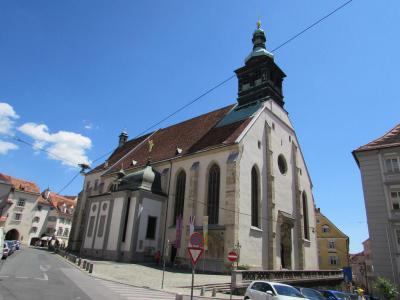


Dom (Graz Cathedral), Graz
Standing beside the former imperial mausoleum in the historic heart of Graz, Graz Cathedral is one of the city’s most important Gothic landmarks. Dedicated to Saint Giles, or Saint Aegydius, it occupies a site where an earlier church had stood since 1174. While that original church stood outside the oldest fortifications as a fortified chapel, the present late-Gothic cathedral was begun around 1438 under Emperor Frederick III inside the newly expanded inner ring of defenses, built to integrate directly with his imperial castle complex.
The exterior is relatively restrained, with a walled choir, buttresses, ridge turrets, a large roof turret, metal doors, old tombstones, and a sculpture of Saint Aegydius. Most of the original façade frescoes were later whitewashed, but one remarkable survivor remains: the famous “Picture of the Plagues.” It shows the disasters that struck Styria in 1480: war, plague, and a locust invasion.
Inside, the cathedral is a spacious hall church, with three naves divided by strong pillars and enriched by later side chapels. Visitors can look for the dated plaques in the choir and sacristy bearing Frederick III’s mysterious motto, AEIOU, often interpreted as “Austria is destined to rule the world.” The long choir lies beyond a tall triumphal arch, flanked by two reliquaries on marble plinths. The Baroque high altar, installed in 1733, replaced an earlier Renaissance altar, while the Baroque organ gallery adds to the richly layered interior.
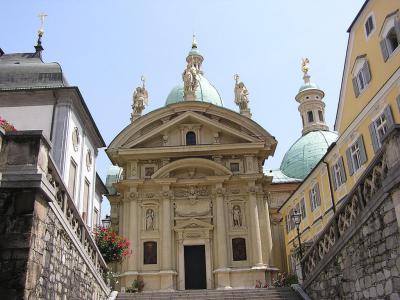
Together with the neighboring Mausoleum of Emperor Ferdinand II and nearby Graz Castle, the cathedral forms one of the city’s finest historic ensembles.
The exterior is relatively restrained, with a walled choir, buttresses, ridge turrets, a large roof turret, metal doors, old tombstones, and a sculpture of Saint Aegydius. Most of the original façade frescoes were later whitewashed, but one remarkable survivor remains: the famous “Picture of the Plagues.” It shows the disasters that struck Styria in 1480: war, plague, and a locust invasion.
Inside, the cathedral is a spacious hall church, with three naves divided by strong pillars and enriched by later side chapels. Visitors can look for the dated plaques in the choir and sacristy bearing Frederick III’s mysterious motto, AEIOU, often interpreted as “Austria is destined to rule the world.” The long choir lies beyond a tall triumphal arch, flanked by two reliquaries on marble plinths. The Baroque high altar, installed in 1733, replaced an earlier Renaissance altar, while the Baroque organ gallery adds to the richly layered interior.
Together with the neighboring Mausoleum of Emperor Ferdinand II and nearby Graz Castle, the cathedral forms one of the city’s finest historic ensembles.
Want to visit this sight? Check out these Self-Guided Walking Tours in Graz. Alternatively, you can download the mobile app "GPSmyCity: Walks in 1K+ Cities" from Apple App Store or Google Play Store. The app turns your mobile device to a personal tour guide and it works offline, so no data plan is needed when traveling abroad.
Download The GPSmyCity App



Dom (Graz Cathedral) on Map
Sight Name: Dom (Graz Cathedral)
Sight Location: Graz, Austria (See walking tours in Graz)
Sight Type: Religious
Guide(s) Containing This Sight:
Sight Location: Graz, Austria (See walking tours in Graz)
Sight Type: Religious
Guide(s) Containing This Sight:
Nearby Sights

Walking Tours in Graz, Austria

Create Your Own Walk in Graz
Creating your own self-guided walk in Graz is easy and fun. Choose the city attractions that you want to see and a walk route map will be created just for you. You can even set your hotel as the start point of the walk.
Graz Old Town Walking Tour
Before humanity understood how planets move, the renowned astronomer Johannes Kepler was studying the skies from Graz between 1594 and 1600. During his time here, he developed ideas that would eventually lead to his revolutionary laws of planetary motion.
Graz, the capital of the Austrian state of Styria, has a history stretching back more than a thousand years. Its name derives from the Slavic... view more
Tour Duration: 2 Hours
Travel Distance: 3 Km or 1.9 Miles
Graz, the capital of the Austrian state of Styria, has a history stretching back more than a thousand years. Its name derives from the Slavic... view more
Tour Duration: 2 Hours
Travel Distance: 3 Km or 1.9 Miles