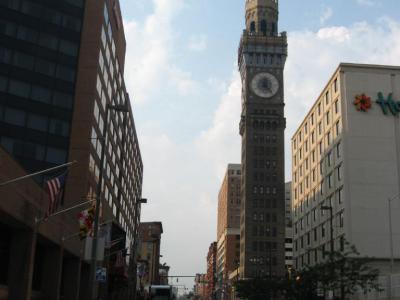


Emerson Bromo-Seltzer Tower, Baltimore
The Emerson Bromo-Seltzer Tower, standing at 15 stories high and 88 meters tall, is an iconic skyscraper in downtown Baltimore. Built in 1911, the tower was designed by architect Joseph Evans Sperry for Isaac E. Emerson, the inventor of Bromo-Seltzer, a popular headache remedy at the time. The tower was the tallest building in Baltimore from its construction in 1911 until 1923, and its design was inspired by the Palazzo Vecchio in Florence, Italy, which Emerson saw during a tour of Europe in 1900.
The tower features four clock faces on its 15th floor, each measuring 24 feet in diameter, with the letters "B-R-O-M-O S-E-L-T-Z-E-R" in translucent white glass, and the Roman numerals being less prominent. Originally powered by weights, the clocks are now electrically powered and are illuminated at night by mercury-vapor lamps. The minute and hour hands of the clocks are 12 and 10 feet in length, respectively.
The tower was originally topped by a 51-foot Bromo-Seltzer bottle, which rotated and glowed blue, with 314 incandescent light bulbs, and a crown. However, due to structural concerns, it was removed in 1936. Despite this, the tower remains a Baltimore landmark and is listed on the National Register of Historic Places.
After an extensive renovation, the Bromo Seltzer Arts Tower was opened in 2008 and now houses studio spaces for visual and literary artists. The tower also features the still-functioning tower clock, the largest four-dial gravity-driven non-chiming clock in the world, designed by Seth Thomas in 1911. The clock underwent a full restoration in 2017.
The Emerson Bromo-Seltzer Tower is a historic and impressive structure that has stood the test of time and remains an important part of Baltimore's skyline and cultural heritage.
The tower features four clock faces on its 15th floor, each measuring 24 feet in diameter, with the letters "B-R-O-M-O S-E-L-T-Z-E-R" in translucent white glass, and the Roman numerals being less prominent. Originally powered by weights, the clocks are now electrically powered and are illuminated at night by mercury-vapor lamps. The minute and hour hands of the clocks are 12 and 10 feet in length, respectively.
The tower was originally topped by a 51-foot Bromo-Seltzer bottle, which rotated and glowed blue, with 314 incandescent light bulbs, and a crown. However, due to structural concerns, it was removed in 1936. Despite this, the tower remains a Baltimore landmark and is listed on the National Register of Historic Places.
After an extensive renovation, the Bromo Seltzer Arts Tower was opened in 2008 and now houses studio spaces for visual and literary artists. The tower also features the still-functioning tower clock, the largest four-dial gravity-driven non-chiming clock in the world, designed by Seth Thomas in 1911. The clock underwent a full restoration in 2017.
The Emerson Bromo-Seltzer Tower is a historic and impressive structure that has stood the test of time and remains an important part of Baltimore's skyline and cultural heritage.
Want to visit this sight? Check out these Self-Guided Walking Tours in Baltimore. Alternatively, you can download the mobile app "GPSmyCity: Walks in 1K+ Cities" from Apple App Store or Google Play Store. The app turns your mobile device to a personal tour guide and it works offline, so no data plan is needed when traveling abroad.
Download The GPSmyCity App



Emerson Bromo-Seltzer Tower on Map
Sight Name: Emerson Bromo-Seltzer Tower
Sight Location: Baltimore, USA (See walking tours in Baltimore)
Sight Type: Attraction/Landmark
Guide(s) Containing This Sight:
Sight Location: Baltimore, USA (See walking tours in Baltimore)
Sight Type: Attraction/Landmark
Guide(s) Containing This Sight:
Nearby Sights
Walking Tours in Baltimore, Maryland

Create Your Own Walk in Baltimore
Creating your own self-guided walk in Baltimore is easy and fun. Choose the city attractions that you want to see and a walk route map will be created just for you. You can even set your hotel as the start point of the walk.
Baltimore Downtown Walking Tour
Before the city fully wakes, picture a harbor under fire, the night sky lit by explosions, and a single question hanging in the smoke: can the flag still be seen at dawn? In 1814, as the bombardment of Fort McHenry came to an end, Francis Scott Key, an American lawyer and poet, looked out and found his answer: “O say can you see, by the dawn’s early light…” From that moment, Baltimore... view more
Tour Duration: 2 Hour(s)
Travel Distance: 3.6 Km or 2.2 Miles
Tour Duration: 2 Hour(s)
Travel Distance: 3.6 Km or 2.2 Miles
Baltimore's Architectural Jewels
Overall, Baltimore's architecture is a testament to the city's rich and varied history, showcasing a wide range of styles and cultural influences that have shaped the local built environment over the centuries. Outside Federal-style row houses and grand Beaux-Arts museums, Baltimore is also known for a multitude of Art Deco buildings and temples of various styles, constructed between the... view more
Tour Duration: 2 Hour(s)
Travel Distance: 3.9 Km or 2.4 Miles
Tour Duration: 2 Hour(s)
Travel Distance: 3.9 Km or 2.4 Miles
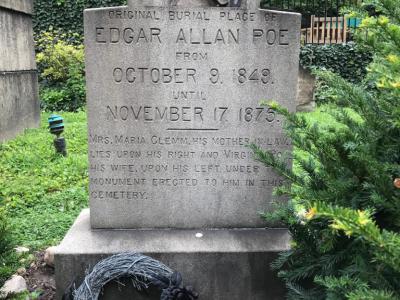
Edgar Allan Poe’s Baltimore
“Deep into that darkness peering, long I stood there wondering, fearing…” wrote Edgar Allan Poe, a line that could just as easily describe his final, mysterious days in Baltimore, the city most closely tied to his life and death.
Edgar Allan Poe was an American writer and poet best known for his tales of mystery, horror, and psychological depth. Although his family had roots in Baltimore,... view more
Tour Duration: 2 Hour(s)
Travel Distance: 5.5 Km or 3.4 Miles
Edgar Allan Poe was an American writer and poet best known for his tales of mystery, horror, and psychological depth. Although his family had roots in Baltimore,... view more
Tour Duration: 2 Hour(s)
Travel Distance: 5.5 Km or 3.4 Miles