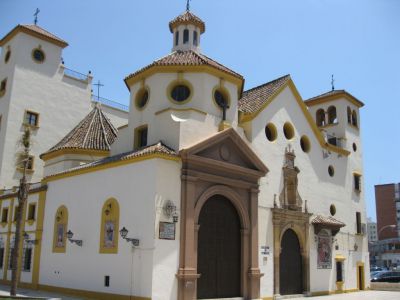


Iglesia San Pedro (Church of San Pedro), Malaga
The Church of San Pedro, located in the historic El Perchel neighborhood of Malaga, is a significant Catholic edifice blending classical, Mudejar, and Baroque styles. Its origins trace back to 1626, when Pedro Díaz de Palacios, then the master builder of Malaga Cathedral, was commissioned to design a church to complement the old parish church of San Juan. The project originally planned for three naves, a main chapel, a sacristy, and a tower. However, only one nave was completed, and the design was simplified, with a bell tower replacing the intended belfry.
In the early 18th century, the monumental Chapel of the Sagrario was added, showcasing a rich Baroque style attributed to master Unzurrunzaga. This chapel is notable for its exuberant plasterwork and paintings, influenced by the Malaga painter Diego de la Cerda.
By the early 20th century, the church had fallen into disrepair, exacerbated by the events of 1931 and 1936. Restoration began in the 1940s under architect Enrique Atencia, who preserved the church's original structure while adding two chapels to house images of the Brotherhood of the Christ of the Expiration. This brotherhood's presence has since become a focal point of devotion in Malaga.
The Church of San Pedro stands out for its sobriety and monumental design, with a striking reddish stone facade contrasting against whitewashed walls. The interior features a single nave covered with pair and knuckle reinforcement, supported by tie braces resting on cane pairs embedded in the side walls. Large semicircular arches, mostly blind, adorn the perimeter, supported by Doric pilasters. Flared stained-glass windows add a touch of light and color to the upper areas.
The main chapel features a flat head with a blind semicircular arch aligning with the nave's walls. A 17th-century limestone baptismal font with a cylindrical foot, octagonal base, and carved circular basin sits on the left of the presbytery. At the rear, a wooden choir, raised on four girders-two supported by cane-includes a balustered parapet.
Today, the Church of San Pedro is not only a place of worship but also a cultural and historical symbol of Malaga, cherished for its architectural simplicity and profound spiritual significance.
In the early 18th century, the monumental Chapel of the Sagrario was added, showcasing a rich Baroque style attributed to master Unzurrunzaga. This chapel is notable for its exuberant plasterwork and paintings, influenced by the Malaga painter Diego de la Cerda.
By the early 20th century, the church had fallen into disrepair, exacerbated by the events of 1931 and 1936. Restoration began in the 1940s under architect Enrique Atencia, who preserved the church's original structure while adding two chapels to house images of the Brotherhood of the Christ of the Expiration. This brotherhood's presence has since become a focal point of devotion in Malaga.
The Church of San Pedro stands out for its sobriety and monumental design, with a striking reddish stone facade contrasting against whitewashed walls. The interior features a single nave covered with pair and knuckle reinforcement, supported by tie braces resting on cane pairs embedded in the side walls. Large semicircular arches, mostly blind, adorn the perimeter, supported by Doric pilasters. Flared stained-glass windows add a touch of light and color to the upper areas.
The main chapel features a flat head with a blind semicircular arch aligning with the nave's walls. A 17th-century limestone baptismal font with a cylindrical foot, octagonal base, and carved circular basin sits on the left of the presbytery. At the rear, a wooden choir, raised on four girders-two supported by cane-includes a balustered parapet.
Today, the Church of San Pedro is not only a place of worship but also a cultural and historical symbol of Malaga, cherished for its architectural simplicity and profound spiritual significance.
Want to visit this sight? Check out these Self-Guided Walking Tours in Malaga. Alternatively, you can download the mobile app "GPSmyCity: Walks in 1K+ Cities" from Apple App Store or Google Play Store. The app turns your mobile device to a personal tour guide and it works offline, so no data plan is needed when traveling abroad.
Download The GPSmyCity App



Iglesia San Pedro (Church of San Pedro) on Map
Sight Name: Iglesia San Pedro (Church of San Pedro)
Sight Location: Malaga, Spain (See walking tours in Malaga)
Sight Type: Religious
Sight Location: Malaga, Spain (See walking tours in Malaga)
Sight Type: Religious
Nearby Sights

Walking Tours in Malaga, Spain

Create Your Own Walk in Malaga
Creating your own self-guided walk in Malaga is easy and fun. Choose the city attractions that you want to see and a walk route map will be created just for you. You can even set your hotel as the start point of the walk.
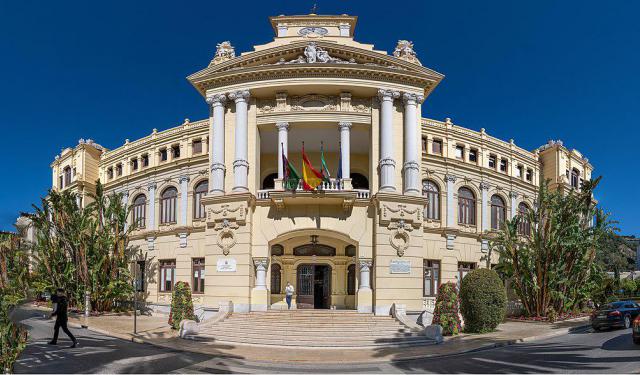
Discover Malaga's Architectural Jewels on Foot
The blooming port city of Málaga has a wealth of architecture with no shortage of ancient and otherwise impressive buildings fit to vow any visitor. Having witnessed the fall and rise of many civilizations, Malaga's uniqueness is marked by the variety of architectural styles, upon which the times past had a great deal of impact. From its stunning Moorish fortress - the best-preserved of its... view more
Tour Duration: 2 Hours
Travel Distance: 3.7 Km or 2.3 Miles
Tour Duration: 2 Hours
Travel Distance: 3.7 Km or 2.3 Miles
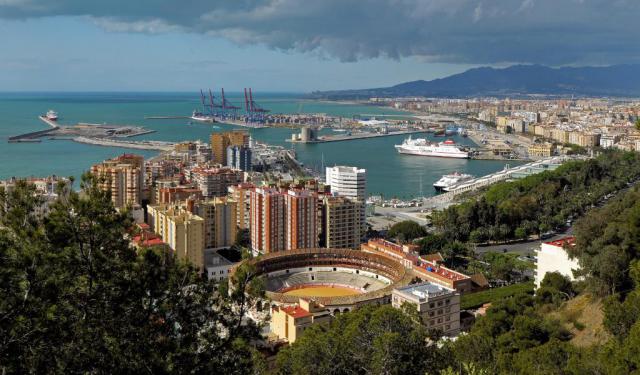
A Walk Through Malaga's Historic City Center
In 1325, the famed Muslim traveller Ibn Battuta reflected on his visit to Málaga, writing: "It is one of the largest and most beautiful towns of Andalusia, combining the conveniences of both sea and land.''
Málaga is one of the oldest continuously inhabited cities in Europe, with a history spanning nearly three millennia. It was founded around the 8th century BC by Phoenician... view more
Tour Duration: 2 Hours
Travel Distance: 3.4 Km or 2.1 Miles
Málaga is one of the oldest continuously inhabited cities in Europe, with a history spanning nearly three millennia. It was founded around the 8th century BC by Phoenician... view more
Tour Duration: 2 Hours
Travel Distance: 3.4 Km or 2.1 Miles
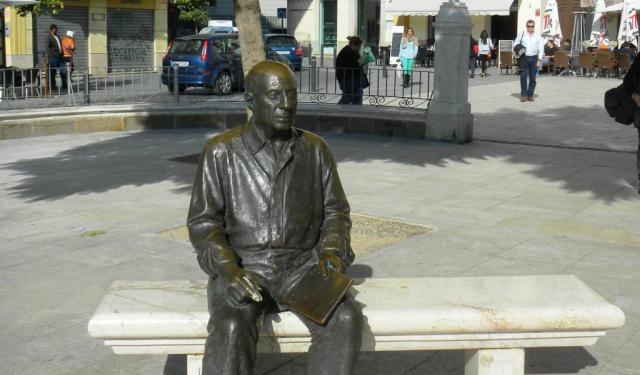
A Walking Guide To Pablo Picasso's Malaga
According to a well-known story, Picasso’s first word was “piz,” a child’s attempt at “lápiz,” meaning “pencil.”
Málaga at the end of the 19th century was a busy Mediterranean port. When Pablo Ruiz Picasso was born here in 1881, the city was neither a bohemian art capital nor a provincial backwater, but a working, outward-looking place where commerce, craftsmanship, and... view more
Tour Duration: 1 Hour
Travel Distance: 1.3 Km or 0.8 Miles
Málaga at the end of the 19th century was a busy Mediterranean port. When Pablo Ruiz Picasso was born here in 1881, the city was neither a bohemian art capital nor a provincial backwater, but a working, outward-looking place where commerce, craftsmanship, and... view more
Tour Duration: 1 Hour
Travel Distance: 1.3 Km or 0.8 Miles
Useful Travel Guides for Planning Your Trip
5 Best Shopping Streets in Malaga, Spain
As well as one of the best cultural destinations in southern Spain, Malaga turns out to be something of a shopping mecca. Along with the ubiquitous shopping malls on the outskirts, the capital of Costa del Sol has managed to preserve its network of specialist shops, difficult to find in most big...
City Walks Overview
