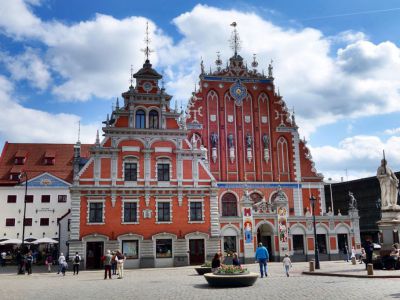


Melngalvju Nams (House of the Black Heads), Riga (must see)
The House of the Blackheads is now a museum celebrating Riga’s rich commercial heritage. The original building was erected in 1334.
It became closely associated with the Brotherhood of the Blackheads, a local guild made up largely of unmarried merchants, shipowners and foreign traders. The organisation was active from the Middle Ages until around 1940. It began as a military and religious association but gradually evolved into an important social and cultural organisation.
The House of the Blackheads served as a meeting place for the brotherhood, where members hosted banquets, celebrations and cultural events. In 1510, the square outside was also the setting for what is traditionally regarded as one of the world’s first decorated Christmas trees. Remarkably, you can still visit the historic site today. A commemorative plaque set into the cobblestones in front of the building, together with a metal Christmas tree sculpture, marks the spot associated with this centuries-old tradition.
The building was destroyed during World War II. It was severely damaged in 1941 and its remaining ruins were demolished by the Soviet authorities in 1948. The House of the Blackheads was reconstructed in the late 1990s, largely restoring its historic appearance. During an initiative known as “I Build the House of the Blackheads,” local residents contributed money towards its reconstruction, symbolically helping to put the building back together. The investment was certainly worthwhile. Make sure to admire the façade’s intricate astronomical clock, gilded statues and colourful coats of arms.
Today, the House of the Blackheads has been restored to its former glory and is open to the public. The upper levels contain magnificent ballrooms that have hosted some of Riga’s most prestigious cultural events. The building has also played an important role in Latvia’s modern political history, serving as the temporary residence and workplace of the President of Latvia between 2012 and 2016. To get a taste of the interior’s opulence, step through the grand entrance and explore the elegant state rooms and historical exhibition halls.
Perhaps the most fascinating area lies underground. In the cellar, visitors can walk through original medieval spaces and explore some of the oldest surviving parts of the building. Once used to store goods, the atmospheric cellar now serves as an exhibition area.
The museum is open daily. On the last Sunday of each month, it offers a free, one-hour guided tour of the building in English, Latvian and Russian.
It became closely associated with the Brotherhood of the Blackheads, a local guild made up largely of unmarried merchants, shipowners and foreign traders. The organisation was active from the Middle Ages until around 1940. It began as a military and religious association but gradually evolved into an important social and cultural organisation.
The House of the Blackheads served as a meeting place for the brotherhood, where members hosted banquets, celebrations and cultural events. In 1510, the square outside was also the setting for what is traditionally regarded as one of the world’s first decorated Christmas trees. Remarkably, you can still visit the historic site today. A commemorative plaque set into the cobblestones in front of the building, together with a metal Christmas tree sculpture, marks the spot associated with this centuries-old tradition.
The building was destroyed during World War II. It was severely damaged in 1941 and its remaining ruins were demolished by the Soviet authorities in 1948. The House of the Blackheads was reconstructed in the late 1990s, largely restoring its historic appearance. During an initiative known as “I Build the House of the Blackheads,” local residents contributed money towards its reconstruction, symbolically helping to put the building back together. The investment was certainly worthwhile. Make sure to admire the façade’s intricate astronomical clock, gilded statues and colourful coats of arms.
Today, the House of the Blackheads has been restored to its former glory and is open to the public. The upper levels contain magnificent ballrooms that have hosted some of Riga’s most prestigious cultural events. The building has also played an important role in Latvia’s modern political history, serving as the temporary residence and workplace of the President of Latvia between 2012 and 2016. To get a taste of the interior’s opulence, step through the grand entrance and explore the elegant state rooms and historical exhibition halls.
Perhaps the most fascinating area lies underground. In the cellar, visitors can walk through original medieval spaces and explore some of the oldest surviving parts of the building. Once used to store goods, the atmospheric cellar now serves as an exhibition area.
The museum is open daily. On the last Sunday of each month, it offers a free, one-hour guided tour of the building in English, Latvian and Russian.
Want to visit this sight? Check out these Self-Guided Walking Tours in Riga. Alternatively, you can download the mobile app "GPSmyCity: Walks in 1K+ Cities" from Apple App Store or Google Play Store. The app turns your mobile device to a personal tour guide and it works offline, so no data plan is needed when traveling abroad.
Download The GPSmyCity App



Melngalvju Nams (House of the Black Heads) on Map
Sight Name: Melngalvju Nams (House of the Black Heads)
Sight Location: Riga, Latvia (See walking tours in Riga)
Sight Type: Attraction/Landmark
Guide(s) Containing This Sight:
Sight Location: Riga, Latvia (See walking tours in Riga)
Sight Type: Attraction/Landmark
Guide(s) Containing This Sight:
Nearby Sights

Walking Tours in Riga, Latvia

Create Your Own Walk in Riga
Creating your own self-guided walk in Riga is easy and fun. Choose the city attractions that you want to see and a walk route map will be created just for you. You can even set your hotel as the start point of the walk.
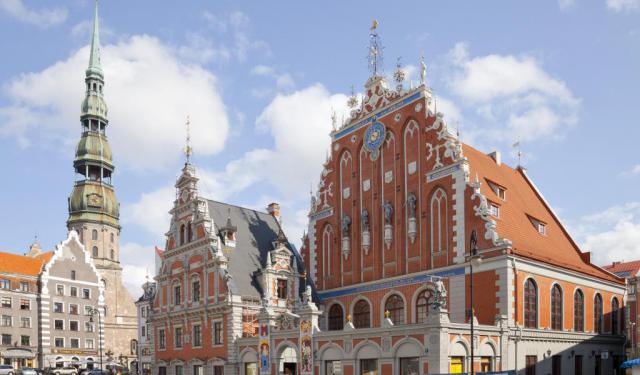
A Walk Through Riga's Charming Old Town
The area that is home to present-day Riga has hosted inhabitants since the days of the Vikings. With a sheltered natural harbor nearby, the River Daugava made Riga a stop on the Vikings' Dvina-Dnieper trade route to Byzantium.
Trade allowed the area to flourish, and the Livs, a Finnic tribe, settled it. In the early Middle Ages, the town's economy revolved around fishing, trading, and... view more
Tour Duration: 2 Hour(s)
Travel Distance: 2.4 Km or 1.5 Miles
Trade allowed the area to flourish, and the Livs, a Finnic tribe, settled it. In the early Middle Ages, the town's economy revolved around fishing, trading, and... view more
Tour Duration: 2 Hour(s)
Travel Distance: 2.4 Km or 1.5 Miles
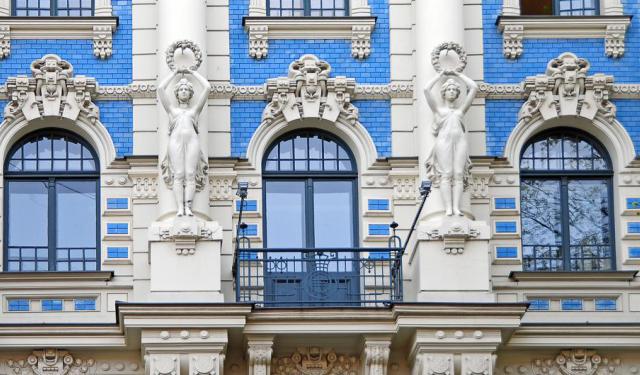
A Walking Guide to Riga's Fairytale Art Nouveau Architecture
An architecture lover in general and that of Art Nouveau in particular will find plenty to look at in the quiet center of Riga. Jūgendstil (Latvian: Art Nouveau) architecture makes up roughly one third of all buildings in the heart of Latvia's capital. In fact, the city boasts the highest concentration of Art Nouveau structures anywhere in the world.
Constructed during a period of rapid... view more
Tour Duration: 1 Hour(s)
Travel Distance: 1.3 Km or 0.8 Miles
Constructed during a period of rapid... view more
Tour Duration: 1 Hour(s)
Travel Distance: 1.3 Km or 0.8 Miles
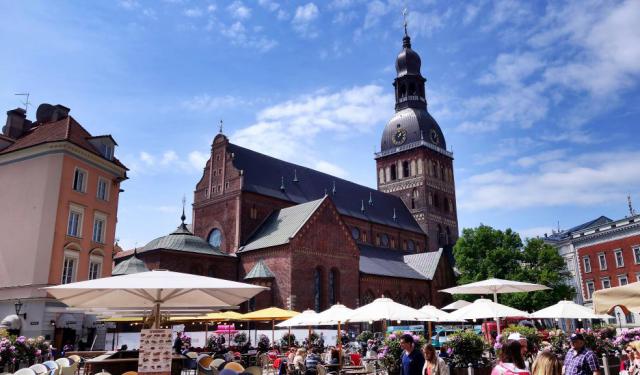
Explore Riga's Historical Churches on Foot
One great thing about Riga is that the majority of its religious sites are concentrated in the historic center. A variety of faiths found in the Latvian capital is fairly broad for such a small country and includes Roman Catholic, Orthodox, and Lutheran, to mention but a few.
The 13th-century Riga Cathedral is perhaps the most significant house of prayer in the city. The imposing mix of... view more
Tour Duration: 2 Hour(s)
Travel Distance: 3.0 Km or 1.9 Miles
The 13th-century Riga Cathedral is perhaps the most significant house of prayer in the city. The imposing mix of... view more
Tour Duration: 2 Hour(s)
Travel Distance: 3.0 Km or 1.9 Miles
Useful Travel Guides for Planning Your Trip
Traveler's Choice of 12 Uniquely Latvian Souvenirs from Riga
Reemerged after regaining independence in the early 1990s, Latvia is anxious to reveal its beauty to the outside world. The country's capital Riga is a good showroom for the country's cultural riches and traditions. Here's the list of the unique Latvian products to look for while in...