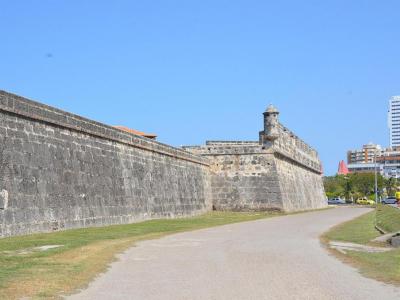


Murallas de Cartagena (Cartagena City Walls), Cartagena (must see)
The Cartagena City Walls are among the city’s most impressive landmarks, forming an extensive defensive system of stone ramparts and bastions around the historic Old Town. Their origins lie in the late 16th century, when Cartagena’s growing importance as a Spanish colonial port made it a frequent target for pirates and rival European powers.
Following the devastating 1586 attack by English privateer Francis Drake, the Spanish Crown began developing a much stronger system of fortifications. Italian military engineer Battista Antonelli produced some of the earliest plans, while generations of engineers subsequently expanded and strengthened the defences. Construction continued for nearly two centuries and was finally completed in 1796.
Stretching for around 11 kilometres (or 7 miles), the thick stone walls incorporated massive bastions, parapets, gateways and positions for artillery. Their design took advantage of Cartagena’s coastal geography, protecting both the city and its strategically important harbour. Together with the surrounding forts, they created one of the most formidable defensive systems in the Spanish Americas.
Parts of the walls were demolished in the early 20th century as Cartagena expanded and modernised, but much of the historic fortification survived. Today, they form part of Cartagena’s UNESCO World Heritage Site and rank among the best-preserved historic fortifications in South America.
Walking along the broad ramparts is one of the best ways to explore the Old Town from a different perspective. As you make your way from the Bastion of Santo Domingo, keep an eye out for the stone steps leading up to the elevated walkway. Along the route, look for old iron cannons, stone sentry boxes and lookout points while enjoying elevated views over Cartagena’s colourful rooftops and the glistening Caribbean Sea. Look down from the ramparts to appreciate the walls’ immense thickness and the angled bastions designed to provide overlapping fields of fire.
The walls are particularly atmospheric in the late afternoon and around sunset. Beyond the well-known Bastion of Santo Domingo, the Cartagena City Walls lead past the bastions of Santa Cruz, Merced, San Diego, Santa Clara and Santa Catalina. Whichever spot you choose, find a comfortable place along the stone parapet and enjoy the sunset over the Caribbean Sea.
Want to visit this sight? Check out these Self-Guided Walking Tours in Cartagena. Alternatively, you can download the mobile app "GPSmyCity: Walks in 1K+ Cities" from Apple App Store or Google Play Store. The app turns your mobile device to a personal tour guide and it works offline, so no data plan is needed when traveling abroad.
Download The GPSmyCity App



Murallas de Cartagena (Cartagena City Walls) on Map
Sight Name: Murallas de Cartagena (Cartagena City Walls)
Sight Location: Cartagena, Colombia (See walking tours in Cartagena)
Sight Type: Attraction/Landmark
Guide(s) Containing This Sight:
Sight Location: Cartagena, Colombia (See walking tours in Cartagena)
Sight Type: Attraction/Landmark
Guide(s) Containing This Sight:
Nearby Sights



Walking Tours in Cartagena, Colombia
Create Your Own Walk in Cartagena
Creating your own self-guided walk in Cartagena is easy and fun. Choose the city attractions that you want to see and a walk route map will be created just for you. You can even set your hotel as the start point of the walk.
Cartagena Introduction Walking Tour
Nobel-prize winning Colombian writer Gabriel García Márquez moved to Cartagena as a young man in 1948. Upon entering the historic centre for the first time, he felt as if he had “been born again.”
Cartagena, a historic port city on Colombia’s Caribbean coast, has a history shaped by Indigenous cultures, Spanish colonisation, maritime trade, slavery, piracy and struggles for... view more
Tour Duration: 2 Hours
Travel Distance: 2.4 Km or 1.5 Miles
Cartagena, a historic port city on Colombia’s Caribbean coast, has a history shaped by Indigenous cultures, Spanish colonisation, maritime trade, slavery, piracy and struggles for... view more
Tour Duration: 2 Hours
Travel Distance: 2.4 Km or 1.5 Miles
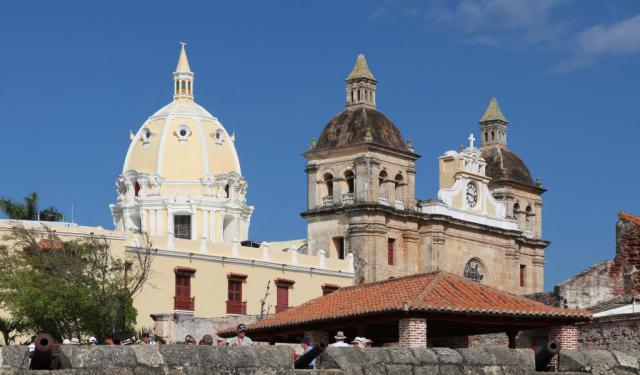
Colonial Architecture Walk
Visiting Cartagena can be a remarkable experience, especially for those keen on architecture. The beautifully-preserved, mostly colonial-style, buildings in the historic center have long been one of the main attributes of this once burgeoning Colombian town.
Recognizing colonial Cartagena is easy, as it is surrounded by colossal stone walls tracing the outline of the old city. The downtown... view more
Tour Duration: 1 Hour
Travel Distance: 2 Km or 1.2 Miles
Recognizing colonial Cartagena is easy, as it is surrounded by colossal stone walls tracing the outline of the old city. The downtown... view more
Tour Duration: 1 Hour
Travel Distance: 2 Km or 1.2 Miles
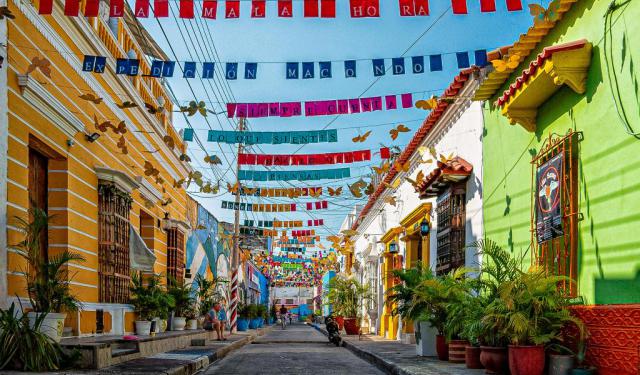
Getsemani Public Arts Walking Tour
Long known as the “neighbourhood of the poor” and notorious for criminal activity, the district of Getsemani has undergone considerable gentrification in recent years, becoming one of Cartagena’s hippest areas and an increasingly popular tourist destination. Local squares once associated with crime have been reclaimed, while many formerly neglected buildings have been transformed into... view more
Tour Duration: 1 Hour
Travel Distance: 0.8 Km or 0.5 Miles
Tour Duration: 1 Hour
Travel Distance: 0.8 Km or 0.5 Miles
Useful Travel Guides for Planning Your Trip

15 Tips to Have Fun in Cartagena De Indias, Colombia
Because of its troubled past, you will hear many nicknames to describe Cartagena de Indias. The magic city, The Heroic, The Rock Corral, The jewel of the Caribbean Coast. The mere mention of them allows you to travel through the history, from pirates and slavery to the revolutions for their...
City Walks Overview
