

Historical Buildings Walking Tour (Self Guided), Montreal
Whenever you gaze upon the historical buildings of Montreal, you are reminded that the true measure of a city's greatness lies in its ability to preserve its past while embracing its future. Old Montreal – home to four centuries of architecture shaped by French sophistication and English practicality – is a place all its own.
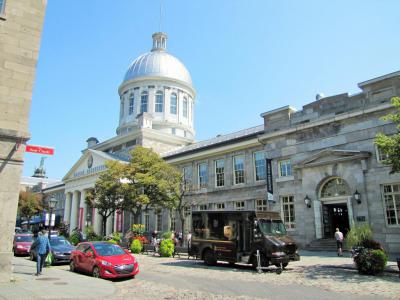
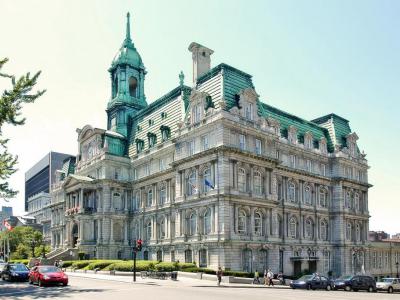
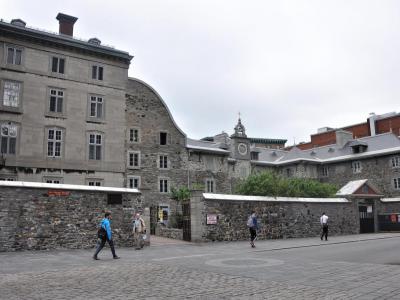
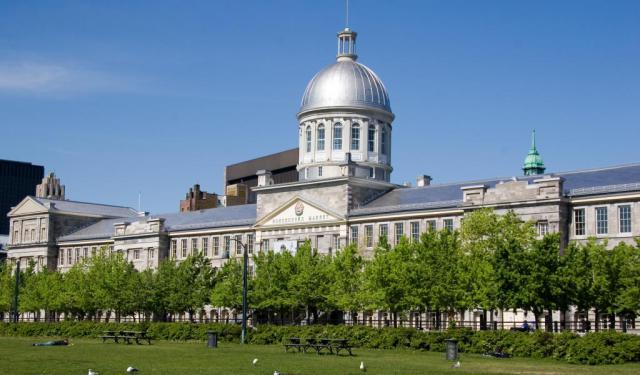
Here, modern buildings coexist with some of the oldest and most fascinating structures like the domed Bonsecours Market (Marché Bonsecours) and the impressive Second Empire-style Montreal City Hall (Hôtel de Ville). These historic landmarks stand out tall as silent witnesses to the passage of time and enduring sights that continue to thrive and define the city's architectural identity. Much the same is the Old Saint-Sulpice Seminary, featuring a blend of French and Quebecois grandeur.
Another guardian of local heritage, preserving the soul of a place, is the Montreal History Center (Centre d'Histoire de Montréal). Just a few blocks away, at the corner of Saint Jacques and Saint Pierre streets, you will find a Beaux-Arts architectural gem known as the Molson Bank.
Among other prominent “storytellers frozen in time” who share tales of the past generations with every brick and arch are the Hudson's Bay (La Baie d'Hudson), the Sun Life Building, and Windsor Station (Gare Windsor).
Montreal's historical buildings are like pages of a living book, each one telling its own chapter of the city's story. If you wish to hear some of them and appreciate first-hand the enduring elegance and artistic vision of those who shaped the skyline of the Quebec capital, embark on this captivating self-guided journey with GPSmyCity.
Here, modern buildings coexist with some of the oldest and most fascinating structures like the domed Bonsecours Market (Marché Bonsecours) and the impressive Second Empire-style Montreal City Hall (Hôtel de Ville). These historic landmarks stand out tall as silent witnesses to the passage of time and enduring sights that continue to thrive and define the city's architectural identity. Much the same is the Old Saint-Sulpice Seminary, featuring a blend of French and Quebecois grandeur.
Another guardian of local heritage, preserving the soul of a place, is the Montreal History Center (Centre d'Histoire de Montréal). Just a few blocks away, at the corner of Saint Jacques and Saint Pierre streets, you will find a Beaux-Arts architectural gem known as the Molson Bank.
Among other prominent “storytellers frozen in time” who share tales of the past generations with every brick and arch are the Hudson's Bay (La Baie d'Hudson), the Sun Life Building, and Windsor Station (Gare Windsor).
Montreal's historical buildings are like pages of a living book, each one telling its own chapter of the city's story. If you wish to hear some of them and appreciate first-hand the enduring elegance and artistic vision of those who shaped the skyline of the Quebec capital, embark on this captivating self-guided journey with GPSmyCity.
How it works: Download the app "GPSmyCity: Walks in 1K+ Cities" from Apple App Store or Google Play Store to your mobile phone or tablet. The app turns your mobile device into a personal tour guide and its built-in GPS navigation functions guide you from one tour stop to next. The app works offline, so no data plan is needed when traveling abroad.
Historical Buildings Walking Tour Map
Guide Name: Historical Buildings Walking Tour
Guide Location: Canada » Montreal (See other walking tours in Montreal)
Guide Type: Self-guided Walking Tour (Sightseeing)
# of Attractions: 10
Tour Duration: 2 Hour(s)
Travel Distance: 3.8 Km or 2.4 Miles
Author: doris
Sight(s) Featured in This Guide:
Guide Location: Canada » Montreal (See other walking tours in Montreal)
Guide Type: Self-guided Walking Tour (Sightseeing)
# of Attractions: 10
Tour Duration: 2 Hour(s)
Travel Distance: 3.8 Km or 2.4 Miles
Author: doris
Sight(s) Featured in This Guide:
- Bonsecours Market (Marche Bonsecours)
- Hotel de Ville (City Hall)
- Notre-Dame Basilica
- Old Saint-Sulpice Seminary
- Caserne Centrale de Pompiers (Central Fire Station)
- Molson Bank
- Hudson's Bay (La Baie d'Hudson)
- Cathedrale Marie-Reine-du-Monde (Mary, Queen of the World Cathedral)
- Sun Life Building
- Windsor Station (Gare Windsor)
1) Bonsecours Market (Marche Bonsecours)
Bonsecours Market (Marché Bonsecours) owes its name to the adjacent Chapel of Our Lady of Good Help (Notre-Dame-de-Bon-Secours).
Inaugurated in 1847, for over a century this was the primary agricultural market for the Montreal area. Also, for a brief period – just one session, in 1849 – the building housed the Legislative Assembly (Parliament) of United Canada and, throughout 1852-1878, accommodated the Montreal City Hall.
The elongated two-story Neoclassical edifice with a tin-plated dome and columns is considered one of the main achievements of Canadian architecture. In 1984, it was designated a National Historic Site of Canada. The design – by British architect William Footner – was influenced by Dublin's Customs House. Further additions, including a 900-square-meter concert and banquet hall, completed in 1860, were designed by Irish-born Montreal architect George Browne.
The building continued to serve as the farmer's central market, as well as a venue for banquets, exhibitions, and festivals until it was closed in 1963. After standing idle for a few years, it was slated for demolition.
Luckily, the property was later transformed into a multi-purpose facility with a mall incorporating outdoor cafés, restaurants, and exclusive boutiques selling authentic Canadian crafts such as jewelry, leather, and hand-blown glass – all made in Quebec. Those keen on maple tree products will be particularly delighted to find here a huge variety of relevant merchandise including beer, wine, butter, and even lollipops.
However, if shopping isn't your prime interest, you may just as well walk around the site and find some pretty angles to photograph the building's grand-looking exterior. Or, perhaps, grab yourself a seat in one of the cafés and restaurants lining the facade and have a good time.
Inaugurated in 1847, for over a century this was the primary agricultural market for the Montreal area. Also, for a brief period – just one session, in 1849 – the building housed the Legislative Assembly (Parliament) of United Canada and, throughout 1852-1878, accommodated the Montreal City Hall.
The elongated two-story Neoclassical edifice with a tin-plated dome and columns is considered one of the main achievements of Canadian architecture. In 1984, it was designated a National Historic Site of Canada. The design – by British architect William Footner – was influenced by Dublin's Customs House. Further additions, including a 900-square-meter concert and banquet hall, completed in 1860, were designed by Irish-born Montreal architect George Browne.
The building continued to serve as the farmer's central market, as well as a venue for banquets, exhibitions, and festivals until it was closed in 1963. After standing idle for a few years, it was slated for demolition.
Luckily, the property was later transformed into a multi-purpose facility with a mall incorporating outdoor cafés, restaurants, and exclusive boutiques selling authentic Canadian crafts such as jewelry, leather, and hand-blown glass – all made in Quebec. Those keen on maple tree products will be particularly delighted to find here a huge variety of relevant merchandise including beer, wine, butter, and even lollipops.
However, if shopping isn't your prime interest, you may just as well walk around the site and find some pretty angles to photograph the building's grand-looking exterior. Or, perhaps, grab yourself a seat in one of the cafés and restaurants lining the facade and have a good time.
2) Hotel de Ville (City Hall)
If city halls could talk, Montreal’s would probably deliver its line in perfect French and English and remind you it was the first purpose-built municipal seat in Canada. Today, Montreal City Hall still runs the show, housing the Mayor, the City Council, and the administrative machinery that keeps the city humming.
Built between 1872 and 1878, this five-storey statement piece is one of Canada’s finest examples of Second Empire architecture. In other words, it’s dressed to impress. The grey limestone façade comes layered with turrets, balconies, and mansard roofs that seem to tip their hats to Paris. Then, there’s the clock tower, rising 45 metres above the street, crowned by a statue of the city’s founder, Paul Chomedey de Maisonneuve—still keeping an eye on things, centuries later.
At one time, this grand dame survived drama. Back in March 1922, a fire tore through the building, gutting the interior and taking many of Montreal’s historical records with it. Only the outer walls remained standing—stubborn, dignified, and slightly smoky. Rather than start from scratch, the city rebuilt within the surviving shell, adding a self-supporting steel structure and modelling the redesign after the city hall of Tours in France. The revived building reopened in February 1926, proving that municipal pride, indeed, can burn brighter than any blaze...
Inside, the Hall of Honour makes it clear this is no ordinary office space. Marble, gold detailing, Art Deco lamps from Paris, and a bronze-and-glass chandelier weighing a metric ton. In the council chamber, five stained-glass windows from the 1920s quietly spell out the pillars of the city: Religion, Agriculture, Sea Port, Commerce, and Finance. In 1984, the building earned its official badge of honour as a National Historic Site of Canada.
And here’s the pleasant surprise: unlike many government buildings, this one actually lets you in. Free guided tours—offered in both English and French—are available, with schedules posted at the entrance.
Just behind the building lies the Field of Mars, once a military parade ground and later a parking lot—because history sometimes does enjoy a bit of irony... In the 1980s, it became a park, and during the makeover, workers uncovered remnants of the old city fortifications. Today, those restored walls share space with lawns and pathways, where Montreal’s past and present casually coexist.
Built between 1872 and 1878, this five-storey statement piece is one of Canada’s finest examples of Second Empire architecture. In other words, it’s dressed to impress. The grey limestone façade comes layered with turrets, balconies, and mansard roofs that seem to tip their hats to Paris. Then, there’s the clock tower, rising 45 metres above the street, crowned by a statue of the city’s founder, Paul Chomedey de Maisonneuve—still keeping an eye on things, centuries later.
At one time, this grand dame survived drama. Back in March 1922, a fire tore through the building, gutting the interior and taking many of Montreal’s historical records with it. Only the outer walls remained standing—stubborn, dignified, and slightly smoky. Rather than start from scratch, the city rebuilt within the surviving shell, adding a self-supporting steel structure and modelling the redesign after the city hall of Tours in France. The revived building reopened in February 1926, proving that municipal pride, indeed, can burn brighter than any blaze...
Inside, the Hall of Honour makes it clear this is no ordinary office space. Marble, gold detailing, Art Deco lamps from Paris, and a bronze-and-glass chandelier weighing a metric ton. In the council chamber, five stained-glass windows from the 1920s quietly spell out the pillars of the city: Religion, Agriculture, Sea Port, Commerce, and Finance. In 1984, the building earned its official badge of honour as a National Historic Site of Canada.
And here’s the pleasant surprise: unlike many government buildings, this one actually lets you in. Free guided tours—offered in both English and French—are available, with schedules posted at the entrance.
Just behind the building lies the Field of Mars, once a military parade ground and later a parking lot—because history sometimes does enjoy a bit of irony... In the 1980s, it became a park, and during the makeover, workers uncovered remnants of the old city fortifications. Today, those restored walls share space with lawns and pathways, where Montreal’s past and present casually coexist.
3) Notre-Dame Basilica (must see)
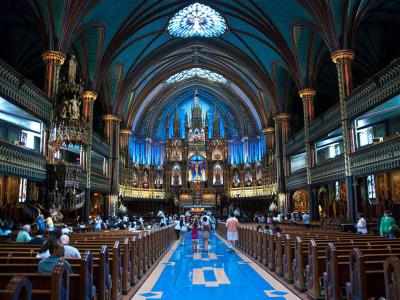
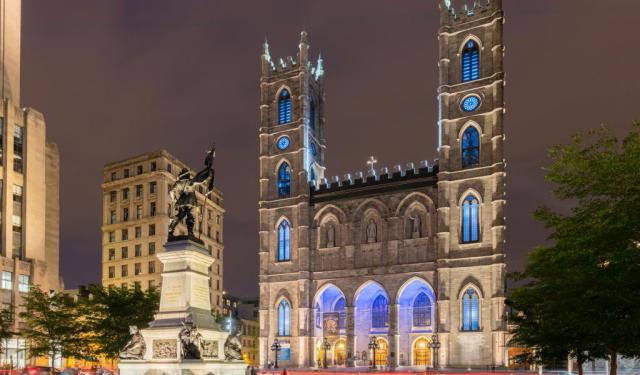
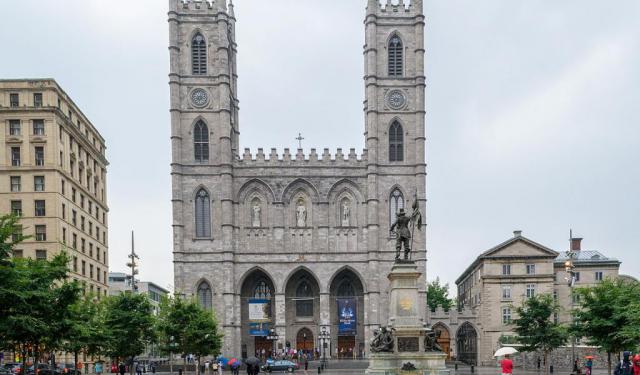
Notre-Dame Basilica of Montreal is a church that doesn’t whisper modestly from the sidelines. It steps confidently into the spotlight as one of the grand showpieces of Gothic Revival architecture in North America. Designed by Irish-American architect James O'Donnell and largely completed in 1829, this temple proves that Montreal doesn’t do subtle when it comes to sacred spaces.
Its sanctuary was constructed a year later, and then came the towers—because, apparently, one dramatic silhouette wasn’t enough. The West Tower, known as La Persévérance, houses a bourdon bell affectionately called Jean-Baptiste. Cast in 1848 and weighing a polite 10,900 kilograms, it doesn’t ring for just anything. Funerals, major religious festivals, Christmas Eve—Jean-Baptiste has standards. Across the façade, the East Tower, called La Tempérance, contains a ten-bell carillon, also from the 1840s, ready to chime with considerably more enthusiasm.
By 1865, the façade was complete, crowned with three statues—of the Virgin Mary for Montreal, Saint John the Baptist for Quebec, and Saint Joseph for Canada—created by French sculptor Henri Bouriché. It’s practically a stone family portrait of the nation...
Once inside, any expectation of restraint disappears. The interior is a riot of colour, carved wood, painted columns, statues, and stained glass. And here’s the twist: the windows don’t focus on biblical scenes. Instead, they tell stories from Montreal’s own history. It’s less “Old Testament” and more “local greatest hits.”
Then, there’s the magnificent pipe organ by Casavant Frères, installed in 1891. Four keyboards. Around 7,000 pipes. It doesn’t accompany music—it commands it.
In 1982, Pope John Paul II elevated the church to minor basilica status, and in 1989, it became a National Historic Site of Canada. Today, more than 11 million visitors pass through its doors each year. Even the ten-dollar admission fee fails to discourage the crowds—because grandeur, apparently, is recession-proof.
This basilica has also seen its share of headline moments: Céline Dion married here in 1994, and former Prime Minister Pierre Trudeau was honoured here in 2000. From pop royalty to political royalty, the guest list is impressive...
If you enjoy choral and organ music, keep an ear out for performances—including Handel’s Messiah at Christmas. The on-site brochure doubles as a handy self-guide, and there’s a free 20-minute English or French tour at entry. And if you can, book ahead for the “AURA” light show. Sit somewhere in the middle. Rest assured—when 7,000 pipes meet immersive light, you’ll want the full effect...
Its sanctuary was constructed a year later, and then came the towers—because, apparently, one dramatic silhouette wasn’t enough. The West Tower, known as La Persévérance, houses a bourdon bell affectionately called Jean-Baptiste. Cast in 1848 and weighing a polite 10,900 kilograms, it doesn’t ring for just anything. Funerals, major religious festivals, Christmas Eve—Jean-Baptiste has standards. Across the façade, the East Tower, called La Tempérance, contains a ten-bell carillon, also from the 1840s, ready to chime with considerably more enthusiasm.
By 1865, the façade was complete, crowned with three statues—of the Virgin Mary for Montreal, Saint John the Baptist for Quebec, and Saint Joseph for Canada—created by French sculptor Henri Bouriché. It’s practically a stone family portrait of the nation...
Once inside, any expectation of restraint disappears. The interior is a riot of colour, carved wood, painted columns, statues, and stained glass. And here’s the twist: the windows don’t focus on biblical scenes. Instead, they tell stories from Montreal’s own history. It’s less “Old Testament” and more “local greatest hits.”
Then, there’s the magnificent pipe organ by Casavant Frères, installed in 1891. Four keyboards. Around 7,000 pipes. It doesn’t accompany music—it commands it.
In 1982, Pope John Paul II elevated the church to minor basilica status, and in 1989, it became a National Historic Site of Canada. Today, more than 11 million visitors pass through its doors each year. Even the ten-dollar admission fee fails to discourage the crowds—because grandeur, apparently, is recession-proof.
This basilica has also seen its share of headline moments: Céline Dion married here in 1994, and former Prime Minister Pierre Trudeau was honoured here in 2000. From pop royalty to political royalty, the guest list is impressive...
If you enjoy choral and organ music, keep an ear out for performances—including Handel’s Messiah at Christmas. The on-site brochure doubles as a handy self-guide, and there’s a free 20-minute English or French tour at entry. And if you can, book ahead for the “AURA” light show. Sit somewhere in the middle. Rest assured—when 7,000 pipes meet immersive light, you’ll want the full effect...
4) Old Saint-Sulpice Seminary
Montréal's second-oldest structure, the Sulpician Seminary located next to Notre-Dame Basilica was declared a National Historic Site of Canada in 1980, taking into consideration the quality of the architecture, which is a rare and remarkable example of 17th-century classical design built during the French Regime, but also the remarkable integrity of its convent garden, which once served as a means of subsistence, besides its use for meditation and leisure.
Since the 1680s, the seminary has served as the residence and administrative centre of the Messieurs of Saint-Sulpice who were the seigneurs of the Island of Montréal until the end of the seigneurial regime. The main building, which is the oldest part, is also the one that has been the least changed over the centuries. Its façade, of rough-cut limestone masonry, has a remarkable neoclassical-style entrance gate, built in 1740, through which you can peek at the clock – one of the oldest of its kind in North America. A real window on Montréal's past, and the oldest Seminary where priests still live today!
5) Caserne Centrale de Pompiers (Central Fire Station)
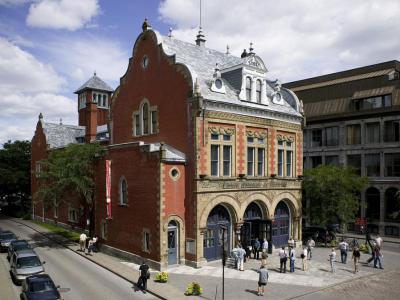
Standing prominently on Place d’Youville, the former Central Fire Station in Montreal is a distinctive landmark that blends architectural charm with deep historical roots. Built between 1903 and 1904 by architects Joseph Perrault and Simon Lesage, the building was originally designed as the headquarters for the Montreal Fire Department. Its Flemish-inspired architecture-uncommon in the city at the time-features buff sandstone, red brick, a mansard roof with a skylight, and a striking square tower capped by a hipped roof. This stylistic choice set it apart from surrounding structures and continues to draw the eye today.
When the station opened in 1904, it operated with horse-drawn steam pumps, symbolizing the era’s firefighting technology. By 1908, it had transitioned to a district station, and the gradual modernization of equipment saw motor vehicles replace horses by 1931. The building remained in active service until 1972, faithfully serving Montreal’s growing urban population. Following its decommissioning, the structure stood unused until its revival in the early 1980s.
In 1983, the fire station was reborn as the Montreal History Centre, a museum dedicated to preserving and presenting the city’s heritage. This new function not only ensured the building’s preservation but also allowed visitors to engage with Montreal’s past in a setting rich with historical resonance. The unique combination of civic architecture and cultural programming made it a meaningful stop for both locals and tourists.
Though the museum has since moved to a new location, the former Central Fire Station remains a symbol of Montreal’s adaptive reuse of heritage buildings. Its story reflects the city’s ongoing dialogue between preservation and progress-a place where bricks and mortar continue to speak of lives, labor, and transformation across generations.
When the station opened in 1904, it operated with horse-drawn steam pumps, symbolizing the era’s firefighting technology. By 1908, it had transitioned to a district station, and the gradual modernization of equipment saw motor vehicles replace horses by 1931. The building remained in active service until 1972, faithfully serving Montreal’s growing urban population. Following its decommissioning, the structure stood unused until its revival in the early 1980s.
In 1983, the fire station was reborn as the Montreal History Centre, a museum dedicated to preserving and presenting the city’s heritage. This new function not only ensured the building’s preservation but also allowed visitors to engage with Montreal’s past in a setting rich with historical resonance. The unique combination of civic architecture and cultural programming made it a meaningful stop for both locals and tourists.
Though the museum has since moved to a new location, the former Central Fire Station remains a symbol of Montreal’s adaptive reuse of heritage buildings. Its story reflects the city’s ongoing dialogue between preservation and progress-a place where bricks and mortar continue to speak of lives, labor, and transformation across generations.
6) Molson Bank
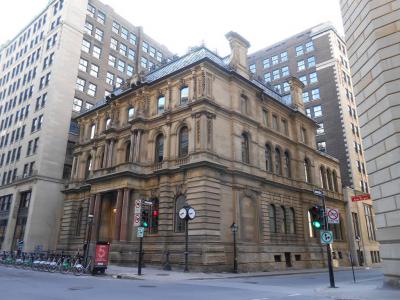
Molson Bank sits at the heart of the city's (and country's) former business center, in the western part of Rue Saint-Jacques, which speaks favorably of, and largely added to, its commercial prestige over the years. The bank's mansion-like appearance is in dramatic contrast with the very tall neighboring structures built in later periods; that notwithstanding, the Ohio buff sandstone facing, an innovation at the time, harmonizes well with the variety of stone used later in the area.
As part of the classical-minded composition, the ground floor's rusticated masonry, and the more delicately treated floor above, owe their architectural vocabulary to northern Italian Renaissance design, recalled by the mascaron keystones. The centre porch and all of the upper part of the building, on the other hand, derived their design from contemporaneous French architecture, as evidenced by the red granite twin columns, segmental windows, spiral-shaped window fins, the crowning sculpture, the mansard roof and the metallic cresting. Imported from London, this manner of combining Italian Renaissance and French influences made the Molson Bank building a participant, before any New York bank, in what would later be designated as the Second Empire style.
Harry Markland Molson, one of the bank's directors, was among the passengers who died in the Titanic disaster. He was last seen on board, removing his shoes with intentions to swim to a nearby ship. His body was never recovered.
As part of the classical-minded composition, the ground floor's rusticated masonry, and the more delicately treated floor above, owe their architectural vocabulary to northern Italian Renaissance design, recalled by the mascaron keystones. The centre porch and all of the upper part of the building, on the other hand, derived their design from contemporaneous French architecture, as evidenced by the red granite twin columns, segmental windows, spiral-shaped window fins, the crowning sculpture, the mansard roof and the metallic cresting. Imported from London, this manner of combining Italian Renaissance and French influences made the Molson Bank building a participant, before any New York bank, in what would later be designated as the Second Empire style.
Harry Markland Molson, one of the bank's directors, was among the passengers who died in the Titanic disaster. He was last seen on board, removing his shoes with intentions to swim to a nearby ship. His body was never recovered.
7) Hudson's Bay (La Baie d'Hudson)
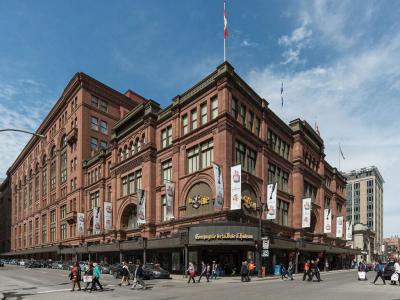
A Canadian colonial institution, the Hudson's Bay Company was first founded in 1670 and controlled much of North America's fur trade. By the early 20th century, it had morphed into one of the biggest chain department stores in Canada. Housed in a grand Neo-Romanesque redbrick building constructed in 1891, the Bay's seven floors offer everything from clothes/footwear for all occasions to great selections of perfumes, jewelry, electronics, as well as a small section of Canadian souvenirs (mysteriously located far from the tourists on the last floor).
Fans of Canadiana should pick up an iconic Hudson's Bay point blanket, a large wool quilt woven with large colored stripes. The blanket was traditionally south after by the First Nations in exchange for beaver pelts, and has now become a Canadian classic and collector's item. What could be more representative of a Montreal visit than a warm quilt to snuggle yourself in on those chilly nights?
8) Cathedrale Marie-Reine-du-Monde (Mary, Queen of the World Cathedral) (must see)
If you think skyscrapers have the last word in downtown Montreal, look up. Rising confidently among the glass and steel is a dome that feels suspiciously Roman.
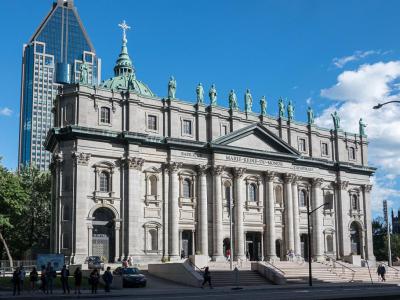
This is Mary, Queen of the World Cathedral, and yes, that dome is modeled on Saint Peter's Basilica. Think of it as Rome’s greatest architectural hit—re-recorded in Québec. Slightly scaled down, perhaps, but impressively faithful, right down to the red copper baldachin above the altar, hand-carved in Rome itself. No shortcuts here...
Completed in the 1890s, the cathedral somehow manages to look older than it is, while also feeling more streamlined than many of its European cousins. Compared to Notre-Dame Basilica of Montreal, its interior feels lighter, calmer, and almost minimalist.
The design is clean, the lines are clear, and the colours lean toward soft pastels rather than dramatic flourishes. On a sunny day, the stained glass comes alive, casting shifting light across the ceiling, the altar, and the organ pipes at the rear. It's the kind of place where you instinctively lower your voice.
Take a moment near the baptismal font and look up: a striking stucco crucifix crowns it—one of Québec’s most significant religious sculptures. Around you, Italian marble stretches across floors and walls, adding a quiet sense of grandeur. The artwork pays tribute not just to biblical figures but to Montreal’s own spiritual history, including Marguerite Bourgeoys and Marguerite d’Youville, founder of the Grey Nuns. This cathedral tells the city’s story as much as it echoes Rome’s.
Step outside and glance at the façade. You’ll notice 13 statues—just like at Saint Peter’s—but with a local twist. Instead of Jesus and the 12 apostles, these figures represent patron saints from parishes that supported the diocese, including Saint Hyacinthe, Saint Francis of Assisi, and Saint John the Baptist. A European silhouette, a distinctly Canadian cast...
The overall effect is peaceful, dignified, and unexpectedly transportive. For a moment, downtown Montreal fades away, and you could almost believe you’ve wandered into an old basilica somewhere in Europe—just with better maple syrup nearby...
And before you leave, have a look at the gift shop. It carries distinctive jewellery and religious keepsakes—small reminders that Rome may be far away, but its architectural spirit has clearly made itself at home here.
This is Mary, Queen of the World Cathedral, and yes, that dome is modeled on Saint Peter's Basilica. Think of it as Rome’s greatest architectural hit—re-recorded in Québec. Slightly scaled down, perhaps, but impressively faithful, right down to the red copper baldachin above the altar, hand-carved in Rome itself. No shortcuts here...
Completed in the 1890s, the cathedral somehow manages to look older than it is, while also feeling more streamlined than many of its European cousins. Compared to Notre-Dame Basilica of Montreal, its interior feels lighter, calmer, and almost minimalist.
The design is clean, the lines are clear, and the colours lean toward soft pastels rather than dramatic flourishes. On a sunny day, the stained glass comes alive, casting shifting light across the ceiling, the altar, and the organ pipes at the rear. It's the kind of place where you instinctively lower your voice.
Take a moment near the baptismal font and look up: a striking stucco crucifix crowns it—one of Québec’s most significant religious sculptures. Around you, Italian marble stretches across floors and walls, adding a quiet sense of grandeur. The artwork pays tribute not just to biblical figures but to Montreal’s own spiritual history, including Marguerite Bourgeoys and Marguerite d’Youville, founder of the Grey Nuns. This cathedral tells the city’s story as much as it echoes Rome’s.
Step outside and glance at the façade. You’ll notice 13 statues—just like at Saint Peter’s—but with a local twist. Instead of Jesus and the 12 apostles, these figures represent patron saints from parishes that supported the diocese, including Saint Hyacinthe, Saint Francis of Assisi, and Saint John the Baptist. A European silhouette, a distinctly Canadian cast...
The overall effect is peaceful, dignified, and unexpectedly transportive. For a moment, downtown Montreal fades away, and you could almost believe you’ve wandered into an old basilica somewhere in Europe—just with better maple syrup nearby...
And before you leave, have a look at the gift shop. It carries distinctive jewellery and religious keepsakes—small reminders that Rome may be far away, but its architectural spirit has clearly made itself at home here.
9) Sun Life Building
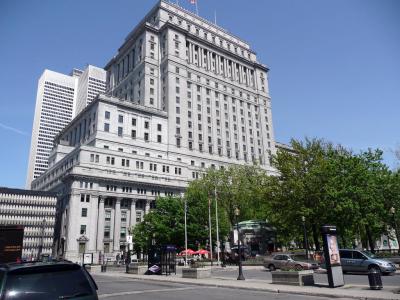
This 24-story office building was an imposing figure when it was completed in 1931, and it continues to stand its ground as one of the most impressive sights on the Montréal skyline. Presiding over the east side of Dorchester Square, its architectural presence is rivaled only by the Dominion Square Building at the north end. If you are around at 5pm, you can still hear the chime music when sitting outside near the park; not only that, but the beautiful lobby is publicly accessible and definitely worth a look.
Here's for some interesting historic background: During WWII, Britain's gold reserves and negotiable foreign securities were secretly packed in crates labelled 'Fish' and shipped across the Atlantic Ocean to Canada. Upon finally reaching Halifax, on 1 July 1940, the British treasure was transferred to trains and the gold sent to Ottawa while the securities were shipped to the Sun Life Building and locked in an underground vault three stories beneath, which was guarded around the clock by police. The extremely secretive United Kingdom Security Deposit, operating in the specially constructed vault, arranged for the sale of Britain's negotiable securities on the New York Stock Exchange over the next few years to pay for Britain's war expenses. The 5,000 employees of Sun Life never suspected what was stored in their basement, and while unloading the treasure ships, not one crate of the cargo went missing. Even though thousands of people were involved, Axis intelligence agencies never found out about 'Operation Fish'.
10) Windsor Station (Gare Windsor)
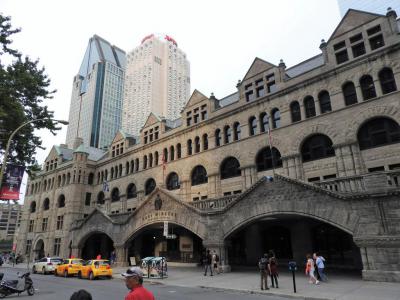
Windsor Station, situated in Montreal, is a former railway station that played a significant role as the Canadian Pacific Railway (CPR) station and CPR headquarters from 1889 to 1996. Its location is bordered by Avenue des Canadiens-de-Montréal to the north, Peel Street to the east, Saint Antoine Street to the south, and the Bell Centre to the west.
Renowned New York City architect Bruce Price was entrusted with the Windsor Station project, where he opted for a Romanesque Revival style. The building's walls are constructed with gray limestone sourced from a quarry in Montreal, while the columns outside boast an impressive width of 2.1 meters (6.9 feet). Originally named the Windsor Street Station after its location on Windsor Street (now known as Peel Street), the station underwent its first expansion between 1900 and 1903, followed by another expansion from 1910 to 1913, both designed by Canadian architects. The third expansion in 1916 introduced a striking fifteen-storey tower that dramatically altered Montreal's skyline.
Since 1993, Windsor Station has been disconnected from the rail network. The site has been transformed into an office complex, accommodating various restaurants and cafés. The interior concourse, accessible to the public, is available for private and public events. The terminal tracks, totaling 13, and the overhead canopy have been removed and replaced with a public square.
Recognized for its historical significance, Windsor Station was designated a National Historic Site of Canada in 1975 and obtained the designation of a Heritage Railway Station in 1990. In 2009, it was further acknowledged as a provincial historic monument.
Renowned New York City architect Bruce Price was entrusted with the Windsor Station project, where he opted for a Romanesque Revival style. The building's walls are constructed with gray limestone sourced from a quarry in Montreal, while the columns outside boast an impressive width of 2.1 meters (6.9 feet). Originally named the Windsor Street Station after its location on Windsor Street (now known as Peel Street), the station underwent its first expansion between 1900 and 1903, followed by another expansion from 1910 to 1913, both designed by Canadian architects. The third expansion in 1916 introduced a striking fifteen-storey tower that dramatically altered Montreal's skyline.
Since 1993, Windsor Station has been disconnected from the rail network. The site has been transformed into an office complex, accommodating various restaurants and cafés. The interior concourse, accessible to the public, is available for private and public events. The terminal tracks, totaling 13, and the overhead canopy have been removed and replaced with a public square.
Recognized for its historical significance, Windsor Station was designated a National Historic Site of Canada in 1975 and obtained the designation of a Heritage Railway Station in 1990. In 2009, it was further acknowledged as a provincial historic monument.
Walking Tours in Montreal, Canada

Create Your Own Walk in Montreal
Creating your own self-guided walk in Montreal is easy and fun. Choose the city attractions that you want to see and a walk route map will be created just for you. You can even set your hotel as the start point of the walk.
The RMS Titanic Walking Tour
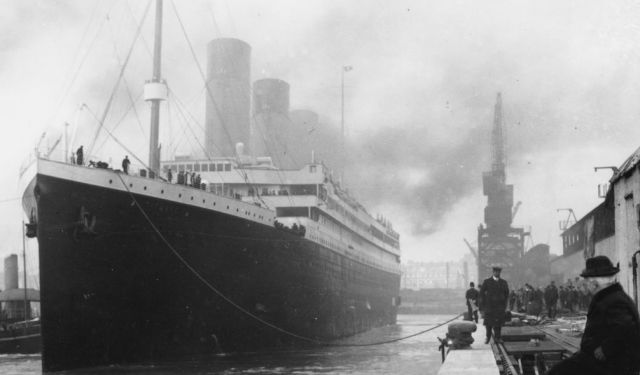
Built as the ship of dreams, the RMS Titanic went down in history as the one that carried “both the hopes and the tragedies of a generation.” The luxury cruiser sank on her maiden voyage across the Atlantic in the early hours of April 15, 1912, and today is largely remembered throughout the world, in part, due to the blockbuster movie starring Leonardo DiCaprio.
Although Montreal's... view more
Tour Duration: 2 Hour(s)
Travel Distance: 3.5 Km or 2.2 Miles
Although Montreal's... view more
Tour Duration: 2 Hour(s)
Travel Distance: 3.5 Km or 2.2 Miles
Historical Churches Walking Tour
Montreal’s skyline doubles as a history book — you just have to know how to read the spires. Before modern towers reshaped the city's skyline, church spires, domes, bell towers, and carved façades didn’t simply decorate neighbourhoods; they announced who lived there. French and British. Catholic and Protestant. Immigrants and long-established communities. If you wanted to understand... view more
Tour Duration: 2 Hour(s)
Travel Distance: 4.2 Km or 2.6 Miles
Tour Duration: 2 Hour(s)
Travel Distance: 4.2 Km or 2.6 Miles
Montreal Introduction Walking Tour
Canada’s second-most populous city likes to keep things interesting. Montreal is old enough to have stories carved in stone, yet modern enough to reinvent itself every few decades. It sits comfortably on an island in the Saint Lawrence River, with Mount Royal rising at its centre—the triple-peaked hill that gave the city its name. In 16th-century French, “réal” and “royal” were... view more
Tour Duration: 2 Hour(s)
Travel Distance: 3.6 Km or 2.2 Miles
Tour Duration: 2 Hour(s)
Travel Distance: 3.6 Km or 2.2 Miles
Old Montreal Walking Tour
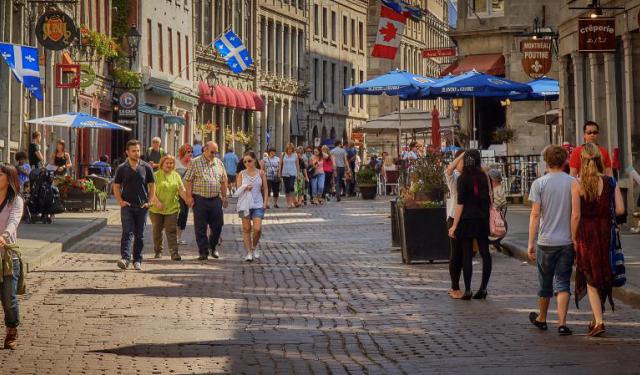
Old Montreal (Vieux-Montréal) is a historic neighborhood southeast of the downtown area, home to many architectural monuments of the New France era. Founded by French settlers in 1642 as Fort Ville-Marie, the settlement gave its name to the city borough of which it is now part.
Most of Montreal's earliest architecture, characterized by uniquely French influence, including grey stone... view more
Tour Duration: 2 Hour(s)
Travel Distance: 3.3 Km or 2.1 Miles
Most of Montreal's earliest architecture, characterized by uniquely French influence, including grey stone... view more
Tour Duration: 2 Hour(s)
Travel Distance: 3.3 Km or 2.1 Miles
Useful Travel Guides for Planning Your Trip

Montreal Souvenirs: 15 Trip Mementos to Bring Home
The outpost of Frenchness in North America (and the world's 2nd largest francophone city after Paris), Montreal is the meeting point of the New and Old World styles, the collision of the French, English and Aboriginal cultures. The historical and ethnic uniqueness of the city is seen throughout...
The Most Popular Cities
/ view all