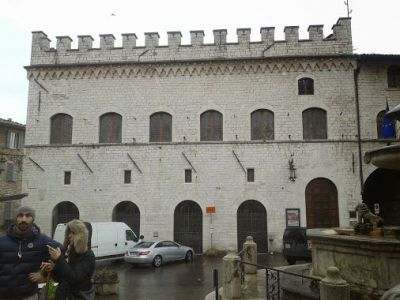


Palazzo dei Priori (Palace of the Priors), Assisi
Located in the picturesque Town Hall Square ("Piazza del Comune"), the heart of Assisi's political and cultural life, this palace has a rich history dating back to the mid-14th century. In 1442, it suffered severe damage from the militias of renowned military commander Niccolò Piccinino; however, it was diligently restored fifty years later under the patronage of Pope Sixtus IV, who expanded it to include the Monte di Pietà and the residence of the apostolic governor. The upper floor housed the Priors from the 1330s onwards, while shops occupied the lower level.
Following Assisi's annexation to the Savoyard state in September 1860, the edifice underwent extensive restoration, transforming it into the seat of municipal administration. In 1870, Alessandro Venanzi adorned the walls of the large entrance hall with views of twenty villas and castles of Assisi, along with the coats of arms of prominent local families. The council chamber, decorated during Mayor Pietro Uber's tenure (1906-1910), features allegorical figures symbolizing School, Charity, Work, and Hygiene, promoting Concord in times of Justice and Freedom. The lunettes display medallions bearing the coat of arms of Assisi and portraits of distinguished figures, while the spandrels showcase the coats of arms of Umbria's main cities.
Today, the palace interior is open to visitors during events and conferences, offering a glimpse into Assisi's cultural legacy.
Following Assisi's annexation to the Savoyard state in September 1860, the edifice underwent extensive restoration, transforming it into the seat of municipal administration. In 1870, Alessandro Venanzi adorned the walls of the large entrance hall with views of twenty villas and castles of Assisi, along with the coats of arms of prominent local families. The council chamber, decorated during Mayor Pietro Uber's tenure (1906-1910), features allegorical figures symbolizing School, Charity, Work, and Hygiene, promoting Concord in times of Justice and Freedom. The lunettes display medallions bearing the coat of arms of Assisi and portraits of distinguished figures, while the spandrels showcase the coats of arms of Umbria's main cities.
Today, the palace interior is open to visitors during events and conferences, offering a glimpse into Assisi's cultural legacy.
Want to visit this sight? Check out these Self-Guided Walking Tours in Assisi. Alternatively, you can download the mobile app "GPSmyCity: Walks in 1K+ Cities" from Apple App Store or Google Play Store. The app turns your mobile device to a personal tour guide and it works offline, so no data plan is needed when traveling abroad.
Download The GPSmyCity App



Palazzo dei Priori (Palace of the Priors) on Map
Sight Name: Palazzo dei Priori (Palace of the Priors)
Sight Location: Assisi, Italy (See walking tours in Assisi)
Sight Type: Attraction/Landmark
Sight Location: Assisi, Italy (See walking tours in Assisi)
Sight Type: Attraction/Landmark
Nearby Sights


Walking Tours in Assisi, Italy

Create Your Own Walk in Assisi
Creating your own self-guided walk in Assisi is easy and fun. Choose the city attractions that you want to see and a walk route map will be created just for you. You can even set your hotel as the start point of the walk.
St. Francis' Assisi Walking Tour
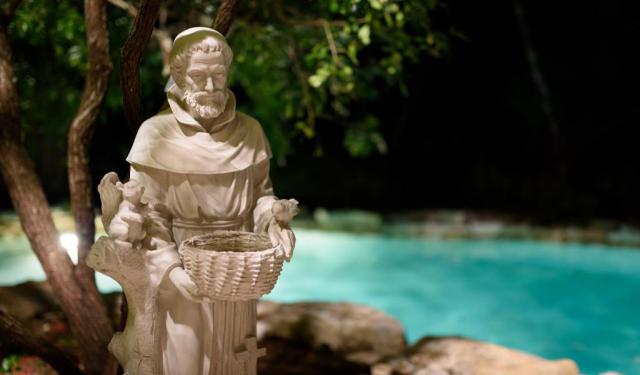
Assisi’s identity as the city of Saint Francis began with a merchant’s son who seemed destined for anything but sainthood. Giovanni di Pietro di Bernardone-later known as Francis-was born here in late 1181 or early 1182 into a prosperous cloth-trading family. As a young man, he delighted in fashionable clothes, music, feasting, and dreams of knighthood. Assisi was then a turbulent commune,... view more
Tour Duration: 2 Hour(s)
Travel Distance: 3.2 Km or 2 Miles
Tour Duration: 2 Hour(s)
Travel Distance: 3.2 Km or 2 Miles
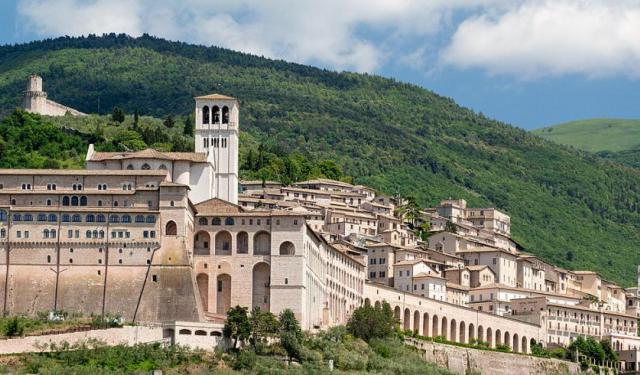
Explore Assisi Medieval Town on Foot
Dante believed that the name Assisi did not fully express the town’s significance. In his poem Paradiso, he suggested that it should instead be called the “East” because Saint Francis rose from its hillside like a new sun.
Assisi stands on the western slope of Mount Subasio, overlooking the Umbrian Valley. Human settlement in the area dates back to prehistoric times, while the town itself... view more
Tour Duration: 2 Hour(s)
Travel Distance: 1.9 Km or 1.2 Miles
Assisi stands on the western slope of Mount Subasio, overlooking the Umbrian Valley. Human settlement in the area dates back to prehistoric times, while the town itself... view more
Tour Duration: 2 Hour(s)
Travel Distance: 1.9 Km or 1.2 Miles