

Place Royale (Royal Square), Quebec City (must see)
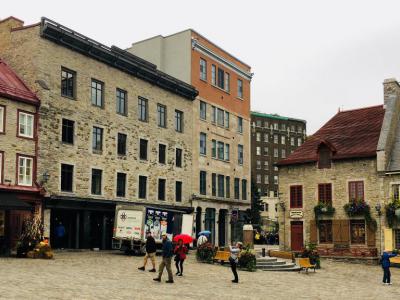
Royal Square is one of the best places in North America to sense the beginnings of French-Canadian civilization. Nowadays, enclosed by restored stone buildings and paved with cobblestones, giving it the feel of a small European town square, this compact space was the area where Samuel de Champlain established his first fortified settlement on the shore of the Saint Lawrence, back in the early 1600s.
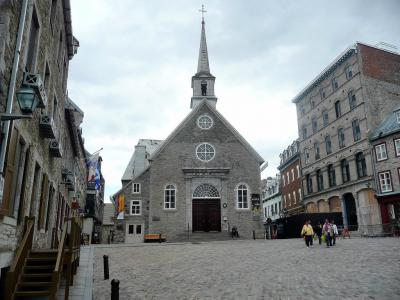
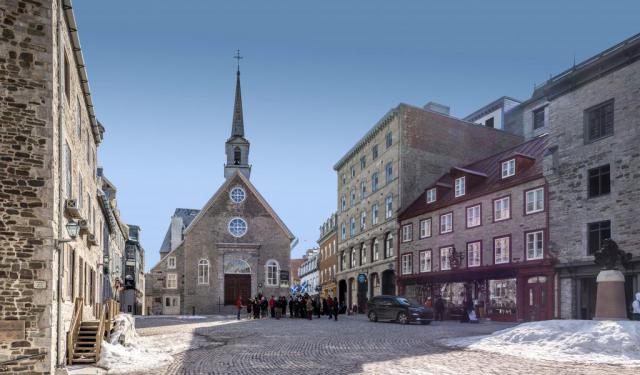
Start your journey in front of the stone church that anchors the square. This is Notre-Dame-des-Victoires, easily identified by its simple façade, small bell tower, and position facing the open square. It is one of the oldest stone churches in North America and is well worth a brief look inside for its calm interior and historic atmosphere. Near the church entrance, notice the bronze plaque commemorating Champlain’s settlement; it's written in French, and it marks one of the key historic moments connected with the site.
Now, look down at the cobblestones in front of the church. The black tile outline set into the pavement marks the footprint of Champlain’s early habitation. It is easy to miss if you are not looking for it, so use the church as your reference point and scan the ground just outside it.
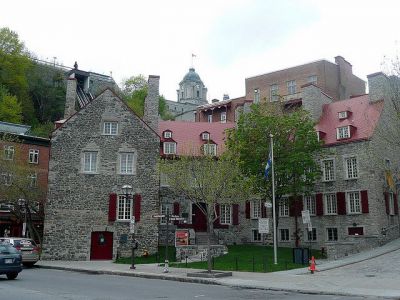
Turn back toward the surrounding houses. The grey fieldstone façades, steep roofs, wide chimneys, small windows, and firewalls recreate the French colonial appearance of the late 1600s, when the square was developed under Louis XIV. Look for the bust of the “Sun King” as another reminder of royal French influence.
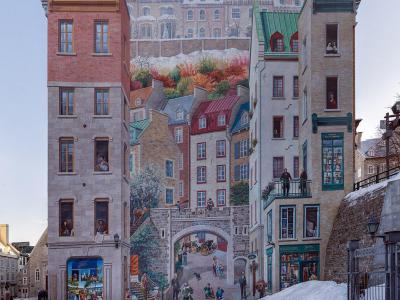
After exploring the square, head toward its northwestern corner, following Notre-Dame Street. In less than a minute, you will reach the corner of Petit-Champlain Street and Côte de la Montagne. Look up at the tall wall on your left to find the Fresque des Québécois. Covering the side of a building, this enormous trompe-l'œil mural creates the illusion of balconies, staircases, windows, and streets populated by more than 100 figures from Quebec City's history. The remarkable three-dimensional effect makes it one of the city's most photographed landmarks and rewards a few minutes spent identifying its famous historical characters and recognizable local monuments.
Apart from atmospheric photos, a quiet church visit and boutique browsing, Royal Square is also ideal for a coffee break – at La Maison Smith. From here, you can continue easily toward Petit-Champlain, another charming area of shops and historic spots.
Start your journey in front of the stone church that anchors the square. This is Notre-Dame-des-Victoires, easily identified by its simple façade, small bell tower, and position facing the open square. It is one of the oldest stone churches in North America and is well worth a brief look inside for its calm interior and historic atmosphere. Near the church entrance, notice the bronze plaque commemorating Champlain’s settlement; it's written in French, and it marks one of the key historic moments connected with the site.
Now, look down at the cobblestones in front of the church. The black tile outline set into the pavement marks the footprint of Champlain’s early habitation. It is easy to miss if you are not looking for it, so use the church as your reference point and scan the ground just outside it.
Turn back toward the surrounding houses. The grey fieldstone façades, steep roofs, wide chimneys, small windows, and firewalls recreate the French colonial appearance of the late 1600s, when the square was developed under Louis XIV. Look for the bust of the “Sun King” as another reminder of royal French influence.
After exploring the square, head toward its northwestern corner, following Notre-Dame Street. In less than a minute, you will reach the corner of Petit-Champlain Street and Côte de la Montagne. Look up at the tall wall on your left to find the Fresque des Québécois. Covering the side of a building, this enormous trompe-l'œil mural creates the illusion of balconies, staircases, windows, and streets populated by more than 100 figures from Quebec City's history. The remarkable three-dimensional effect makes it one of the city's most photographed landmarks and rewards a few minutes spent identifying its famous historical characters and recognizable local monuments.
Apart from atmospheric photos, a quiet church visit and boutique browsing, Royal Square is also ideal for a coffee break – at La Maison Smith. From here, you can continue easily toward Petit-Champlain, another charming area of shops and historic spots.
Want to visit this sight? Check out these Self-Guided Walking Tours in Quebec City. Alternatively, you can download the mobile app "GPSmyCity: Walks in 1K+ Cities" from Apple App Store or Google Play Store. The app turns your mobile device to a personal tour guide and it works offline, so no data plan is needed when traveling abroad.
Download The GPSmyCity App



Place Royale (Royal Square) on Map
Sight Name: Place Royale (Royal Square)
Sight Location: Quebec City, Canada (See walking tours in Quebec City)
Sight Type: Attraction/Landmark
Guide(s) Containing This Sight:
Sight Location: Quebec City, Canada (See walking tours in Quebec City)
Sight Type: Attraction/Landmark
Guide(s) Containing This Sight:
Nearby Sights
Walking Tours in Quebec City, Quebec

Create Your Own Walk in Quebec City
Creating your own self-guided walk in Quebec City is easy and fun. Choose the city attractions that you want to see and a walk route map will be created just for you. You can even set your hotel as the start point of the walk.
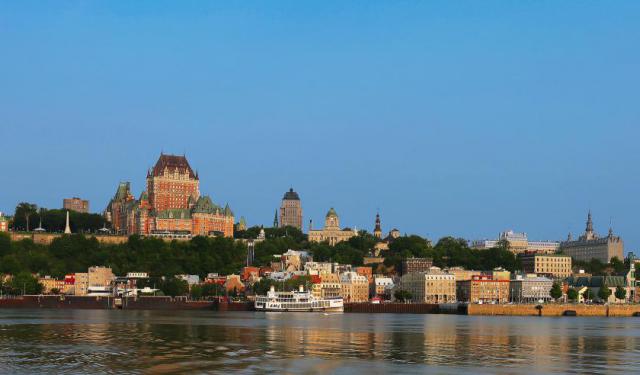
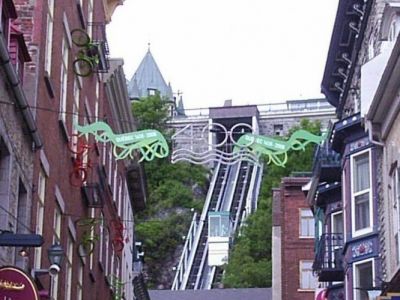
Quebec City Introduction Walking Tour
Cresting a cliff above the St. Lawrence River, Quebec City is the soul of the province of Quebec – a place all its own; a country within a country with its own traditions, architecture, and French-speaking population.
The Algonquian people had originally named this area Kébec, which means "where the river narrows", because the Saint Lawrence River indeed narrows proximate to the... view more
Tour Duration: 2 Hour(s)
Travel Distance: 3.2 Km or 2 Miles
The Algonquian people had originally named this area Kébec, which means "where the river narrows", because the Saint Lawrence River indeed narrows proximate to the... view more
Tour Duration: 2 Hour(s)
Travel Distance: 3.2 Km or 2 Miles
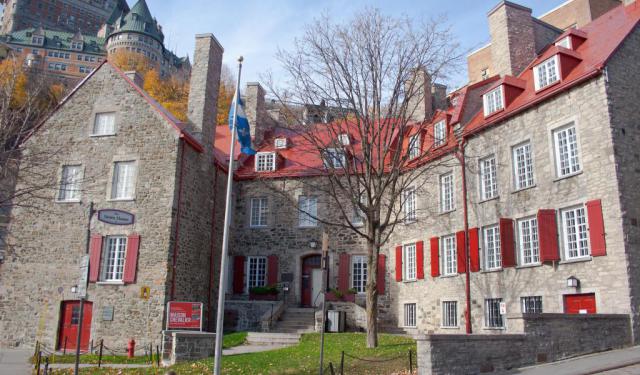
Historical Houses Walking Tour
Quebec City, particularly evocative of Europe in its atmosphere, is often referred to as the cradle of New France. The city boasts one of the richest architectural heritages in North America, though most of its buildings had to be adapted to harsh winters and the lack of specialized workers and materials in the colony. As such, the majority of local houses were designed as simple and efficient... view more
Tour Duration: 2 Hour(s)
Travel Distance: 2.5 Km or 1.6 Miles
Tour Duration: 2 Hour(s)
Travel Distance: 2.5 Km or 1.6 Miles
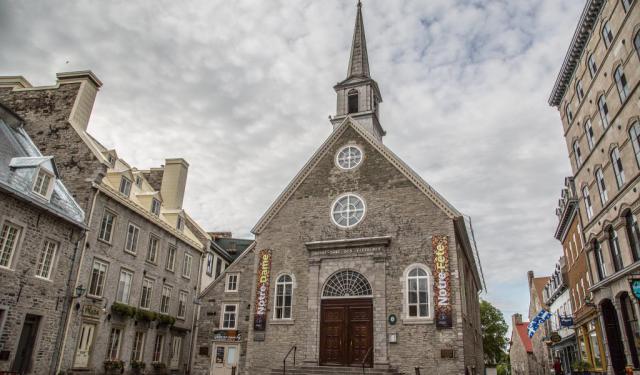
Qucbec City's Historical Churches Walking Tour
The first religious buildings in Canada were established by the Récollets and Jesuits, in 1615 and 1625, respectively, when they first arrived in New France. Later on, the French colonists brought along their culture and architectural traditions, and the establishment of British and evangelical society triggered further major developments in Quebec City.
Over the course of the 17th and 18th... view more
Tour Duration: 1 Hour(s)
Travel Distance: 2.9 Km or 1.8 Miles
Over the course of the 17th and 18th... view more
Tour Duration: 1 Hour(s)
Travel Distance: 2.9 Km or 1.8 Miles
Old Quebec Walk
The historic part of Quebec City known as Old Quebec (French: Vieux-Québec), sometimes also referred to as the Latin Quarter (Quartier Latin), is the neighborhood centered around Cape Diamond (Cap Diamant), located on the eastern edge of Quebec hill promontory. The area comprises Upper Town (Haute-Ville) and Lower Town (Basse-Ville) and is currently listed among UNESCO’s World Heritage Sites.
... view more
Tour Duration: 2 Hour(s)
Travel Distance: 2.6 Km or 1.6 Miles
... view more
Tour Duration: 2 Hour(s)
Travel Distance: 2.6 Km or 1.6 Miles