Custom Walk in Granada, Spain by ekpoll8_dff75 created on 2023-12-08
Guide Location: Spain » Granada
Guide Type: Custom Walk
# of Sights: 6
Tour Duration: 1 Hour(s)
Travel Distance: 1.6 Km or 1 Miles
Share Key: LGBSQ
Guide Type: Custom Walk
# of Sights: 6
Tour Duration: 1 Hour(s)
Travel Distance: 1.6 Km or 1 Miles
Share Key: LGBSQ
How It Works
Please retrieve this walk in the GPSmyCity app. Once done, the app will guide you from one tour stop to the next as if you had a personal tour guide. If you created the walk on this website or come to the page via a link, please follow the instructions below to retrieve the walk in the app.
Retrieve This Walk in App
Step 1. Download the app "GPSmyCity: Walks in 1K+ Cities" on Apple App Store or Google Play Store.



Step 2. In the GPSmyCity app, download(or launch) the guide "Granada Map and Walking Tours".
Step 3. Tap the menu button located at upper right corner of the "Walks" screen and select "Retrieve custom walk". Enter the share key: LGBSQ
1) The Alhambra Palace and Fortress Complex (must see)
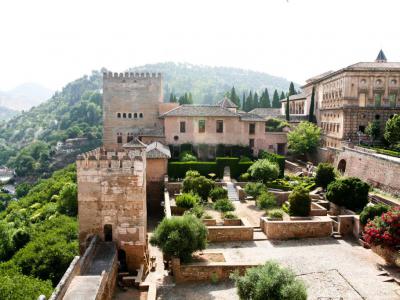
Alhambra in Arabic is "The Red One." It is a palace and fortress complex. It was originally built on the ruins of a Roman fortress in 889. It was rebuilt in the 13th century by the Muhammad I of Granada, the first ruler of the Emirate of Granada. It was converted to a palace by Yusuf I, Sultan of Granada. In 1492 it became the royal court of Ferdinand and Isabella.
The Alhambra was the place where Christopher Columbus received his commission to find the Indies which he never found. In 1526 Charles I of Spain ordered a Renaissance palace in the Mannerist style with its humanism contrasting with Nasrid architecture. After the decline of Nasrid influence, the Alhambra complex fell into neglect and disrepair.
Centuries later after Napoleon I had destroyed the site, the Alhambra was rediscovered. It is today one of the greatest tourist attractions in Spain. The Alhambra is a UNESCO World Heritage Site. It has been described by poets as a pearl in emeralds. This was a literal description of the colors of the stones imbedded in the surrounding woods.
The Alhambra park is stocked with nightingales. Running water from the fountains and cascades can be heard at all times. The idea was to create a kind of "paradise on earth." The exterior was made to be plain and austere.
The Alcazaba, also known as the old citidel, is the oldest part. All that is left are the great outer walls, towers and ramparts. Beyond the Alcazaba is the palace of the Arab rulers. There are the Nasrid Palaces of Alhambra and then the Alhambra Alta. originally meant for court officials.
The royal palace is of three parts. The Mexuar is plain and simple. It was for functions of business and government. Sersllo contains the Court of the Myrtles. The Harem is richly decorated. It was the living quarters for the wives and mistresses of the Sultan. It provided hot and cold running water, including showers.
Poets of the Nasrid period made poems for the Palace. Lines are inscribed in arches and columns in arabesque, cursive script. "There is no victor but God." appears often.
Why You Should Visit:
One should visit often in order to focus on the different places of interest. There are so many, all of them captivating. Don't travel thousands of miles to see a Spanish McDonald's. Visit to see what you can see nowhere else.
Tips:
Be prudent about crowds. There were cutpurses in Nasrid times, there are pickpockets now.
The Alhambra was the place where Christopher Columbus received his commission to find the Indies which he never found. In 1526 Charles I of Spain ordered a Renaissance palace in the Mannerist style with its humanism contrasting with Nasrid architecture. After the decline of Nasrid influence, the Alhambra complex fell into neglect and disrepair.
Centuries later after Napoleon I had destroyed the site, the Alhambra was rediscovered. It is today one of the greatest tourist attractions in Spain. The Alhambra is a UNESCO World Heritage Site. It has been described by poets as a pearl in emeralds. This was a literal description of the colors of the stones imbedded in the surrounding woods.
The Alhambra park is stocked with nightingales. Running water from the fountains and cascades can be heard at all times. The idea was to create a kind of "paradise on earth." The exterior was made to be plain and austere.
The Alcazaba, also known as the old citidel, is the oldest part. All that is left are the great outer walls, towers and ramparts. Beyond the Alcazaba is the palace of the Arab rulers. There are the Nasrid Palaces of Alhambra and then the Alhambra Alta. originally meant for court officials.
The royal palace is of three parts. The Mexuar is plain and simple. It was for functions of business and government. Sersllo contains the Court of the Myrtles. The Harem is richly decorated. It was the living quarters for the wives and mistresses of the Sultan. It provided hot and cold running water, including showers.
Poets of the Nasrid period made poems for the Palace. Lines are inscribed in arches and columns in arabesque, cursive script. "There is no victor but God." appears often.
Why You Should Visit:
One should visit often in order to focus on the different places of interest. There are so many, all of them captivating. Don't travel thousands of miles to see a Spanish McDonald's. Visit to see what you can see nowhere else.
Tips:
Be prudent about crowds. There were cutpurses in Nasrid times, there are pickpockets now.
2) Palace of Charles V (must see)
Inside the Nasrid fortification of the Alhambra, well fed cats peer dispassionately at The visitors who come from all over the world. The visitors take pictures of the cats. Then they pass through the lush flower gardens to the Palace of the Holy Roman Emperor, Charles V. The palace, begun in 1527, was not completed until the 20th century.
Charles was not only an emperor, he was a king. He was ruler of Spain and most of Southern Europe. He had palaces galore, but he needed a summer place. Ferdinand and Isabella had taken rooms at the Alhambra. He needed something new.
He chose Pedro Machuca as architect. Pedro had studied with Michelangelo. He would create something unique, something Italian. The palace is stylistically Mannerist. At that time Mannerism was all the rage in Italy. The exterior is a mix of rusticated stone on the first floor and ashlar smoothness above. The building was avant-garde, unique in Spain.
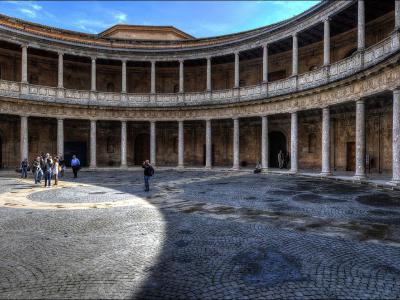
The palace is a square with a circular patio within. The roof has a circular opening above the patio. The patio is enclosed in two levels. A Doric colonnade encircles the lower level. The upper level is wrapped in a stylized Ionic colonnade. The visitors entering the patio are surprised, having passed from the square to the circle.
Charles never lived in the palace. As the visitors leave they pass through the gardens again. The cats watch them go.
Charles was not only an emperor, he was a king. He was ruler of Spain and most of Southern Europe. He had palaces galore, but he needed a summer place. Ferdinand and Isabella had taken rooms at the Alhambra. He needed something new.
He chose Pedro Machuca as architect. Pedro had studied with Michelangelo. He would create something unique, something Italian. The palace is stylistically Mannerist. At that time Mannerism was all the rage in Italy. The exterior is a mix of rusticated stone on the first floor and ashlar smoothness above. The building was avant-garde, unique in Spain.
The palace is a square with a circular patio within. The roof has a circular opening above the patio. The patio is enclosed in two levels. A Doric colonnade encircles the lower level. The upper level is wrapped in a stylized Ionic colonnade. The visitors entering the patio are surprised, having passed from the square to the circle.
Charles never lived in the palace. As the visitors leave they pass through the gardens again. The cats watch them go.

3) Comares Palace
The Comares Palace is thought to be the most important structure in the Alhambra. It was the residence for the king and it has rooms surrounding the Court of the Myrtles. The rooms are galleries with porticoes at each end.
Yusuf wanted his palace to amaze and awe his visitors. He did not live to see the result. His son Mohammed V was responsible for finishing the facade. It is on a stage of three steps, covered with stucco carvings once brilliantly painted. On the facade are two identical doors with lintels, decorated tiles and plaster work.
We have the classic choice: Door Number One or Door Number two? But this is not the "Lady or the Tiger." The door on the left opens to a hall decorated with mocarabes. The ceiling is interlaced wood panels. The hall leads to a dark passage to the Court of the Myrtles. The door on the right provides access to family rooms.
At the north end of the palace is the Hall of the Boat (Sala de la Barca) and the Hall of the Ambassadors (Sala de los Embajadores) inside the Comares Tower (Torre de Comares). The Hall of the Ambassadors gets the prize for being the most impressive room.
The hall is dark but for natural light coming through large windows. There are three windows on each wall. The central window shines on the throne. High up in the room are smaller windows illuminating a wooden ceiling depicting the seven heavens a soul must traverse to meet Allah.
Yusuf wanted his palace to amaze and awe his visitors. He did not live to see the result. His son Mohammed V was responsible for finishing the facade. It is on a stage of three steps, covered with stucco carvings once brilliantly painted. On the facade are two identical doors with lintels, decorated tiles and plaster work.
We have the classic choice: Door Number One or Door Number two? But this is not the "Lady or the Tiger." The door on the left opens to a hall decorated with mocarabes. The ceiling is interlaced wood panels. The hall leads to a dark passage to the Court of the Myrtles. The door on the right provides access to family rooms.
At the north end of the palace is the Hall of the Boat (Sala de la Barca) and the Hall of the Ambassadors (Sala de los Embajadores) inside the Comares Tower (Torre de Comares). The Hall of the Ambassadors gets the prize for being the most impressive room.
The hall is dark but for natural light coming through large windows. There are three windows on each wall. The central window shines on the throne. High up in the room are smaller windows illuminating a wooden ceiling depicting the seven heavens a soul must traverse to meet Allah.
4) Plaza Nueva (The New Square) (must see)
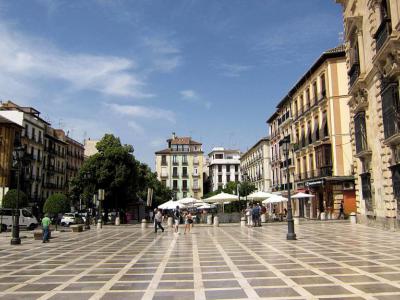
Despite its name, the Plaza Nueva (New Square) is one of the oldest squares in Granada. In former times the plaza was the scene of bull fights, tournaments and an occasional execution, definitely a spectator event. Before it was a square, however, it was a bridge. Called the Bridge of of Loggers, it spanned the River Darro.
The square is centrally located and is an ideal starting point for explorations on foot. Walk from the Puerto Granadas to the Alhambra forest to the Alhambra, a 15 or 20 minute journey. Exit by way of the cobbled street on the left of the Church of Santa Ana to the River Darro. Perhaps go up Elvira Street to the Mirador San Nicolas and the Albaicin.
The main attraction of the square itself is the High Court of Andalusia. The court building was formerly the Chancilleria Real (Royal Chancellery). Construction of the Chancellery began in 1530. In the rear of the building a prison, handy to the court. The square is also home to the Arborea Flamenco. Cafes, flamenco, ole!
The square is centrally located and is an ideal starting point for explorations on foot. Walk from the Puerto Granadas to the Alhambra forest to the Alhambra, a 15 or 20 minute journey. Exit by way of the cobbled street on the left of the Church of Santa Ana to the River Darro. Perhaps go up Elvira Street to the Mirador San Nicolas and the Albaicin.
The main attraction of the square itself is the High Court of Andalusia. The court building was formerly the Chancilleria Real (Royal Chancellery). Construction of the Chancellery began in 1530. In the rear of the building a prison, handy to the court. The square is also home to the Arborea Flamenco. Cafes, flamenco, ole!
5) Alcaicería (The Arab Market)
In the sixth century the Byzantine Emperor Justinian granted the Arabs the exclusive right to make and sell silk within the Empire. To show appreciation the Arabs gave their bazaars the Arabic name for Caesar, al-Kaysar-ia, "the place of Ceasar." Sounds like "Alcaiceria." And so from that time all Arab bazaars took this name.
The Alcaiceria of Granada was opened in the 15th century. It lasted well into the 19th century when it was destroyed by fire. The fire was caused by a shop for matches. The shop went up first, then all else followed. The replacement Alcaiceria is a weak imitation of the original. It is smaller, made with cheaper materials. It looks worn.
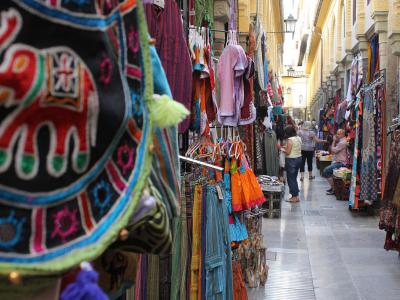
The first Alcaiceria held over 200 shops and stalls within a maze of streets and alleys. The streets were closed with iron gates to keep horsemen out. The gates were locked at night. Business was given over almost exclusively to the precious silks. Today the Aciceria is devoted to souvenir stalls, knick-knacks, and memorabilia.
The Alcaiceria of Granada was opened in the 15th century. It lasted well into the 19th century when it was destroyed by fire. The fire was caused by a shop for matches. The shop went up first, then all else followed. The replacement Alcaiceria is a weak imitation of the original. It is smaller, made with cheaper materials. It looks worn.
The first Alcaiceria held over 200 shops and stalls within a maze of streets and alleys. The streets were closed with iron gates to keep horsemen out. The gates were locked at night. Business was given over almost exclusively to the precious silks. Today the Aciceria is devoted to souvenir stalls, knick-knacks, and memorabilia.
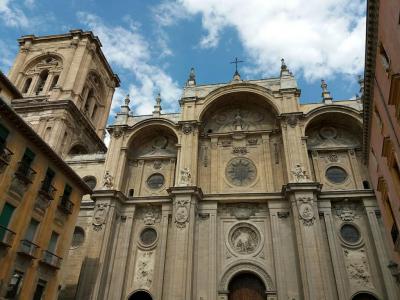
6) Granada Cathedral (must see)
Granada Cathedral is a Roman Catholic church. It is the seat of the Archdiocese of Granada and it was built on top of the bones of the Mosque of the City. The construction took place in 1518 after the Christian Reconquest of Andalusia.
The Cathedral was started in The Spanish Renaissance style rather than the Gothic. In 1523 the first architect, Enrique Egas was replaced by Diego de Siloe. The work continued for forty years. Diego planned for a triforium of five naves rather than three. His principal chapel (capilla mayor) was circular, not a semicircular apse.
For 181 years alterations and revisions proceeded under different architects until 1667. Alonso Cano and Gaspar de la Pena introduced Baroque elements to the facade. In 1699 after 181 years, this document of stone might be considered almost complete. But two high towers were planned and never built. The ground underneath was considered unstable.
The Cathedral was meant to be the royal mausoleum but Philip II moved the royal burial site to the palace of El Escorial near Madrid.
The Cathedral was started in The Spanish Renaissance style rather than the Gothic. In 1523 the first architect, Enrique Egas was replaced by Diego de Siloe. The work continued for forty years. Diego planned for a triforium of five naves rather than three. His principal chapel (capilla mayor) was circular, not a semicircular apse.
For 181 years alterations and revisions proceeded under different architects until 1667. Alonso Cano and Gaspar de la Pena introduced Baroque elements to the facade. In 1699 after 181 years, this document of stone might be considered almost complete. But two high towers were planned and never built. The ground underneath was considered unstable.
The Cathedral was meant to be the royal mausoleum but Philip II moved the royal burial site to the palace of El Escorial near Madrid.
