Custom Walk in Iasi, Romania by alejandro_rodriguez_san_jose_b28c4 created on 2024-08-18
Guide Location: Romania » Iasi
Guide Type: Custom Walk
# of Sights: 9
Tour Duration: 2 Hour(s)
Travel Distance: 3.8 Km or 2.4 Miles
Share Key: G2LG9
Guide Type: Custom Walk
# of Sights: 9
Tour Duration: 2 Hour(s)
Travel Distance: 3.8 Km or 2.4 Miles
Share Key: G2LG9
How It Works
Please retrieve this walk in the GPSmyCity app. Once done, the app will guide you from one tour stop to the next as if you had a personal tour guide. If you created the walk on this website or come to the page via a link, please follow the instructions below to retrieve the walk in the app.
Retrieve This Walk in App
Step 1. Download the app "GPSmyCity: Walks in 1K+ Cities" on Apple App Store or Google Play Store.



Step 2. In the GPSmyCity app, download(or launch) the guide "Iasi Map and Walking Tours".
Step 3. Tap the menu button located at upper right corner of the "Walks" screen and select "Retrieve custom walk". Enter the share key: G2LG9

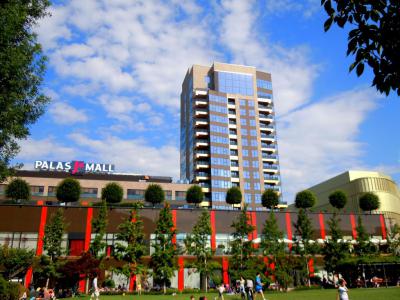
2) Palas Mall
Palas Mall is a vast shopping center in the Civic Centre district of Iasi, part of a huge lifestyle center, comprising more than 270,000 square meters of commercial space. It is located not far from the landmark Palace of Culture.
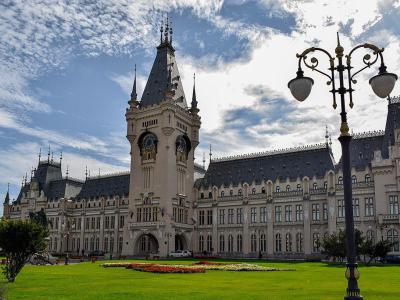
3) Palatul Culturii (Palace of Culture) (must see)
The Palace of Culture is a spacious (299 rooms/36,000 m²) architectural landmark, symbol of Iasi and a listed national monument. It was built between 1906 and 1925 (the construction was somewhat halted by WWI) by prominent Romanian architect I.D. Berindei partially on the ruins of medieval princely court and a 19th century royal palace. In front of the building stands a mounted statue of Stephan the Great, medieval ruler of the Principality of Moldavia. During World War II the palace served as barracks sheltering first the German and then the Soviet troops. During the communist era, all the interior frescoes featuring Romanian monarchs were painted over. Until 1955, the building had served as the County Court of Law. Today, the flamboyant Neo-Gothic palace houses four museums (The Moldavian History Museum, The Moldavian Museum of Ethnography, The Museum of Art, and The Museum of Science and Technology), several art galleries and a huge public library.
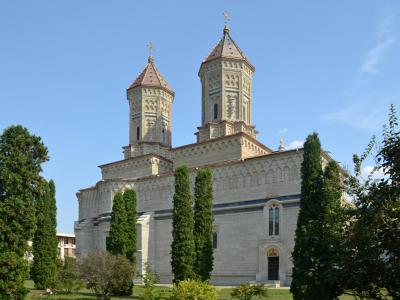
4) Manastirea Sfintii Trei Ierarhi (Three Hierarchs Monastery) (must see)
Situated in the old centre of Iasi, on Stefan cel Mare Boulevard (previously known as the Princely Street), the Monastery of the Three Holy Hierarchs symbolizes cultural and spiritual legacy of the Moldavia region of Romania. It was built in 1637-1639 by Vasile Lupu, prince of Moldavia, as a manifestation of his sovereignty, and remains under the patronage of Three Holy Hierarchs - Saint Basil the Great, Saint Gregory the Theologian and Saint John Chrysostom. The "Trisfetite" Church, inside the monastery, was initially intended as a royal burial ground, pursuant to which it holds the remains of the local saint, Paraskeve, and prominent state persons, members of Vasile Lupu's royal family: Princes Dimitrie Cantemir and Alexandru Ioan Cuza. At some point, the monastery also housed a print house and the future Princely Academy known as "Schola Basiliana". In 1970 the monastery was shut down and remained so until 1989 when it was reopened. The complex's architecture represents a combination of Romanian, Turkish, Arab, Georgian, Armenian and Persian elements.
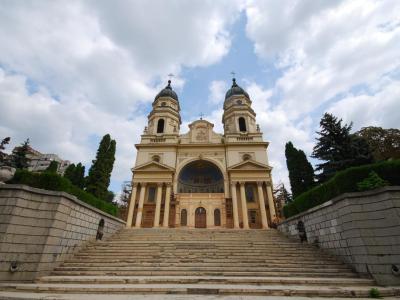
5) Catedrala Mitropolitana (Metropolitan Cathedral) (must see)
The Iași Metropolitan Cathedral is the seat of the Romanian Orthodox Archbishop of Iaşi and Metropolitan of Moldavia and Bukovina, and is the largest Orthodox temple in Romania. It is built on the site of two churches dating back to the 15th and 17th centuries, and was opened in April 1887 in the presence of King Carol I. The architecture is inspired by the late Italian Renaissance and abounds in Baroque elements. The interior is adorned with paintings by Gheorghe Tatarescu, showing influence of Italian neoclassicism. The building is listed in the National Register of Historic Monuments.
Sight description based on Wikipedia.
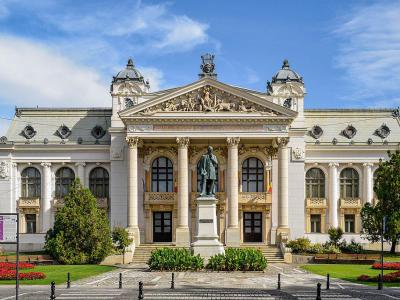
6) The National Theatre "Vasile Alecsandri" (must see)
The Iași National Theatre is the oldest national theatre and one of the most commercially successful in Romania, operational since May 1840. In February 1888, the original theatre building completely burned down. The restoration took two years (1894-1896), and was run by Viennese architects, Fellner and Helmer. The result was a combination of Neoclassic exterior and lavishly decorated interior, featuring a mixture of Rococo and Baroque styles, earning the building the status of one of the most elegant in Romania. In 1956, marking the 140th anniversary of the first theatrical performance in the Romanian language, the theater was named after of Romania's prominent playwright and poet Vasile Alecsandri. Today, this is a listed National Historic Monument and also home to the Romanian National Iasi Opera.
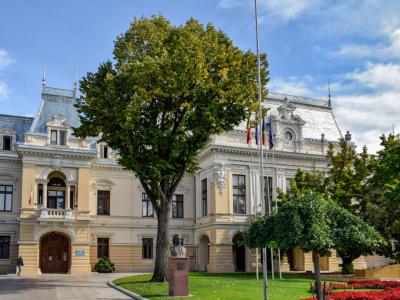
7) Roznovanu Palace / Iasi City Hall (must see)
Roset-Roznovanu Palace (Romanian: Palatul Roset-Roznovanu) dates back to the second half of the 18th century. Throughout 1830-1833 it was rebuilt by Iordache Ruset-Roznovanu, member of the Rosetti princely family (rulers of the Moldavia province). During World War I, the palace was the seat of the Romanian government. Today it houses the Iași City Hall and is a listed National Historic Monument.
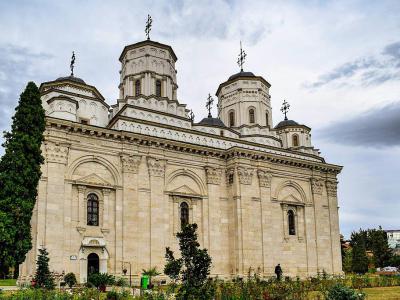
8) Manastirea Golia (Golia Monastery) (must see)
The Golia Monastery is a Romanian Orthodox monastery established in the 16th century by boyar Ioan Golia. Currently it is listed as a National Historic Monument and in 2012 was awarded the European Union Prize for Cultural Heritage. The monastery is surrounded with tall walls, featuring corner turrets and a 30 m (98.43 ft) Goliath tower – one of the key symbols of Iasi – from the top of which one can enjoy a fantastic view of the city; to get there, one has to climb 120 steps. The monastery also houses the Museum of Ion Creangă, famous Romanian writer and former curator of the monastery's church, and Doxologia Cultural Missionary Centre of the Metropolis of Moldavia and Bukovina.
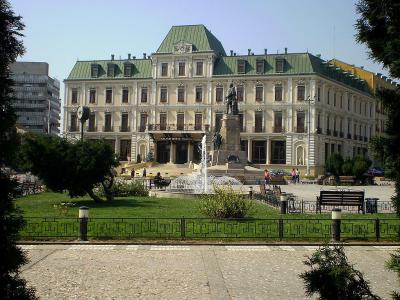
9) Piata Unirii (Union Square) (must see)
Piața Unirii (Unification or Union Square) is one of the key gathering spots in Iasi much loved by the local youth and, in some cases, even protesters, owing to whom it sees a lot of action on a regular basis.. The square flanks Stefan cel Mare Boulevard on one end (with the Palace of Culture and Palas Mall flanking it on the opposite end) and is sided by two hotels: Grand Traian Hotel and Unirea Hotel.
