Custom Walk in Cork, Ireland by gerrymackay_85fac created on 2025-04-01
Guide Location: Ireland » Cork
Guide Type: Custom Walk
# of Sights: 8
Tour Duration: 3 Hour(s)
Travel Distance: 5.6 Km or 3.5 Miles
Share Key: BF3TL
Guide Type: Custom Walk
# of Sights: 8
Tour Duration: 3 Hour(s)
Travel Distance: 5.6 Km or 3.5 Miles
Share Key: BF3TL
How It Works
Please retrieve this walk in the GPSmyCity app. Once done, the app will guide you from one tour stop to the next as if you had a personal tour guide. If you created the walk on this website or come to the page via a link, please follow the instructions below to retrieve the walk in the app.
Retrieve This Walk in App
Step 1. Download the app "GPSmyCity: Walks in 1K+ Cities" on Apple App Store or Google Play Store.



Step 2. In the GPSmyCity app, download(or launch) the guide "Cork Map and Walking Tours".
Step 3. Tap the menu button located at upper right corner of the "Walks" screen and select "Retrieve custom walk". Enter the share key: BF3TL
1) St. Anne's Church in Shandon (must see)
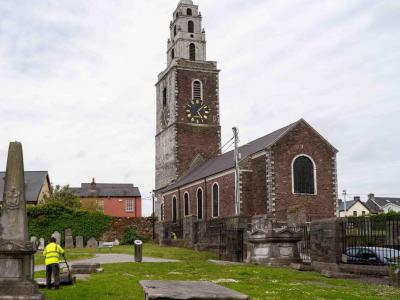
Saint Anne's Church is a notable landmark that overlooks the River Lee. The church was constructed between 1722 and 1726 on the site of a medieval church dedicated to Saint Mary, which was destroyed during the Williamite wars in 1690. The decision to build a new church on this ancient site was due to population growth in the area.
The Church of Saint Anne was built using two types of stone, red sandstone from the original Shandon Castle and limestone from the derelict Franciscan Abbey, which stood on the North Mall. The use of these materials has been linked to the colors used to represent the city. The walls of the tower are two meters thick and the height was extended to 15 meters to accommodate the pepper pot adornment on the tower.
Saint Anne's Church is most famous for its eight bells, which are featured in the popular song "The Bells of Shandon" by Francis Sylvester Mahony. The largest of the bells weighs over 1.5 tons and was cast by Abel Rudhall of Gloucester. Visitors can climb to the first floor of the tower and ring the bells themselves using an Ellacombe apparatus. The bells have been recast twice, in 1865 and 1906.
The clock on the tower is known as "The Four Faced Liar" because the time may not appear to correspond perfectly on each face due to the effects of wind on the hands of a given face. At the top of the pepper pot adornment is a weather vane in the form of a salmon, which represents the fishing industry of the River Lee.
Why You Should Visit:
The place to go for a great 360 view of the city.
Plus, you can have a nice walk through the emblematic neighborhood of Shandon.
Tip:
Once you make it to the top you may get the chance to ring the bells!
The Church of Saint Anne was built using two types of stone, red sandstone from the original Shandon Castle and limestone from the derelict Franciscan Abbey, which stood on the North Mall. The use of these materials has been linked to the colors used to represent the city. The walls of the tower are two meters thick and the height was extended to 15 meters to accommodate the pepper pot adornment on the tower.
Saint Anne's Church is most famous for its eight bells, which are featured in the popular song "The Bells of Shandon" by Francis Sylvester Mahony. The largest of the bells weighs over 1.5 tons and was cast by Abel Rudhall of Gloucester. Visitors can climb to the first floor of the tower and ring the bells themselves using an Ellacombe apparatus. The bells have been recast twice, in 1865 and 1906.
The clock on the tower is known as "The Four Faced Liar" because the time may not appear to correspond perfectly on each face due to the effects of wind on the hands of a given face. At the top of the pepper pot adornment is a weather vane in the form of a salmon, which represents the fishing industry of the River Lee.
Why You Should Visit:
The place to go for a great 360 view of the city.
Plus, you can have a nice walk through the emblematic neighborhood of Shandon.
Tip:
Once you make it to the top you may get the chance to ring the bells!
2) St. Peter and Paul's Church
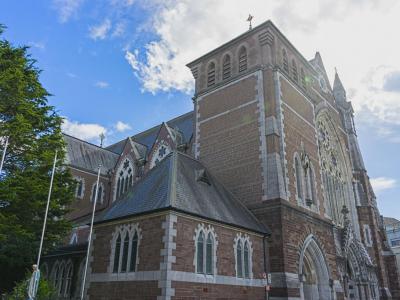
Let's say you’re strolling down Saint Patrick’s Street, scanning the storefronts, and suddenly a sweep of limestone and pointed arches interrupts the flow of shop windows. That’s St. Peter and Paul’s Church - a Gothic Revival flourish from the mid-19th century, planted on ground where Catholic churches weren’t even allowed a century earlier. Between 1859 and 1866, architect E.W. Pugin, son of Gothic revival champion Augustus Pugin, brought this vision to life for a city whose Catholic community was ready to build with confidence. The result? A structure that announces itself with pride even without the towering spire it once dreamed of - a casualty of budget and structural caution.
The exterior does its job - handsome, dignified, undeniably Gothic - but the real magic waits inside. Here, red marble pillars rise under finely carved timber ceilings, the light pouring through stained-glass windows in a way that turns the space into a living kaleidoscope. The high altar demands attention with its intricate detail, while the Russian oak pulpit seems to have absorbed every sermon ever preached from it. Biblical scenes unfold in glass and stone, each one rendered with a care that rewards slow looking.
It’s not a space you rush through. Every detail - from the arches to the altar rail - feels like it was meant to be noticed. Photographers can chase the light as it shifts through the day, history fans can tick off another E.W. Pugin work from their list, and anyone craving a moment of calm will find it here, right in the churn of the city centre.
The exterior does its job - handsome, dignified, undeniably Gothic - but the real magic waits inside. Here, red marble pillars rise under finely carved timber ceilings, the light pouring through stained-glass windows in a way that turns the space into a living kaleidoscope. The high altar demands attention with its intricate detail, while the Russian oak pulpit seems to have absorbed every sermon ever preached from it. Biblical scenes unfold in glass and stone, each one rendered with a care that rewards slow looking.
It’s not a space you rush through. Every detail - from the arches to the altar rail - feels like it was meant to be noticed. Photographers can chase the light as it shifts through the day, history fans can tick off another E.W. Pugin work from their list, and anyone craving a moment of calm will find it here, right in the churn of the city centre.
3) National Monument and Grand Parade Street
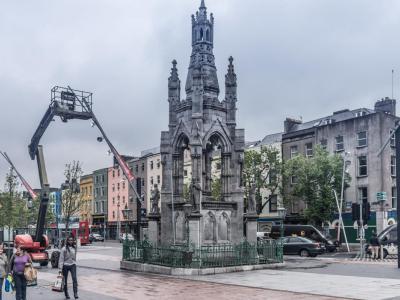
The National Monument standing on the Grand Parade Street in Cork is a significant landmark of the city. It was built to commemorate the great Irish patriots and martyrs involved in the revolts of 1798, 1803, 1848, and 1867. The foundation stone was laid by the Mayor of Cork, Patrick Meade, in 1898, but it was not until 1902 that the design of the monument was commissioned to the famous architect, D.J Coakley, and John Francis Davis was asked to sculpt the figurines on the monument.
The monument's design is early Irish Gothic styled, and it stands at the junction of Grand Parade and South Mall, which was previously occupied by the statue of King George II. The monument's construction faced difficulties in fundraising as the locals were regarded as disrespectful and indifferent towards the country’s patriots and independence struggles.
The National Monument is adorned with statues of Wolfe Tone, Michael Dwyers, Davis, and O’Neill Crowley at the four corners of the monument. In the center, under the canopy, is the eight feet high statue of Erin. It bears a stark resemblance to the Holy Trinity Church and is an impressive and awe-inspiring structure to behold.
Grand Parade Street is one of the main streets in Cork city that runs from South Mall in the south to St. Patrick's Street/Daunt Square in the north. The street retains a number of commercial properties, with retail being most common at the northern end of the street and offices more common at the southern end close to the South Mall. The street is also home to Cork's main library, Bishop Lucey Park, and the mid-19th century Berwick Fountain.
The street's Irish name, Sráid an Chapaill Bhuí ("Yellow Horse Street"), originates from a time when a statue of King George II on horse-back was located at the junction with South Mall. The location of this statue is now occupied by the National Monument, a testament to the city's rich history and the struggles of its people for independence. Grand Parade Street is a vibrant and bustling area of Cork, attracting locals and tourists alike.
The monument's design is early Irish Gothic styled, and it stands at the junction of Grand Parade and South Mall, which was previously occupied by the statue of King George II. The monument's construction faced difficulties in fundraising as the locals were regarded as disrespectful and indifferent towards the country’s patriots and independence struggles.
The National Monument is adorned with statues of Wolfe Tone, Michael Dwyers, Davis, and O’Neill Crowley at the four corners of the monument. In the center, under the canopy, is the eight feet high statue of Erin. It bears a stark resemblance to the Holy Trinity Church and is an impressive and awe-inspiring structure to behold.
Grand Parade Street is one of the main streets in Cork city that runs from South Mall in the south to St. Patrick's Street/Daunt Square in the north. The street retains a number of commercial properties, with retail being most common at the northern end of the street and offices more common at the southern end close to the South Mall. The street is also home to Cork's main library, Bishop Lucey Park, and the mid-19th century Berwick Fountain.
The street's Irish name, Sráid an Chapaill Bhuí ("Yellow Horse Street"), originates from a time when a statue of King George II on horse-back was located at the junction with South Mall. The location of this statue is now occupied by the National Monument, a testament to the city's rich history and the struggles of its people for independence. Grand Parade Street is a vibrant and bustling area of Cork, attracting locals and tourists alike.
4) Red Abbey
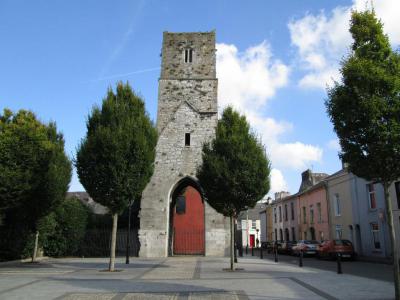
The Red Abbey in Cork is a medieval structure that was constructed using reddish sandstone. It was founded in the late 13th or early 14th century by a member of the De Courcey family and was named after the distinctive color of the sandstone used in its construction. The Red Abbey was an Augustinian abbey that was occupied by the friars until the 17th century, even though it was dissolved in 1541.
During the Siege of Cork in 1690, the Red Abbey's central bell tower was used by John Churchill as a vantage point and battery to suppress an uprising in the city associated with the expelled Catholic King of England, James II. The abbey remained standing throughout the 18th century when the Augustinian friars established a new friary in Fishamble Lane, and the Red Abbey was turned over for use as a sugar refinery. However, in 1799, a fire destroyed much of the abbey's structure.
The remains of the Red Abbey were excavated in 1977, revealing fragmented human bones, pottery dating from medieval times to the 19th century, and approximately 300 pieces of lead shot. Today, the only part of the Red Abbey that remains standing is the central bell tower of the abbey's church. This tower is now a designated national monument and is maintained by Cork City Council.
During the Siege of Cork in 1690, the Red Abbey's central bell tower was used by John Churchill as a vantage point and battery to suppress an uprising in the city associated with the expelled Catholic King of England, James II. The abbey remained standing throughout the 18th century when the Augustinian friars established a new friary in Fishamble Lane, and the Red Abbey was turned over for use as a sugar refinery. However, in 1799, a fire destroyed much of the abbey's structure.
The remains of the Red Abbey were excavated in 1977, revealing fragmented human bones, pottery dating from medieval times to the 19th century, and approximately 300 pieces of lead shot. Today, the only part of the Red Abbey that remains standing is the central bell tower of the abbey's church. This tower is now a designated national monument and is maintained by Cork City Council.
5) Elizabeth Fort
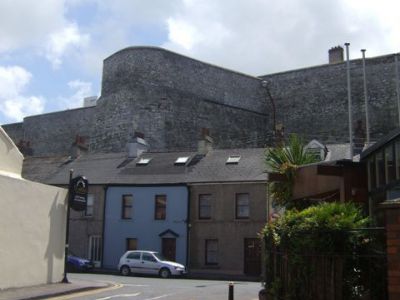
Elizabeth Fort in Cork looks like a stone star dropped on the city map, though its origins were anything but peaceful. It first appeared in 1601, ordered by Sir George Carew and named for Queen Elizabeth I, right after the Battle of Kinsale on Christmas Eve put everyone on edge. Perched just outside the medieval walls, it kept watch for trouble-until 1603, when it was torn down. By the early 1620s, Carew had it rebuilt in stone, giving it the sturdy form that still stands today.
Back then, the fort sat high and outside the city. As Cork swelled, it was eventually swallowed by the streets around it. Its purpose shifted with the times-defending the city during the 1690 Siege of Cork, housing soldiers, storing convicts, and later serving as headquarters for the Royal Irish Police. By the 20th century, the National Police moved in, before history finally claimed it as a heritage site.
These days, the place is as much a stage as it is a monument. Festivals spill through its gates-Cork Midsummer Festival, St. Patrick’s celebrations, Culture Night-and the walls echo with music, chatter, and the shuffle of curious visitors. Strolling its ramparts offers a full sweep of the city, with St. Fin Barre’s Cathedral stealing the skyline.
Inside, exhibits unpack its many past lives, from cannon smoke to police boots, tracing the story of a fort that never stopped adapting. Its star-shaped design is straight out of the early modern military playbook, complete with bastions and ramparts that make it easy to imagine its defensive days.
Back then, the fort sat high and outside the city. As Cork swelled, it was eventually swallowed by the streets around it. Its purpose shifted with the times-defending the city during the 1690 Siege of Cork, housing soldiers, storing convicts, and later serving as headquarters for the Royal Irish Police. By the 20th century, the National Police moved in, before history finally claimed it as a heritage site.
These days, the place is as much a stage as it is a monument. Festivals spill through its gates-Cork Midsummer Festival, St. Patrick’s celebrations, Culture Night-and the walls echo with music, chatter, and the shuffle of curious visitors. Strolling its ramparts offers a full sweep of the city, with St. Fin Barre’s Cathedral stealing the skyline.
Inside, exhibits unpack its many past lives, from cannon smoke to police boots, tracing the story of a fort that never stopped adapting. Its star-shaped design is straight out of the early modern military playbook, complete with bastions and ramparts that make it easy to imagine its defensive days.
6) St. Fin Barre's Cathedral (must see)
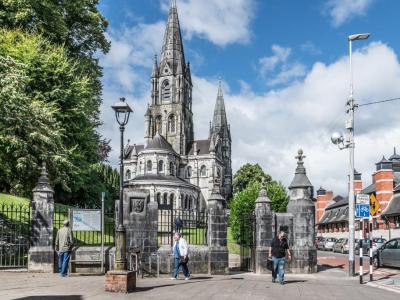
Saint Finn Barre’s Cathedral practically crowns Cork, with three spires that have been keeping watch since the late 19th century. But the story goes back much further. In the 7th century, Saint Fin Barre, Cork’s patron, founded a monastery here. That first building didn’t survive the 12th-century Norman invasion, and its successors fared no better-each replaced by something grander, as if every generation was trying to outdo the last. The Gothic Revival masterpiece you see today was built between 1863 and 1879, designed by William Burges, a man who wasn’t content to just draw blueprints-he dreamed up everything from the stained glass to the furniture.
Burges was so determined to see the cathedral completed his way that he left behind two detailed “how-to” manuals-the Book of Furniture and the Book of Designs-like a Victorian IKEA guide, only with more angels and gargoyles. Those plans have kept restorations faithful to the original, even down to re-carving sculptures degraded by Cork’s damp climate. Built mainly from local limestone, with marble columns inside, the cathedral’s skyline signature is the gilded copper “Golden Angel,” gleaming from the sanctuary roof.
Step inside and it’s sensory overload-in the best way. Mosaic pavements underfoot, a marble nave soaring above, and a pulpit propped up on four sculpted legs. The brass lectern stares back at you with the faces of Moses and King David. Seventy-four stained glass windows tell biblical tales, except in the nave, where the signs of the zodiac sneak in. The 1870 William Hill & Sons pipe organ has more than 4,500 pipes, making sure any note played resonates through both stone and soul. And if you can brave a steep, dim staircase, you’ll be rewarded with a sweeping panorama of Cork, spires in the foreground, rooftops fading into the distance.
Today, St. Fin Barre’s is more than a place of worship-it’s part of Cork’s cultural bloodstream, hosting concerts, events, and standing within easy reach of Elizabeth Fort and the city’s historic lanes. For anyone with an eye for architecture, a love of history, or just an appreciation for an excellent city view, it’s a stop that delivers on every level.
Burges was so determined to see the cathedral completed his way that he left behind two detailed “how-to” manuals-the Book of Furniture and the Book of Designs-like a Victorian IKEA guide, only with more angels and gargoyles. Those plans have kept restorations faithful to the original, even down to re-carving sculptures degraded by Cork’s damp climate. Built mainly from local limestone, with marble columns inside, the cathedral’s skyline signature is the gilded copper “Golden Angel,” gleaming from the sanctuary roof.
Step inside and it’s sensory overload-in the best way. Mosaic pavements underfoot, a marble nave soaring above, and a pulpit propped up on four sculpted legs. The brass lectern stares back at you with the faces of Moses and King David. Seventy-four stained glass windows tell biblical tales, except in the nave, where the signs of the zodiac sneak in. The 1870 William Hill & Sons pipe organ has more than 4,500 pipes, making sure any note played resonates through both stone and soul. And if you can brave a steep, dim staircase, you’ll be rewarded with a sweeping panorama of Cork, spires in the foreground, rooftops fading into the distance.
Today, St. Fin Barre’s is more than a place of worship-it’s part of Cork’s cultural bloodstream, hosting concerts, events, and standing within easy reach of Elizabeth Fort and the city’s historic lanes. For anyone with an eye for architecture, a love of history, or just an appreciation for an excellent city view, it’s a stop that delivers on every level.
7) University College Cork (must see)
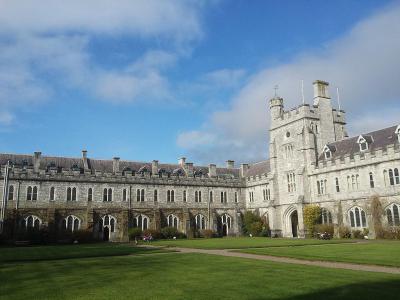
If Cork had an academic crown jewel, University College Cork would be it-though it began life in 1845 as Queen’s College Cork, one of three colleges founded under Queen Victoria. By 1908, it had joined the National University of Ireland and swapped the royal title for its current name. The original quadrangle, in stately Tudor Gothic style, still anchors the 42-acre campus. And while its lawns roll gently down to the River Lee, the whole place sits just a brisk ten-minute walk from Cork’s city centre.
This is also the campus that made medical history in 1898, when Ireland’s first two female doctors graduated here-decades before many universities even considered opening those door to women. The stone façades and arched windows look suitably scholarly, but the details tell their own stories. The Aula Maxima, the university’s ceremonial heart, brims with portraits and period furnishings. At the Crawford Observatory, late-19th-century telescopes-restored to working order-still point skyward, recalling a time of astronomy lectures.
In more recent history, UCC has been named Irish University of the Year five times and once claimed the European Commission’s title for top performing university. On the cultural side, the Glucksman Gallery-a bold piece of modernist architecture that earned a spot in 1001 Buildings You Must See Before You Die-hosts exhibitions from Irish and international artists, adding contemporary flair to the historic grounds.
Then there are the Ogham stones: early medieval standing stones carved with ancient script, sitting quietly among the green spaces as if waiting for you to decipher them. A seasonal campus walk, time spent with the art collections, or the contrast between historic quads and city streets-however you approach it, UCC offers a layered mix of history, architecture, and cultural life that stands out in Cork.
This is also the campus that made medical history in 1898, when Ireland’s first two female doctors graduated here-decades before many universities even considered opening those door to women. The stone façades and arched windows look suitably scholarly, but the details tell their own stories. The Aula Maxima, the university’s ceremonial heart, brims with portraits and period furnishings. At the Crawford Observatory, late-19th-century telescopes-restored to working order-still point skyward, recalling a time of astronomy lectures.
In more recent history, UCC has been named Irish University of the Year five times and once claimed the European Commission’s title for top performing university. On the cultural side, the Glucksman Gallery-a bold piece of modernist architecture that earned a spot in 1001 Buildings You Must See Before You Die-hosts exhibitions from Irish and international artists, adding contemporary flair to the historic grounds.
Then there are the Ogham stones: early medieval standing stones carved with ancient script, sitting quietly among the green spaces as if waiting for you to decipher them. A seasonal campus walk, time spent with the art collections, or the contrast between historic quads and city streets-however you approach it, UCC offers a layered mix of history, architecture, and cultural life that stands out in Cork.
8) Cork City Gaol (must see)
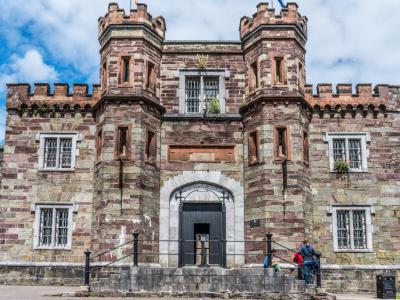
Cork City Gaol looks more like a Gothic fortress than a former prison, which was exactly the point when William Robertson designed it in 1818. The law was meant to feel imposing, and this place did the job. Even future art legend John Hogan cut his teeth here-though as a draughtsman, not an inmate-before going on to sculpt his way into Ireland’s cultural history. When the doors first opened in 1824, the gaol replaced Cork’s overcrowded old prison and took in both men and women, often for offences so minor-like drunkenness or foul language-that they wouldn’t raise an eyebrow today. In 1919, it even hosted Constance Markievicz, the first woman elected to the British Parliament, for giving a politically charged speech.
By 1878, the prison housed only women, switching back to a mixed population in 1922 before shutting down entirely a year later. The next chapter was unexpected: from 1927 to the 1950s, its thick stone walls broadcast RTÉ radio programmes instead of holding prisoners. After that, it slipped into partial ruin, its unused wings slowly gathering dust-until a 1993 restoration gave the building a second life as a museum.
Step inside today and you’ll find restored cells with wax figures and period belongings that make it hard not to imagine the sounds and smells of daily prison life. Displays dig into Cork’s social history, the harsh realities of 19th-century justice, and the odd daring escape. There’s a radio museum too, a shout-out to its broadcasting years, while graffiti left by real inmates lingers as a raw reminder of the human stories behind the bars. With panoramic views over the city from its hillside perch, the gaol mixes eerie atmosphere with architectural splendor, making it a memorable stop for anyone curious about Ireland’s past.
By 1878, the prison housed only women, switching back to a mixed population in 1922 before shutting down entirely a year later. The next chapter was unexpected: from 1927 to the 1950s, its thick stone walls broadcast RTÉ radio programmes instead of holding prisoners. After that, it slipped into partial ruin, its unused wings slowly gathering dust-until a 1993 restoration gave the building a second life as a museum.
Step inside today and you’ll find restored cells with wax figures and period belongings that make it hard not to imagine the sounds and smells of daily prison life. Displays dig into Cork’s social history, the harsh realities of 19th-century justice, and the odd daring escape. There’s a radio museum too, a shout-out to its broadcasting years, while graffiti left by real inmates lingers as a raw reminder of the human stories behind the bars. With panoramic views over the city from its hillside perch, the gaol mixes eerie atmosphere with architectural splendor, making it a memorable stop for anyone curious about Ireland’s past.
