Custom Walk in Zagreb, Croatia by khigeli_4637a created on 2025-04-08
Guide Location: Croatia » Zagreb
Guide Type: Custom Walk
# of Sights: 10
Tour Duration: 2 Hour(s)
Travel Distance: 3.4 Km or 2.1 Miles
Share Key: 9E2NV
Guide Type: Custom Walk
# of Sights: 10
Tour Duration: 2 Hour(s)
Travel Distance: 3.4 Km or 2.1 Miles
Share Key: 9E2NV
How It Works
Please retrieve this walk in the GPSmyCity app. Once done, the app will guide you from one tour stop to the next as if you had a personal tour guide. If you created the walk on this website or come to the page via a link, please follow the instructions below to retrieve the walk in the app.
Retrieve This Walk in App
Step 1. Download the app "GPSmyCity: Walks in 1K+ Cities" on Apple App Store or Google Play Store.



Step 2. In the GPSmyCity app, download(or launch) the guide "Zagreb Map and Walking Tours".
Step 3. Tap the menu button located at upper right corner of the "Walks" screen and select "Retrieve custom walk". Enter the share key: 9E2NV

1) King Tomislav Square
King Tomislav Square is one of the key open spaces in Zagreb’s Lower Town and forms the southern starting point of the city’s planned Green Horseshoe. It is named after King Tomislav, who ruled in the early 10th century and is credited with unifying the regions of Dalmatia and Pannonia into the early Croatian state. Originally named after Franz Joseph I, the square was renamed following the dissolution of the Austro-Hungarian Empire.
The square’s broad lawns and formal layout were designed to create a dignified entrance into the city centre, especially for those arriving at the nearby main railway station, which faces the square. Today, it remains a meticulously maintained public space, framed by tree-lined paths, vibrant flowerbeds, and the impressive yellow façade of the Art Pavilion at its northern edge.
At the centre stands the equestrian statue of King Tomislav, unveiled in 1947, anchoring the space visually. Benches and pathways invite visitors to pause, whether near the central fountain or along the perimeter, while the adjacent underground shopping centre and steady flow of pedestrians add to the square’s everyday rhythm.
In warmer months, the lawns become a popular place to relax, while in winter the square transforms with an ice rink and illuminated trees. At night, the softly lit Art Pavilion casts a warm glow across the northern end of the square.
The square’s broad lawns and formal layout were designed to create a dignified entrance into the city centre, especially for those arriving at the nearby main railway station, which faces the square. Today, it remains a meticulously maintained public space, framed by tree-lined paths, vibrant flowerbeds, and the impressive yellow façade of the Art Pavilion at its northern edge.
At the centre stands the equestrian statue of King Tomislav, unveiled in 1947, anchoring the space visually. Benches and pathways invite visitors to pause, whether near the central fountain or along the perimeter, while the adjacent underground shopping centre and steady flow of pedestrians add to the square’s everyday rhythm.
In warmer months, the lawns become a popular place to relax, while in winter the square transforms with an ice rink and illuminated trees. At night, the softly lit Art Pavilion casts a warm glow across the northern end of the square.
2) Botanical Garden
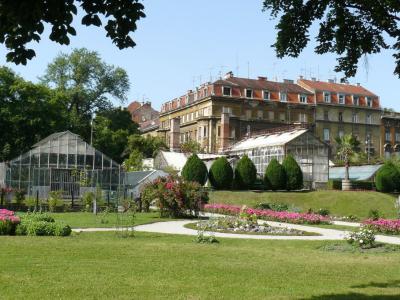
The Botanical Garden in Zagreb is a carefully designed green space at the southern edge of the Lower Town, forming part of the city’s Green Horseshoe. It was founded in 1889 by Antun Heinz as part of the Faculty of Science at the University of Zagreb and officially opened in 1891. Covering around five hectares at an elevation of about 120 metres, the garden was established to support botanical research and teaching while remaining accessible to the public.
Today, it hosts more than 10,000 plant species, including around 1,800 exotic varieties. The layout is organized into themed sections that reflect both botanical classification and geographic origin. Visitors can explore native Croatian flora arranged to mirror natural habitats, including rock gardens, alongside collections of alpine, aquatic, and exotic plants. A systematic field is also included for educational use, particularly for university teaching.
The garden’s design incorporates a variety of landscape styles. Its arboretum follows the principles of English landscape gardening, with a wide range of trees and shrubs, while the western section near the glasshouses features a formal French-style flower parterre with geometric patterns. Fourteen greenhouses contain tropical and subtropical species, as well as plants used for research.
Man-made lakes and pools support marsh vegetation and attract birdlife, adding to the garden’s calm atmosphere.
Today, it hosts more than 10,000 plant species, including around 1,800 exotic varieties. The layout is organized into themed sections that reflect both botanical classification and geographic origin. Visitors can explore native Croatian flora arranged to mirror natural habitats, including rock gardens, alongside collections of alpine, aquatic, and exotic plants. A systematic field is also included for educational use, particularly for university teaching.
The garden’s design incorporates a variety of landscape styles. Its arboretum follows the principles of English landscape gardening, with a wide range of trees and shrubs, while the western section near the glasshouses features a formal French-style flower parterre with geometric patterns. Fourteen greenhouses contain tropical and subtropical species, as well as plants used for research.
Man-made lakes and pools support marsh vegetation and attract birdlife, adding to the garden’s calm atmosphere.
3) Croatian National Theater
The Croatian National Theater in Zagreb stands as one of the city’s principal cultural landmarks and a leading institution for drama, opera, and ballet. Its origins date back to 1834, when the first city theatre was established in what is now the Old City Hall. It officially became the Croatian National Theatre in 1860 and gained government support the following year, aligning it with other major European national theatres.
The current building, opened in 1895 during the era of the Austro-Hungarian Empire, was inaugurated in the presence of Franz Joseph I. It was designed by the Viennese architects Fellner & Helmer, known for their theatre designs across Central Europe. Over the decades, as Zagreb expanded, the structure itself became a crown jewel of the city’s Green Horseshoe parks.
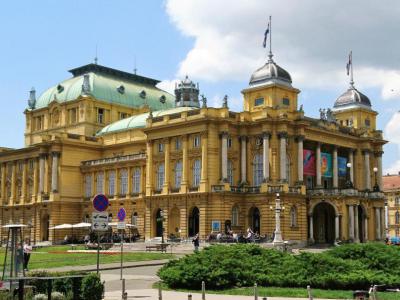
The structure is an example of Neo-Baroque architecture, defined by its symmetrical façade, decorative ornamentation, and prominent central entrance. Its bright yellow exterior makes it a focal point within the surrounding square. The first highlight, the fountain “The Well of Life,” is located directly in front of the theatre. To find it, stand at the base of the main entrance steps and look down into the circular bronze basin created in 1905 by Ivan Meštrović; look for the ten figures representing the different stages of life as they cling to the water’s edge.
Inside, the richly decorated auditorium, with its red and gold tones and painted ceiling, reflects late 19th-century design. The central focal point is the Ceremonial Curtain, located on the main stage. Once you find yourself inside the hall, look for Vlaho Bukovac’s masterpiece titled The Reformation of Croatian Literature and Art, which depicts famous 19th-century cultural figures. Directly opposite the stage, find the final highlight: the Emperor’s Box. Look for the most ornate, centrally positioned balcony in the first tier, which still features the plush gold and red velvet reserved for royalty since the building’s opening.
The theatre continues to host a wide program of performances. Visitors should note that access to the auditorium is usually restricted during rehearsals and performances, so checking guided tour times or performance schedules in advance is advisable.
The current building, opened in 1895 during the era of the Austro-Hungarian Empire, was inaugurated in the presence of Franz Joseph I. It was designed by the Viennese architects Fellner & Helmer, known for their theatre designs across Central Europe. Over the decades, as Zagreb expanded, the structure itself became a crown jewel of the city’s Green Horseshoe parks.
The structure is an example of Neo-Baroque architecture, defined by its symmetrical façade, decorative ornamentation, and prominent central entrance. Its bright yellow exterior makes it a focal point within the surrounding square. The first highlight, the fountain “The Well of Life,” is located directly in front of the theatre. To find it, stand at the base of the main entrance steps and look down into the circular bronze basin created in 1905 by Ivan Meštrović; look for the ten figures representing the different stages of life as they cling to the water’s edge.
Inside, the richly decorated auditorium, with its red and gold tones and painted ceiling, reflects late 19th-century design. The central focal point is the Ceremonial Curtain, located on the main stage. Once you find yourself inside the hall, look for Vlaho Bukovac’s masterpiece titled The Reformation of Croatian Literature and Art, which depicts famous 19th-century cultural figures. Directly opposite the stage, find the final highlight: the Emperor’s Box. Look for the most ornate, centrally positioned balcony in the first tier, which still features the plush gold and red velvet reserved for royalty since the building’s opening.
The theatre continues to host a wide program of performances. Visitors should note that access to the auditorium is usually restricted during rehearsals and performances, so checking guided tour times or performance schedules in advance is advisable.
4) Zagreb Funicular
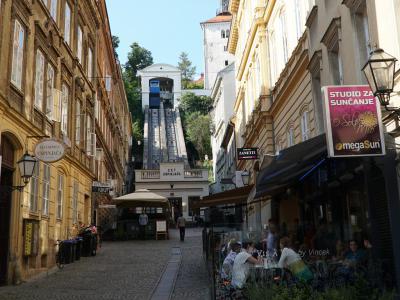
The Zagreb Funicular is one of the city’s most distinctive yet modest landmarks, linking the Lower Town with the historic Upper Town in just over a minute. Commissioned in 1888 by contractor D. W. Klein from Osijek and opened in 1890, it is the oldest form of public transport in Zagreb and has operated continuously ever since. Measuring only about 66 meters, it is often described as one of the shortest public funiculars in the world.
Initially powered by steam, the system struggled with low pressure and frequent breakdowns until it was electrified in 1934—greatly improving reliability. Today, two wagons operate on parallel tracks, each with 16 seats and standing room for 12 passengers, moving at a steady pace of about 1.5 meters per second. The lower station sits on Tomićeva Street, just off Ilica Street, while the upper station is located at the foot of Lotrščak Tower, along Strossmayer Promenade, replacing earlier wooden steps.
The short ride offers a quick transition between two contrasting parts of the city, along with a glimpse over rooftops. Despite its size, it has carried an impressive range of passengers over time, from local residents to visiting dignitaries, including members of royalty such as King Charles III and Queen Camilla.
Initially powered by steam, the system struggled with low pressure and frequent breakdowns until it was electrified in 1934—greatly improving reliability. Today, two wagons operate on parallel tracks, each with 16 seats and standing room for 12 passengers, moving at a steady pace of about 1.5 meters per second. The lower station sits on Tomićeva Street, just off Ilica Street, while the upper station is located at the foot of Lotrščak Tower, along Strossmayer Promenade, replacing earlier wooden steps.
The short ride offers a quick transition between two contrasting parts of the city, along with a glimpse over rooftops. Despite its size, it has carried an impressive range of passengers over time, from local residents to visiting dignitaries, including members of royalty such as King Charles III and Queen Camilla.
5) Lotršcak Tower
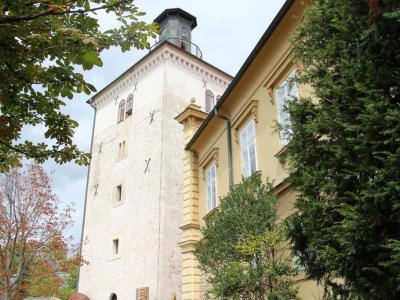
The Lotrščak Tower stands on the edge of Zagreb’s Upper Town, a solid reminder of the city’s medieval past. Built in the mid-13th century, around 1266, it formed part of the defensive walls of Gradec, following a demand by Hungarian King Béla IV to strengthen the southern ramparts. Rising about 99 feet, with walls over six feet thick, it guarded the Dverce Gate and served as a lookout. Its bells once warned of fires, storms, the closing of the gates, and approaching Ottoman forces.
The tower’s name comes from the Latin words “thieves’ bell,” which represents the first of its historic highlights. To find this relic, look toward the upper bell chamber within the tower’s top section, where the original bell was rung each evening to signal that the gates were about to close. Over time, as danger receded, the tower shifted roles—serving at various moments as a warehouse, a café, a residence, a gallery, and more—while always remaining city property and occasionally rented out when funds were needed.
It is noon in Zagreb. Each day at that exact hour, the Grič Cannon fires from the tower, a tradition begun in January 1877. This central highlight is located on the fourth floor of the tower; to find it, climb the interior stairs and look for the cannon positioned behind the large window overlooking the Strossmayer Promenade. Legend claims the shot once struck a Turkish pasha’s lunch, while others say it was simply meant to keep the cannon in working order and synchronize the city’s clocks.
Today, visitors can explore small exhibitions on the ground floor and climb to the belvedere for wide views over red-tiled roofs and the lower city. The final highlight is the 360-degree observation deck located at the very top of the structure, accessible by the last set of wooden stairs. Once on this uppermost level, look for panoramic vistas that stretch from the Cathedral spires to the distant Medvednica mountain. Just don’t worry about the cannon—you’re only in danger if you happen to be carrying lunch for a pasha.
Visitors should note that if they are inside the tower at noon, the blast of the cannon is exceptionally loud, so checking the time before reaching the fourth floor is advisable.
The tower’s name comes from the Latin words “thieves’ bell,” which represents the first of its historic highlights. To find this relic, look toward the upper bell chamber within the tower’s top section, where the original bell was rung each evening to signal that the gates were about to close. Over time, as danger receded, the tower shifted roles—serving at various moments as a warehouse, a café, a residence, a gallery, and more—while always remaining city property and occasionally rented out when funds were needed.
It is noon in Zagreb. Each day at that exact hour, the Grič Cannon fires from the tower, a tradition begun in January 1877. This central highlight is located on the fourth floor of the tower; to find it, climb the interior stairs and look for the cannon positioned behind the large window overlooking the Strossmayer Promenade. Legend claims the shot once struck a Turkish pasha’s lunch, while others say it was simply meant to keep the cannon in working order and synchronize the city’s clocks.
Today, visitors can explore small exhibitions on the ground floor and climb to the belvedere for wide views over red-tiled roofs and the lower city. The final highlight is the 360-degree observation deck located at the very top of the structure, accessible by the last set of wooden stairs. Once on this uppermost level, look for panoramic vistas that stretch from the Cathedral spires to the distant Medvednica mountain. Just don’t worry about the cannon—you’re only in danger if you happen to be carrying lunch for a pasha.
Visitors should note that if they are inside the tower at noon, the blast of the cannon is exceptionally loud, so checking the time before reaching the fourth floor is advisable.
6) Saint Mark's Church and Square (must see)
Saint Mark's Church and Saint Mark’s Square form the political and historical heart of Zagreb’s Upper Town, occupying the space where the medieval settlement of Gradec once governed itself. The square developed as a civic centre after the 1242 Golden Bull of King Béla IV granted Gradec the status of a free royal city. Over time, it became the focal point for administration and public life—a role it continues to hold today.
Saint Mark’s Church is often described as one of the oldest architectural monuments in Zagreb, with elements such as a Romanesque window on the south façade and the semicircular plan of Saint Mary’s Chapel pointing to a 13th-century origin. However, the church was largely rebuilt in the 14th century as a three-nave Gothic structure, with ribbed vaults supported by sturdy columns.
The central highlight, the richly decorated southern portal, is located on the exterior right side of the church as you face it from the square. Considered among the finest Gothic portals in Central Europe, it features fifteen sculpted figures of the Holy Family, Saint Mark, and the Apostles. To find this detail, walk toward the right-hand entrance of the building; once there, look for the intricate shallow niches that house these medieval statues.
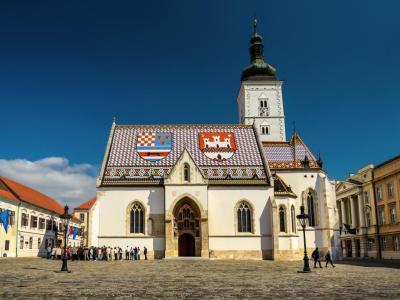
The church’s most recognizable feature—the colorful tiled roof—was added in 1880 and represents the building’s crowning glory. Visible from across the Upper Town, the roof displays two distinct coats of arms: the emblem of the Triune Kingdom of Croatia, Dalmatia, and Slavonia on the left, and the city of Zagreb on the right. To find the best view, stand in the center of the square and look for the vibrant red, white, and blue tiles that form these large heraldic shields.
Inside, the atmosphere becomes more intimate, defined by works by Croatian artists Ivan Meštrović, Jozo Kljaković, and Ljubo Babić. Sculptures by Ivan Meštrović are located primarily within the chancel and near the altars; look for his powerful, modern interpretations of religious figures, which contrast with the church’s restored frescoes and gilded ceiling finished in gold leaf.
The square surrounding the church is framed by key state institutions, including the seat of the Croatian Government, the Parliament building, and the Constitutional Court, while the Old City Hall stands at one corner. Renovated in 2006, the square has also served as a stage for modern political life, including presidential inaugurations until 2020. Security measures introduced after a 2020 attack have at times limited access, affecting the usual flow of visitors, so checking current access to the square and church in advance is advisable.
Saint Mark’s Church is often described as one of the oldest architectural monuments in Zagreb, with elements such as a Romanesque window on the south façade and the semicircular plan of Saint Mary’s Chapel pointing to a 13th-century origin. However, the church was largely rebuilt in the 14th century as a three-nave Gothic structure, with ribbed vaults supported by sturdy columns.
The central highlight, the richly decorated southern portal, is located on the exterior right side of the church as you face it from the square. Considered among the finest Gothic portals in Central Europe, it features fifteen sculpted figures of the Holy Family, Saint Mark, and the Apostles. To find this detail, walk toward the right-hand entrance of the building; once there, look for the intricate shallow niches that house these medieval statues.
The church’s most recognizable feature—the colorful tiled roof—was added in 1880 and represents the building’s crowning glory. Visible from across the Upper Town, the roof displays two distinct coats of arms: the emblem of the Triune Kingdom of Croatia, Dalmatia, and Slavonia on the left, and the city of Zagreb on the right. To find the best view, stand in the center of the square and look for the vibrant red, white, and blue tiles that form these large heraldic shields.
Inside, the atmosphere becomes more intimate, defined by works by Croatian artists Ivan Meštrović, Jozo Kljaković, and Ljubo Babić. Sculptures by Ivan Meštrović are located primarily within the chancel and near the altars; look for his powerful, modern interpretations of religious figures, which contrast with the church’s restored frescoes and gilded ceiling finished in gold leaf.
The square surrounding the church is framed by key state institutions, including the seat of the Croatian Government, the Parliament building, and the Constitutional Court, while the Old City Hall stands at one corner. Renovated in 2006, the square has also served as a stage for modern political life, including presidential inaugurations until 2020. Security measures introduced after a 2020 attack have at times limited access, affecting the usual flow of visitors, so checking current access to the square and church in advance is advisable.
7) Kamenita Vrata (The Stone Gate)
The Stone Gate is the only preserved medieval city gate of Zagreb’s Upper Town, marking the eastern entrance to the former fortified settlement of Gradec. In 1242, Gradec was declared a free royal city with the right to self-government, prompting the construction of defensive walls and fortified gates; the Stone Gate, believed to date from 1266, is the sole survivor.
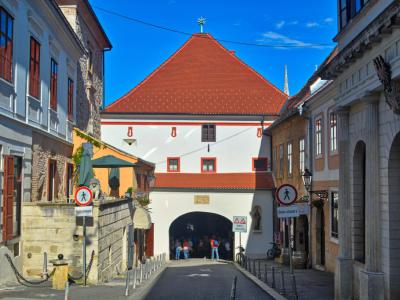
It takes the form of a rectangular entrance tower, once integrated into the town walls. Narrow loopholes on its northern and western sides, added in the 16th century, hint at its defensive past, while the central passage still functions as a route through the structure.
In 1731, a fire destroyed much of Gradec, but a painting of the Virgin Mary with the Infant Jesus, housed inside the gate, was found untouched. This event transformed the passage into a place of devotion, and a chapel was established within the gateway, with the painting set behind a wrought-iron grille. Whether viewed as a miracle or not, the site remains active, with visitors and locals alike lighting candles and offering prayers.
Rows of candles line the walls, and among the details is a small figure of Dora Krupićeva, a character from The Goldsmith's Gold, shown holding the keys to the city.
It takes the form of a rectangular entrance tower, once integrated into the town walls. Narrow loopholes on its northern and western sides, added in the 16th century, hint at its defensive past, while the central passage still functions as a route through the structure.
In 1731, a fire destroyed much of Gradec, but a painting of the Virgin Mary with the Infant Jesus, housed inside the gate, was found untouched. This event transformed the passage into a place of devotion, and a chapel was established within the gateway, with the painting set behind a wrought-iron grille. Whether viewed as a miracle or not, the site remains active, with visitors and locals alike lighting candles and offering prayers.
Rows of candles line the walls, and among the details is a small figure of Dora Krupićeva, a character from The Goldsmith's Gold, shown holding the keys to the city.
8) Tkalčićeva Street (must see)
Tkalčićeva Street in Zagreb follows the former course of the Medveščak Creek, which once formed the boundary between the medieval settlements of Gradec and Kaptol. From the earliest days of the city, the creek powered a line of watermills that supported local industry, producing cloth, paper, soap, liquor, and leather. Competition over these mills often led to disputes between the two communities, prompting a treaty in 1392 that limited further construction and left only two mills within the city, both owned by the Cistercian Monastery.
By 1898, the polluted creek was covered over and the mills demolished, giving way to a new street called Creek Street. In 1913, it was renamed after the historian and priest Ivan Tkalčić. Most of the buildings lining the street today date from the 18th and 19th centuries. In the early 20th century, Tkalčićeva also became Zagreb’s main red-light district, where prostitution was legal and regulated, and brothels occupied many of the houses, including the well-known Green Lantern. This phase ended with the upheavals of the Second World War, while earlier trades, such as leather production, had already declined by 1938.
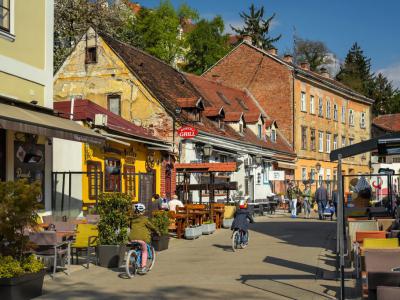
Today, Tkalčićeva Street is one of the most animated parts of central Zagreb, known for its cafés, bars, and restaurants that line the pedestrian route. Small businesses have replaced the old mills, and the street functions as a social corridor connecting key areas of the historic centre. Visitors will notice preserved facades, along with details such as the statue of writer Marija Jurić Zagorka and a traditional sundial.
The former creek now runs beneath as part of the city’s sewer system, but above ground, the street offers a steady rhythm of terraces and everyday activity, making it an easy place to pause for coffee, people-watching, or a relaxed meal.
By 1898, the polluted creek was covered over and the mills demolished, giving way to a new street called Creek Street. In 1913, it was renamed after the historian and priest Ivan Tkalčić. Most of the buildings lining the street today date from the 18th and 19th centuries. In the early 20th century, Tkalčićeva also became Zagreb’s main red-light district, where prostitution was legal and regulated, and brothels occupied many of the houses, including the well-known Green Lantern. This phase ended with the upheavals of the Second World War, while earlier trades, such as leather production, had already declined by 1938.
Today, Tkalčićeva Street is one of the most animated parts of central Zagreb, known for its cafés, bars, and restaurants that line the pedestrian route. Small businesses have replaced the old mills, and the street functions as a social corridor connecting key areas of the historic centre. Visitors will notice preserved facades, along with details such as the statue of writer Marija Jurić Zagorka and a traditional sundial.
The former creek now runs beneath as part of the city’s sewer system, but above ground, the street offers a steady rhythm of terraces and everyday activity, making it an easy place to pause for coffee, people-watching, or a relaxed meal.
9) Zagreb Cathedral (must see)
Rising above the historic Kaptol district, Zagreb Cathedral is the most prominent landmark in Zagreb and a key reference point within the city’s skyline. Its origins date to 1093, when Ladislaus I of Hungary moved the bishopric from Sisak to Zagreb and declared the existing church a cathedral. Reconstruction began immediately and continued after his death, with the building consecrated in 1217 by King Andrew II of Hungary.
The cathedral was destroyed during the Mongol invasion of 1242 and rebuilt soon after, while later threats from the Ottoman Empire led to the addition of defensive walls and a watchtower. Over time, the structure underwent several transformations—serving as a fortified religious center and a symbol of national resilience—most notably after the 1880 earthquake, when it was rebuilt in a Neo-Gothic style. Today, dedicated to the Assumption of the Blessed Virgin Mary, it remains the tallest sacral building in Croatia, its twin spires defining the skyline.
The central altar area is located at the front of the nave, serving as the liturgical heart of the building. To find it, walk straight down the main aisle toward the east end of the church. There, you will see the High Altar, which portrays the Holy Family and draws focus along the central axis of the interior. Visitors can observe the intricate Neo-Gothic details that anchor the sanctuary, often illuminated by light filtering through the tall windows.
Beneath the towering arches, and located behind the main altar level, a major historical shrine represents a relic of Croatia's 20th-century history. After you walk around the high altar to the rear of the chancel, you will reach the tomb of Cardinal Alojzije Stepinac. Once you are behind the altar, look for the relief by sculptor Ivan Meštrović, which depicts the cardinal with Christ. The tomb is a place of deep pilgrimage and is one of the most evocative sections of the cathedral’s interior.
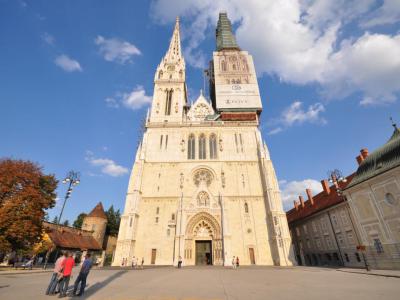
The main façade is rich in sculptural detail and serves as the primary entrance to the cathedral. To find this highlight, stand directly in front of the Neo-Gothic West Portal before entering the building. The tympanum between the towers depicts the Virgin and Child with angels, while statues of saints—including Methodius, George, Barbara, Catherine, Florian, and Cyril—line the entrance. Above the doorway, look for the figure of Christ flanked by the Hungarian kings Stephen and Ladislaus.
Alongside these elements, the cathedral also features a series of chapels containing unique artworks. Visitors should note that the cathedral has recently faced periods of reconstruction and reorganization due to earthquake damage, so checking ahead for access updates is advisable.
The cathedral was destroyed during the Mongol invasion of 1242 and rebuilt soon after, while later threats from the Ottoman Empire led to the addition of defensive walls and a watchtower. Over time, the structure underwent several transformations—serving as a fortified religious center and a symbol of national resilience—most notably after the 1880 earthquake, when it was rebuilt in a Neo-Gothic style. Today, dedicated to the Assumption of the Blessed Virgin Mary, it remains the tallest sacral building in Croatia, its twin spires defining the skyline.
The central altar area is located at the front of the nave, serving as the liturgical heart of the building. To find it, walk straight down the main aisle toward the east end of the church. There, you will see the High Altar, which portrays the Holy Family and draws focus along the central axis of the interior. Visitors can observe the intricate Neo-Gothic details that anchor the sanctuary, often illuminated by light filtering through the tall windows.
Beneath the towering arches, and located behind the main altar level, a major historical shrine represents a relic of Croatia's 20th-century history. After you walk around the high altar to the rear of the chancel, you will reach the tomb of Cardinal Alojzije Stepinac. Once you are behind the altar, look for the relief by sculptor Ivan Meštrović, which depicts the cardinal with Christ. The tomb is a place of deep pilgrimage and is one of the most evocative sections of the cathedral’s interior.
The main façade is rich in sculptural detail and serves as the primary entrance to the cathedral. To find this highlight, stand directly in front of the Neo-Gothic West Portal before entering the building. The tympanum between the towers depicts the Virgin and Child with angels, while statues of saints—including Methodius, George, Barbara, Catherine, Florian, and Cyril—line the entrance. Above the doorway, look for the figure of Christ flanked by the Hungarian kings Stephen and Ladislaus.
Alongside these elements, the cathedral also features a series of chapels containing unique artworks. Visitors should note that the cathedral has recently faced periods of reconstruction and reorganization due to earthquake damage, so checking ahead for access updates is advisable.
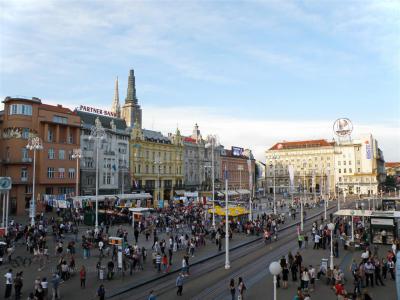
10) Ban Jelačić Square (must see)
Ban Jelačić Square forms the central gathering point of Zagreb. The square takes its name from Josip Jelačić, a 19th-century governor remembered for his role in resisting Hungarian authority within the Habsburg Monarchy. His equestrian statue, erected in the 19th century, remains the square’s focal point, though it has had a complex history: removed in 1947 by Communist authorities—who renamed the space Republic Square—it was returned in 1990 as Croatia moved toward independence.
The square’s origins date to 1641, when a new marketplace was established outside the medieval cores of Gradec and Kaptol, near the Manduševac spring. Initially known as Manduševac, it later became Harmica which means "thirtieth”. Historically, the square was the place where merchants paid a tax of about 1/30 levied on goods brought into a town In 1848, it was renamed Ban Jelačić Square. Over time, it developed into Zagreb’s main commercial and social hub, framed by buildings that reflect a mix of Classicist, Secessionist, and Modernist styles.
In the late 20th century, the square underwent significant transformation. Ahead of the 1987 World University Games, it was repaved with stone blocks and pedestrianized, while the Manduševac Fountain—whose spring had been buried in 1898—was uncovered and restored.
Splavnica Street can be found on the northern side of the square and it leads to Dolac Market. The market is easily recognized by its rows of red umbrellas, where locals shop for fresh produce, cheese, and flowers. Throughout the year, the square functions as a lively urban stage, but in winter it takes on a more festive character, with Christmas trees and lights illuminating the surrounding façades.
The square’s origins date to 1641, when a new marketplace was established outside the medieval cores of Gradec and Kaptol, near the Manduševac spring. Initially known as Manduševac, it later became Harmica which means "thirtieth”. Historically, the square was the place where merchants paid a tax of about 1/30 levied on goods brought into a town In 1848, it was renamed Ban Jelačić Square. Over time, it developed into Zagreb’s main commercial and social hub, framed by buildings that reflect a mix of Classicist, Secessionist, and Modernist styles.
In the late 20th century, the square underwent significant transformation. Ahead of the 1987 World University Games, it was repaved with stone blocks and pedestrianized, while the Manduševac Fountain—whose spring had been buried in 1898—was uncovered and restored.
Splavnica Street can be found on the northern side of the square and it leads to Dolac Market. The market is easily recognized by its rows of red umbrellas, where locals shop for fresh produce, cheese, and flowers. Throughout the year, the square functions as a lively urban stage, but in winter it takes on a more festive character, with Christmas trees and lights illuminating the surrounding façades.
