Custom Walk in Aberdeen, Scotland by arthurs6_575c7 created on 2025-04-26
Guide Location: Scotland » Aberdeen
Guide Type: Custom Walk
# of Sights: 6
Tour Duration: 5 Hour(s)
Travel Distance: 12.1 Km or 7.5 Miles
Share Key: PSNN4
Guide Type: Custom Walk
# of Sights: 6
Tour Duration: 5 Hour(s)
Travel Distance: 12.1 Km or 7.5 Miles
Share Key: PSNN4
How It Works
Please retrieve this walk in the GPSmyCity app. Once done, the app will guide you from one tour stop to the next as if you had a personal tour guide. If you created the walk on this website or come to the page via a link, please follow the instructions below to retrieve the walk in the app.
Retrieve This Walk in App
Step 1. Download the app "GPSmyCity: Walks in 1K+ Cities" on Apple App Store or Google Play Store.



Step 2. In the GPSmyCity app, download(or launch) the guide "Aberdeen Map and Walking Tours".
Step 3. Tap the menu button located at upper right corner of the "Walks" screen and select "Retrieve custom walk". Enter the share key: PSNN4
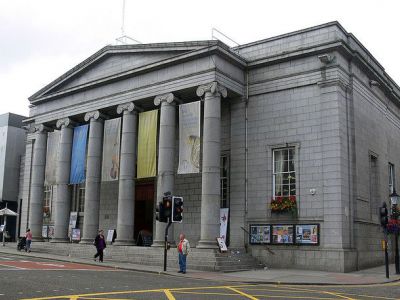
1) Aberdeen Music Hall (must see)
The Aberdeen Music Hall, located on Union Street in the heart of the city, is one of Scotland’s oldest and most significant concert venues. Originally designed as the Assembly Rooms by renowned Aberdeen architect Archibald Simpson in 1820, the building was completed in 1822. It transformed into a concert hall in 1859 and has since been a cornerstone of Aberdeen's cultural scene. A historic venue, the Music Hall hosted Aberdeen’s first cinema screening in September 1896. It also houses a bronze plaque memorializing the citizens of Aberdeen who served in the Spanish Civil War.
The Music Hall reopened in 2018 after undergoing a major redevelopment. Its main auditorium, known for its excellent acoustics, seats 1,300 and regularly welcomes performances by the Royal Scottish National Orchestra, the Scottish Chamber Orchestra, and the BBC Scottish Symphony Orchestra. The venue also plays host to the Aberdeen International Youth Festival and a variety of pop and rock acts, having seen performances by icons like David Bowie, Emeli Sandé, Led Zeppelin, and Iron Maiden.
In addition to the main auditorium, the Music Hall features two smaller spaces, the Big Sky Studio and the Tutti Creative Learning Studio, offering versatile spaces for events and community engagement. Operated by Aberdeen Performing Arts, alongside His Majesty's Theatre and The Lemon Tree, the Music Hall continues to serve as a vital hub for concerts, comedy shows, and cultural events, embodying nearly 200 years of Aberdeen's rich musical and community life.
The Music Hall reopened in 2018 after undergoing a major redevelopment. Its main auditorium, known for its excellent acoustics, seats 1,300 and regularly welcomes performances by the Royal Scottish National Orchestra, the Scottish Chamber Orchestra, and the BBC Scottish Symphony Orchestra. The venue also plays host to the Aberdeen International Youth Festival and a variety of pop and rock acts, having seen performances by icons like David Bowie, Emeli Sandé, Led Zeppelin, and Iron Maiden.
In addition to the main auditorium, the Music Hall features two smaller spaces, the Big Sky Studio and the Tutti Creative Learning Studio, offering versatile spaces for events and community engagement. Operated by Aberdeen Performing Arts, alongside His Majesty's Theatre and The Lemon Tree, the Music Hall continues to serve as a vital hub for concerts, comedy shows, and cultural events, embodying nearly 200 years of Aberdeen's rich musical and community life.
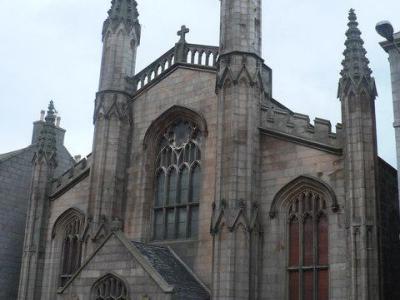
2) Cathedral Church of Saint Andrew
The Cathedral Church of Saint Andrew, also known as Saint Andrew's Cathedral, is an important landmark in Aberdeen. It serves as the seat of the Bishop of Aberdeen and Orkney within the Scottish Episcopal Church, making it the focal point of the Diocese of Aberdeen and Orkney. Originally opened in 1817 as Saint Andrew’s Chapel, the building was elevated to cathedral status in 1914. This Category A listed building is noted for its distinctive architectural history and its significance in the religious landscape of Aberdeen.
The original structure, designed by renowned Aberdeen architect Archibald Simpson, showcases the perpendicular Gothic style. While much of the building is constructed from the local granite, typical of Aberdeen’s architecture, the front façade facing King Street was built from sandstone for economic reasons. Despite Simpson’s opposition to the use of sandstone, this choice has become a defining feature of the cathedral. Over time, the building saw significant additions, including a chancel by George Edmund Street in 1880 and a porch by Robert Lorimer in 1911.
The cathedral holds historical importance as the site is closely linked to the consecration of Samuel Seabury, the first bishop of the Episcopal Church in the United States, who was ordained in Aberdeen in 1784. His consecration, performed by Robert Kilgour, Bishop of Aberdeen, and other bishops, took place in an upper room of a house near the present cathedral. This event is commemorated by a granite plaque on the wall of Marischal College.
In the 1930s, renovations for the 150th anniversary of Seabury’s consecration expanded the cathedral, with architect Ninian Comper adding ornate designs like a vaulted ceiling and gold-painted baldachino. The Kennedy family, including Joseph and John F. Kennedy, attended the opening of an extension in 1938. Originally Anglo-Catholic, the cathedral saw liturgical reforms in the 1980s under Provost Donald Howard, making worship more inclusive. Today, Saint Andrew’s Cathedral honors its history while evolving in its practices.
The original structure, designed by renowned Aberdeen architect Archibald Simpson, showcases the perpendicular Gothic style. While much of the building is constructed from the local granite, typical of Aberdeen’s architecture, the front façade facing King Street was built from sandstone for economic reasons. Despite Simpson’s opposition to the use of sandstone, this choice has become a defining feature of the cathedral. Over time, the building saw significant additions, including a chancel by George Edmund Street in 1880 and a porch by Robert Lorimer in 1911.
The cathedral holds historical importance as the site is closely linked to the consecration of Samuel Seabury, the first bishop of the Episcopal Church in the United States, who was ordained in Aberdeen in 1784. His consecration, performed by Robert Kilgour, Bishop of Aberdeen, and other bishops, took place in an upper room of a house near the present cathedral. This event is commemorated by a granite plaque on the wall of Marischal College.
In the 1930s, renovations for the 150th anniversary of Seabury’s consecration expanded the cathedral, with architect Ninian Comper adding ornate designs like a vaulted ceiling and gold-painted baldachino. The Kennedy family, including Joseph and John F. Kennedy, attended the opening of an extension in 1938. Originally Anglo-Catholic, the cathedral saw liturgical reforms in the 1980s under Provost Donald Howard, making worship more inclusive. Today, Saint Andrew’s Cathedral honors its history while evolving in its practices.
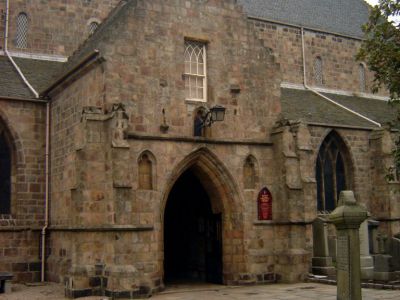
3) St. Machar's Cathedral (must see)
Saint Machar's Cathedral, sometimes called Old Machar, is a Church of Scotland church. The church is named in honor of Saint Machar who was said to have accompanied Saint Columba on his travel to Iona. The legend states that, on this journey, God told Machar to establish a church at the River Don. Saint Machar is said to have founded the church in the year 580.
A cathedral was built on this site in 1131. It was replaced in 1290 with the current Early English style building. Work continued on the cathedral for more than 150 years before it was fully functional. During that time, a quarter of Sir William Wallace's remains were interred in the walls of the cathedral. The church was finally completed in 1530.
Visitors to the church will find a stone interior with massive gothic archways. There are multiple stained glass windows throughout the church with dates that range from 1870s to 1970s. The Sanctuary Cross in the south aisle is a conglomerate from a 21st century shaft and a 12th century head. The Barbour Tryptich, made from wood, was created by Roland Fraser in 1997.
The three effigies are some of the most striking features of the church. These effigies represent three clerics that date to the 1400s. They were previously held outside of the church but were moved to the interior during one of the many restoration projects.
A number of notable Scottish individuals have been interred on the church grounds and inside the building itself. Along with William Wallace, some of these burials include John Joy Bell, James Edward Crombie, George Dickie and David Gill.
Why You Should Visit:
See the beautiful stained glass cathedral, enjoy the English and gothic architecture, and pay respects to some of Scotland's most notable individuals.
A cathedral was built on this site in 1131. It was replaced in 1290 with the current Early English style building. Work continued on the cathedral for more than 150 years before it was fully functional. During that time, a quarter of Sir William Wallace's remains were interred in the walls of the cathedral. The church was finally completed in 1530.
Visitors to the church will find a stone interior with massive gothic archways. There are multiple stained glass windows throughout the church with dates that range from 1870s to 1970s. The Sanctuary Cross in the south aisle is a conglomerate from a 21st century shaft and a 12th century head. The Barbour Tryptich, made from wood, was created by Roland Fraser in 1997.
The three effigies are some of the most striking features of the church. These effigies represent three clerics that date to the 1400s. They were previously held outside of the church but were moved to the interior during one of the many restoration projects.
A number of notable Scottish individuals have been interred on the church grounds and inside the building itself. Along with William Wallace, some of these burials include John Joy Bell, James Edward Crombie, George Dickie and David Gill.
Why You Should Visit:
See the beautiful stained glass cathedral, enjoy the English and gothic architecture, and pay respects to some of Scotland's most notable individuals.
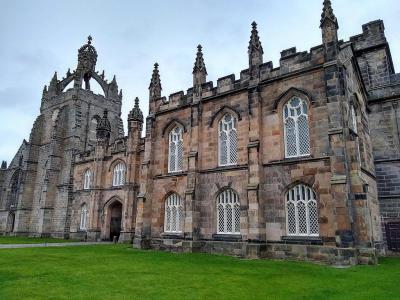
4) King's College Chapel
The King’s College Chapel in Aberdeen is a central part of the University of Aberdeen's historical landscape. Founded in 1495 as the University and King’s College of Aberdeen, this formerly independent institution is now a key part of the University of Aberdeen, with its most iconic structure being the late 15th-century King's College Chapel. Situated in Old Aberdeen, this chapel stands as the focal point of the King’s College campus, with its construction beginning in 1498 and concluding with its consecration in 1509.
The chapel’s most remarkable feature is its Crown Tower, a distinctive architectural element that has become symbolic of the university itself. The chapel is dedicated to the Trinity and the Blessed Virgin Mary, with its name also paying tribute to King James IV of Scotland, the institution’s principal patron. Inside, the chapel holds one of the most complete medieval church interiors in Scotland, notably featuring 16th-century choir stalls and a rood screen dating from around 1509.
Serving as more than just a place of worship, since 1928, the ante-chapel has acted as a war memorial for the university, commemorating 524 students who lost their lives in the First and Second World Wars. The chapel also holds historical significance as the burial site of the college’s founder, Bishop Elphinstone, and its first principal, Hector Boece, although the exact location of Elphinstone’s body remains a mystery. The chapel’s design, inspired by Solomon’s Temple, gives it a unique place in both religious and academic history.
The chapel’s most remarkable feature is its Crown Tower, a distinctive architectural element that has become symbolic of the university itself. The chapel is dedicated to the Trinity and the Blessed Virgin Mary, with its name also paying tribute to King James IV of Scotland, the institution’s principal patron. Inside, the chapel holds one of the most complete medieval church interiors in Scotland, notably featuring 16th-century choir stalls and a rood screen dating from around 1509.
Serving as more than just a place of worship, since 1928, the ante-chapel has acted as a war memorial for the university, commemorating 524 students who lost their lives in the First and Second World Wars. The chapel also holds historical significance as the burial site of the college’s founder, Bishop Elphinstone, and its first principal, Hector Boece, although the exact location of Elphinstone’s body remains a mystery. The chapel’s design, inspired by Solomon’s Temple, gives it a unique place in both religious and academic history.
5) His Majesty's Theatre (must see)
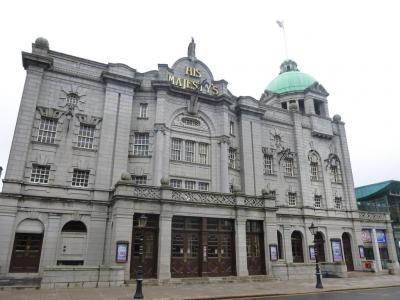
His Majesty's Theatre opened in 1906. The granite building was designed by Frank Matcham in the Free Renaissance architectural style. The four-story theatre has a copper domed tower and a Tragedy and Comedy statue.
His Majesty's Theatre underwent a significant refurbishment in 1999. Along with new seats and backstage facilities, it was granted a new box office, bars that are open for pre-show drinks, a cafe and a restaurant.
Though it originally held more than 2,300 seats, it remains the largest theatre in Aberdeen with a seating capacity of more than 1,400. It regularly hosts touring companies, international performing artists and local acts. Along with the Music Hall, His Majesty's Theatre hosts the annual Aberdeen International Youth Festival.
Tourists can visit His Majesty's Theatre in person during box office hours. The box office is open from 10 AM to 6 PM on Tuesday through Saturday. It is also open one hour before each show is scheduled to start.
His Majesty's Theatre underwent a significant refurbishment in 1999. Along with new seats and backstage facilities, it was granted a new box office, bars that are open for pre-show drinks, a cafe and a restaurant.
Though it originally held more than 2,300 seats, it remains the largest theatre in Aberdeen with a seating capacity of more than 1,400. It regularly hosts touring companies, international performing artists and local acts. Along with the Music Hall, His Majesty's Theatre hosts the annual Aberdeen International Youth Festival.
Tourists can visit His Majesty's Theatre in person during box office hours. The box office is open from 10 AM to 6 PM on Tuesday through Saturday. It is also open one hour before each show is scheduled to start.
6) The Gordon Highlanders Museum (must see)
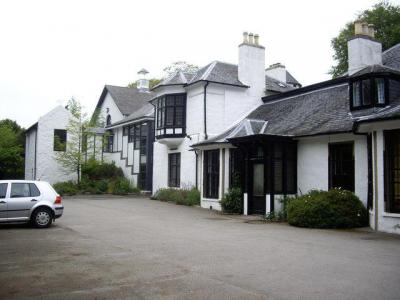
The Gordon Highlanders Museum, located in Aberdeen, commemorates the storied history of the Gordon Highlanders regiment. The regiment, originally founded in 1794 as the 92nd (Gordon Highlanders) Regiment of Foot, merged with the 75th (Stirlingshire) Regiment of Foot in 1881 to form the Gordon Highlanders, and in 1994 was amalgamated into a larger British Army unit. The museum, a 5-star Scottish Tourist Board attraction, is housed in a 19th-century residence once owned by Scottish artist Sir George Reid. Purchased by Reid in 1867, the house was later acquired by the War Office in 1960 to serve as the regiment's headquarters. After being transferred to the regiment’s trustees in 1994, it was expanded and reopened as a museum in 1997.
Nestled near a stream on Viewfield Road, the museum offers visitors a mix of historical displays and serene settings. Its grounds include a volunteer-maintained garden and a tea room, both of which can be rented for events. Inside, visitors can explore the main gallery (the Grant Room), an armory showcasing weapons, a mock-up of the Regimental Officers' Mess, and a Silver Room. The museum also features temporary exhibitions, with works by Sir George Reid on loan from Aberdeen Art Gallery.
A notable addition in 2019 was the Moffat Trench, a replica of a First World War trench, which led to a 50% increase in visitor numbers and earned a tourism award. The museum was also featured as one of the locations in the 2019 Aberdeen edition of Monopoly.
Nestled near a stream on Viewfield Road, the museum offers visitors a mix of historical displays and serene settings. Its grounds include a volunteer-maintained garden and a tea room, both of which can be rented for events. Inside, visitors can explore the main gallery (the Grant Room), an armory showcasing weapons, a mock-up of the Regimental Officers' Mess, and a Silver Room. The museum also features temporary exhibitions, with works by Sir George Reid on loan from Aberdeen Art Gallery.
A notable addition in 2019 was the Moffat Trench, a replica of a First World War trench, which led to a 50% increase in visitor numbers and earned a tourism award. The museum was also featured as one of the locations in the 2019 Aberdeen edition of Monopoly.
