Custom Walk in Marseille, France by somesy2526 created on 2025-05-05
Guide Location: France » Marseille
Guide Type: Custom Walk
# of Sights: 5
Tour Duration: 5 Hour(s)
Travel Distance: 12.4 Km or 7.7 Miles
Share Key: ZUXZV
Guide Type: Custom Walk
# of Sights: 5
Tour Duration: 5 Hour(s)
Travel Distance: 12.4 Km or 7.7 Miles
Share Key: ZUXZV
How It Works
Please retrieve this walk in the GPSmyCity app. Once done, the app will guide you from one tour stop to the next as if you had a personal tour guide. If you created the walk on this website or come to the page via a link, please follow the instructions below to retrieve the walk in the app.
Retrieve This Walk in App
Step 1. Download the app "GPSmyCity: Walks in 1K+ Cities" on Apple App Store or Google Play Store.



Step 2. In the GPSmyCity app, download(or launch) the guide "Marseille Map and Walking Tours".
Step 3. Tap the menu button located at upper right corner of the "Walks" screen and select "Retrieve custom walk". Enter the share key: ZUXZV
1) Vieux-Port (Old Port) (must see)
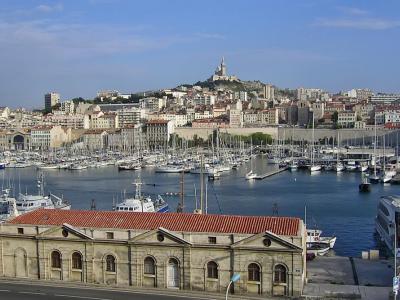
The Old Port is the city’s historic heart and one of the most evocative harbours in Europe, being a centre of maritime life for over 2,600 years. The site was first used as a trading post by the Phoenicians, long before the Greek settlers from Phocaea officially established it in 600 BCE as the port of Massalia, making it the birthplace of the city itself.
Through the centuries, the Old Port became a hub of Mediterranean commerce and naval activity. Kings Louis XII and Louis XIII expanded the shipyards in the 15th and 16th centuries, while King Louis XIV added the imposing Fort Saint John and Fort Saint Nicholas to defend the entrance of the harbour. The port reached its commercial peak in the 19th century, when up to 18,000 merchant vessels docked here annually, rivaling the activity of major ports such as Liverpool and Le Havre. However, with the arrival of large steamships that required deeper waters, Marseille shifted much of its industrial trade to the Port of La Joliette, located farther north.
The Old Port suffered immense damage during World War II, when German forces, assisted by French police, demolished much of the area to block access to Allied troops. Postwar reconstruction reshaped the district, and by the late 20th century, major urban renewal projects restored the port’s vitality. Architect Norman Foster’s redesign, featuring the The Shade Pavilion, a mirrored canopy that reflects the harbour below, marked a new era of pedestrian-friendly space and modern elegance.
Today, the Port serves as a marina for yachts, ferries, and fishing boats, as well as the site of a daily fish market that preserves centuries-old local tradition. Lined with cafés, restaurants, and open-air terraces, it remains a favourite gathering place for both locals and visitors.
Through the centuries, the Old Port became a hub of Mediterranean commerce and naval activity. Kings Louis XII and Louis XIII expanded the shipyards in the 15th and 16th centuries, while King Louis XIV added the imposing Fort Saint John and Fort Saint Nicholas to defend the entrance of the harbour. The port reached its commercial peak in the 19th century, when up to 18,000 merchant vessels docked here annually, rivaling the activity of major ports such as Liverpool and Le Havre. However, with the arrival of large steamships that required deeper waters, Marseille shifted much of its industrial trade to the Port of La Joliette, located farther north.
The Old Port suffered immense damage during World War II, when German forces, assisted by French police, demolished much of the area to block access to Allied troops. Postwar reconstruction reshaped the district, and by the late 20th century, major urban renewal projects restored the port’s vitality. Architect Norman Foster’s redesign, featuring the The Shade Pavilion, a mirrored canopy that reflects the harbour below, marked a new era of pedestrian-friendly space and modern elegance.
Today, the Port serves as a marina for yachts, ferries, and fishing boats, as well as the site of a daily fish market that preserves centuries-old local tradition. Lined with cafés, restaurants, and open-air terraces, it remains a favourite gathering place for both locals and visitors.
2) Cathédrale de la Major (Marseille Cathedral) (must see)
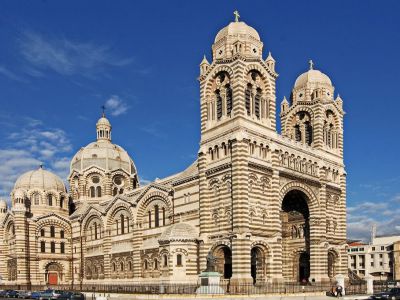
The Marseille Cathedral, also known as the Cathedral of Saint Mary Major, unites two eras of faith and architecture. The site includes both the Old Marseille Cathedral, dating to the 12th century, and the New Marseille Cathedral, constructed under Emperor Napoleon III in the late 19th century. Napoleon ordered the older Provençal Romanesque building replaced but preserved part of it—the choir and one bay of the nave—after public protests over its demolition.
The New Marseille Cathedral dominates the waterfront with its vast Romanesque-Byzantine Revival design. Stretching 469 feet in length, with a main dome reaching 231 feet in height, it can hold about 3,000 worshippers. Its façade alternates bands of white and dark stone, a combination of Florentine limestone and Ligurian green porphyry, producing a striped pattern affectionately nicknamed “the Pajamas” by locals. Inside, the cathedral reveals a rich blend of imported materials: white Carrara marble from Italy, onyx from Tunisia, and dazzling Venetian mosaics that illuminate its chapels and domes.
Beside this grand 19th-century structure lie the remains of the Old Cathedral, a humble yet evocative remnant of Marseille’s medieval heritage. The surviving chancel and apse feature smaller side chapels and a cylindrical vault crowned with octagonal and heptagonal domes. Archaeological traces beneath the site even reveal earlier Christian structures dating to the 5th century, showing that this location has been a place of worship for over fifteen centuries.
A visit to Marseille Cathedral offers not just architectural splendor but also some of the best panoramic views of the port and the Mediterranean. Rising between sea and city, the cathedral stands as both a symbol of continuity and a beacon of faith—undeniably one of Marseille’s must-see attractions.
The New Marseille Cathedral dominates the waterfront with its vast Romanesque-Byzantine Revival design. Stretching 469 feet in length, with a main dome reaching 231 feet in height, it can hold about 3,000 worshippers. Its façade alternates bands of white and dark stone, a combination of Florentine limestone and Ligurian green porphyry, producing a striped pattern affectionately nicknamed “the Pajamas” by locals. Inside, the cathedral reveals a rich blend of imported materials: white Carrara marble from Italy, onyx from Tunisia, and dazzling Venetian mosaics that illuminate its chapels and domes.
Beside this grand 19th-century structure lie the remains of the Old Cathedral, a humble yet evocative remnant of Marseille’s medieval heritage. The surviving chancel and apse feature smaller side chapels and a cylindrical vault crowned with octagonal and heptagonal domes. Archaeological traces beneath the site even reveal earlier Christian structures dating to the 5th century, showing that this location has been a place of worship for over fifteen centuries.
A visit to Marseille Cathedral offers not just architectural splendor but also some of the best panoramic views of the port and the Mediterranean. Rising between sea and city, the cathedral stands as both a symbol of continuity and a beacon of faith—undeniably one of Marseille’s must-see attractions.
3) Abbaye Saint-Victor (Saint-Victor Abbey) (must see)
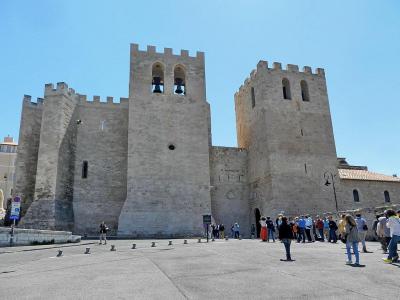
Overlooking the sea stands the Saint-Victor Abbey, a historic monastery that has occupied this site since around 415 CE, being among the first Christian sanctuaries established in Provence. Tradition holds that it was founded by the monk John Cassian, and some believe the crypt contains relics of Saint Victor himself—or even traces of an ancient Greek quarry.
Cassian originally established two monasteries here, one for men and one for women, on opposite sides of the old harbor. Both were destroyed by Saracen raiders in the 8th or 9th centuries, but monastic life resumed in 977. The abbey flourished for several centuries before being stripped of its treasures during the French Revolution in 1794. At various times it served as a warehouse, prison, and barracks, before being restored under Napoleon. In 1934, Pope Pius XI elevated it to the rank of minor basilica following extensive renovation.
Visitors find tombs of saints and bishops, alongside pagan sarcophagi from the early Christian period. Above, the abbey’s crenelated towers offer panoramic views over the harbor and the Mediterranean. Its elevated position near Fort Saint Nicholas once allowed monks to watch for approaching Saracen or Viking ships. Each year on Candlemas, a traditional pilgrimage takes place from the Old Port to the abbey. The Black Madonna, normally kept in the crypt, is wrapped in a green cloak and carried to the square before the church, where she receives a blessing from the bishop.
Tip: It’s worth paying the small entrance fee to visit the crypt—it truly feels like entering another world.
Cassian originally established two monasteries here, one for men and one for women, on opposite sides of the old harbor. Both were destroyed by Saracen raiders in the 8th or 9th centuries, but monastic life resumed in 977. The abbey flourished for several centuries before being stripped of its treasures during the French Revolution in 1794. At various times it served as a warehouse, prison, and barracks, before being restored under Napoleon. In 1934, Pope Pius XI elevated it to the rank of minor basilica following extensive renovation.
Visitors find tombs of saints and bishops, alongside pagan sarcophagi from the early Christian period. Above, the abbey’s crenelated towers offer panoramic views over the harbor and the Mediterranean. Its elevated position near Fort Saint Nicholas once allowed monks to watch for approaching Saracen or Viking ships. Each year on Candlemas, a traditional pilgrimage takes place from the Old Port to the abbey. The Black Madonna, normally kept in the crypt, is wrapped in a green cloak and carried to the square before the church, where she receives a blessing from the bishop.
Tip: It’s worth paying the small entrance fee to visit the crypt—it truly feels like entering another world.
4) Notre-Dame de la Garde (must see)
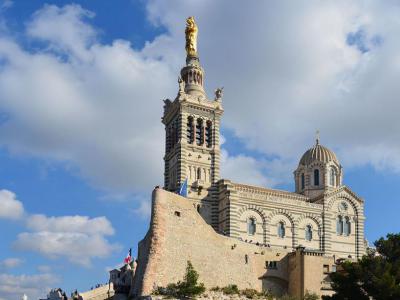
Notre-Dame de la Garde stands proudly as an opulent Neo-Byzantine church situated atop the highest natural point in Marseille, perched upon a 532 feet limestone outcrop on the south side of the Old Port. This majestic site has become a cherished destination for an annual pilgrimage on Assumption Day.
Conceived by the talented architect Henri-Jacques Espérandieu, the basilica received its consecration on the 5th of June in 1864. Its origins trace back to a church with the same name, first erected in 1214 and later reconstructed during the 15th century. Remarkably, the basilica's foundations rest upon a 16th-century fortress built by Francis I of France to fend off Emperor Charles V's siege of the city in 1536.
The basilica comprises two distinct sections: a lower church or crypt, artistically carved into the rock in the Romanesque style, and an upper church boasting Neo-Byzantine elegance adorned with breathtaking mosaics. Towering above is a square bell-tower, reaching a height of 135 feet, crowned with a belfry standing at 42 feet. At its peak, a monumental statue of the Madonna and Child, crafted from copper gilded with gold leaf, soars to an impressive 27 feet.
During its history, the basilica encountered challenges, particularly regarding the stone used in its construction, which proved susceptible to atmospheric corrosion. In response, extensive restoration work took place from 2001 to 2008. This effort encompassed the meticulous repair of the mosaics, damaged by candle smoke over the years, as well as by bullets during the Liberation of France at the end of World War II.
Conceived by the talented architect Henri-Jacques Espérandieu, the basilica received its consecration on the 5th of June in 1864. Its origins trace back to a church with the same name, first erected in 1214 and later reconstructed during the 15th century. Remarkably, the basilica's foundations rest upon a 16th-century fortress built by Francis I of France to fend off Emperor Charles V's siege of the city in 1536.
The basilica comprises two distinct sections: a lower church or crypt, artistically carved into the rock in the Romanesque style, and an upper church boasting Neo-Byzantine elegance adorned with breathtaking mosaics. Towering above is a square bell-tower, reaching a height of 135 feet, crowned with a belfry standing at 42 feet. At its peak, a monumental statue of the Madonna and Child, crafted from copper gilded with gold leaf, soars to an impressive 27 feet.
During its history, the basilica encountered challenges, particularly regarding the stone used in its construction, which proved susceptible to atmospheric corrosion. In response, extensive restoration work took place from 2001 to 2008. This effort encompassed the meticulous repair of the mosaics, damaged by candle smoke over the years, as well as by bullets during the Liberation of France at the end of World War II.
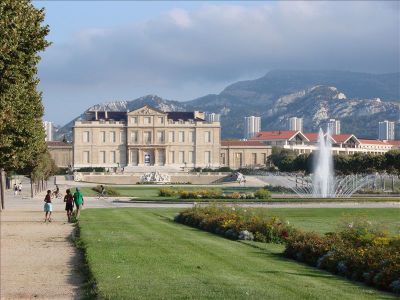
5) Parc Borély (must see)
Borély Park, a public municipal park, holds the prestigious title of being one of the Notable Gardens of France, designated by the French Ministry of Culture. This exquisite park spans an impressive 17 hectares and comprises three distinct and enchanting gardens.
Its origins trace back to the 17th century when Joseph Borely, a French ship owner and merchant, purchased land in the picturesque area of Bonneveine, Marseille, with the intention of establishing a country house. Eventually, the domain was inherited by Louis-Joseph Borély in 1770, who then enlisted the renowned landscape architect Embry to create a magnificent Garden à la française.
In the 19th century, the property changed hands, passing first to Paulin Talabot, the director of the pioneering PLM railroad that connected Paris to Marseille, before being acquired by the city of Marseille.
Under the city's guidance, the eminent landscape architect Adolphe Alphande was entrusted to design a park with three distinct sections: a charming French garden, an idyllic English landscape park, and a horse racing track along the seaside. Several wooden pavilions were skillfully erected, with one remaining today - the former pavilion by the lake, which once served as the botanical laboratory of the Institut Colonial.
During the late 19th and early 20th centuries, Borély Park also served as a botanical garden, a role later moved to an adjacent site. In 2002, a splendid two-hectare promenade was added, beautifully linking the park with the nearby sea.
Its origins trace back to the 17th century when Joseph Borely, a French ship owner and merchant, purchased land in the picturesque area of Bonneveine, Marseille, with the intention of establishing a country house. Eventually, the domain was inherited by Louis-Joseph Borély in 1770, who then enlisted the renowned landscape architect Embry to create a magnificent Garden à la française.
In the 19th century, the property changed hands, passing first to Paulin Talabot, the director of the pioneering PLM railroad that connected Paris to Marseille, before being acquired by the city of Marseille.
Under the city's guidance, the eminent landscape architect Adolphe Alphande was entrusted to design a park with three distinct sections: a charming French garden, an idyllic English landscape park, and a horse racing track along the seaside. Several wooden pavilions were skillfully erected, with one remaining today - the former pavilion by the lake, which once served as the botanical laboratory of the Institut Colonial.
During the late 19th and early 20th centuries, Borély Park also served as a botanical garden, a role later moved to an adjacent site. In 2002, a splendid two-hectare promenade was added, beautifully linking the park with the nearby sea.
