Custom Walk in Seville, Spain by corlin3_4689f created on 2025-05-11
Guide Location: Spain » Seville
Guide Type: Custom Walk
# of Sights: 15
Tour Duration: 4 Hour(s)
Travel Distance: 6.6 Km or 4.1 Miles
Share Key: L27M6
Guide Type: Custom Walk
# of Sights: 15
Tour Duration: 4 Hour(s)
Travel Distance: 6.6 Km or 4.1 Miles
Share Key: L27M6
How It Works
Please retrieve this walk in the GPSmyCity app. Once done, the app will guide you from one tour stop to the next as if you had a personal tour guide. If you created the walk on this website or come to the page via a link, please follow the instructions below to retrieve the walk in the app.
Retrieve This Walk in App
Step 1. Download the app "GPSmyCity: Walks in 1K+ Cities" on Apple App Store or Google Play Store.



Step 2. In the GPSmyCity app, download(or launch) the guide "Seville Map and Walking Tours".
Step 3. Tap the menu button located at upper right corner of the "Walks" screen and select "Retrieve custom walk". Enter the share key: L27M6
1) Casco Antiguo
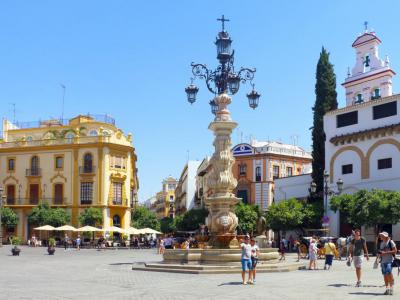
The Casco Antiguo, which translates to "Ancient District" in Spanish, is the central district of Seville. This historic area encompasses Seville's old town and is situated on the eastern bank of the Guadalquivir river. It shares boundaries with the Macarena district to the north, Nervión and San Pablo-Santa Justa districts to the east, and the Distrito Sur to the south. Several bridges spanning the Guadalquivir connect the Casco Antiguo to neighborhoods like Los Remedios, Triana, and La Cartuja.
Within this district, you can find three UNESCO World Heritage Sites: the Seville Cathedral, the Alcazar, and the Archivo General de Indias. The Gothic Cathedral, constructed in 1403, was built on the site of a former mosque, preserving the Almohad minaret, known as the Giralda, as its bell tower. It stands as the largest Gothic building in Europe and serves as the resting place of Christopher Columbus. The Alcázar, originally built by the Moors in 712, underwent conversion into a Christian royal residence in 1248. The Archive of the Indies, envisioned as a hub for American treasures' trade by Juan de Herrera under King Philip II of Spain's directive, never fulfilled that purpose. In 1784, King Charles III of Spain designated it as the repository for all documents related to the Americas' conquest.
Other notable structures in this district include the Torre del Oro, the City Hall, the Palace of San Telmo, and the Metropol Parasol. The University of Seville primarily occupies the former Royal Tobacco Factory in the southern part of the Casco Antiguo, which serves as the backdrop for the story and opera Carmen. Additionally, the city's bullring is located in the El Arenal neighborhood.
Within this district, you can find three UNESCO World Heritage Sites: the Seville Cathedral, the Alcazar, and the Archivo General de Indias. The Gothic Cathedral, constructed in 1403, was built on the site of a former mosque, preserving the Almohad minaret, known as the Giralda, as its bell tower. It stands as the largest Gothic building in Europe and serves as the resting place of Christopher Columbus. The Alcázar, originally built by the Moors in 712, underwent conversion into a Christian royal residence in 1248. The Archive of the Indies, envisioned as a hub for American treasures' trade by Juan de Herrera under King Philip II of Spain's directive, never fulfilled that purpose. In 1784, King Charles III of Spain designated it as the repository for all documents related to the Americas' conquest.
Other notable structures in this district include the Torre del Oro, the City Hall, the Palace of San Telmo, and the Metropol Parasol. The University of Seville primarily occupies the former Royal Tobacco Factory in the southern part of the Casco Antiguo, which serves as the backdrop for the story and opera Carmen. Additionally, the city's bullring is located in the El Arenal neighborhood.
2) Palacio Arzobispal (Archbishop's Palace)
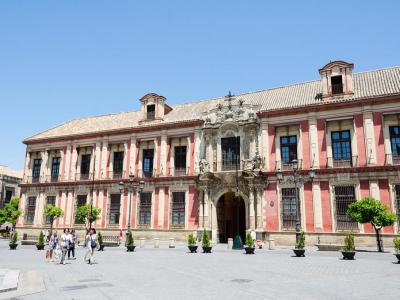
The Archbishop's Palace or El Palacio Arzobispal in Seville has served as the residence of bishops and archbishops of the episcopal sees and numerous nobleman and military figures to the present time. Of Spanish Baroque architectural style, it is impressive both for its architectural beauty as for its colorful character and has had the status of National Monument since 1969.
After many years of very restricted access, you can now visit the interior of this artistic gem of Seville. The palace has an important artistic heritage consisting of paintings and sculptures from the Seville Baroque period, spread through the palace, surpassed only in Seville by the Museum of Fine Arts and the Seville Cathedral. The palace contains works by painters such as Francisco Herrera el Viejo, Francisco Pacheco, Zurbarán, Murillo, Antonio Palomino, and Juan de Espinal. There are also collections from the Italian and Dutch baroque schools.
Why You Should Visit:
A visit is worthwhile not only for the certainly impressive facade but also for the value of the palace's treasured pictorial works; however, note that all visits must be guided.
After many years of very restricted access, you can now visit the interior of this artistic gem of Seville. The palace has an important artistic heritage consisting of paintings and sculptures from the Seville Baroque period, spread through the palace, surpassed only in Seville by the Museum of Fine Arts and the Seville Cathedral. The palace contains works by painters such as Francisco Herrera el Viejo, Francisco Pacheco, Zurbarán, Murillo, Antonio Palomino, and Juan de Espinal. There are also collections from the Italian and Dutch baroque schools.
Why You Should Visit:
A visit is worthwhile not only for the certainly impressive facade but also for the value of the palace's treasured pictorial works; however, note that all visits must be guided.
3) Bar La Goleta
What to buy here: Orange wine
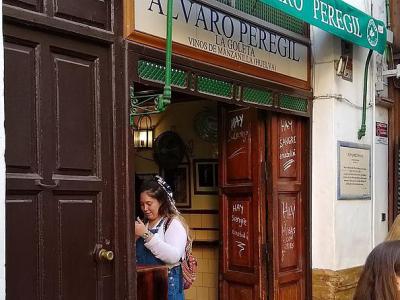
Seville’s orange trees provide jam to England, and a bittersweet vino de naranja for the rest of us. Though many tourist shops sell a similar product, Bar La Goleta, one of the city’s most famous, is owned by the son of flamenco singer Pepe Perejil and boasts the sweetest juice. Since he owns the exclusive rights to market and distribute the wine, he has made it popular with both the native and tourist crowds. Just steps from the Giralda tower, this cozy bar serves up typical tapas to compliment the wine, served in teeny glasses, and the bartenders are always up for a conversation.
Price: ¾ L bottle – 7€, 2L garafa – 12€.
Seville’s orange trees provide jam to England, and a bittersweet vino de naranja for the rest of us. Though many tourist shops sell a similar product, Bar La Goleta, one of the city’s most famous, is owned by the son of flamenco singer Pepe Perejil and boasts the sweetest juice. Since he owns the exclusive rights to market and distribute the wine, he has made it popular with both the native and tourist crowds. Just steps from the Giralda tower, this cozy bar serves up typical tapas to compliment the wine, served in teeny glasses, and the bartenders are always up for a conversation.
Price: ¾ L bottle – 7€, 2L garafa – 12€.
4) Universidad de Sevilla (University of Seville)
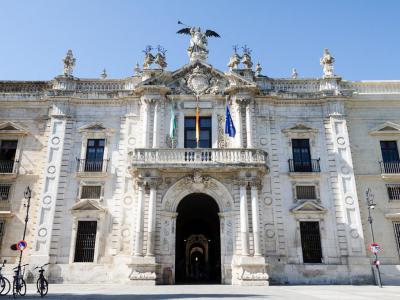
A short walk from the Spain Square we find an antique building. It is the former Royal Tobaco Factory. The old factory building is a grand example of renaissance style 18th century industrial architecture. Carmen, of Bizet's opera Carmen, worked here before she got her big break.
Royal Spain dominated the tobacco business in the New World and it took full advantage of the European captive market. In this building, for a while, every cigar in Europe was made. Its interiors have been preserved although adapted to University use. Its high vaulted ceilings, halls and courtyards offer a stunning visual experience.
In the 1950s the old factory was taken over by the University of Seville. It now houses the University's School of Literature and Philology and the School of Geography and History. Other campuses and buildings are in different locations around the city.
The University of Seville was created in the 15th century. It was originally called College of Santa Maria de Jesus and it became a true university in 1505 in a decree by Pope Julius II.
The university today is self governed and independent. The motto of the university is: "Equality, Liberty, Justice and Pluralism." Currently it has a student population of 65,000 and it is one of the top-ranked universities in the country.
Royal Spain dominated the tobacco business in the New World and it took full advantage of the European captive market. In this building, for a while, every cigar in Europe was made. Its interiors have been preserved although adapted to University use. Its high vaulted ceilings, halls and courtyards offer a stunning visual experience.
In the 1950s the old factory was taken over by the University of Seville. It now houses the University's School of Literature and Philology and the School of Geography and History. Other campuses and buildings are in different locations around the city.
The University of Seville was created in the 15th century. It was originally called College of Santa Maria de Jesus and it became a true university in 1505 in a decree by Pope Julius II.
The university today is self governed and independent. The motto of the university is: "Equality, Liberty, Justice and Pluralism." Currently it has a student population of 65,000 and it is one of the top-ranked universities in the country.
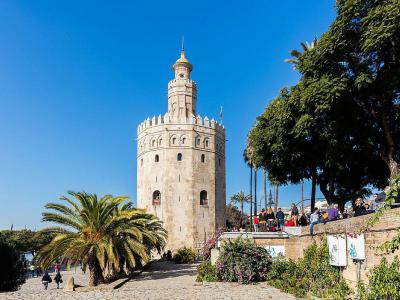
5) Torre del Oro (Gold Tower)
The Gold Tower, situated in Seville, is a twelve-sided military watchtower constructed by the Almohad dynasty to control access to Seville via the Guadalquivir river. It was built in the early 13th century and had a role as a prison during the Middle Ages. Its name originates from the radiant golden reflection it cast on the river, attributed to its construction materials, which consisted of a blend of mortar, lime, and compacted hay.
This tower is divided into three levels, with the third and uppermost level being circular in shape, added in 1769. Nearby, there is a smaller octagonal tower known as the Silver Tower, believed to have been built during the same era.
In recent centuries, the Gold Tower faced a threat when the adjacent road needed expansion. However, due to strong opposition from the local population, the idea of demolishing the tower was abandoned. In 1868, there was an attempt to sell it as scrap, but this proposal was also vehemently rejected by the city's residents. Today, the tower has been restored and serves as a naval museum, housing engravings, letters, models, instruments, and historical documents. The museum provides insights into the naval history of Seville and the significance of its river.
This tower is divided into three levels, with the third and uppermost level being circular in shape, added in 1769. Nearby, there is a smaller octagonal tower known as the Silver Tower, believed to have been built during the same era.
In recent centuries, the Gold Tower faced a threat when the adjacent road needed expansion. However, due to strong opposition from the local population, the idea of demolishing the tower was abandoned. In 1868, there was an attempt to sell it as scrap, but this proposal was also vehemently rejected by the city's residents. Today, the tower has been restored and serves as a naval museum, housing engravings, letters, models, instruments, and historical documents. The museum provides insights into the naval history of Seville and the significance of its river.

6) Plaza de toros de la Maestranza (Maestranza Bullring) (must see)
The Plaza de Toros de la Maestranza is Spain's oldest bullring and is associated with the Real Maestranza de Caballería de Sevilla, a venerable guild dedicated to traditional cavalry training. It serves as the venue for one of the world's most renowned bullfighting festivals during the annual Seville Fair in Seville.
The bullring itself is among the city's most popular tourist attractions, drawing a significant number of visitors. It is considered a particularly challenging arena for bullfighting due to its historical significance, unique features, and a demanding audience that is known to be unforgiving among bullfighting enthusiasts.
In Seville, bullfights during the Feria de Abril represent the highlight of the city's bullfighting calendar. The regular bullfighting season typically runs from March or April (depending on the dates of Semana Santa) until late September. Each year, the Real Maestranza commissions a painter to create a poster announcing the bullfighting season at its Royal Bullring.
Regular tours are available for visitors to explore the Bullring and its associated Museum, providing a genuine sense of what both the bull and the bullfighter experience. It's worth noting that you don't need to be a bullfighting enthusiast to find these tours and the history of the place intriguing.
Tip:
If you go on a Sunday to attend a bullfight, make sure you buy tickets in the shade. Don't bring huge hats – you'll probably be asked by irate patrons behind you to take it off since its blocking their view.
The bullring itself is among the city's most popular tourist attractions, drawing a significant number of visitors. It is considered a particularly challenging arena for bullfighting due to its historical significance, unique features, and a demanding audience that is known to be unforgiving among bullfighting enthusiasts.
In Seville, bullfights during the Feria de Abril represent the highlight of the city's bullfighting calendar. The regular bullfighting season typically runs from March or April (depending on the dates of Semana Santa) until late September. Each year, the Real Maestranza commissions a painter to create a poster announcing the bullfighting season at its Royal Bullring.
Regular tours are available for visitors to explore the Bullring and its associated Museum, providing a genuine sense of what both the bull and the bullfighter experience. It's worth noting that you don't need to be a bullfighting enthusiast to find these tours and the history of the place intriguing.
Tip:
If you go on a Sunday to attend a bullfight, make sure you buy tickets in the shade. Don't bring huge hats – you'll probably be asked by irate patrons behind you to take it off since its blocking their view.
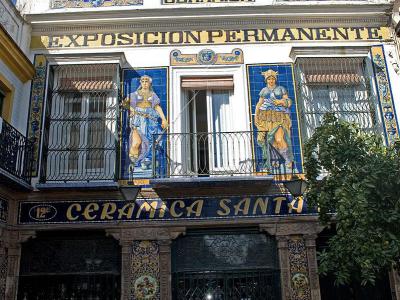
7) Ceramicá Santa Ana
What to buy here: Cartuja ceramics.
Seville’s Cartuja Monastery, now a world-class modern art museum, still stands witness to the large kilns used to fire the hand-crafted ceramics that emblazons the city. You’d be hard-pressed to find a traditional eatery in the city that didn’t have the iconic celosía tiles lining the perimeter of the establishment, and most Spanish homes have ceramic pieces decorating balconies, walls or even bathrooms. Taking home handcrafted ceramic makes a delicate yet gorgeous gift, and its practicality is appreciated on both sides of the Atlantic. You can pick up anything from a magnet to a set of bowls in blue, green, yellow and red hues, or even find a tile of the city’s patron saint, San Fernando.
While the Cartuja monastery gave the name to this time of handicraft, tile is no longer produced there. Instead, the small shops that cluster C/San Jorge and C/Antillano Campos produce, paint and fire their products in-house. Most shops offer the option of designing your own wares, but all will neatly pack up your purchase to ensure they don’t break on the trip back home. Price: 3€ - 100€ or more.
Seville’s Cartuja Monastery, now a world-class modern art museum, still stands witness to the large kilns used to fire the hand-crafted ceramics that emblazons the city. You’d be hard-pressed to find a traditional eatery in the city that didn’t have the iconic celosía tiles lining the perimeter of the establishment, and most Spanish homes have ceramic pieces decorating balconies, walls or even bathrooms. Taking home handcrafted ceramic makes a delicate yet gorgeous gift, and its practicality is appreciated on both sides of the Atlantic. You can pick up anything from a magnet to a set of bowls in blue, green, yellow and red hues, or even find a tile of the city’s patron saint, San Fernando.
While the Cartuja monastery gave the name to this time of handicraft, tile is no longer produced there. Instead, the small shops that cluster C/San Jorge and C/Antillano Campos produce, paint and fire their products in-house. Most shops offer the option of designing your own wares, but all will neatly pack up your purchase to ensure they don’t break on the trip back home. Price: 3€ - 100€ or more.
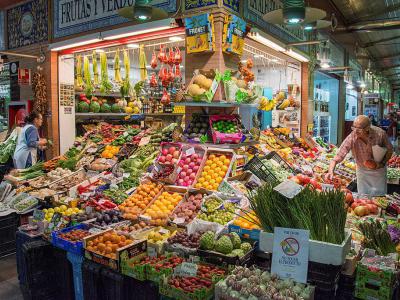
8) Mercado de Triana
The Triana Market, situated in Plaza del Altozano within Seville's Triana neighborhood in Andalusia, has been a site for food vending since 1823, although its present structure was established in 2001.
During the early 19th century, Triana was a densely populated suburb. Its physical separation by the river often isolated it from Seville. This led to the development of its own facilities, including a cemetery, a parish, and a market. The market area was primarily concentrated around Plaza del Altozano, characterized by scattered and unsanitary stalls.
In 1800, the San Jorge castle on this site was in ruins. Originally owned by the Jesuits, it was transferred to Seville City Council after the Jesuit order was disbanded. The council then decided to construct a market on this land.
In 1822, the council sanctioned the building of a market, designed by Tomás de Escacena y Anaya, completed in 1823. During 1983 renovations, old castle remains were found. By the 1980s, the market's poor condition led to its 1987 demolition and a new market's construction, allowing archaeological studies on the castle site. The new market, with about 100 stalls over 4,000 square meters and a three-level parking, opened in 2001. The archaeological site and interpretation center opened in 2009.
The market offers a variety of local produce, including oranges from Aljarafe and melons from Huelva, along with fishmongers, bakeries, and traditional Andalusian cuisine. Some vendors have maintained this family business for over a century.
There's also a gastronomic section with bars and restaurants serving fresh local dishes like salmorejo soup and Sevillian tapas. The market features a section dedicated to traditional flamenco, showcasing typical dance costumes, accessories, and handcrafted ceramics.
During the early 19th century, Triana was a densely populated suburb. Its physical separation by the river often isolated it from Seville. This led to the development of its own facilities, including a cemetery, a parish, and a market. The market area was primarily concentrated around Plaza del Altozano, characterized by scattered and unsanitary stalls.
In 1800, the San Jorge castle on this site was in ruins. Originally owned by the Jesuits, it was transferred to Seville City Council after the Jesuit order was disbanded. The council then decided to construct a market on this land.
In 1822, the council sanctioned the building of a market, designed by Tomás de Escacena y Anaya, completed in 1823. During 1983 renovations, old castle remains were found. By the 1980s, the market's poor condition led to its 1987 demolition and a new market's construction, allowing archaeological studies on the castle site. The new market, with about 100 stalls over 4,000 square meters and a three-level parking, opened in 2001. The archaeological site and interpretation center opened in 2009.
The market offers a variety of local produce, including oranges from Aljarafe and melons from Huelva, along with fishmongers, bakeries, and traditional Andalusian cuisine. Some vendors have maintained this family business for over a century.
There's also a gastronomic section with bars and restaurants serving fresh local dishes like salmorejo soup and Sevillian tapas. The market features a section dedicated to traditional flamenco, showcasing typical dance costumes, accessories, and handcrafted ceramics.
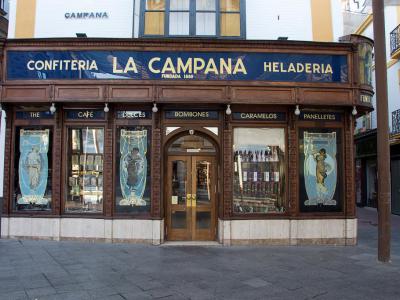
9) Confitería La Campana
What to buy here: Tortas del Aceite.
A lunchbox staple and afternoon snack favorite, tortas del aceite are simple cakes made of flour, sugar and salt that are fried in olive oil. Dipped in coffee or hot chocolate, the small cakes are crunchy and light, so it’s a good treat to break up a shopping day. Located on the main shopping street, Calle Sierpes, you’ll find Confitería La Campana, one of Seville’s oldest and most respected pastry shops. The waiters, dressed in Old World uniforms, serve cakes and pastries on gorgeous china out of a wood-paneled shop. You can have a torta in their outdoor seating, standing up at the bar, or take some home for family and friends. Price: 1,30€ (about 30g).
A lunchbox staple and afternoon snack favorite, tortas del aceite are simple cakes made of flour, sugar and salt that are fried in olive oil. Dipped in coffee or hot chocolate, the small cakes are crunchy and light, so it’s a good treat to break up a shopping day. Located on the main shopping street, Calle Sierpes, you’ll find Confitería La Campana, one of Seville’s oldest and most respected pastry shops. The waiters, dressed in Old World uniforms, serve cakes and pastries on gorgeous china out of a wood-paneled shop. You can have a torta in their outdoor seating, standing up at the bar, or take some home for family and friends. Price: 1,30€ (about 30g).
10) Setas de Sevilla (Metropol Parasol) (must see)
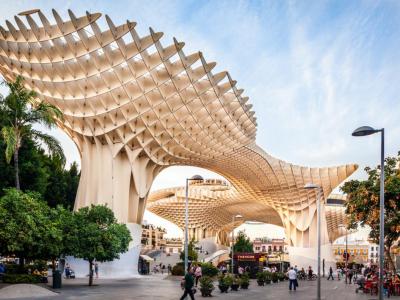
Metropol Parasol is a wooden structure erected in La Plaza de Encarnacion. It has 113,000 square feet of area and 85 feet in height. It is the largest of its kind in the world. People call it "The Mushrooms" because it looks like mushrooms. It is formed by six parasols in the form of mushrooms.
The design of the mushrooms was inspired by the vaults of the Cathedral of Seville and the ficus trees in the Plaza de Cristo de Burgos. There are four levels. Level zero (underground) is home to the Antiquarium. The Antiquarium is a museum displaying Roman and Moorish remains and artifacts discovered while the Parasols were being built.
The next level is Level One. Level One is the street-level open air public plaza and market. Level One is shaded by the wooden parasols above. Levels Two and Three are panoramic terraces and a restaurant. The Parasol project was not created without controversy. There are cost problems, people disliked the appearance, and there are safety concerns.
Since the 19th century there was a market in the plaza, within a "dedicated" building. Following plans for urban renewal, the building was pulled down in part in 1948. The market remained until 1973 before the remainder of the building was removed. The land stayed fallow until 1990 when the city had finally decided on an underground parking lot.
Then the unexpected happened. The diggers discovered ruins and remains dating to the Roman and Moorish eras. All work was stopped and archeology took over. After an expenditure of more than 14 million Euros, the project went into deep freeze. At last, in 2004 the city tried to resume development and opened a competition for bids.
The winner of the competition was destined to change the profile of Seville forever. The winner was German architect Jurgen Mayer who designed six mushroom shapes as parasols to shelter the public area below. The mushrooms were constructed entirely of imported Finnish wood known for its straightness.
The honey-comb structure provides shade for the shops and market below. Admission is free for residents of the city. For others tickets to the top of the parasol cost a few euros. This includes a free drink. The best time to go is at sunset. The view from the top is magical.
The design of the mushrooms was inspired by the vaults of the Cathedral of Seville and the ficus trees in the Plaza de Cristo de Burgos. There are four levels. Level zero (underground) is home to the Antiquarium. The Antiquarium is a museum displaying Roman and Moorish remains and artifacts discovered while the Parasols were being built.
The next level is Level One. Level One is the street-level open air public plaza and market. Level One is shaded by the wooden parasols above. Levels Two and Three are panoramic terraces and a restaurant. The Parasol project was not created without controversy. There are cost problems, people disliked the appearance, and there are safety concerns.
Since the 19th century there was a market in the plaza, within a "dedicated" building. Following plans for urban renewal, the building was pulled down in part in 1948. The market remained until 1973 before the remainder of the building was removed. The land stayed fallow until 1990 when the city had finally decided on an underground parking lot.
Then the unexpected happened. The diggers discovered ruins and remains dating to the Roman and Moorish eras. All work was stopped and archeology took over. After an expenditure of more than 14 million Euros, the project went into deep freeze. At last, in 2004 the city tried to resume development and opened a competition for bids.
The winner of the competition was destined to change the profile of Seville forever. The winner was German architect Jurgen Mayer who designed six mushroom shapes as parasols to shelter the public area below. The mushrooms were constructed entirely of imported Finnish wood known for its straightness.
The honey-comb structure provides shade for the shops and market below. Admission is free for residents of the city. For others tickets to the top of the parasol cost a few euros. This includes a free drink. The best time to go is at sunset. The view from the top is magical.
11) Convento San Leandro
What to buy here: Convent sweets.
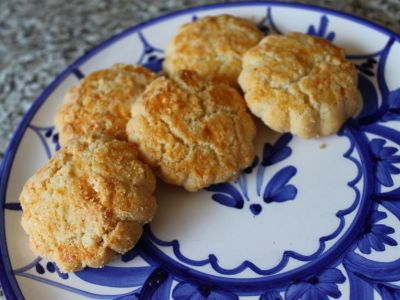
The historic city center is dotted with convents where the nuns pass their time making sweets and peddling them out of turnstiles in the foyer. From honeys and jams to cookies, the nuns provided sevillanos with their sugar rush. Enter into any of the small doors next to the convent, and a cloistered nun – hidden from view – will ask your order. Tell them you’ve come without sin, and you’ll be awarded with something sinful – pestiños, yemas San Leandro and other goodies.
The convent sweets do come in boxes, however just basic cardboard boxes and do require some care if you aim to take them home with you.
During the first weekend in December, there’s also a market in the Patio de las Banderas of the Alcázar palace which showcases the city’s most delicious treats.
Most of the cloistered nunneries in the city have treats for sale, but listed below are some of the more popular.
Price: 5€ for a box of almond sweets and up to 16€ for Yemas de San Leandro, an egg yolk pastry.
The historic city center is dotted with convents where the nuns pass their time making sweets and peddling them out of turnstiles in the foyer. From honeys and jams to cookies, the nuns provided sevillanos with their sugar rush. Enter into any of the small doors next to the convent, and a cloistered nun – hidden from view – will ask your order. Tell them you’ve come without sin, and you’ll be awarded with something sinful – pestiños, yemas San Leandro and other goodies.
The convent sweets do come in boxes, however just basic cardboard boxes and do require some care if you aim to take them home with you.
During the first weekend in December, there’s also a market in the Patio de las Banderas of the Alcázar palace which showcases the city’s most delicious treats.
Most of the cloistered nunneries in the city have treats for sale, but listed below are some of the more popular.
Price: 5€ for a box of almond sweets and up to 16€ for Yemas de San Leandro, an egg yolk pastry.
Image Courtesy of Cat Gaa.
12) Iglesia Colegial del Salvador (Church of the Divine Savior) (must see)
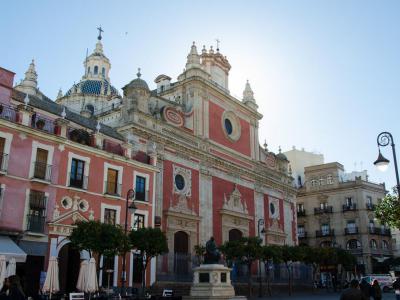
Located in the Plaza del Salvador in Seville, the Church of the Divine Savior is the largest church in the city after the Cathedral. The church was built over the remains Ibn Adabba, the Great Mosque, and an early Christian chapel. It fell into disrepair over the centuries between 1340 and 2008 when it was fully restored to its former glory.
The church is baroque. The facade however, has a mannerist influence. Mannerist architecture developed after the end of the renaissance style and the first signs of the Baroque, about 1610. The building is rectangular and it has three naves. The vaults are a barrel type. Pillars with columns support the vaults. The drum is octagonal.
The main altarpiece was by Cayetano de Acosta in Baroque style. The immaculate Mary appears over the tabernacle. In the center is the Transfiguration of Jesus, surrounded by Archangels. In the central nave the columns have a tracery of eucharistic symbols. There are lions and castles. The church is about the moment Jesus reveals his divinity.
Tip:
Purchase the "combined" ticket here and you'll be able to skip the long line at the Cathedral and Giralda.
The church is baroque. The facade however, has a mannerist influence. Mannerist architecture developed after the end of the renaissance style and the first signs of the Baroque, about 1610. The building is rectangular and it has three naves. The vaults are a barrel type. Pillars with columns support the vaults. The drum is octagonal.
The main altarpiece was by Cayetano de Acosta in Baroque style. The immaculate Mary appears over the tabernacle. In the center is the Transfiguration of Jesus, surrounded by Archangels. In the central nave the columns have a tracery of eucharistic symbols. There are lions and castles. The church is about the moment Jesus reveals his divinity.
Tip:
Purchase the "combined" ticket here and you'll be able to skip the long line at the Cathedral and Giralda.
13) Plaza del Salvador
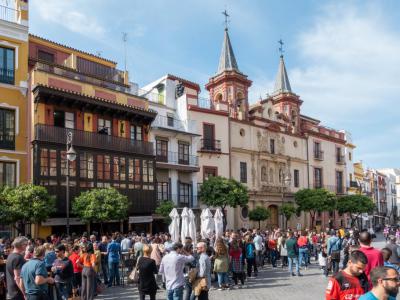
El Salvador Square, known as Plaza del Salvador, is an open pedestrian area situated in the Alfalfa neighborhood, within the historic Casco Antiguo district of Seville. This square holds significant renown in Seville, serving as a gathering point for locals during the day and a popular hangout spot in the evenings. Interestingly, it was once the central square of the ancient Roman city of Hispalis. The focal point of the square is the Iglesia Colegial del Divino Salvador, an impressive baroque church constructed between 1674 and 1712, built upon the site where the main mosque of Islamic Ishbiliya once stood.
Within the square, you can find a statue of Martínez Montañés, a renowned Spanish sculptor from the Renaissance and Baroque period in Seville. This statue was originally placed in 1923 but underwent two relocations, first to a square near the cathedral in 1967 and ultimately to its current and permanent location in Plaza del Salvador in 1985. During the years 1968 to 1970, the Bolea poplar trees were replaced with orange trees in the square's surroundings.
Notably, the square is surrounded by remarkable structures adorned with exquisite baroque facades. Furthermore, it serves as a significant shopping hub, housing grocery stores, cafes, and popular wine cellars, adding to its vibrant atmosphere.
Within the square, you can find a statue of Martínez Montañés, a renowned Spanish sculptor from the Renaissance and Baroque period in Seville. This statue was originally placed in 1923 but underwent two relocations, first to a square near the cathedral in 1967 and ultimately to its current and permanent location in Plaza del Salvador in 1985. During the years 1968 to 1970, the Bolea poplar trees were replaced with orange trees in the square's surroundings.
Notably, the square is surrounded by remarkable structures adorned with exquisite baroque facades. Furthermore, it serves as a significant shopping hub, housing grocery stores, cafes, and popular wine cellars, adding to its vibrant atmosphere.
14) Plaza Nueva (The New Square)
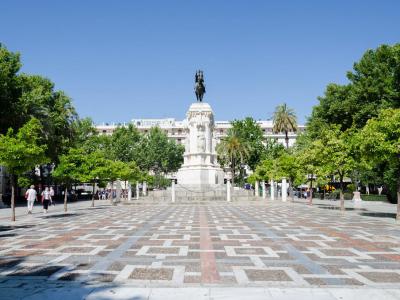
Plaza Nueva (New Square), located in Seville's heart, is home to the city's municipal building. This square, now a central public area, originally belonged to the San Fernando convent from 1270 to 1840. It was later repurposed by the city authorities into a plaza, completed in 1856.
Initially, this site was part of the Guadalquivir River until the 11th century. Remarkable historical discoveries, including a 10th-century ship and a 6th-century Byzantine anchor, were unearthed here in 1981 during the Seville Metro construction. By the 11th century, the area transformed into a cemetery and orchards.
The Plaza Nueva's space was once occupied by the Convento Casa Grande de San Francisco from 1270 to 1840. This convent, with its extensive gardens, stretched beyond today's plaza boundaries, reaching up to the current Calle Zaragoza. The 19th-century Napoleonic invasion severely damaged the convent, culminating in a fire in 1810. In 1840, the government acquired and demolished the remaining structures, paving the way for the plaza.
Central to Plaza Nueva is a statue of Fernando III, who seized Seville in 1248 and was canonized in 1671. The plaza's design initially contemplated various monuments, including tributes to Murillo and Isabella II, but ultimately, in 1920, it was resolved to honor Fernando III. The monument, a collaboration between architect Juan Talavera y Heredia and sculptor Joaquín Bilbao, was unveiled in August 1924.
Initially, this site was part of the Guadalquivir River until the 11th century. Remarkable historical discoveries, including a 10th-century ship and a 6th-century Byzantine anchor, were unearthed here in 1981 during the Seville Metro construction. By the 11th century, the area transformed into a cemetery and orchards.
The Plaza Nueva's space was once occupied by the Convento Casa Grande de San Francisco from 1270 to 1840. This convent, with its extensive gardens, stretched beyond today's plaza boundaries, reaching up to the current Calle Zaragoza. The 19th-century Napoleonic invasion severely damaged the convent, culminating in a fire in 1810. In 1840, the government acquired and demolished the remaining structures, paving the way for the plaza.
Central to Plaza Nueva is a statue of Fernando III, who seized Seville in 1248 and was canonized in 1671. The plaza's design initially contemplated various monuments, including tributes to Murillo and Isabella II, but ultimately, in 1920, it was resolved to honor Fernando III. The monument, a collaboration between architect Juan Talavera y Heredia and sculptor Joaquín Bilbao, was unveiled in August 1924.
15) Droguería del Arenal
What to buy here: Orange blossom perfume.
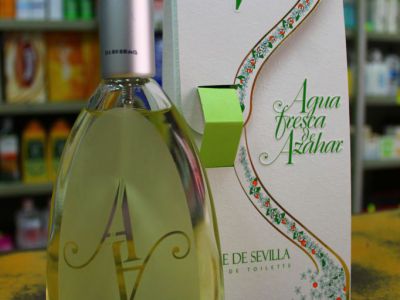
When the bitter Seville oranges are plucked from the thousands of trees around the city, the orange blossoms spread their intoxicating scent over the city. You can have it bottled up and take home the fragrance by purchasing orange blossom perfume, called agua de azahar. While this product is often used in baking and even, the small white flower is pressed and mixed with alcohol to leave a smell that can be likened to fresh laundry with a sprig of citrus, or just an afternoon roaming the streets of Seville during the springtime. Price: 14€ a bottle.
When the bitter Seville oranges are plucked from the thousands of trees around the city, the orange blossoms spread their intoxicating scent over the city. You can have it bottled up and take home the fragrance by purchasing orange blossom perfume, called agua de azahar. While this product is often used in baking and even, the small white flower is pressed and mixed with alcohol to leave a smell that can be likened to fresh laundry with a sprig of citrus, or just an afternoon roaming the streets of Seville during the springtime. Price: 14€ a bottle.
Image Courtesy of Cat Gaa.
