Custom Walk in Saint Louis, Missouri by janelle_fff69 created on 2025-05-20
Guide Location: USA » Saint Louis
Guide Type: Custom Walk
# of Sights: 6
Tour Duration: 2 Hour(s)
Travel Distance: 3.8 Km or 2.4 Miles
Share Key: MWCQD
Guide Type: Custom Walk
# of Sights: 6
Tour Duration: 2 Hour(s)
Travel Distance: 3.8 Km or 2.4 Miles
Share Key: MWCQD
How It Works
Please retrieve this walk in the GPSmyCity app. Once done, the app will guide you from one tour stop to the next as if you had a personal tour guide. If you created the walk on this website or come to the page via a link, please follow the instructions below to retrieve the walk in the app.
Retrieve This Walk in App
Step 1. Download the app "GPSmyCity: Walks in 1K+ Cities" on Apple App Store or Google Play Store.



Step 2. In the GPSmyCity app, download(or launch) the guide "Saint Louis Map and Walking Tours".
Step 3. Tap the menu button located at upper right corner of the "Walks" screen and select "Retrieve custom walk". Enter the share key: MWCQD
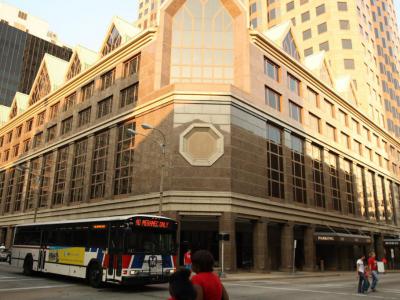
1) One Metropolitan Square
One Metropolitan Square, or Met Square, is a prominent office building situated in downtown St. Louis. It was completed in 1989 and is the tallest building in the city at a height of 180.7 meters (593 feet). The building was designed by the renowned architecture firm Hellmuth, Obata and Kassabaum, which is also one of the major tenants of the building.
One Metropolitan Square is the second tallest building in Missouri, surpassed only by One Kansas City Place in Kansas City by a mere 31 feet. The building has become an iconic symbol of St. Louis' skyline, and its sleek and modern design is a testament to the city's commitment to progress and innovation.
The building has several notable tenants, including the Bryan Cave law firm, the Evans & Dixon law firm, the Brown & Crouppen law firm, and the Better Business Bureau. These firms are some of the largest and most respected in the region and have contributed to the building's reputation as a hub for business and commerce in St. Louis.
Despite its impressive stature and cutting-edge design, Met Square was not immune to unexpected incidents. In early May 2014, a DJI Phantom quadcopter drone crashed into the building, causing some damage.
One Metropolitan Square is the second tallest building in Missouri, surpassed only by One Kansas City Place in Kansas City by a mere 31 feet. The building has become an iconic symbol of St. Louis' skyline, and its sleek and modern design is a testament to the city's commitment to progress and innovation.
The building has several notable tenants, including the Bryan Cave law firm, the Evans & Dixon law firm, the Brown & Crouppen law firm, and the Better Business Bureau. These firms are some of the largest and most respected in the region and have contributed to the building's reputation as a hub for business and commerce in St. Louis.
Despite its impressive stature and cutting-edge design, Met Square was not immune to unexpected incidents. In early May 2014, a DJI Phantom quadcopter drone crashed into the building, causing some damage.
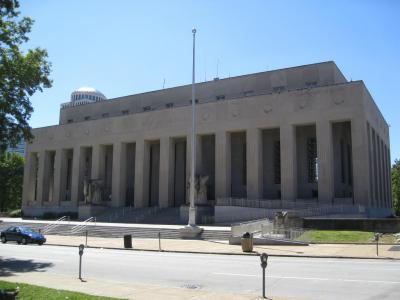
2) Soldiers' Memorial Military Museum
The Soldiers Memorial Military Museum in Saint Louis is a beautiful and solemn tribute to the soldiers who fought for the United States in various wars, especially World War I. It is owned by the City of St. Louis, but operated by the Missouri Historical Society.
The building was designed by the St. Louis architectural firm Mauran, Russell & Crowell in a stripped Classical style, which means that it has a simplified form and limited ornamentation. The Soldiers Memorial Military Museum was dedicated by Franklin Delano Roosevelt in 1936 and officially opened to the public on Memorial Day in 1938.
The interior of the museum features east and west wings with display cases filled with military displays and memorabilia from World War I and subsequent American wars. Visitors can see artifacts, uniforms, weapons, and photographs from various conflicts that helped shape the nation.
The most striking feature of the museum is the open-air central breezeway, which contains a massive black marble cenotaph. This cenotaph is engraved with the names of all of St. Louis' war dead from the first world war. It is a solemn and moving tribute to those who gave their lives in service to their country.
Outside the museum, visitors can see four monumental sculptural groups representing figures of Loyalty, Vision, Courage, and Sacrifice. These sculptures were created by sculptor Walker Hancock and feature figures on horseback. There are also other architectural sculptures completed by Hillis Arnold.
Why You Should Visit:
An amazing military museum housing every imaginable weapon. Most exhibits are presented in outdated glass display cases, but if you overlook that, there's plenty to see.
The building was designed by the St. Louis architectural firm Mauran, Russell & Crowell in a stripped Classical style, which means that it has a simplified form and limited ornamentation. The Soldiers Memorial Military Museum was dedicated by Franklin Delano Roosevelt in 1936 and officially opened to the public on Memorial Day in 1938.
The interior of the museum features east and west wings with display cases filled with military displays and memorabilia from World War I and subsequent American wars. Visitors can see artifacts, uniforms, weapons, and photographs from various conflicts that helped shape the nation.
The most striking feature of the museum is the open-air central breezeway, which contains a massive black marble cenotaph. This cenotaph is engraved with the names of all of St. Louis' war dead from the first world war. It is a solemn and moving tribute to those who gave their lives in service to their country.
Outside the museum, visitors can see four monumental sculptural groups representing figures of Loyalty, Vision, Courage, and Sacrifice. These sculptures were created by sculptor Walker Hancock and feature figures on horseback. There are also other architectural sculptures completed by Hillis Arnold.
Why You Should Visit:
An amazing military museum housing every imaginable weapon. Most exhibits are presented in outdated glass display cases, but if you overlook that, there's plenty to see.
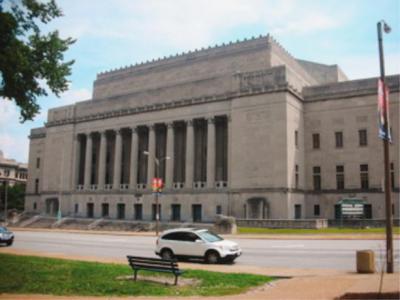
3) Stifel Theatre
The Stifel Theatre is a historic performing arts venue that has undergone a series of transformations and renovations over the years. Originally known as the Municipal Opera House, it was founded in honor of former St. Louis Mayor Henry Kiel and opened in 1934 as part of the Municipal Auditorium and Opera House complex. The theatre operated until 1991, when it and the adjacent Kiel Auditorium were closed so that the auditorium could be demolished and replaced by the Kiel Center, now known as the Enterprise Center.
The Stifel Theatre has a rich history of iconic performances. In 1965, the Rat Pack—Frank Sinatra, Dean Martin, and Sammy Davis Jr.—performed their only televised concert together there, with Johnny Carson as emcee, during a fundraiser for Dismas House, the first halfway house for ex-convicts. After being lost for thirty years, a print of the show was rediscovered and later broadcast on Nick at Nite and released on DVD.
Additionally, in 1978, The Rolling Stones performed a sold-out concert at the theatre with a stripped-down, minimal stage setup. Due to the limited seating, fans who were unable to purchase tickets gathered outside the building in protest, requiring a police presence with dogs to maintain order.
The Stifel Theatre has a rich history of iconic performances. In 1965, the Rat Pack—Frank Sinatra, Dean Martin, and Sammy Davis Jr.—performed their only televised concert together there, with Johnny Carson as emcee, during a fundraiser for Dismas House, the first halfway house for ex-convicts. After being lost for thirty years, a print of the show was rediscovered and later broadcast on Nick at Nite and released on DVD.
Additionally, in 1978, The Rolling Stones performed a sold-out concert at the theatre with a stripped-down, minimal stage setup. Due to the limited seating, fans who were unable to purchase tickets gathered outside the building in protest, requiring a police presence with dogs to maintain order.
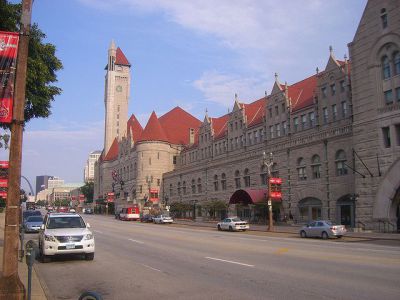
4) Saint Louis Union Station
St. Louis Union Station, designed by Theodore Link and opened in 1894, was once the world’s largest and busiest train terminal, with all tracks and passenger areas on one level. Expanded in 1903 for the 1904 St. Louis World’s Fair, it became a powerful symbol of the city’s prosperity. At its peak in the 1940s, the station served 100,000 passengers daily and united 22 railroads—more than any other terminal in the world. A mural by Louis Grell, added during this period, depicted iconic scenes from St. Louis’s history, reflecting the grandeur and spirit of the city’s golden age of rail travel.
However, as air travel became dominant in the 1950s and 1960s, passenger rail declined, and the enormous station grew too costly to maintain. By 1961, some of the once-busy train tracks had been converted into parking spaces. In 1970, St. Louis Union Station was designated a National Historic Landmark, but by 1978, the last Amtrak train had departed, marking the end of an era.
A major renovation in the 1980s gave St. Louis Union Station a new life as a hotel, shopping, and entertainment complex. The former headhouse and parts of the vast train shed were transformed into the elegant St. Louis Union Station Hotel, now operated by Marriott. Around the hotel, restaurants, boutique shops, and family-friendly attractions line a scenic lake.
On the upper level, the Memories Museum showcases artifacts and exhibits celebrating the station’s railroading history. The Grand Hall, with its 65-foot barrel-vaulted ceiling, stained glass, and gilded details, remains the station’s most breathtaking feature. Its “whispering arches” still delight visitors, while the evening light show across the ceiling adds a magical touch to this architectural gem.
Tip:
A light show happens every hour, from 5-11pm. It is on the ceiling of the historic Grand Hall. There are comfortable seats and a full-service bar.
However, as air travel became dominant in the 1950s and 1960s, passenger rail declined, and the enormous station grew too costly to maintain. By 1961, some of the once-busy train tracks had been converted into parking spaces. In 1970, St. Louis Union Station was designated a National Historic Landmark, but by 1978, the last Amtrak train had departed, marking the end of an era.
A major renovation in the 1980s gave St. Louis Union Station a new life as a hotel, shopping, and entertainment complex. The former headhouse and parts of the vast train shed were transformed into the elegant St. Louis Union Station Hotel, now operated by Marriott. Around the hotel, restaurants, boutique shops, and family-friendly attractions line a scenic lake.
On the upper level, the Memories Museum showcases artifacts and exhibits celebrating the station’s railroading history. The Grand Hall, with its 65-foot barrel-vaulted ceiling, stained glass, and gilded details, remains the station’s most breathtaking feature. Its “whispering arches” still delight visitors, while the evening light show across the ceiling adds a magical touch to this architectural gem.
Tip:
A light show happens every hour, from 5-11pm. It is on the ceiling of the historic Grand Hall. There are comfortable seats and a full-service bar.
5) St. Louis Public Library
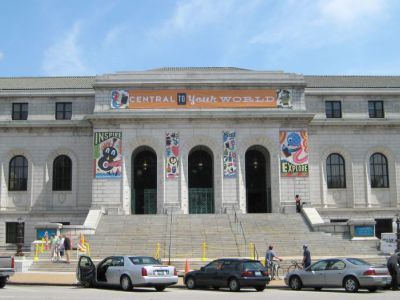
The St. Louis Public Library was founded as a members-only private library in 1865 with a collection of 1,500 books. It was opened to the public in 1874 and reestablished as a publicly supported free lending library in 1893-94, by which time the collection included 90,000 books. In 1901, Andrew Carnegie made a large donation which was used for expansion, including building the current central library.
By 1938 the collection included 900,000 items, and by 2014, 4,600,000 items. Nowadays the central Saint Louis Public Library is one of the most significant buildings from the early 20th century in the city. It was designed by architect Cass Gilbert in 1912. The structure houses a vast collection of books in various fields of study. The Library regularly hosts organized events such as authors' readings, live music concerts and others.
Why You Should Visit:
A goldmine for historians and anyone who just want to learn something unique about Saint Louis.
The building is amazing, the books are great and the opportunity/options to read, play games, eat and just hang out are endless.
Tip:
Make sure to check out the events they hold at the Public Library on their website.
By 1938 the collection included 900,000 items, and by 2014, 4,600,000 items. Nowadays the central Saint Louis Public Library is one of the most significant buildings from the early 20th century in the city. It was designed by architect Cass Gilbert in 1912. The structure houses a vast collection of books in various fields of study. The Library regularly hosts organized events such as authors' readings, live music concerts and others.
Why You Should Visit:
A goldmine for historians and anyone who just want to learn something unique about Saint Louis.
The building is amazing, the books are great and the opportunity/options to read, play games, eat and just hang out are endless.
Tip:
Make sure to check out the events they hold at the Public Library on their website.
6) National Blues Museum
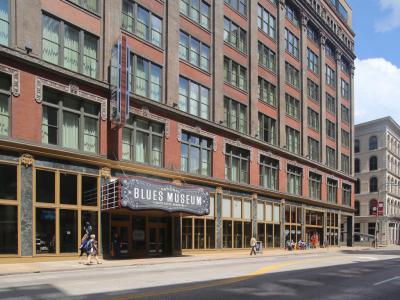
The National Blues Museum is a non-profit organization that is dedicated to exploring the history and impact of blues music. The museum is a great entertainment and educational resource that aims to highlight the significance of blues as the foundation of all modern American music. It is a must-visit destination for all music enthusiasts who are interested in learning about the roots of American music.
The museum is housed in a renovated historic building in downtown St. Louis that cost $14 million to create. The museum's opening was attended by Surly King, daughter of the legendary blues musician B.B. King. The museum's original branding, graphic design, and website were provided by the agency, Project 13.
The National Blues Museum has a rotating collection of exhibits that showcase the rich history of blues music. Visitors can learn about the evolution of blues, the key figures who shaped the genre, and the influence of blues on other musical styles. The exhibits are artifact-driven, featuring a range of historical objects and memorabilia related to blues music.
In addition to the exhibits, the museum also has a state-of-the-art theater that hosts live performances in the Lumiere Place Legends room. Visitors can enjoy performances by blues musicians from all over the world in an intimate setting that is perfect for experiencing the raw energy of blues music.
The National Blues Museum is not just a museum but also a hub for public programming. The museum offers various educational programs, workshops, and seminars that help visitors gain a deeper understanding of blues music. These programs are designed for people of all ages and backgrounds, making the museum an inclusive space for everyone.
The museum is housed in a renovated historic building in downtown St. Louis that cost $14 million to create. The museum's opening was attended by Surly King, daughter of the legendary blues musician B.B. King. The museum's original branding, graphic design, and website were provided by the agency, Project 13.
The National Blues Museum has a rotating collection of exhibits that showcase the rich history of blues music. Visitors can learn about the evolution of blues, the key figures who shaped the genre, and the influence of blues on other musical styles. The exhibits are artifact-driven, featuring a range of historical objects and memorabilia related to blues music.
In addition to the exhibits, the museum also has a state-of-the-art theater that hosts live performances in the Lumiere Place Legends room. Visitors can enjoy performances by blues musicians from all over the world in an intimate setting that is perfect for experiencing the raw energy of blues music.
The National Blues Museum is not just a museum but also a hub for public programming. The museum offers various educational programs, workshops, and seminars that help visitors gain a deeper understanding of blues music. These programs are designed for people of all ages and backgrounds, making the museum an inclusive space for everyone.
