Custom Walk in Krakow, Poland by t_dean_26d87 created on 2025-06-02
Guide Location: Poland » Krakow
Guide Type: Custom Walk
# of Sights: 5
Tour Duration: 2 Hour(s)
Travel Distance: 3 Km or 1.9 Miles
Share Key: L4LBK
Guide Type: Custom Walk
# of Sights: 5
Tour Duration: 2 Hour(s)
Travel Distance: 3 Km or 1.9 Miles
Share Key: L4LBK
How It Works
Please retrieve this walk in the GPSmyCity app. Once done, the app will guide you from one tour stop to the next as if you had a personal tour guide. If you created the walk on this website or come to the page via a link, please follow the instructions below to retrieve the walk in the app.
Retrieve This Walk in App
Step 1. Download the app "GPSmyCity: Walks in 1K+ Cities" on Apple App Store or Google Play Store.



Step 2. In the GPSmyCity app, download(or launch) the guide "Krakow Map and Walking Tours".
Step 3. Tap the menu button located at upper right corner of the "Walks" screen and select "Retrieve custom walk". Enter the share key: L4LBK
1) Wawel Royal Castle (must see)
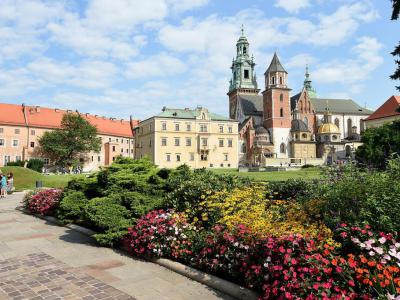
The Wawel Royal Castle stands as one of Poland’s most important historical landmarks, a castle hill complex that oversaw centuries of national, royal, and artistic history.
The hill on which Wawel sits has been inhabited since ancient times, but Wawel began taking shape as a seat of power in the early Middle Ages, with the earliest stone buildings appearing around the 11th–12th centuries. Over the following centuries, successive rulers transformed the residence. In the 14th century, under Casimir III the Great, the castle was fortified and rebuilt in a Gothic style, establishing the core structure that would survive in part to this day.
The 16th century brought a major transformation under Sigismund I the Old. He commissioned Italian architects to rebuild and expand the castle, turning it into a Renaissance-style palace — a shift that reshaped Wawel from a medieval fortress into a grand royal residence. Over time, Baroque and later architectural layers were added, so today the castle exhibits a blend of Romanesque, Gothic, Renaissance, and Baroque styles.
Wawel Royal Castle functions partly as a museum complex — the Wawel Royal Castle National Art Collection — offering access to royal apartments, state rooms, historic art, armor, furniture, tapestries, and a rich collection of paintings and decorative arts. Strolling through the arcade courtyard gives a sense of the Renaissance grandeur that reshaped the castle, while the various rooms and exhibitions reveal the lives of kings and the history of Polish statehood.
Among the standout attractions are the historic royal apartments and state chambers, furnishings, and art. For those interested in arms and military history, the museum’s collection of armor, weapons, and historic artifacts provides a vivid window into past conflicts and noble life. The castle’s collections also include fine tapestries, period furniture, ceramics, and decorative art — including items from across Europe and the Near East — showing Poland’s historical ties and international influences.
Beyond indoor treasures, the castle’s position on the hill beside the river, its layered architecture, and its atmosphere provide a strong sense of place — a fitting way to describe one of the earliest UNESCO World Heritage Sites.
The hill on which Wawel sits has been inhabited since ancient times, but Wawel began taking shape as a seat of power in the early Middle Ages, with the earliest stone buildings appearing around the 11th–12th centuries. Over the following centuries, successive rulers transformed the residence. In the 14th century, under Casimir III the Great, the castle was fortified and rebuilt in a Gothic style, establishing the core structure that would survive in part to this day.
The 16th century brought a major transformation under Sigismund I the Old. He commissioned Italian architects to rebuild and expand the castle, turning it into a Renaissance-style palace — a shift that reshaped Wawel from a medieval fortress into a grand royal residence. Over time, Baroque and later architectural layers were added, so today the castle exhibits a blend of Romanesque, Gothic, Renaissance, and Baroque styles.
Wawel Royal Castle functions partly as a museum complex — the Wawel Royal Castle National Art Collection — offering access to royal apartments, state rooms, historic art, armor, furniture, tapestries, and a rich collection of paintings and decorative arts. Strolling through the arcade courtyard gives a sense of the Renaissance grandeur that reshaped the castle, while the various rooms and exhibitions reveal the lives of kings and the history of Polish statehood.
Among the standout attractions are the historic royal apartments and state chambers, furnishings, and art. For those interested in arms and military history, the museum’s collection of armor, weapons, and historic artifacts provides a vivid window into past conflicts and noble life. The castle’s collections also include fine tapestries, period furniture, ceramics, and decorative art — including items from across Europe and the Near East — showing Poland’s historical ties and international influences.
Beyond indoor treasures, the castle’s position on the hill beside the river, its layered architecture, and its atmosphere provide a strong sense of place — a fitting way to describe one of the earliest UNESCO World Heritage Sites.
2) Basilica of St. Mary (must see)
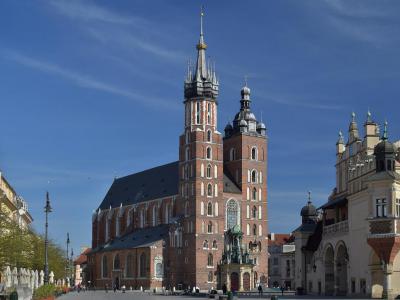
Saint Mary's Basilica is one of the city’s most iconic landmarks, rising over the Main Market Square with its distinctive pair of uneven towers. Its history stretches back to the early 13th century, when the original church was built on the foundations of an even earlier Romanesque structure. After the Mongol invasion of 1241 left much of Kraków in ruins, the church was rebuilt in Gothic style, taking on its recognizable form. Over the following centuries, it became one of the most important religious and artistic centers in the city.
Once you find yourself in front of the church, you can clearly see that the left tower is the taller one. In terms of design, it is more intricate than the right one, and its helmet has sharper spires. As you step inside, you will notice the soaring vaulted ceiling painted a deep blue and dotted with gold stars, creating a cosmic effect that draws the eye upward. However, the church’s most celebrated treasure is the monumental wooden altarpiece carved by German sculptor Veit Stoss in the late 15th century. Even though it is visible as soon as you enter the church, its beauty is best admired up close. The famous altarpiece can be found under the chancel opening, which is marked by a huge cross. Considered one of the greatest Gothic sculptures in Europe, the altarpiece depicts scenes from the life of the Virgin Mary in extraordinary detail, with dozens of figures carved from linden wood and highlighted with bold colors and gold leaf.
Another highlight is the basilica’s stained-glass windows, including some of Poland’s finest examples of medieval and 19th-century glasswork. The most impressive windows can be observed behind and beside the Veit Stoss masterpiece. Moreover, richly decorated chapels line the nave, showcasing centuries of donations by wealthy patrons, guilds, and noble families.
Outside, the basilica’s taller tower reveals its more distinct function. From this tower, every hour, a trumpeter plays a brief melody that ends abruptly, commemorating a legendary trumpeter who was shot while warning the city of a Mongol attack. The live performance of this bugle call remains one of Kraków’s most beloved traditions. Don’t miss it.
Once you find yourself in front of the church, you can clearly see that the left tower is the taller one. In terms of design, it is more intricate than the right one, and its helmet has sharper spires. As you step inside, you will notice the soaring vaulted ceiling painted a deep blue and dotted with gold stars, creating a cosmic effect that draws the eye upward. However, the church’s most celebrated treasure is the monumental wooden altarpiece carved by German sculptor Veit Stoss in the late 15th century. Even though it is visible as soon as you enter the church, its beauty is best admired up close. The famous altarpiece can be found under the chancel opening, which is marked by a huge cross. Considered one of the greatest Gothic sculptures in Europe, the altarpiece depicts scenes from the life of the Virgin Mary in extraordinary detail, with dozens of figures carved from linden wood and highlighted with bold colors and gold leaf.
Another highlight is the basilica’s stained-glass windows, including some of Poland’s finest examples of medieval and 19th-century glasswork. The most impressive windows can be observed behind and beside the Veit Stoss masterpiece. Moreover, richly decorated chapels line the nave, showcasing centuries of donations by wealthy patrons, guilds, and noble families.
Outside, the basilica’s taller tower reveals its more distinct function. From this tower, every hour, a trumpeter plays a brief melody that ends abruptly, commemorating a legendary trumpeter who was shot while warning the city of a Mongol attack. The live performance of this bugle call remains one of Kraków’s most beloved traditions. Don’t miss it.
3) Rynek Główny (Main Square) (must see)
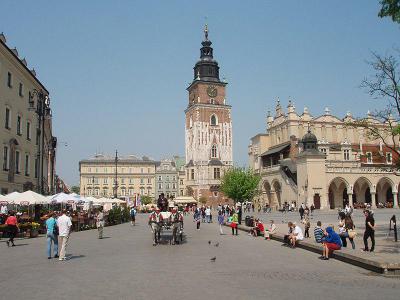
Kraków’s Main Square is the largest medieval square in Europe, serving as the vibrant heart of the city for more than 750 years. Covering nearly 40,000 square meters, it was laid out in 1257 after the Mongol invasion, when Kraków was rebuilt according to a new urban plan that emphasized order, trade, and civic life. The square quickly became the centre of commerce and public events, surrounded by merchant houses, noble residences, and key municipal buildings. Over the centuries, it has witnessed royal ceremonies, markets, festivals, uprisings—everything under the sun.
At the center of the square stands the Cloth Hall, a Renaissance trading hall that once formed part of the city’s major commercial network. Today, it houses craft stalls on the ground floor and an art gallery upstairs, continuing its tradition as a marketplace. Nearby rises the iconic St. Mary’s Basilica, distinguished by its two asymmetrical towers.
Elegant palaces line the perimeter, many now home to museums, cafés, and restaurants. Beneath the square, the Rynek Underground Museum reveals archaeological traces of medieval market stalls, roads, and merchant activity, immersing visitors in the city’s early urban history.
At the center of the square stands the Cloth Hall, a Renaissance trading hall that once formed part of the city’s major commercial network. Today, it houses craft stalls on the ground floor and an art gallery upstairs, continuing its tradition as a marketplace. Nearby rises the iconic St. Mary’s Basilica, distinguished by its two asymmetrical towers.
Elegant palaces line the perimeter, many now home to museums, cafés, and restaurants. Beneath the square, the Rynek Underground Museum reveals archaeological traces of medieval market stalls, roads, and merchant activity, immersing visitors in the city’s early urban history.
4) Collegium Maius (Great College) (must see)
The Great College is the oldest building of Jagiellonian University and one of the oldest university structures in Poland.
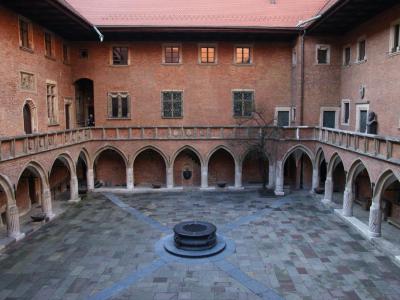
Its story begins in the late 14th and early 15th centuries. In 1400, after the university had been re-established, the reigning king donated a corner townhouse to the academy. From this modest start, over the course of the 15th century, adjacent buildings were acquired and merged. Fires in 1462 and 1492 damaged parts of the complex, but reconstruction and expansion after these events gave the building its late-Gothic appearance: a quadrangle around a courtyard with arcaded galleries.
For hundreds of years, Collegium Maius was the heart of academic life in Kraków. Lectures took place on the ground floor, while professors lived and worked on the upper floors. During the early modern period, and especially the Renaissance, the university became a renowned center for law, medicine, theology, mathematics, and astronomy, drawing students from across Europe. Among the students who passed through these halls was Nicolaus Copernicus, who studied here in the 1490s before going on to lay the foundations for modern astronomy.
In the 19th century, the building’s role shifted. After 1840, it was repurposed as the university library. Later, following World War II and restoration work, the Great College found new life as a museum: the Jagiellonian University Museum.
Today, the building is valuable for several reasons. Its peaceful inner courtyard can be accessed directly from the main gateway. Like many courtyards from the same period, its appeal lies in the elegant brick arcades that line the perimeter of the space. Highlights inside the college include the Common Room and the Great Hall. They can be reached via a broad stone staircase visible along the northern side of the courtyard. A wooden door awaits on the left once you reach the top of the staircase. The Common Room used to serve as the main gathering spot for scholars and it is filled with Gothic furnishings and portraits of university rectors. Meanwhile, the Great Hall is an atmospheric room, as it was used to host lectures and ceremonies. It features carved wooden benches, vaulted ceilings and portraits of notable professors.
Another side of the museum showcases a remarkable collection of old scientific instruments: astrolabes, globes (including an early 16th-century globe on which the newly discovered Americas appear), and astronomical, cartographic, chemical, and physical instruments used by scholars.
A charming modern touch is the clock mounted above the northwest arcade of the courtyard. Every two hours between 9 AM and 5 PM, it triggers a small mechanical procession of historical figures tied to the university’s past along with medieval music — a whimsical nod to centuries of academic tradition.
Its story begins in the late 14th and early 15th centuries. In 1400, after the university had been re-established, the reigning king donated a corner townhouse to the academy. From this modest start, over the course of the 15th century, adjacent buildings were acquired and merged. Fires in 1462 and 1492 damaged parts of the complex, but reconstruction and expansion after these events gave the building its late-Gothic appearance: a quadrangle around a courtyard with arcaded galleries.
For hundreds of years, Collegium Maius was the heart of academic life in Kraków. Lectures took place on the ground floor, while professors lived and worked on the upper floors. During the early modern period, and especially the Renaissance, the university became a renowned center for law, medicine, theology, mathematics, and astronomy, drawing students from across Europe. Among the students who passed through these halls was Nicolaus Copernicus, who studied here in the 1490s before going on to lay the foundations for modern astronomy.
In the 19th century, the building’s role shifted. After 1840, it was repurposed as the university library. Later, following World War II and restoration work, the Great College found new life as a museum: the Jagiellonian University Museum.
Today, the building is valuable for several reasons. Its peaceful inner courtyard can be accessed directly from the main gateway. Like many courtyards from the same period, its appeal lies in the elegant brick arcades that line the perimeter of the space. Highlights inside the college include the Common Room and the Great Hall. They can be reached via a broad stone staircase visible along the northern side of the courtyard. A wooden door awaits on the left once you reach the top of the staircase. The Common Room used to serve as the main gathering spot for scholars and it is filled with Gothic furnishings and portraits of university rectors. Meanwhile, the Great Hall is an atmospheric room, as it was used to host lectures and ceremonies. It features carved wooden benches, vaulted ceilings and portraits of notable professors.
Another side of the museum showcases a remarkable collection of old scientific instruments: astrolabes, globes (including an early 16th-century globe on which the newly discovered Americas appear), and astronomical, cartographic, chemical, and physical instruments used by scholars.
A charming modern touch is the clock mounted above the northwest arcade of the courtyard. Every two hours between 9 AM and 5 PM, it triggers a small mechanical procession of historical figures tied to the university’s past along with medieval music — a whimsical nod to centuries of academic tradition.
5) Dragon's Lair
Krakow is the perfect place to get lost in rich history and ancient lore. With castles, museums, traditional concert halls and mystical folklore, Krakow is the perfect blend that offers every visitor a reason to spend time here. The Dragon’s Lair is one such destination. Located on the foot of the Wawel Hill on the banks of the River Vistula, the Dragon’s Lair is a must visit in Krakow.
According to legend, in the time of King Krak, a dragon terrorized the city named after him. It demanded livestock or young maidens from the town. The king's daughter, Wanda, was almost sacrificed. None could defeat the dragon until a clever shoemaker named Dratewka used a sulphur-filled ram to make the dragon drink excessively. The dragon exploded, saving the town. Experience this tale at the Dragon's Lair.
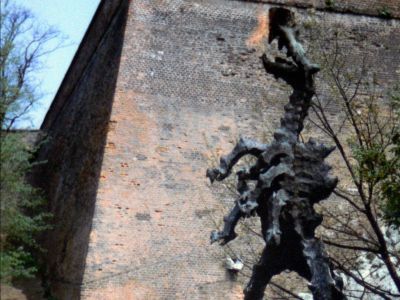
Nowadays, the Dragon's Lair has become accessible to the general public during the summer season. Explorers will enter the cavern by means of an aged well, descending a distance of 21 meters to experience this exceptional location. The cave extends until it reaches the shores of the Vistula River. Emerging from the cave's entrance is a sizable statue resembling a dragon, meticulously crafted in the year 1971. This particular spot stands as a highly favored destination for tourists, particularly among children, as the dragon vividly exhales bursts of fire from its mouth at five-minute intervals.
According to legend, in the time of King Krak, a dragon terrorized the city named after him. It demanded livestock or young maidens from the town. The king's daughter, Wanda, was almost sacrificed. None could defeat the dragon until a clever shoemaker named Dratewka used a sulphur-filled ram to make the dragon drink excessively. The dragon exploded, saving the town. Experience this tale at the Dragon's Lair.
Nowadays, the Dragon's Lair has become accessible to the general public during the summer season. Explorers will enter the cavern by means of an aged well, descending a distance of 21 meters to experience this exceptional location. The cave extends until it reaches the shores of the Vistula River. Emerging from the cave's entrance is a sizable statue resembling a dragon, meticulously crafted in the year 1971. This particular spot stands as a highly favored destination for tourists, particularly among children, as the dragon vividly exhales bursts of fire from its mouth at five-minute intervals.
